SteamyTea
-
Posts
23382 -
Joined
-
Days Won
190
Everything posted by SteamyTea
-
That can give you other problems. Polystyrene can degrade the PVC insulation.
-
 Just reading MS Project has sent me into a very deep depressing.
 -
This is what I was trying to work out when I asked the question Ask @ProDave
-
Wall mounted basic ASHP for workshop
SteamyTea replied to Mudmouse's topic in Air Source Heat Pumps (ASHP)
Or a 2 kW fan heater. -
Is there a diversity formula for ring circuit?
-
Wall mounted basic ASHP for workshop
SteamyTea replied to Mudmouse's topic in Air Source Heat Pumps (ASHP)
Something like this may do it. https://www.powrmatic.co.uk/products/air-conditioning/airco290/ -
Clean Heat Market Mechanism to incentivise heat pumps
SteamyTea replied to LnP's topic in Air Source Heat Pumps (ASHP)
That is just an educational matter, oh hang on, the government is responsible for rducation. PVGIS uses 14% system losses as a default, the national grid uses 8% (most in the last substation and local cabling), so you even loose out there. -
Ask them in 20 years time, I suspect the answer will be "in 20 years".
-
Christmas challenge: Faking a stove's radiative feel
SteamyTea replied to Sparrowhawk's topic in Boffin's Corner
It can be, easily. -
And how many charge/discharge are left, and what is the charging penalty for using knackered batteries 20%? At the moment domestic storage is just not worth it. Let the big power generators and DNOs deal with it and take the lower overall cost of power. Store any local PV in water and bricks, you know it makes sense. And it is kWh not kwh.
-
So spend £7500 on storage to halve the cost of your electricity, maybe. Now I know there are some fantastic deals on ToU power, but are they going to outlast the battery i.e. 5000 cycles. As it is winter, and I am at home a lot at the moment, my usage and usage split has gone the wrong way. I use about 11 kWh/day, with 2 of those outside the E7 window. Now I could fit batteries and and shift some of the space heating i.e. less charge in the storage heater and run a fan heater more. Say that is a 4 kWh shift. So night usage will become (with the latest price increase) 5 kWh x 15p/kWh = 75p, day will be 6 kWh x 30p/kWh = 180p. Total a day 255p/day. As I am currently using 9 kWh at night and 2 kWh during the day, I pay 195p/day. So that gives us 60p/day to play with. Battery system at £7500 divided by usable charge/discharge cycles of 5000 is 150p a cycle (say down to 20% and up to 80%, which is actually only 9 kWh of storage). £1.50 will buy about 5 kWh of peak rate electricity. Even if you get 10,000 cycles, it is still a greater amount, by 75p/day, than just being on bog standard E7. And who knows what is just around the corner. We all thought that the 'challenger' energy companies would reduce the prices paid, all it has done is added a few billion to the overall pricing. Domestic batteries are a fun hobby, but quite an expensive one.
-
Not that that sort of price difference though. Saving a kWh is really not that hard. And it is not really a matter of never using that kWh, we can divert power, we already do. Say there is a supermarket chain that has 500 stores, and each store has 50 fridges and freezers. Probably save to say that the cooling load in a store is in the region of 10 kW, That is 120 MWh/day. Now shifting that by a few hours is easy enough, it is already done though a pricing mechanism. Change the pricing mechanism to a compulsory one. i.e. don't allow the supermarket to actively cool during the 5PM to 7 PM window, but guarantee power during the more stable 10 AM to 2 PM window.
-
I wonder if it is better to not use a kWh than try and store 10% of that. Simple number. Storage £500/kWh, expected cycles 5000, price of wholesale electricity £0.085/kWh. Total £0.185/kWh. 10% storage costs £0.0183 Not using saves £0.085 4.6 times cheaper not to use any.
-
Clean Heat Market Mechanism to incentivise heat pumps
SteamyTea replied to LnP's topic in Air Source Heat Pumps (ASHP)
I just had a look at how much it cost the UK government to bail out Bulb, seems it was £6.5bn. FFS, how can it be so much, that is 93 TWh of gas (6.2 million households), or 22 TWh of electricity (5.4 million households). More money that the company could ever hoped to raise via sales. -
Yes, I heard this on the radio this morning, along with Grayson Perry and his £40k EDF bill. Would it not be the same if you looked at the cost of not using your car. Say your car is on finance, at £310 a month, so a tenner a day (just to keep the numbers simple) and your daily commute cost your a fiver. So to use the car cost you £15, to not use it cost you £10. Alternatively, you could just paying for the days use it, say 300 days a year, so £12.40 plus the £5 fuel, £17.40 a day. If you do a bit of dodgy arithmetic, those numbers can be made to look like it is either a saving, or a cost, of between £2.40 and £10 a day. I would like to know who started the story, I bet it was the large gas fired or nuclear generation companies.
-
A lot more information would be needed. First things first though, run your proposed PV system though PVGIS and see what kind of output you are likely to get, but remember that it is long term averages, not real time, fine grained data. My view is that battery systems will actually cost you money, so better off seeing who will buy your excess PV generation.
-
Clean Heat Market Mechanism to incentivise heat pumps
SteamyTea replied to LnP's topic in Air Source Heat Pumps (ASHP)
Or they wouldn’t….. remember, most people can barely tie their own shoelaces. That is so true. And the really sad thing is that when I offered to create a course to help explain 'energy', no one was interested. Picture framing and reiki healing courses were popular. I am not even sure that the current energy prices are the real problem, they have gone from, on average, under 3% of household income to around 7%. That is after a few years of gradual decline in prices, the long term average has been 5% of household income, pretty cheap really. I think what has upset people is that the price rise came in one big hit, and the government grant of up to £550 (pensioners got even more) was soon forgotten. The media will always pick up on some poor sap that is totally clueless and spout nonsense like 'I have halved my usage and my bills have still doubled'. Should really be the medias job to challenge that nonsense. No amount of tinkering in the market is going to make a jots worth of difference to the domestic user. Much better to just invest heavily in renewable generation capacity. Near enough every household in the country was given at least £400, so that is £12bn, enough cash to install ~20 GW of PV (the quick and easy one to install). That would be an extra 20 TWh of inflation and political shock proof generation. Connecting up an extra 20 GW of distributed PV should not be a problem, it would take planning on behalf of the DNO, but they have a good idea already about what is possible. It would only take about 20,000 hectares of land, England is 13,293,000 hectares, so under 0.2% of the land area. It would also set a trend and highlight that renewables are going to be the major generation source. The above does rather sound like a nationalised power generation project, but the government is currently subsiding, one way or another, the private generators, so apart from political ideologies, which mean jack shit when you are shivering in the dark, we might as well just do it. -
Clean Heat Market Mechanism to incentivise heat pumps
SteamyTea replied to LnP's topic in Air Source Heat Pumps (ASHP)
At how many amps? -
I find both hopium and unobtanium the best storage materials.
-
If you are a fairly practical person, consider making an air blower that fits in a suitable window. Find out where the leaks are, before you squirt anything into unseen cavities.
-
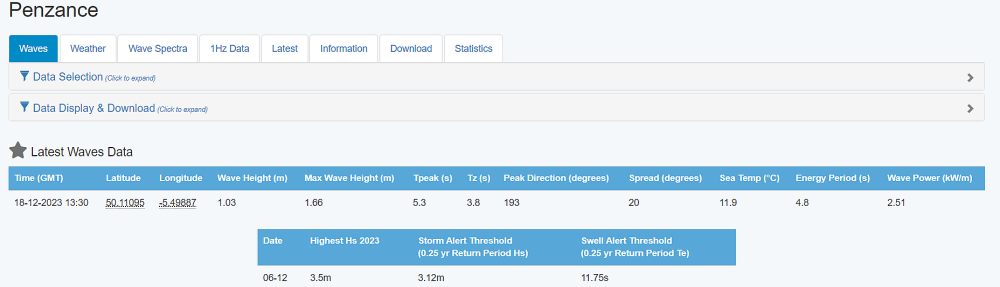
That is tidal, not wave, generation. A totally different beast. To give you an idea of how much power is in a wave, this is Penzance on a quiet day. A 1 metre swell and for every meter of wave front, 2.5 kW is produced. That is a lot of wallop.
-
Not a mad reason it is not utilised. Find a wave machine anywhere that has worked reliably, then ask the manufacturers to pay back my local council who invested heavily in WaveHub.
-
Clean Heat Market Mechanism to incentivise heat pumps
SteamyTea replied to LnP's topic in Air Source Heat Pumps (ASHP)
I asked https://zzzcode.ai/ import numpy as np import matplotlib.pyplot as plt # Generate random weather data np.random.seed(0) temperature = np.random.normal(10, 5, 365) # Generate heating system output based on weather data heating_output = temperature * 0.8 + 20 # Plot the weather compensation curve plt.plot(temperature, heating_output) plt.xlabel('Outside Temperature (°C)') plt.ylabel('Heating Output (%)') plt.title('Weather Compensation Curve') plt.grid(True) plt.show() -
I did work it out after I had had a mug of tea. https://www.bbc.co.uk/programmes/m001t353 https://www.bbc.co.uk/programmes/m001t9vd
-
Sound like it is either a faulty unit of has not be fitted correctly.