SBMS
-
Posts
1064 -
Joined
-
Last visited
Everything posted by SBMS
-
Thanks @saveasteading - might ask the SE about this. Is cracking typically due to the pressure being exerted by the ground outside the structure, or something else unique to blockwork walls underground?
-
Sorry completely misread house B with A.. long day! I would say you’d be absolutely fine then as you’re occupying it as your principal residence. I think the legislation states that it must be occupied by P as P’s sole or main residence. The qualification is or and therefore sole is only supplied to make clear that if it is your sole residence it must also be your main residence. But if it is not your sole residence it must be your main residence. I’d say it’s pretty clear.
-
What next for heat pumps after BUS and MCS?
SBMS replied to joth's topic in Environmental Building Politics
Does MCS have a pricing structure? I would have assumed it was up to the supplier to quote accordingly? -
Our LA are very clear that CIL is payable if you no longer ‘occupy’ the residence. They specifically call out renting it out as a CIL triggering event. How they would find out is another matter but I would not risk it.
-
We've had some input from the SE and it's looking more of a go-er. He's got a 'basement design' that means it can be constructed out of minimal blockwork with a simple waterproofing, drain and backup sump pump. Chap who sells the pools told me that you don't really need any chlorine in it because the oxygen generator, UV light, sand filter etc is so good, but we could drop a chlorine table in once ever couple of weeks if concerned. Anyway - is there any reason not to consider putting a conventional MVHR system in the pool room? My thinking is that if I installed a conventional MVHR system (say a vent-axia sentinel) and put the ACH target slightly higher - perhaps 1ACH, then every hour the entire content of the room would be replaced, and dehumidified, and heat recovered. The room is around 144m3. Bearing in mind the swim spa pool I am looking at has an electric roller cover 90% of the time, so really it'd just be MVHR boost when we open the pool room up... I understand some MVHR suppliers (Zehnder) are nervous to approve their usage because of chlorine in the air, but if that's minimal then I can't think of a reason not to use it? A lot of the systems that are used in residential pools (£10k like @AliG's) are so expensive because they have a lot of ducting, and they also heat the pool (I don't need this). So.. good idea? Bad idea?
-
Explaining this thermal bridging door threshold detail?
SBMS replied to SBMS's topic in Brick & Block
Probably a mad idea, but is there any reason not to put superfoil under (and overlapped potentially) the track in door openings to reduce thermal bridging? By my reckoning the R value of SF60 is comparable to a thermoblock brick? -
Explaining this thermal bridging door threshold detail?
SBMS replied to SBMS's topic in Brick & Block
Thanks. The marmox technical support chap said to do something similar to this: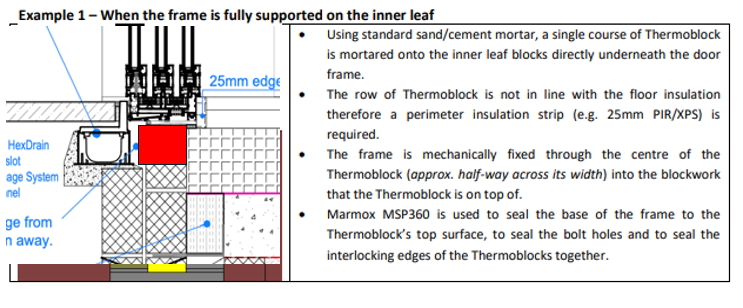
-
Explaining this thermal bridging door threshold detail?
SBMS replied to SBMS's topic in Brick & Block
Thanks Russell. Can I do a row of marmox (easier to source than compacfoam) - and would it be advisable to do the full width of the cavity in marmox (two 100mm)? -
Explaining this thermal bridging door threshold detail?
SBMS replied to SBMS's topic in Brick & Block
Do you think the EPS is actually doing anything? -
Explaining this thermal bridging door threshold detail?
SBMS replied to SBMS's topic in Brick & Block
Cavity above but then what supports the door track? -
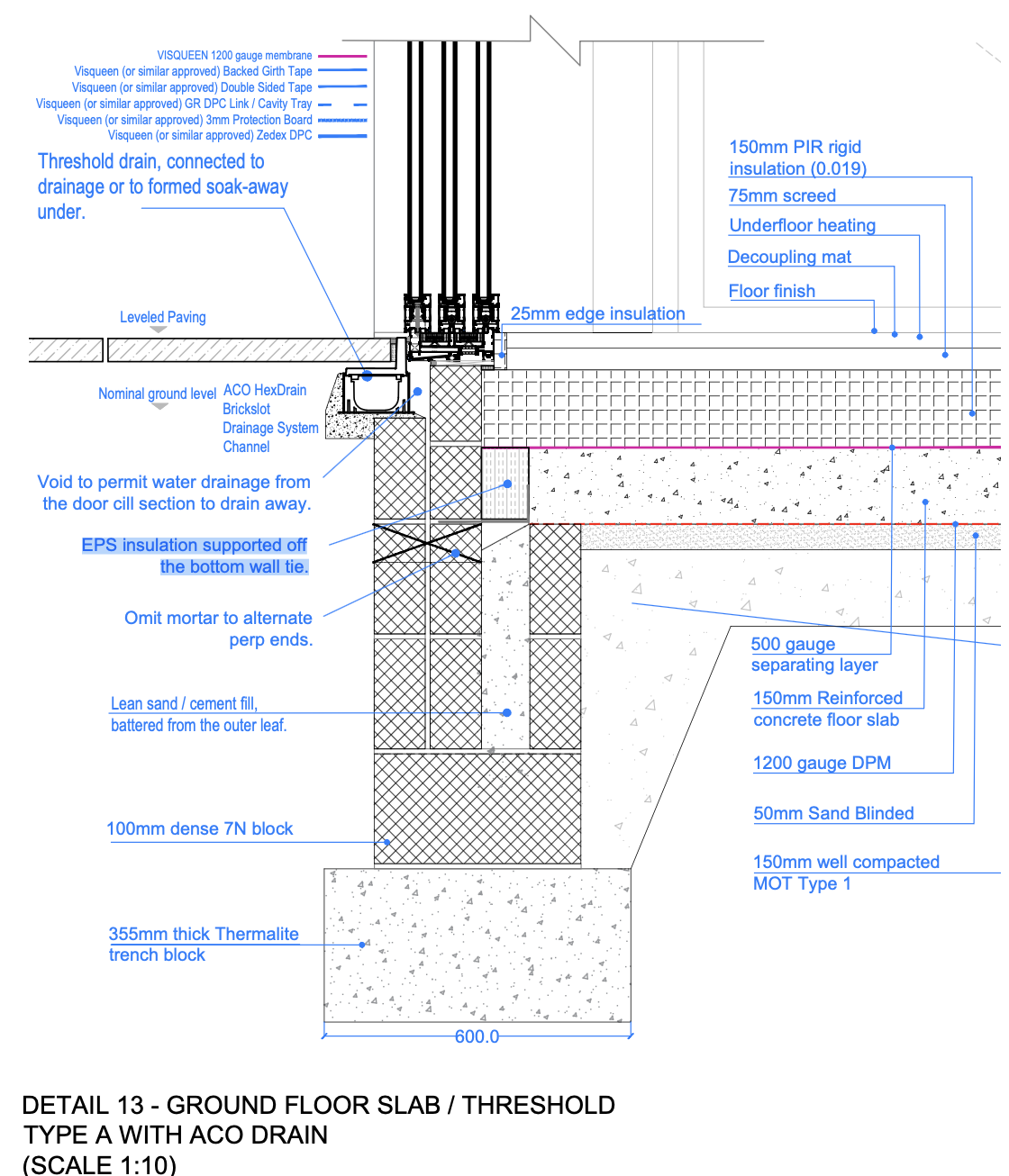
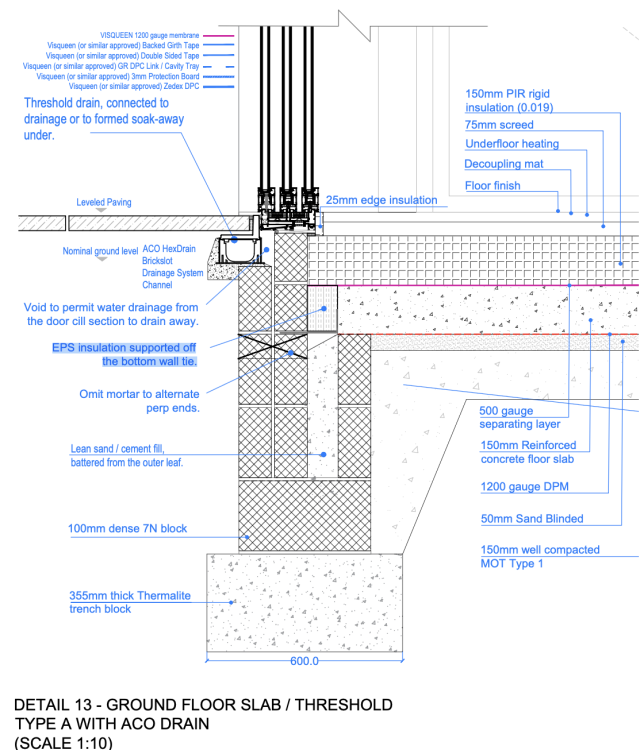
The architect has designed a detail to minimise thermal bridging at our door thresholds. We've got a 200mm cavity with EPS beads, and large sets of sliders. I asked for a detail that minimised thermal bridging, but also a detail that needed to support the weight of the bottom of the sliding doors. They didn't look at compacfoam etc because we tried to keep it as standard construction details as possible. However, I am struggling to understand, on the below, what the purpose of the "EPS Insulation supported off the bottom wall tie" is for? Does this aid in reducing bridging? Builder also can't understand how the detail reduces thermal bridning. Our sliding door track does actually have a thermal break in it as well so I might be overthinking this detail?
-
Is this side and rear extension Permitted development?
SBMS replied to SBMS's topic in Planning Permission
Thanks @DevilDamo I guess I wondered how much diligence planners take to actually check the status of the build and whether it is in a PD ready state. As planners don’t have access to BR sign off status do they actually take any measures to check this in determining an LDC or just assume it is in this state.. -
Is this side and rear extension Permitted development?
SBMS replied to SBMS's topic in Planning Permission
When can one submit an LDC out of interest? If the main house is currently under construction does it have to be ‘substantially complete’ before an LDC can be submitted? I understand that PD rights only arise once it is substantially complete, but can an application for an LDC be submitted earlier? -
Is this side and rear extension Permitted development?
SBMS replied to SBMS's topic in Planning Permission
Do you mean submit both option 1 and option 2 simultaneously as a LDC? -
Is this side and rear extension Permitted development?
SBMS replied to SBMS's topic in Planning Permission
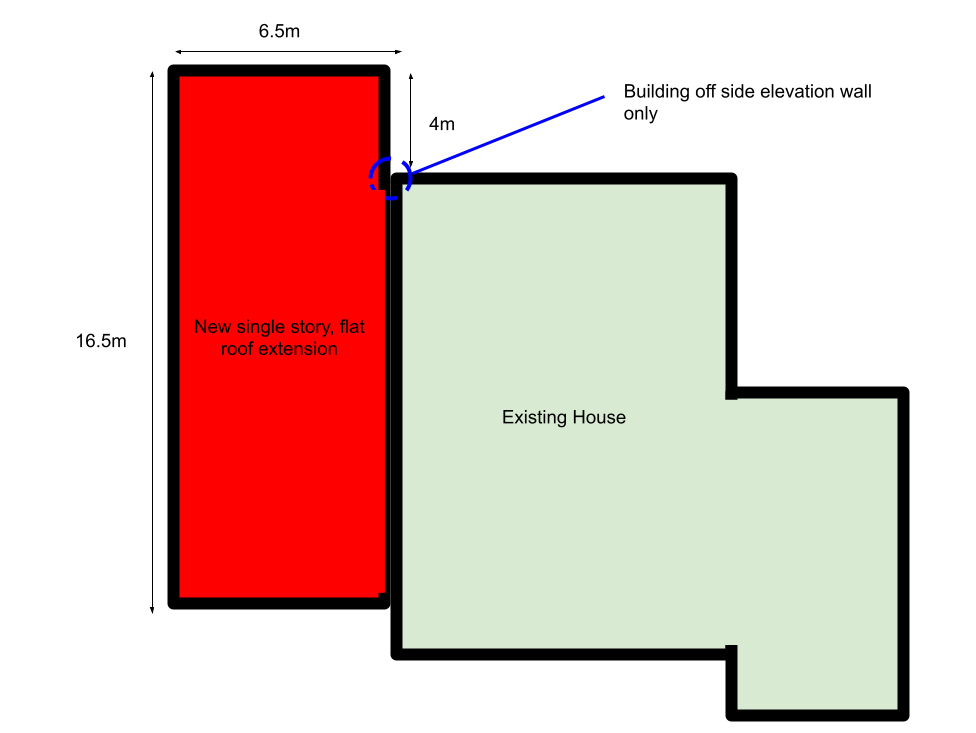
Thanks Marvin. Have read all this, no other conditions like AONB, 50% curtilage etc is all met. Property has brand new PD rights (new build). It’s just option 1 isn’t actually referenced as an example in the tech guide… -
Is this side and rear extension Permitted development?
SBMS replied to SBMS's topic in Planning Permission
I tried reading the entire guidance for permitted development (the 60 page guide) and there’s a clear example of option 2. We will be submitting a LDC prior in any event - but is there anything prohibiting option 1 in permitted development rules? It’s still less than half the house width and less than 4m deep… -
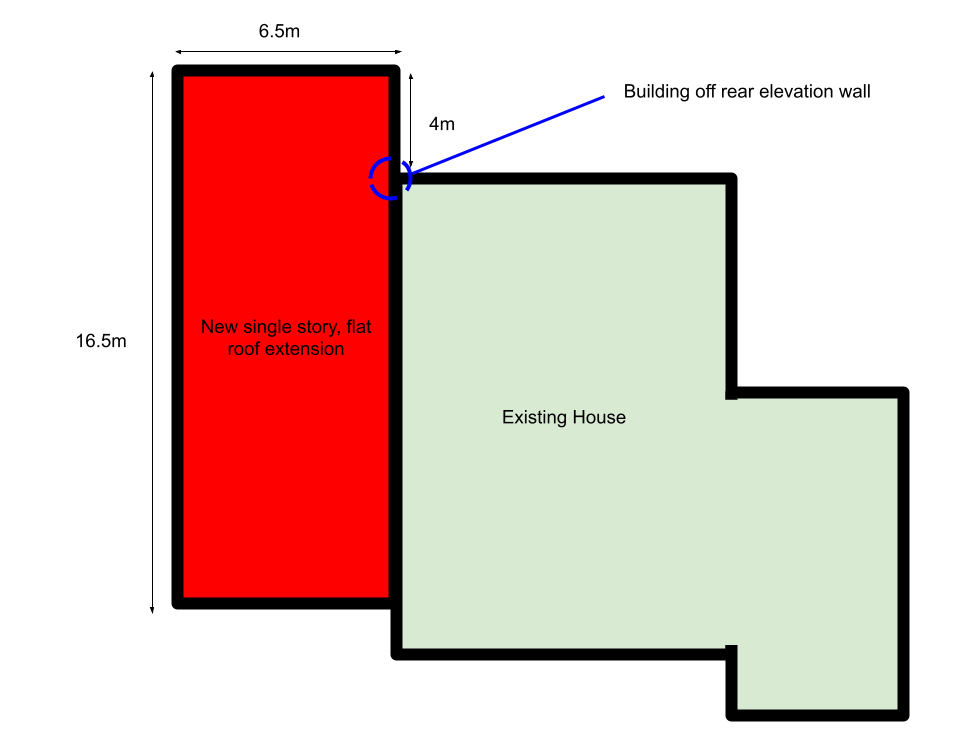
We are looking at what is possible under permitted development. As I understand you can build a side extension that projects past the rear elevation 4m without any prior approval, under permitted development. I understand that if you go more than 4m you need prior approval (shouldn't impact this question). Am currently unsure if building a side extension off the rear elevation (option 1 below) is permitted development, or does this trigger some form of 'wrap around' limitation? I am pretty sure that option 2 (where the extension only connects to the side wall) is definitely permitted - but is option 1 permitted under PD? Its technically a side and rear extension but wasn't sure if it needed to expressly not touch the rear elevation wall in order to be PD? @DevilDamo - I know you've commented on a similar one before on the forum, be interested for your take too.. Option 1 - building off rear elevation Option 2 - Only building off side elevation
-
Probably gone a bit off topic here, but my two cents was when I looked into this it did sound like MVHR and solid fuel stoves weren’t an ideal match and we therefore steered away from them for our build (although I am a sucker for a real fire). Be interested to hear how others with airtight houses, with MVHR run their wood burner?
-
I think ChatGPT is in itself a pretty good research tool as it can provide a balanced list of reasons. I would say that whilst I agree with the point from @ProDave on air drawn down the flue what ChatGPT is actually advocating is neutral pressure which makes sense. I can see an argument why slightly negative is not desirable to @ProDave’s point. However I can’t see many scenarios in which positive pressure (your argument) is desirable and I think this accords with what @JohnMo was stating.
-
ChatGPT disagrees: “When building an airtight house, it is generally recommended to maintain neutral or slightly negative air pressure in a room with a multi-fuel stove. Here’s why and what to consider: 1. Neutral or Slightly Negative Pressure Neutral pressure is ideal to prevent backdrafts (where exhaust gases flow back into the room) and ensure safe operation of the stove. Slightly negative pressure ensures that combustion gases from the stove are safely drawn up the chimney or vent. However, too much negative pressure can cause drafting issues or make it harder for the stove to operate properly. 2. Key Considerations Air Supply: A multi-fuel stove requires a dedicated supply of fresh air for combustion. In an airtight house, this is typically achieved by installing an external air intake directly connected to the stove. Ventilation System: If the house has a mechanical ventilation system (e.g., an HRV or ERV), ensure it is balanced to avoid creating excessive positive or negative pressure in the room. Chimney Design: The chimney should be properly designed to create a consistent draft, which helps with safe exhaust of combustion gases. Room Sealing: The room containing the stove should be sealed from other areas of the house to prevent pressure imbalances caused by other appliances or ventilation systems. 3. Avoid Positive Pressure Positive pressure in the room can cause combustion gases to leak into the house instead of exiting through the chimney, which poses safety risks, including carbon monoxide exposure. admission: I know nothing about this topic, just thought I’d ask ChatGPT. Its responses do make logical sense though. admission #2 ChatGPT could be wrong. It’s sources might even be this forum 😂
-
Not being overly pedantic but it does increase ventilation losses, all things being equal. It’s only ever adding to the ventilation, never taking away so how can it not increase ventilation losses? Obviously we design it in because we build an airtight house that therefore needs controlled ventilation. But if you have two identical houses with the same ACH50 score and one has MVHR and the other doesn’t, isn’t the one without MVHR more energy efficient? Only if airtight and using MVHr. Otherwise It certainly can be. If a house is well insulated and poorly ventilated, then ventilation can easily account for the majority of the heat loss.
-
Coldwells Passivhaus Turnkey Houses.
SBMS replied to TheMitchells's topic in New House & Self Build Design
Seems expensive. Davidson 170m2 on their self build price is around £1600 sqm for a shell. That doesn’t include groundworks either.. and, in my opinion, very bland layouts and designs. -
Completely agree @MikeSharp01 and this is exactly how I look at it from a design point of view - ie what is my ventilation and heat loss strategy. I think I was mentioning it from how I think the MCS installer might look at it, and from a fairly procedural view: whatever natural ventilation exists + mvhr ventilation = more heat loss. Of course it’s right that if you start out to minimise natural ventilation and control it with mvhr the overall heat loss will be much lower. Jeremys spreadsheet was great for this as I realised how much of a difference controlled, heat recovered ventilation makes. Tweaking his ACH figure and reducing the MVHR recovery to zero was a bit of a shock first time I tried it. It is by FAR the biggest contributor to heat loss and it surprises me that there’s a singular focus on fabric heat loss and tightening of u values when so much heat loss is through uncontrolled ventilation. it’s why I stopped with a 200mm cavity and beads because I really was in the realm of diminishing returns - better to spend money on airtightness and MVHR by far. And also that it’s a challenge to get the MCS installers to properly factor this in (especially when it’s pretty easy from a modelling perspective).
-
It does - if you think about it, @SteamyTeais right. There’s uncontrolled ventilation from air tightness. Then, no matter how airtight your house is, adding MVHR always ADDS more ventilation and therefore more heat loss. It can’t remove the heat loss from the uncontrolled ventilation so it necessarily always adds to heat loss. That being said, the idea is to be so airtight that we need mvhr to provide minimum ventilation, and that controlled ventilation is heat recovered so overall it’s efficient. But it does have to increase the heat loss somewhat.
-
Does sound like I’ll need to sit down and discuss with the installer what they would be prepared to accept.