Moonshine
-
Posts
2094 -
Joined
-
Last visited
-
Days Won
6
Everything posted by Moonshine
-

Ceiling service void batten sizes
Moonshine replied to Moonshine's topic in New House & Self Build Design
Holy sh@t I had forgotten that! That makes things easier! -
I am building a warm roof with the air tightness layer going below the roof joists, no MVHR I am going to batten below the joists to allow sevices such as down lighters and fan extract in a bathroom. How big are the battens typically spec'ed as to allow sevices for bedrooms and bathrooms to run?
-
Basement waterproof concrete (Type B)
Moonshine replied to Moonshine's topic in Waterproofing & Sealants
I shouldn't need pumps as its a 3 sided basement and i think that i can get the drainage channel out the front open side and be drained by gravity. Most of the warranty providers seem to want two waterproofing systems, even in the garage area! -
Correcting this is wrong!!!! the calculation of 0.15 is based on 0.020 W/mK, though from my quick calcs 100mm of Xtratherm (thermal conductivity: 0.022W/mK) and 50mm below should give a U-value of 0.18. However i would get confirmation from Xtratherm
-
I can't say that i am an expert at roof design but if that is what the architect has specified, go to that. The question is, with the 100mm insulation can you still have the 25mm gap? how big are the rafters?
-
Basement waterproof concrete (Type B)
Moonshine replied to Moonshine's topic in Waterproofing & Sealants
nice one and glad it was an easy fix ? -
based on the Kooltherm having a conductivity of 0.020 W/mK, that construction is indicated to give you a U-value of 0.18 https://www.uvalue-calculator.co.uk/calculator/pitched roof/insulation between and under rafters (partially filled)/ventilated/no sarking board/150mm/400mm/52.5/90/ Xtratherm has a thermal conductivity: 0.022W/mK, so it should actually be better due to the thickness and give you a U-value of 0.15 (according to the above calculator). You should probably give the Xtratherm technical team on 0371 222 1055 to confirm the u-value. The only thing that i would caution is that with the 100mm between the rafters there is still a ventilation space of 50mm above the insulation (if its a ventilated roof design).
-
Basement waterproof concrete (Type B)
Moonshine replied to Moonshine's topic in Waterproofing & Sealants
You are right, i have spoken to SIKA and they a reinforced concrete retaining wall with a minimum thickness of 175mm designed to maximum crack width or 0.3mm. They want to be able to inspect the concrete once poured which they would not be able to do if its behind a blockwork wall. Two options going forward i think - Cavity filled blockwork retaining wall with Type A barrier to exterior, and Type C to internal habitable spaces. - cast in situ retaining with Type B barrier (waterproof concrete), and Type C to internal habitable spaces. -
They should be able to give you the calculations that back up the value fairly easily. What build up are you concerned about?
-
Basement waterproof concrete (Type B)
Moonshine replied to Moonshine's topic in Waterproofing & Sealants
Who was your warranty provider? It would be great if I could get away with single method of protection, though the habitable space in the basement is limited to about 7m of retaining wall and may install a type 3 system in here just to make sure. Did you put a geodrain or similar on the outsite of the retaining wall? The ground investigation of the site found no ground water within any boreholes to depths down to 40.70m, and the lowest proposed raft is located at 42m, The groundwater levels in the area (sample point 7km from the site) are circa 26m. The retaining wall isn't going be a shuttered wall but a probably a reinforced concrete block (100mm) work retaining wall (total thickness 350mm), with 150mm concrete filled cavity, hopefully with sika waterproof concrete.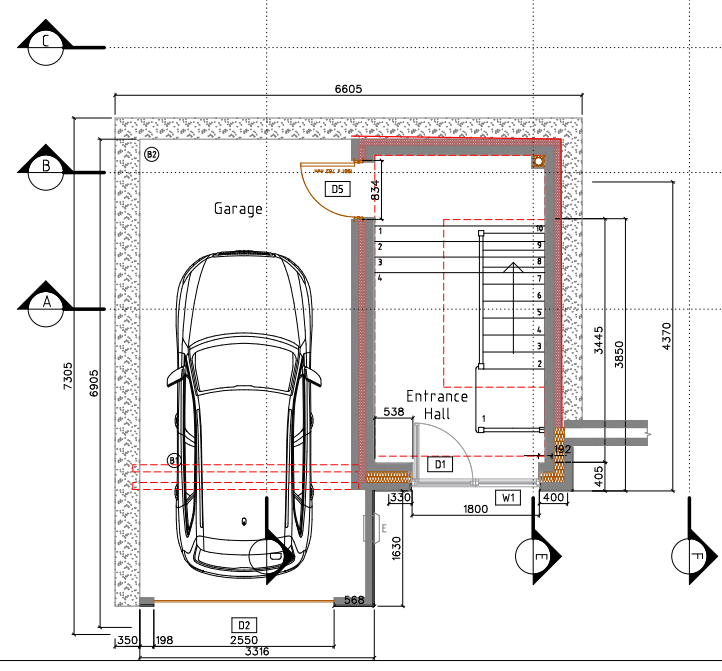
-
Has anyone used waterproof concrete (Type B) for waterproofing of a new basement? https://www.sikawaterproofing.co.uk/products-systems/sika-watertight-concrete/ I am looking at this a a possible solution for a semi basement as one level of waterproofing to meet Grade 3 conditions. There is a 60% uplift in material costs of waterproof concrete cost over standard, but it could save a load of material cost and labour to putting a Type A barrier on the external side of the retaining wall. Any experience?
-
Building a garage over my own services (gas and elec)
Moonshine replied to Moonshine's topic in General Construction Issues
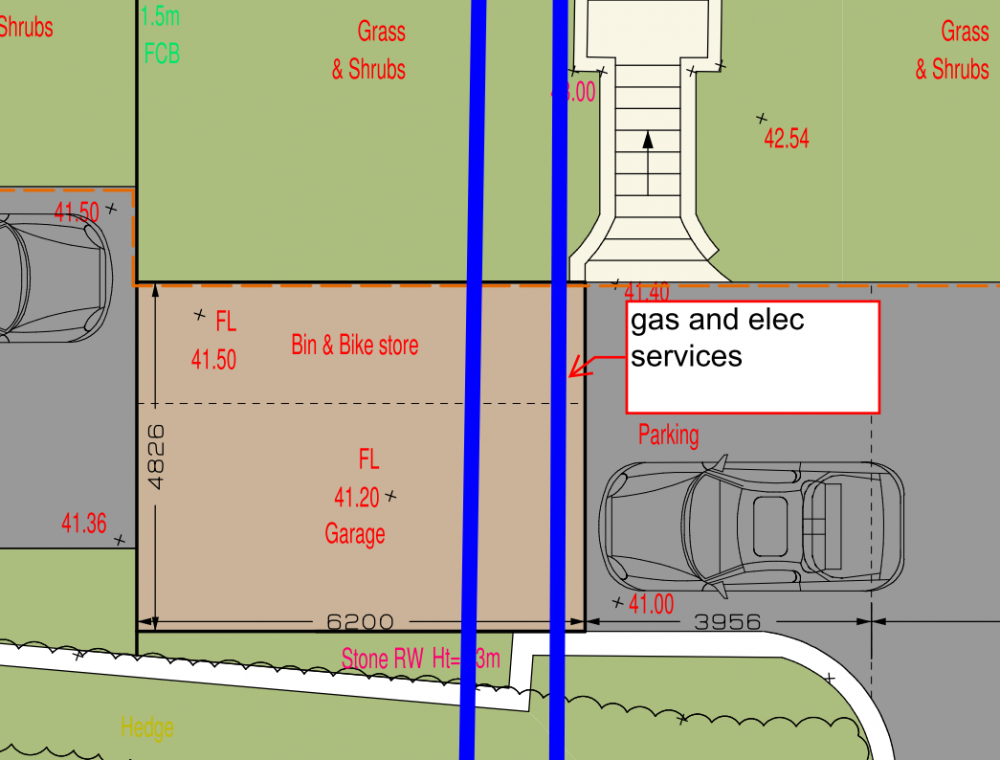
I could be in luck then, especially as just below the image posted, there is a circa 1m wall down to the pavement, so they should be buried deep on my site to account for that level difference. -
Building a garage over my own services (gas and elec)
Moonshine replied to Moonshine's topic in General Construction Issues
I do for the new house, this is the existing house, who's garden is the plot for the new house. This is the replacement garage for the existing garage which is getting demolished to make room for the new house. -
This may be in the wrong place but I don't know where else to put it (mods please move if required) I have got planning for a garage in front of my house as below, and recently the ground investigation identified where the gas and electric come into the main house (indicated in the blue lines below), bang under where I want to put the garage. I am looking to do an insulated raft foundation to the garage which will probably need to be circa 300mm deep from current levels. The question i have is can you build over these types of services, if so what safe depth do they need to be? how do you find out how deep they are? Alternatively we could reroute the services round the front of the proposed garage, but i don't know how feasible this is and the likely cost. Any ideas?
-
if you want to use rockwool you are going to need circa 350mm thickness to get U-value of 0.1, as it has a thermal conductivity of 0.039 W/mK.
-
FYI you can buy them, and i am sure a local sawmill could knock them up https://www.roofingsuperstore.co.uk/product/tapered-firring-for-flat-roofs.html
-
I don't quite know what you mean buy rockwool and foam? I am looking at a flat roof myself and tbh i think that you are going to have to use furrings or some method to get the required 1:40 fall of the roof. I have been looking at the firestone EPDM product and there are two ways of fixing it, mechanically or adhesive, both of these methods you lay the EPDM straight onto PIR insulation without another layer of OSB. There is something very important about the EPDM with the PIR insulation you specify and the knock on effect on your U-value. If you choose to adhesive the EPDM straight onto the insulation you have to use tissue faced PIR, where as if its mechanically fixed you can use foil faced PIR, tissue faced PIR has a conductivity (W/mK) of around 0.024 (e.g. Thermaroof TR27) and foil faced PIR has a conductivity (W/mK) of around 0.022. For a u-value of 0.1 you will need 200mm of foil faced PIR (0.022) when mechanically fixing, and 220mm of tissue faced PIR (0.024) when sticking the EPDM down
-
Staining on external wall insulation system
Moonshine replied to Heidi's topic in Introduce Yourself
This is typical stains of this type of render (limed based render), when weathers, have a look at below. The fact that its following the gaps in the insulation slabs indicates that its dampness coming from the masonry in the building, google the term "ghosting render''. here is one example of the blocks showing through -
Quandary: Timber frame or masonry cavity wall
Moonshine replied to Moonshine's topic in General Construction Issues
It will be the PIR, great for thermal insulation, not good for acoustic insulation as it's not porous. -
Quandary: Timber frame or masonry cavity wall
Moonshine replied to Moonshine's topic in General Construction Issues
what is your construction, purely timber or with a masonry outer skin? Also PIR or mineral wool insulation? -
Quandary: Timber frame or masonry cavity wall
Moonshine replied to Moonshine's topic in General Construction Issues
That is the part that i am struggling to work out, i have quotes from TF'ers, but i don't know what the equivalent would be to do the internal skin block and a floorings etc. -
Quandary: Timber frame or masonry cavity wall
Moonshine replied to Moonshine's topic in General Construction Issues
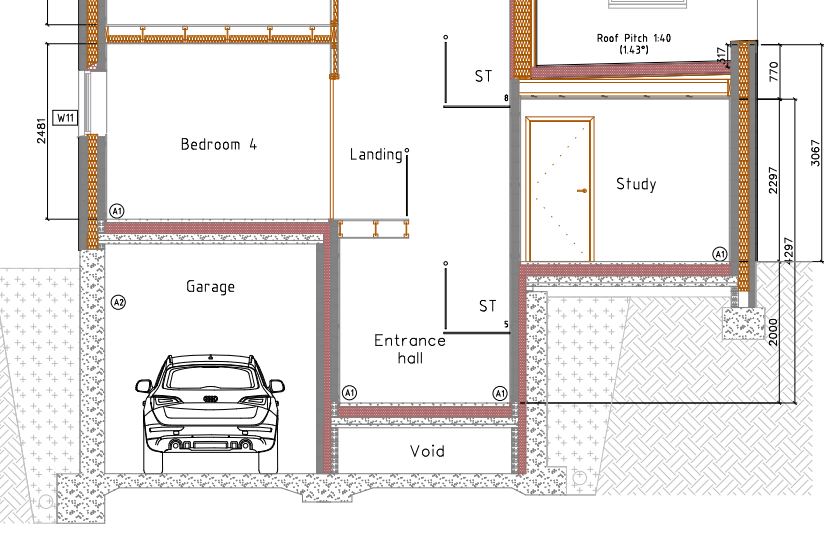
Thanks, the basement doesn't cover the whole footprint and most of the basement is garage, so the ground floor in this case is going to be traditional block and beam sat on traditional footings and onto of the cavity filled basement wall. I would look to do something like this at the base of the external walls / on top of retaining walls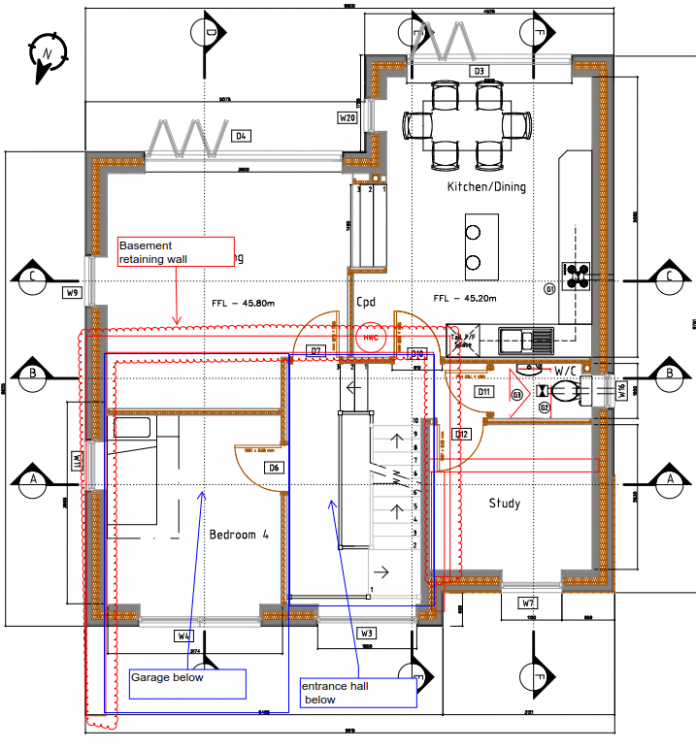
-
i have just had a look at warm roof build up, using www.uvalue-calculator.co.uk as below For U value of 0.11 you would need 180mm of 0.022 W/mK PIR, for U value of 0.13 (current Part L) you would need 155mm of 0.022 W/mK PIR For a quick comparison Recticel Eurothane GP 25mm is £11.30 a sheet (£3.92 / m2). Over a 100m2 flat roof its an extra £400 in materials
-
Any specific ones? i know Jewson have a paid for service.
-
true (i was about to put a comment on Grenfell but didn't)