Ferdinand
-
Posts
12213 -
Joined
-
Last visited
-
Days Won
41
Everything posted by Ferdinand
-
 If you have teenage children who like over-long showers, and a sufficiently Machiavellian mindset, is this an opportunity for lifetime indoctrination to short showers? Just asking .... 😇.
 -
I think this thread highlights well the importance of homework - including asking questions that we think may be naive here. It also highlights the importance of our ASHP market developing, and the industry continuing to grow.
-
A couple of reasons - one simply that laths come in 5m lengths and is inexpensive, so there was enough! And I decided since it was a rental it would make sense to protect the celotex everywhere rather than just by the door. I was referring to this one below, but I think I misunderstood slightly in that it does not save depth over a single 18mm thickness; what it does is make it monolithic.
-
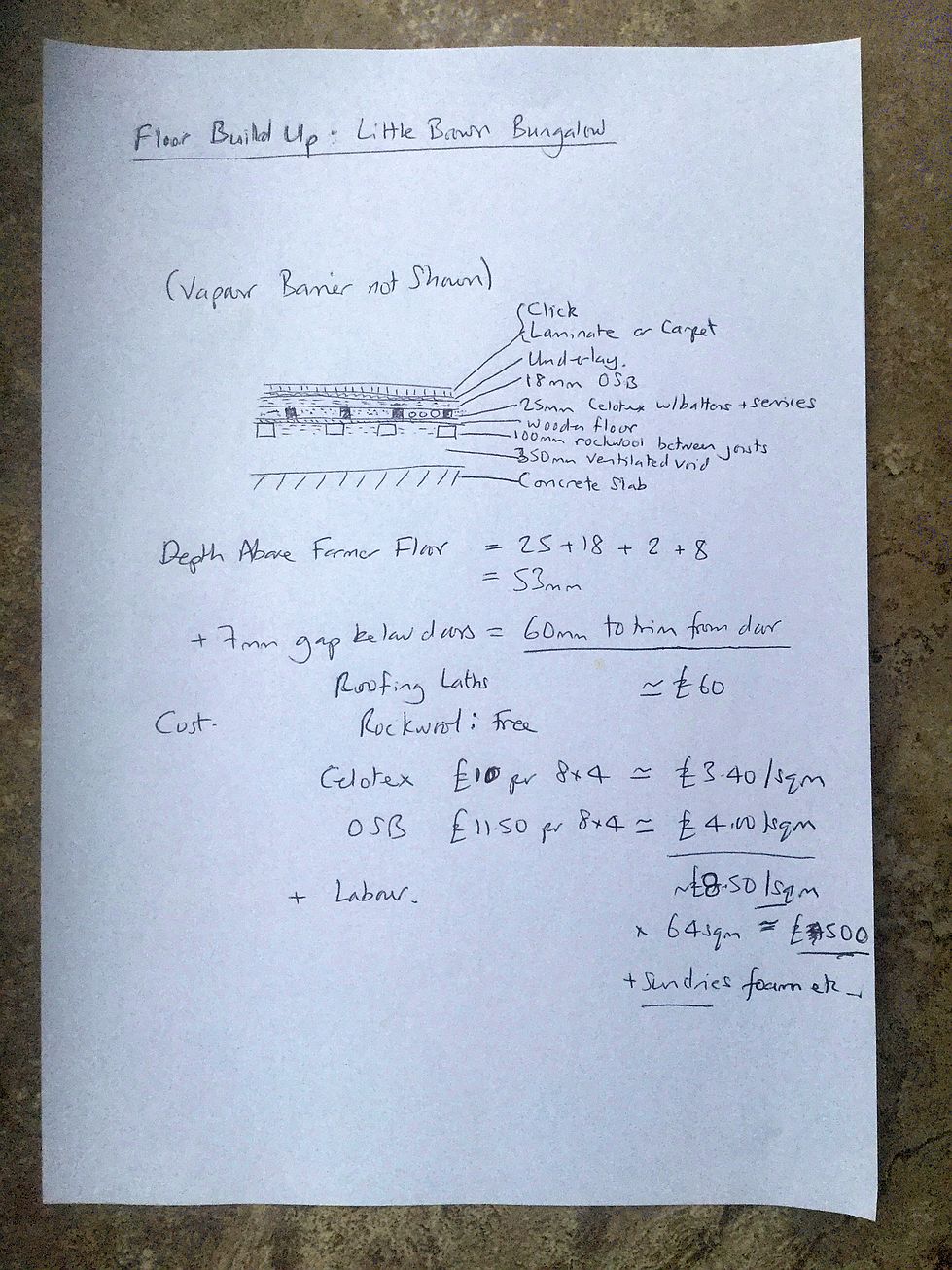
Does the @JohnMo idea give you depth to make your 20mm of insulation a bit thicker? When I wanted to insulate above a (wooden, suspended) floor for a renovation for a tenanted property back in 2017-18 I did somethjng similar. I couldn't go down (but could do some underfloor insulation), and I was replacing doors without redoing door lintels etc. My height limitation was that modern doors are not as trimmable as might be assumed. The best trimming margin I could find was ~60mm combined off top and bottom. *Watch this point* . My layering was 25mm insulation board, slip membrane to stop allow movement / stop squeaks, 18mm OSB (gaps of ~6mm between sheet edges iirc), then underlay and carpet. I could have used Click Laminate (ie QuickStep as I always use) instead of carpet. 2 extra tricks I put in: 1 - I dealt with my carpet edges by using quadrant siliconed onto the skirting not nailed or glued - can take off with a Stanley knife. 2 - I did 1 because I left an insulated well 300mm wide around the inside walls where I ran all my wiring for sockets and plumbing for radiators (which were also put on the inside walls) to reduce penetrations and keep everything inside the insulated envelope, and it all needed to be accessible. I framed out my 25mm insulation using 25x38mm roofing laths - leaving the channels round the edge, and cut the OSB to match the framing, so that could just be lifted to get at wiring and plumbing I can't honestly remember if I screwed the OSB to the laths or just left it floating with the sheet edges aligned to the frame. One alternative to the "monolithic floating floor" is to frame out at the size of your laminate and put a thick strong laminate directly onto the frame; that will save a bit more height. There is a thread about it here, which also covers other aspects - not all of which I did. The insulated floor worked and the (mid-high end) underlay and carpet still looks as good as new (change of tenant last August and they love it).
-
If it is a rented property, are there limitations on what and how you can attach things to the door? Can you use something like Aerogel blanket (ie Spacetherm or similar) for your layer on the door face and then one of the suggestion above as a cover? Aerogel blanket is available in self-adhesive form, I believe - if you look around.
-
regularisation Retrospective regularisation
Ferdinand replied to pseek's topic in Building Regulations
One middle way is to ask the seller to provide a statement via their solicitor that the work referred to was in place when they arrived. It would be strongest as a notarised Statement of Truth, but even a query from your solicitor to their solicitor, with a written answer, should have weight. If their solicitor has already said that, there is no reason it cannot be via an email or letter exchange. That avoids pfaff with indemnity policies, and may feel less confrontational to the seller. But TBF it is currently a sellers market, so there may be opportunity for you to insist on an Indemnity Policy. If you insist that will put it up their agenda if they want you as a buyer. An indemnity policy is usually inexpensive, so even if you chose to buy one it would be a tiny fraction of the cost of the house. It is your call. -
For @Roger440 stuck down or just escaped from the rabbithole (!), here is the Octopus Smart Tariffs page, with this graphic suggesting who should consider what options. It may (or may not) help. I don't really agree with the last line, as I value stability and am risk-averse at present. I sympathesise with your desire for a KISS. I waited for a whole year's figures on Outgoing Agile before deciding that Outgoing Fixed would pay me more - 15p per unit exported rather than about 11p; another small step on my quest for zero net energy bills. https://octopus.energy/octopus-smart-tariffs/ (I am on Outgoing Fixed for my exports - which pays me 15p per exported unit on top of my FIT payments, as I have FIT solar PV but no battery. And on Octopus Fixed October 2023 version for my incoming electric.)

-
At the moment it all seems marginal - with differences on normal tariffs of well under 10%. I made my call last autumn and did the Octopus 12m Fix, which gives me rates of 26.76 p/kWh electric, and 6.76 p/kWh gas until next autumn, with stiff exit penalties. Plus the Octopus Loyalty Bonus reduces those by about £2 per fuel per month (=£48 per year), which seems to have been adopted by many other suppliers now. Giving me rates quoted on my bill of 25.49p for electric and 6.44p for gas overall. I think. Current Octopus rates are now at 28.26p and 6.61p before loyalty bonus. These are due to increase by ~5% from January I think. But I will lose out relatively in the summer period when the OFGEM Cap is forecast to come down - which is when I use very little energy. I think it will be to my benefit by £100-£200 over the year; nice but only a small lollipop. The other bonus I get is cover against the market being upturned.
-
Thanks for posting the information - it highlights for me how different it all is for different people / living arrangements. Mine are on a separate thread somewhere, but are completely different as I am running low background gas ufh and playing around with a biggish portable A2A unit with a view to maybe installing first as an alternative to gas, then mainstay, then replacement. Larger 4-bed house but no one here except me and the last bit of the Christmas turkey (which is actually gammon). My gas ufh is not very responsive, so I may start with A2A downstairs when I do for responsiveness. Upstairs is gas rads on a separate circuit. Apparently the time to have them fitted is winter when demand is low. And well done on your reduction. I'd suggest keeping a careful eye on the annexe - a 2kW direct panel can run up a lot of electric if used fairly constantly. There are through the wall heat pump based heat / cool / dehumidify A2A units designed for apartments which may be appropriate. Solar in the future? 😉 (I can't get my head around the room sizes either, nor spot an obvious unit crossover that could generate the numbers. The plans are a great help.)
-
Is this the @Pocster garden? And is the stuff previously nicked and thrown back over the fence in disgust? 🤠
-
ProDave as the new Roger Dudding, who made much of his (couple of hundred) millions from lockup garages, as well as from his business making ticket dispensing queueing machines, as used everywhere. Also a well-known car collector. I first heard of him in Rich Lists in the early 1990s. https://en.wikipedia.org/wiki/Rodger_Dudding
-
Depending on how much you have to raise in capital and/or income, are there options such as taking in a lodger or two, which would be tax free for the first £7500 of income? OTOH if your plan was always to sell the big house, then it may be time to think about that and downsize at this point. My only comment would be that it may be good to look at bungalows, of which I am a huge fan. Wishing you all the best.
-
Are you sure that that is correct? I thought that there was a right to continue living in the shared dwelling without being able to be forced to sell it to let the Council access funds to pay for care. On that basis when my mum and I moved house a few years ago such that I could be her carer, she lifetime-gifted me half of the house. * There are lots of ins and outs though, and each situation is different, as are ways of managing it - so I'm raising not trying to lay down an answer, and specific advice may be needed. Ferdinand * ironically she died 6.5 years later, so there was some tax to pay on the gift.
-
Creating a smile in the mind - with bricks.
Ferdinand replied to ToughButterCup's topic in Brick & Block
No. 89.97%. -
(Useful comments from @joth around context. Thanks.) As it happens my kitchen-bathroom man turned up with an invoice this morning, for replacement of the door gear in a uPVC door he installed in a tenants house back in 2017 or so. Door gear is the gubbins (minus the lock) that engages the locking multipoints. His comment was around what work is actually regulated. We chatted on whether, for example, connection of an electric hob or like for like replacement or an electric shower is restricted to electricians. It's quite funny - he turned up looking a bit hipster-like with a growth of beard and hair on top. It turns out that his daughter is doing a hairdressing module on her course at Sheffield University, and is required to demonstrate that at the end she has the skills to cut hair and shave a beard. Inevitably, dad is the chosen victim 😁 . The joys of being a parent.
-
My experience of LED G9s is that they go pop a lot more often than LED GU10s. I find that I have to replace more at changes of tenant, even though I generally have fewer of them than GU10s. Usually no GU10s at all will have gone pop, but the T will have used up the G9 in the spare bulb selection I supply. I see the same pattern at home. My sample is small enough not to be a firm guide, but is perhaps useful anecdata. For something like that, a cheapish consumable that is a pain if it keeps breaking, perhaps a Trade Rated product from Screwfix, or a similar thing elsewhere, is a useful guide?
-
Lots of people getting excited about electrics / electricians and plumbers / plumbing in bathrooms, and I am nonplussed. Can anyone explain to me what exactly needs to be disconnected in order to retile a bathroom, and why it needs an electrician or plumber to do it? Obviously a bathroom cannot be wired or rewired by a non-electrician - but it's not being wired or rewired. I've just had a look at both my bathrooms, and I can't find anything except - possibly - an electric shower. Everything else is I think on the ceiling. There's a shaver socket on the side of my bathroom mirror, which may involve a penetration behind the mirror (can't remember), but that's more a job for a joiner or handyman than an electrician once originally wired in by a lecky. Full tiling to ceiling would make a small difference, but very little. When I'm designing a bathroom I would go out of my way to make sure that as little as possible - especially electrics - is installed on tiles, because it's such a PITA. To completely disconnect my bathrooms I flick a couple of switches on the consumer unit, and I expect the tiler / fitter or whoever to work around the minor things that are there. And they are. But my guy who does tiling does entire bathrooms, and also entire kitchens, beautifully and without turning a hair, and has been doing jobs for my dad before me - back to the 1990s. He also does all my 2G and external doors, since he has the kind of trade contacts I do not have. I would not ask him to rewire a house of course, since that is correctly heavily regulated for safety - and if I did he would tear me off a strip. Normally that is done before the kitchen is fitted, of course, as I'm sure we all do. Am I missing something, here? Or is my man bionic? As a note I tend to keep it simple by not having huge tiles and so on. But I've had about 10 bathrooms done without the "but what about the plumber and electrician I need" issue ever even being mentioned. And several by others than my main man.
-
Welcome @Joel . 1 - If I have it right, you are in a 1st floor flat experiencing an ingress of smoke from downstairs. 2 - The aim is to keep the smoke out. I'd make 2 points: 3 - For simplicity, you can also look at this from above the floor, if you include a membrane (eg DPC polythene sheet - comes in 4m width so easy to do). You could, for example, lay a click-fit laminate floor over a 2 layer combo of membrane and a layer of normal laminate sponge-base. Seal the edges carefully, ideally by wrapping up behind skirting boards and sealing the membrane / wall join, and that should help a great deal. If you use a click fit system you can potentially take it up again and then do the harder underfloor option if you find it not good enough. So you get to try the easy way first. The only click-fit system I use in house renovations is Uniclic from Quick Step, because I know it is suitable to be taken up and put back down. And it comes with a 25 year guarantee (or did last time I bought some). 4 - Then look into PIV (or through the wall ASHP units if you want heating, dehumidifying, and ventilating as well) to use mechanical ventilation to help. I think that for smoke particles and smells you will need an activated carbon filter which will need periodic replacement. 5 - There are other ways of applying a seal, such as sealing between all your floorboards. In any case I would aim to get any low hanging fruit too, such as raise one floorboards and seal the light fitting carefully. A chance for some bonus Christmas Zoot. Alas, I also cannot resist 😉.
-
I think it's a multifaceted question, My comments: 1 - I'm not convinced inflation is much of a risk in the medium term - say 3-6 years. It is coming down and will stay down. So imo a 3-6 year fixed rate investment, ideally with an escape hatch cause to limit risk, is perhaps a good choice. I wouldn't necessarily view a letting investment as a good money shelter; prices are falling and if someone finally gets a grip of housebuilding that may continue. There are now lettings based investment trusts. 2 - On rental, I don't think it has been easy, and has been targeted, for a number of years. Down here in South Britain holiday lets are one form of private letting that still has most of the tax breaks in place, but which have been reversed for most of the rest (unless you incorporate). 3 - Are there a couple of other interesting options you could consider. Two that spring to mind are: a - An annexe to your existing property, which you could let out for holidays as @Crofter does. i Such an annexe could be attached - I once rented one with a locked door to the main house, which they just unlocked if a relative was currently in situ (this could be set up as a "spare room" to keep it tax free. ii Or separate, in which case if your plot is suitably configured it could even be extended and sold off later as a separate dwelling if appropriate. b - An as-packaged-as-possible investment in a safe market city which is wholly managed by an agent. In Nottingham I could tell you what to buy and who to have to run it, but I am not well informed about property in Scotland. My sense for this option is that you need to be looking at something like a student flat or two in a city with a couple of universities and a hospital. That would deliver an income and an asset. 4 - Given current law, which I think broadly applies in Scotland as well as England the sweet spots for rentals are due to how you are taxed on your finance expenses as if it were income, so you pay the bank and then you pay the Inland Revenue as if you had kept it. Current sweet spots are a - Things with finance which do not tip you into higher tax band, b - Cash purchases which you do not need finance on, c - A property company. 5 - I'm a very firm supporter of ratcheting up EPC requirements, especially on Owner Occupier, and I'm jealous it had happened in Scotland and been canned in England. Should have been done from 2013 at the same time as for landlords, but Conservative Governments always pander cynically to their hoped-for Daily Mail reader supporters. But this is a side-issue n your thread. HTH Ferdinand
-
OT: IIRC Grenfell was an early 1970s build, so would probably be before such design practices came in.
-
I think your quote is notably expensive. I don't understand stuff like "plumber to disconnect", "electrician to disconnect" and a few of the other lines. I would file those under "wtf?". I'd say that in this particular case someone is taking the p, or might it be possible that he doesn't want the job and is trying to scare you off? One question on the existing work is that to me the tiles seem to have similar direction orientation - all lined and joined up, rather than random orientations. That may be one factor in emphasizing the "large pattern" rather than going for a broken up "background texture" look. I had 2 bathrooms quite heavily redone fairly recently (2019) to do with enlarging and adjusting shower cubicles and a new bath put in, changes to the floor structure to correct mistakes by the original self-builder (had used subfloor material that moved in moisture and cracked tiles), sounds insulation, and "accessibility" for my elderly mum. When my plumber-joiner-kitchen-bathroom-fitter needed stuff disconnecting he just made me turn off the circuit at the fuse, or turn the water off at the SureStop switch. I'm not sure what takes a full day to do that, unless it is some peculiar estimating or work system and he has a funny strict contract with his subs for which you are having to pay? I'd suggest getting the rest done, and return to this in a few months with separate quotes from several tilers. Then spend the money (£3-5k?) you save on a nice holiday. There are other approaches you could take, such as full size fabric hangings on a wall or two. Ferdinand
-
The heater there is fed by the same heat pump as everything else. But does it really make a difference? It's just a strategically placed radiator, after all. I'll try and come back to the other points in detail later. Remember that I am speaking from my experience in the English Midlands with traditionally built houses, and English climate (which is may be very different to a typical climate in your part of France) and gas boilers / radiator heating. But on this one is the way to find out just to switch that bit off and see if it makes any difference over say a year? It may be that a low steady heat distributed throughout the house via slow background airflow helps with keeping it all fresh, and that is worth the investment of keeping it running. You can get humidity / thermometer max/min meters off Amazon for under £10 that you can move around over a period of time to see where your peaks and troughs are. I have about three; one routine use I make of them is to tell me when washing is dry in the drying closet I use in winter (which is my small bathroom with the fan left on and a dehumidifier running). There are I think others on Buildhub based in France who may be able to advise.
-
Can anyone quote me a specific example or two of the efficiency level of an MVHR system, and supporting data? I'm having a debate elsewhere (about how far we can reduce energy demand in narrow boats, of all things), "90%" has been quoted for MHVR efficiency (I had quoted 75%-80% for HR extract fans), and someone has asked for evidence for the 90% 🙂. Thanks Ferdinand
-
Do you actually need the PIV? In answer to your first question, my view is that Yes, you can create a sort-of-MVHR. You will not get the same performance, but you get improved performance in so far as you got towards matching the conditions in a modern well sealed, well insulated house. And over a trad house I reckon one can get more than half way there. It has been my standard approach across renovating properties, dated 1850-1970+, in the last decade. My current habit is to install a PIV, which is set at the appropriate level (so it is background not blowing a hoolie) at the top, and put in a background HR extract fan at the other end (eg utility room downstairs). I have been using Vent-Axia Lo Carbon Tempra units since about 2014, which state an efficiency of 78% for their heat exchanger. i call it poor man's MVHR. My reno scheme is now typically good double glazing and doors, under floor insulation, backdraft shutters on extract fans, proper sealing of penetrations, air sealed loft hatch, and all the other detailed stuff I can get at. Plus good -> very good insulation in other respects - aiming for say a good C in EPC terms. To help internal air circulation you may need to do something like trimming the bottom of doors. TBH if you have open chimneys to the rooms then that is likely significantly or entirely to undermine any attempt to control your ventilation or environmental conditions well. IMO seal and ventilate. PIVs have always been almost a magic bullet for fixing condensation (assuming leaks etc sorted), and imo this is the next level. If your house fabric is still full of holes and leaks, then I'm not sure about heating incoming air on the PIV. That's direct electric heating, which imo is not perhaps a good idea if you are about low energy bills. Does insulation in that attic (and the other attics?) require some attention?
-
There are less expensive options (still not cheap): https://www.elesi.com/soho-lighting-brushed-chrome-flat-plate-dimmer-and-rocker-switch-combo-blk-ins