Ferdinand
-
Posts
12213 -
Joined
-
Last visited
-
Days Won
41
Everything posted by Ferdinand
-
Presumably with that driveway you have an innovative solution to fire protection / suppression ie sprinklers, which will be a few k extra. I don't think that meets the conditions wrt distance from road and fire engine access (iirc 2.75m absolute min width or all the building within 45m of the roadway where the engine can go).
-

You're underground what did you expect ?
Ferdinand replied to Pocster's topic in General Self Build & DIY Discussion
I would probably consider a permanent framework disguised as a pergola for fitting a portable electric winch, or permanent mounting points for a temporary system that can be recreated in half an hour. An external domestic lift does seem to be a good option, but @pocster will not get one for tuppence. Actually I suppose a further option is to repurpose a set of wheel ramps used for loading vehicles onto trailers as the inclined plane, which are only £100 or so. There's a set available for free in Italy somewhere: http://www.youtube.com/watch?v=t2oEVBSedjE -
Renovation and extending 1950's house
Ferdinand replied to Bridgfordman's topic in Introduce Yourself
.. -
Help on building front garden wall
Ferdinand replied to Matt1972's topic in Bricklaying, Blockwork & Mortar
My point would be to check that your chosen blocks will be frost tolerant in the way you plan to use them. I think blocks are more resilient than bricks (where you need engineering not facing bricks for a wall to prevent spalling over time), but worth a check. This is what happens to brick walls not done properly with the correct bricks.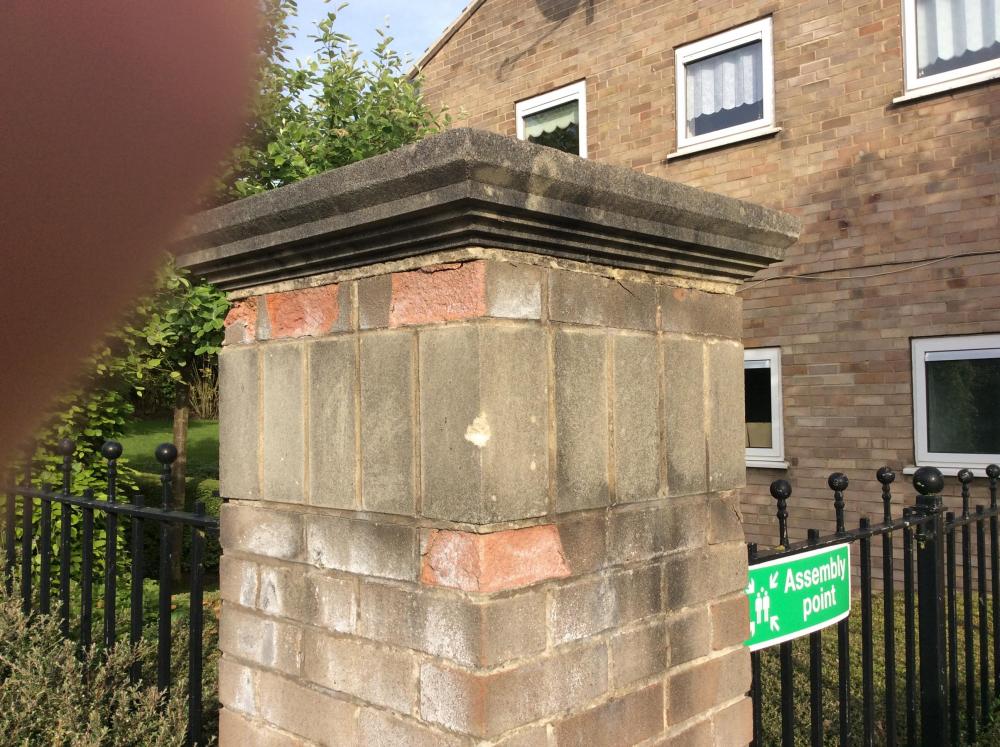
-
You should be able to adjust the aspect ratios of the font by up to 15% each way without detriment using stretching or kerning horizontally or tracking vertically if several lines, or just switch your font. Those were the sort of adjustments which were possible when I used to design publications (though 7-10% was better). So I think that should be manageable, depending on how much control you get.
-
My first question was going to be why every self builder suddenly looks decades older in the 6 months later piccie compared to the avatar, but then you said it was your mum ? . Looks good. Gentle warning - now until next spring is not necessarily ample time to deal with planning. You will have to get your queries right with only time for one or two cycles, depending how quickly it gets processed, Corona backlog etc.
-
You're underground what did you expect ?
Ferdinand replied to Pocster's topic in General Self Build & DIY Discussion
You can take all the ever decreasing circles this thread has gone in and make a spiral staircase. Serious answer: Portable manual jib crane. Scaff framework and a block and tackle (what I would do). Put some pavers or hunks of ply on the poor ground. Inclined plane and a block and tackle. Non serious answer. Is there a suitable lifting cushion for that height that you can just blow up and deflate? Ferdinand -
I use my local monumental mason.
-
Renovation and extending 1950's house
Ferdinand replied to Bridgfordman's topic in Introduce Yourself
Welcome. -
any comeback on surveyor that missed something
Ferdinand replied to tonygg's topic in Surveyors & Architects
To c9me back at the surveyor I think you would have to have proof of the at the time, and that they were negligent give) their methodology at that time. Personally 8 think it may be easier just to address the causes. none of it sounds excessively expensive or complicated. eg You can reopen up your air bricks. Ferdinand -
any comeback on surveyor that missed something
Ferdinand replied to tonygg's topic in Surveyors & Architects
It depends how it is getting in. Do you ever get standing water outside at airbrick level. If so you can modify drainage outside or modify your airbricks eg by putting the offset "z" vents in to move it once course up the wall. -
Welcome. Could you tell us a little about your project?
-
it is something that is very enjoyable to learn and do if someone is so inclined and does eg an evening course. My mum did such when we had a lot of Guy Rogers furniture, and dining chairs from grandparents. You could get a job which is 90-95% as good as a pro. But allow an elapsed year or 18 months overall. Then you will always have a talking point in the house. Or if you are in a furniture area then I am sure there will be umpteen people who do it weekends. Just ask around. Eg ask a local gym who redoes the leather on their machines. Or get your company to do it. Personally I have a tenant who is a professional upholsterererer who works on the line at a high end furniture manufacturer, so I am sitting in clover eating a buttercup on this one ? . (*) F (*) Sorry - cowslip, as they are more exclusive than buttercups - see Watership Down. Reserved for owsla.
-
The name would be surveyor or Chartered Surveyor, but measured boundaries would need to be done with mutual consent. It may honestly be easier to make his hedge a bit shorter. If the deviation has been in place with no action for x years then it becomes the boundary anyway.
-
What EWI for 1930s solid brick (215mm) wall home
Ferdinand replied to tanneja's topic in Heat Insulation
Having said what I said, on my latest reno I fitted extended window and door sills to all the new 2G windows to allow for future EWI if required. However for a small 3 bed bungalow experience with the tenants has shown all energy bills running at around £55-60 per month having just done the normal things (UFI, loft, decent 2G, careful detailing) well, so there is not enough saving left to justify that much more - and as it is a rental I would need an extra benefit to do it. Much of this reno is on the forum search "Little Brown Bungalow". F -
What EWI for 1930s solid brick (215mm) wall home
Ferdinand replied to tanneja's topic in Heat Insulation
You can PIR in any thickness well, beyond 70mm up to and including say 150mm or even 200mm. eg Celotex to 200mm https://www.celotex.co.uk/assets/handy-guide_nov18.pdf The insulation material is a relatively small amount of the cost, and my advice is to really work on the detail and ask lots of questions. I have looked over the years at EWI on half a dozen different houses and always ended up doing IWI, underfloor insulation and loft insulation instead. That is probably not what you want to hear, but you will need to be doing the project on the basis of comfort as well as economics. Happy to comment and point you to resources. Ferdinand -
A Strong Drink and a Peer Group
Ferdinand commented on Ferdinand's blog entry in The BuildHub Gardening Blog
I think that's it. As the RHS say: "Linaria purpurea is a vigorous perennial with erect stems clad in narrow, grey-green leaves, with purple flowers 1.5cm long in slender terminal racemes in summer and early autumn; often seeds freely." They are right it seeds freely; it's bloody everywhere. -
A Strong Drink and a Peer Group
Ferdinand commented on Ferdinand's blog entry in The BuildHub Gardening Blog
I have a small amount of that - and a plague of cats - but I know catmint. I would describe the leaves as "straplike". Thanks. -
Why not grow an evergreen or flowering climber, or say tomatoes? If you look back at editions of some gardening programmes there has been a lot of "from the presenters garden", and some have included balcony gardening in flats. eg If you look up The Beechgrove Garden on BBC2, one of the presenters has been stuck in a flat in Edinburgh. I am something of a fan of that programme since introduced to it by mum, on the basis that if something will grow just outside Aberdeen in the land of howling gales, I have a reasonable chance of making it work 400 miles to the South on my modest hill in Notts. They also seem to be far less up themselves than other gardening programmes. Ferdinand
-
A Strong Drink and a Peer Group
Ferdinand commented on Ferdinand's blog entry in The BuildHub Gardening Blog
I am actually wondering whether it is a traditional wallflower. They are noticeably shallow rooted. -
Getting started on the roof
Ferdinand commented on dnb's blog entry in Building in a woodland on the Isle of Wight
That site does look quite like the one from the IoW that was on Grand Designs a long time ago. Very attractive. -
Douglas Adams, in "Life, the Universe and Everything", that Arthur Dent expressed a need for "a strong drink and a peer group". That is what this Gardening Blog is for - my need for the same thing because my knowledge about gardening is patchy, just like my garden. Buildhub cannot supply a strong drink, but I am hoping that the peer group can help me get to grips with the garden I inherited last year. The idea has been around for a couple of months, and is now in a position start. We talk a lot about building here, but not so much about all the aspects of the settings of our houses - planning, clearance, climate, fencing, groundworks, trees, plants, soil, hedges and all the rest. That is what I hope can get a bit more coverage and conversation here, in all its aspects. This is a group blog, with potentially as many authors as wish to contribute, so if you have a question, or a project, or a garden you have liked or a plant you have spotted or grown, we can sign you up as an author or do a one-off contribution. If you would like to involved as a one-off or regular, do send me a Private Message. For my first question - what is the purple plant in the middle of the piccie below, and is it a weed or a specimen? Do I take it out or leave it in? Comments are most welcome. Plant identification is one of my weak points. * The header picture is of the Dill and Watercress in my microveg "Green Wall" - which has been one my new projects during the lockdown period, which I will post about more as things go on.
- 32 comments
-
- 1
-

-
- ferdinand
- housekeeping
- (and 1 more)
-
Shower Wall Panels
Ferdinand replied to canalsiderenovation's topic in Bathrooms, Ensuites & Wetrooms
That wasn't me - I would douse my leg in nitric acid, cut it off with a rusty hacksaw, and feed it to a rabid labradoodle before doing that. I use something with a texture selected specifically to hide any potential lines, and especially any marks or scratches. Rather like the sensible default colour for any car being the same as the colour of the local dust. I am not one of the "lets create as much aggro as humanly possible for ourselves by buying the most awkward patterns possible" set ? . Give me a construction cocktail instead, any day. , -
Digging and swapping soil for sand - work estimate
Ferdinand replied to ReX's topic in Landscaping, Decking & Patios
Great news. ? *polishes nails on shirtfront* -
Shower Wall Panels
Ferdinand replied to canalsiderenovation's topic in Bathrooms, Ensuites & Wetrooms
You could frame out with eg 20x10mm rather than normal size timber.