


Marvin
-
Posts
2389 -
Joined
-
Last visited
-
Days Won
3
Everything posted by Marvin
-
Hi @sharpener Expanding @JohnMos comment further.... IMHO a CoP is only an indicator of what is possible with a particular ASHP. Similar to about as useful as how many miles per gallon a manufacturer says a car can travel! However in this case the manufacturer has no control over where it is installed and what it is connected to (and like a car how it is used.) Simply put, referring to the CoP your measuring how much energy is put into an ASHP in relation to how much heat is produced by a given temperature difference between the air outside and the exiting water temperature, at exit, from the ASHP. I am not surprised that companies are very conservative when sizing an ASHP. I assume you are trying to work out what would be a reasonable size ASHP for your building. To decide the suitable size of an ASHP for your building with more certainty than "an expected size and plus some" requires much, much, much, more information all the way down to how the end user wants or needs to use the system. Something not really practical or sometimes possible to do when quoting. If you want to take the long path of finding out with more certainty, it can be done as people here have, but don't expect a quick answer. Good luck Marvin
-
Hi @Temp I don't extend the concrete founds past the face of the stud walls to try and keep the concrete protected from the rain.
-
Proceed with caution! Our system has to be turned off by the panels first and then off by the mains, and reverse when turning on.
-
For your information our PV complements our mains power. That is to say when it produces an output this feeds into our mains and is either used to supplement our demand or heads to the grid. Ours does not turn on or off.
-
I think photos are required!
-
Solic 200 mod - scheduled boost for off peak hot water
Marvin replied to RichardL's topic in Photovoltaics (PV)
Hi @RichardL Seems the above by @JohnMo is the latest thing: https://cdn.shopify.com/s/files/1/2612/5402/files/Solar_Diverter_Data_Sheet_r-min_1.pdf?v=1669043972 -
Do you understand gravity? 🤣🤣🤣
-
Solic 200 mod - scheduled boost for off peak hot water
Marvin replied to RichardL's topic in Photovoltaics (PV)
Not quite that simple. Will elaborate later... -
Hi @Sophiae As your title indicates the drawings require the detailed information to show that the work will be carried out in accordance with the building regulations. To understand what to write one would need to know the regulations. If this is not your field of knowledge I would suggest saving the money up rather than spending a lot longer working it all out. However, if you would like to see the regulations: https://www.gov.uk/guidance/building-regulations-and-approved-documents-index Good luck. M
-
The simplest is as already suggested: an isolator inside the house. Otherwise it's the tap box if it was me. If your concerned with vandals I would suggest avoiding tap locks. One could just unscrew the tap. Good luck. M
-
Solic 200 mod - scheduled boost for off peak hot water
Marvin replied to RichardL's topic in Photovoltaics (PV)
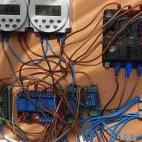
We run our immersion via a digital thermostat (which is a 2 channel relay but too weak to take 3kW) which signals another relay that can take the power for the immersion, supplied via our solic diverter. We run the back up via our ASHP which uses a different digital thermostat. The 2 probes fit 1 pocket in our tank. The back up comes on when the tank temp is too low and is set just high enough to give us what we need. The diverter temperature is set at 75°C or more in the winter and 60°C in the summer and is easy to change because the controller is not on tank. M -
Between the inline and the consumer box one??
-
Hi @TonyT Thanks for this. Does this mean a 30ma RCD can be in the meter box at the start of the 4 meter tails?
-
Does the electrician need to put a breaker in the tails as they are 4 meters long? Different DNO's seem to say different things. Also told that Tails must be surface mounted in trunking. Client doesn't want this!! Oh happy days.
-
I will look into that thanks P
-
Hi A friend of mine asked what would be a suitable orbital sander to sand down a single garage wooden door frame. I don't think he will be expecting to do much more than that with it and he didn't want to shell out for one that would do half a house... Thanks Marvin
-
ASHP winter additional heating ideas?
Marvin replied to ashthekid's topic in Air Source Heat Pumps (ASHP)
Hi @ashthekid However £450 over 12 months is what £5.6k? We are not using the ASHP for heating at all now, and won't until about October. I'm sitting here eating lunch and its 23.7°C and my wife had had the cooler on! We only have 100m2 with 5.12kW PV (16 panels) ASHP, 205litre hot water pump, and a PV diverter and we are using about 3000kWh a year for the heating. We noticed that in the winter months although there is a reduction in the PV electricity generation to about a quarter of the summer production its usually produced in bunches of days. We also noticed that the hot water tank temperature drops quite quickly in the winter months, although our tank is super insulated and is in the thermal envelope with an air temperature no lower than 19°C 24 hours a day. We put it down to temperature migration along the pipes connected to the central heating (not on 24 hours a day). In the winter we have the water temperature quite low, with a boost every month over 60°C remembering that the closer the ASHP water output temperature is to the outside air temperature, the more efficient. Setting up a relay on the tank thermostat which is using the PV excess diverter means you can heat the tank up from the excess solar and after that divert it to a night storage heater. This can store heat for about 24 hours. However to achieve the same sort of ratio of PV panels to floor surface as us would mean you would need about 60 PV panels (assuming that they have about the same assumed output per panel of about 320W) Best of luck. M -
Building regs specific to batteries, solar PV?
Marvin replied to Drellingore's topic in Energy Storage
and now I know. Thanks @Drellingore -
Wish I had a brother-in-law with a digger!!!
-
https://fiber-optic-catalog.ofsoptics.com/Products/Optical-Fibers-for-Communication-3100102024
-
Last week 150mm hole using a 4mm bit in my percussion drill
-
MVHR loft install help
Marvin replied to richo106's topic in Mechanical Ventilation with Heat Recovery (MVHR)
We lifted the thermal envelope over our MVHR pipes. We found that the heat recovery side is less able to hold the building temperature in the summer/ winter without it. This is on top of the Domus insulation directly to the pipes.... -
Or turn both rad valves off and undo the nuts fixing the valves to the radiator, putting buckets or trays to catch the water. I usually use a sheet of plastic to protect carpets. When all water out you can usually remove the valves from the rad, but be careful not to spill any water by lifting one end up and draining into container. Shut the bleed valve, turn the radiator upside down and I usually put kitchen roll in the open radiator ends to stop drips before moving it out the way.
-
Pressure relief valve on the boiler? I assume your going to eventually install a drain valve. If possible you could saw partly through the copper pipe where you want a drain point and fill buckets. Bit messy and often best to throw a cloth over the pipe to stop it squrting all over the place.
-
Could manually open the pressure relief valve. Are the rads upstairs?


