


saveasteading
-
Posts
11094 -
Joined
-
Last visited
-
Days Won
98
Everything posted by saveasteading
-

Fire resistant party loft wall.
saveasteading replied to Mike DC's topic in Lofts, Dormers & Loft Conversions
It can be a single stud of timber or steel, and doesn't necessarily need insulation, though you should anyway. You will need a proven detail to satisfy the bco and insurers. Go to " knauf systemfinder " and see the range of standard details. -
Connecting to 110mm soil pipe
saveasteading replied to jpadie's topic in Rainwater, Guttering & SuDS
How about a small soakaway. Just a rubble or gravel pit, say 500 x 500 x300 deep? Or a long thin one that would also help the garden in summer. Or just a 4m length of perforated pipe with membrane around it. -
If the SE says 500 then the bco will have to accept it, but it's good to know they are personally comfortable, and they know the norm in the area. The builder has likely done 10 years less study than the SE.
-
Contesting final invoice - please help!
saveasteading replied to Tom's topic in General Self Build & DIY Discussion
Ok. I think you have now got it all in your head. Draft it here if if helps. -
Contesting final invoice - please help!
saveasteading replied to Tom's topic in General Self Build & DIY Discussion
1.5 disputed as unsatisfactory tiling. 1.5 disputed as not applicable 2k for electrics they agree is incomplete. So 5k is disputed and justified readily???? They demand 8k but refuse to complete the works. now i speculate:You believe that getting another contractor to remove and complete the tiles and electrics will cost not 3.5 but between 5 and 7k?????? because new contractors will want a premium for getting involved in a problem job if at all. Plus replacing cracked tiles is extra work. Plus you allow a large contingency in case there are other problems. Why did they crack? Can you get replacements that match exactly ( same batch even). Might you have to replace them all? I've no idea the cost. What if there are issues with the electrics? Maybe it has big ossues which us why they want to jump ship. What contingency should you allow? So you could agree that 3k is due for extra tiling costs but need a contingency for the other works. You should have told them this already though. List all contingencies and costs separately in case the judge disagrees with any. -
Came across this from 2 years ago and felt I should share. This is literally a threshold. This space was a threshing room. The floor was, and remains, lower than the doorway so that the threshed material is held indoors. To be clear, there was previously a floor of cobbles, leaving about 3" sticking up. There is also a dressed hole in the wall where a shaft would link the engine outdoors to the machine indoors.
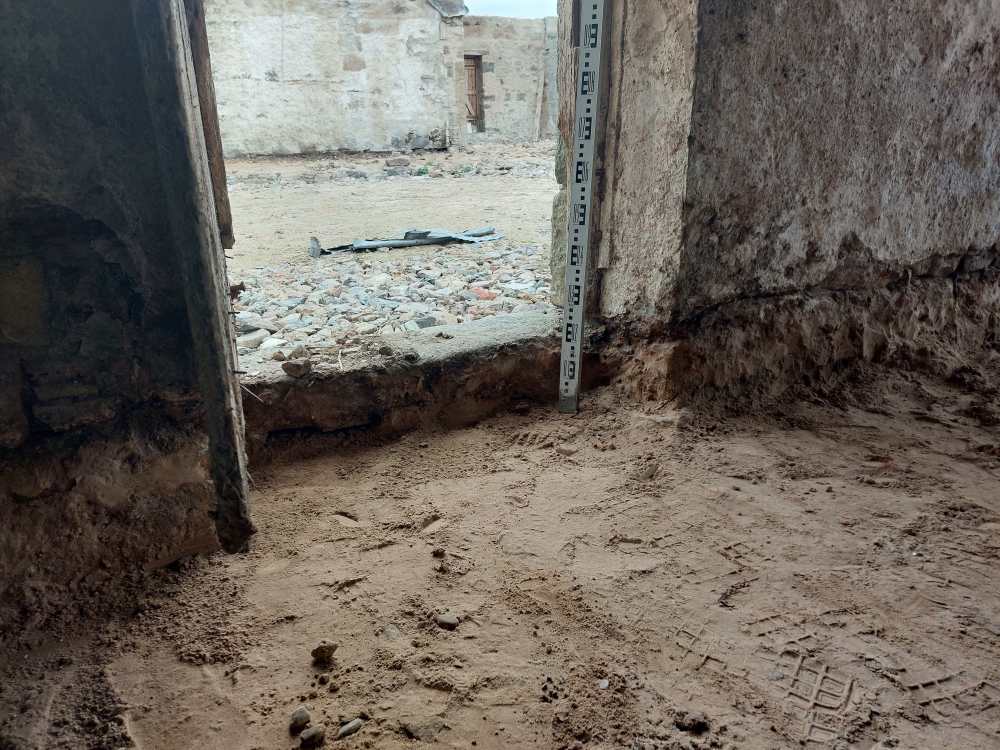
-
Contesting final invoice - please help!
saveasteading replied to Tom's topic in General Self Build & DIY Discussion
Pretend you are thd judge. Better yet, get a friend to play the part. You don't pay a retention in bits as they deal with the easy parts, so no more money. Remind us please. If your arguments all satnd up, do they owe you any money as well as defect correction? Plus if you need alternative contractors they will prob cost more. -
Contesting final invoice - please help!
saveasteading replied to Tom's topic in General Self Build & DIY Discussion
OK. One more turn at being reasonable. Respond to say their message has been received. That you believe you have dealt with all their issues but they have not responded to them. That If they have any new argument then you will be happy to receive it. Small claims judge is a proper judge. It is a small process but no less forbidding. The jusge will not look kindly on any new argument or evidence. It should all have been argued out already. They will look at each item in turn, not at the whole. Make sure you have easy- to-demonstrate proofs of every one of your points. The judge then adds up the sums and tells one of you to pay the other the difference, and who is to pay the court cost. The judge is perfectly happy to score 20 : nil. They don't get soft come item 20 unlike an adjudicator might. BUT if it gets remotely technical they will decide it needs expert reports and is not a small claims matter. Thus try to have a layman's argument plus a technical one. If any of your arguments are weak, compromise on them (only) pdq. Equally you must be ready to summarise your contra-costs. Don't put your papers up on here....they might be watching. -
Self Builders/Renovators in Scotland.
saveasteading replied to Mike DC's topic in Introduce Yourself
A long way north of there. 200 miles, 5 hours. Scotland is quite big. -
Normal for all houses with or without mvhr. Well worth doing anyway...Good air supply and control, no back draughts.
-
The pipes have start and finish location. Between it doesn't matter if it turns slightly laterally. For falls though, don't adjust by insulation. Lay the pipe to grade using either a level. A spirit level with packers on one end. Then fix solid on dots and dabs, and perhaps a weight on top. Check by eye. Insulation then fits around this arrangement.
-
Agreed. And not enough attention* is given to the insulation from the ground beneath the floor. In a chunky house, a lot of the floor is far from the cold outside world. * the manufacturers choose not to tell us.
-
Replacing sodden lawn with fake lawn
saveasteading replied to RJC82's topic in Landscaping, Decking & Patios
I'm totally against fake grass. Plastic that will fade and wear and that will end up being tipped after just a few years. Plus the issues above. Gravel, perhaps in grids will drain the rain. Slabs for some more formal harder areas. Pots of plants: a few glazed ones look great and plants like them -
Pir 0.022 eps 0.037 PIR provides significantly better insulation, close to double, but similarly more expensive: close to double I'm gradually coming round to 100mm EPS under 100mm PIR as optimum, with joints staggered. Or see what the market is doing at the time. This because if diminishing returns with depth. @Nickfromwalesplease explain your sacrificial idea? Is this straight on the blinding? Sacrificial meaning some will be damaged and replaced? Or squashed into protruding stones?
-
Talk to the builder. Some are happy to reduce their turnover, for insurance, account levels, even vat threshhold. and exposure to risk of you or another client being slow payers. Or they may hate having clients question everything or being late with deliveries...or getting orders wrong. so insist they include supply. Don't expect the builder to prepare the materials enquiries, help with managing deliveries, sort problems while you get the discount. Equally tell them what concerns you.
-
The sand blinding is only for level control, as stone is tricky to get level and smooth. It shouldn't be thick. The dpm goes on that. A slab on that is unnecessary structurally but gives control....ie it is hard and doesn't get displaced or the dpm get torn.. But it can be a thinnish screed. In this case you might reduce the hardcore equivalently.
-
But also that the builder does. Most small builders are happy to have one account at one BM. Everything on its merits. When you prove you are a good payer it can get better too, especially if you send a nice big enquiry.
-
I'm going out so will review later. Thats a very simplistic table. I think I'd put the 100mm in at 1:80 and explain to the bco why that isn't a problem, because it isn't. What's going to get stuck?
-
ICF How much more expensive ?
saveasteading replied to Dave Jones's topic in Insulated Concrete Formwork (ICF)
Because you can't. But in a hollow block wall you can, and fill with concrete, depending on the need of course. Hollow concrete aren't as strong as solids. Eps obviously isn't strong at all. Don't reinvent the system. -
So the b and b floor is really the constraint on levels. So I revise my advice. 100mm pipe throughout. Use the level where the pipe passes out of the house just touching the floor as your datum. Run ig from there to the house connections at 1: 80, and from there to the sewer at whatever gradient is available. If this results in slight intrusion into the screed then either increase the insulation thickness or let it intrude into the screed. Or take the drains outside by the shortest route, but that increases drain runs and cost.
-
I wtote this hours ago and forgot to send. May be superseded but haven't time to check.... I'm sorry but I might be misunderstanding something. I like gravity too. Why use 150mm pipe? 100 is plenty, in fact will run better. Start at the street connection. Work from there using 100mm at minimum grade. See where it ends up. If available then you can steepen the slopes. Be sure to use manhole bases that do not lose any height at the junctions. The pipes don't need to be 40mm or 65mm below the eps: they can be in it even.
-
How to space two parallel reinforcement bars vertically?
saveasteading replied to AartWessels's topic in Foundations
I didn't realise that. It doesn't really matter. Steel needs water and oxygen to rust, so it won't reach the working bars. -
How to space two parallel reinforcement bars vertically?
saveasteading replied to AartWessels's topic in Foundations
Not at all. Unless you can explain why the accurate position of the bars does not matter. Perhaps they aren't necessary at all. My thought was to cut the control bars 25mm wider than the internal width and wiggle them into the inner faces, both sides. Then they are not exposed. But it's not a greatly thought out design, and I would have expected a 'system' to have a standard solution. Spacer for the bottom and 2 layers is still my preference IF you can trust the builder or supervise....otherwise they will likely end on the bottom. -
It should be removed as best practice. Whether it matters is another matter. The top will go soft and rot very quickly. You can rake it out.The deeper parts will go soft quickly and become compost over a few years.
-
How to space two parallel reinforcement bars vertically?
saveasteading replied to AartWessels's topic in Foundations
You mean how, physically, to keep them in the right place while pouring? Once you know the dimensions. Your SE should also tell you how much overlap of bars ( top of my head, it is 40 x 12 = 480mm). You can get plastic or voncrete spacers which you tie to the bottom rod. They keep it off the bottom. F rr the other one I suggest you pour the concrete up to that height and compact it, then lay the other rod, then complete the pour. Be sure to then mix through that surface to make it monolithic just use a 2 x 2. Alternatively you could poke some small rods across the space at the right height and wire the rod to them. The advantage is that nobody forgets.




