


ReedRichards
-
Posts
891 -
Joined
-
Last visited
Everything posted by ReedRichards
-
When my ASHP was retro-fitted my installer applied to the DNO to upgrade my mains fuse from 60 A to 80 A, as 80 A was the largest upgrade they would do for free. There was a bit of confusion which was resolved after a week or two; the engineer came to do the upgrade and it turned out I already had an 80 A mains fuse, although the case was marked 60 A. Also, I trust that you understand that there are two types of UFH, one that heats using water and the other that heats using electrical wires.
-
When my ASHP was retro-fitted my installer applied to the DNO to upgrade my mains fuse from 60 A to 80 A, as 80 A was the largest upgrade they would do for free. There was a bit of confusion which was resolved after a week or two; the engineer came to do the upgrade and it turned out I already had an 80 A mains fuse, although the case was marked 60 A.
-
If you keep your rooms at 21 C then ∆30 might mean that the flow temperature is 53.5 C and the return is 48.5 C. Your ASHP won't be running very efficiently at those sorts of temperatures so you want to minimise the amount of time for which it happens. In your model, what is the outside temperature when you need the ∆30 radiator output? Also, your RHI payments, if you could get them, will depend on the SCoP and that will go down the higher you make your maximum flow temperature for heating. Setting up your ASHP to match your existing radiators will increase the running cost for the sake of a little bit of convenience.
-
Advice needed before I tackle the installers!
ReedRichards replied to MattB67's topic in Air Source Heat Pumps (ASHP)
You can buy radiators with an integral fan but the point of the fan is that it increases the heat output from the radiator. That means your heat pump/boiler has to supply more energy to the radiator so a fan will increase your energy bill if it does its job. Radiators with integral fans are useful in situations where you don't have room for a bigger radiator without a fan. But on some of the ones I have seen, the fan only cuts in when the water temperature gets high enough and an ASHP may not get your water to the cut-in temperature. -
Thank heavens for that. If the flow temperature is 45 C then typically the return temperature might be 40 C (heat pumps usually use a higher water flow rate than conventional boilers so the temperature differential across the radiators is less). So if your room temperature is 21 C and your average radiator temperature is 42.5 C that means Δ21.5! It's hugely important to get this right or you won't be able to get your dwelling warm enough in winter.
-
If you skip to the "Tuning" section at the bottom of the page, this website gives instructions on how to tune a PID controller: https://www.thorlabs.com/newgrouppage9.cfm?objectgroup_id=9013
-
Would one ever want to use Weather Compensation for DHW (it's not even an option with my LG ASHP)? Maybe in summer I don't need the water I shower with to be as hot but I think I want to wash dishes in water at the same temperature all year round. I have used a few PID controllers in my time but they have all been capable of learning. So as long as the initial parameters are not too far wrong in the first place the controller will automatically improve on them, presumably in this instance in order to control the temperature better by minimising the undershoot/overshoot.
-
Does an ASHP stack up financially?
ReedRichards replied to SBMS's topic in Air Source Heat Pumps (ASHP)
This isn't an ASHP issue. The less insulation you have the greater your heat loss. The greater your heat loss the higher your running costs and the greater the output capacity you need from your heat source. -
Does an ASHP stack up financially?
ReedRichards replied to SBMS's topic in Air Source Heat Pumps (ASHP)
You would need to check your specifics but heat pump cylinders need to be heated with lower temperature water. You need to heat the cylinder quite quickly as the heating to the house is off whilst the cylinder is being heated. So heat pump cylinders typically have longer coils with a larger surface area. -
Does an ASHP stack up financially?
ReedRichards replied to SBMS's topic in Air Source Heat Pumps (ASHP)
Apart from the standing charge for the LPG tank, will you have to pay to get it removed when you eventually have to? Would you get a low temperature LPG boiler? Will you provision for an "airing cupboard" in case you need a hot water cylinder at some time in the future? -
Does an ASHP stack up financially?
ReedRichards replied to SBMS's topic in Air Source Heat Pumps (ASHP)
For best economy of operation you need the output water flow temperature to be as low ("tepid") as you can make it. Typically that is lower for UFH than it is for radiators so if you mix the two you don't get any economic benefit from the UFH. -
The heat output from a radiator depends on its average temperature so if the differential is 5 C instead of 10 C then the average temperature will be 2.5 C hotter. As heat pumps operate at lower water temperatures than conventional boilers do (or used to) then your radiators can be bit smaller if the differential is small and a 5 C differential seems to be what is favoured for heat pumps. You can increase the differential across a radiator by partially closing the valves to reduce the flow rate but if the valves are fully open you have to increase the pump speed to up the flow rate and reduce the differential. There may be more to it than this but if so I'm sure somebody will post to correct me. If your system is running okay I would not worry about trying to make adjustments.
-
If your radiators were specified to work with a condensing boiler with 50 C flow and 30 C return then it's likely they would be suitable for your heat pump. However if you have an older property where the condensing boiler was a retrofit for a non-condensing boiler then it's highly unlikely that your radiators will be suitable.
-
I have a Drayton Wiser heating controller. I tried using this with Drayton smart TRVs but if any one of these calls for heat then the system remains on, even if room thermostat is satisfied. There is no facility for "majority voting" for heat and no facility to give the room thermostat precedence over the TRVs. In the Drayton Wiser implantation smart TRVs are only useful if you want a room to be cooler some of the time (such as bedrooms during the day). All TRVs and no room thermostat might work better but then there is more risk of only one radiator calling for heat.
-
That seems highly unlikely. If it's true then your house must heat up very rapidly when your oil boiler turns on and once your house is at temperature the boiler probably runs in short on/off cycles. Be prepared for a very much slower change in room temperatures when you get the heat pump.
-
Your LPG system is probably set up for a larger temperature differential across the radiators than a heat pump would use. So the best simulation would be to turn the heating right down but double or treble the pump speed if that were possible and safe to do (I suspect it's neither).
-
Under-sized vs over-sized ASHP conundrum
ReedRichards replied to muhrix's topic in Air Source Heat Pumps (ASHP)
In my case the buffer tank is under the hot water cylinder (as a single integrated unit). In makes the cylinder very tall (and heavy) but doesn't waste usable space and means the buffer is within the heated part of the building. -
Under-sized vs over-sized ASHP conundrum
ReedRichards replied to muhrix's topic in Air Source Heat Pumps (ASHP)
I don't think my heat pump is capable of being fully optimised; is yours @J1mbo? It will either target a fixed output water temperature or it will target an output water temperature that varies according to the outside temperature ("Weather Compensation"). So my radiator surface temperatures vary as the heat pump cycles but the peak surface temperature only goes down if the outside temperature warms up. This was my entire house power consumption yesterday (relatively mild for December).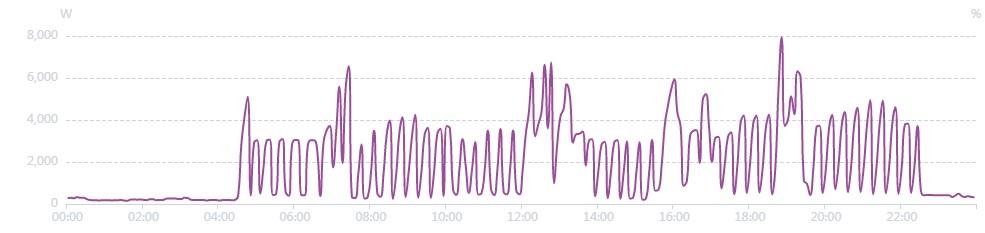
-
Under-sized vs over-sized ASHP conundrum
ReedRichards replied to muhrix's topic in Air Source Heat Pumps (ASHP)
I did not know this was unusual - I thought that is how heat pumps work best. Keeping them running when needed, allowing radiators to be like warm emitting a steady and low amount of heat. Doesn’t that apply to radiators? I was not planning on having them off over night. I assume the pump will switch off once return and flow temperatures are too close, then switch back on once the temperature has gone down and the thermostat calls for heat. Most people with radiators either switch their heating off at night or use a set-back temperature. I'm not referring specifically to ASHPs, just the generality of radiator-based heating. I have radiators with my ASHP and I set back the temperature to 17.5 C at night; it varies between 18.5 and 20.5 during the day. There are two reasons to do this: It saves money by not heating the house when you don't need the heat. It saves money by not running the heat pump (much) when the outside temperatures are lowest, which is typically overnight. If you do this, as I do, then you want to be sure you are warm enough in the morning which means that your heat pump and radiators need to have enough capacity to raise the temperature at a reasonable rate. If you have underfloor heating it responds very slowly and is best left on all the time. Some of the myths about heat pumps have arisen because they are frequently used with UFH and the requirement of the UFH is mistakenly thought to be a heat pump requirement. Also, it's unlikely your heat pump will know what room temperature you are trying to achieve and if it does know it's unlikely that it can do anything about it. This would be a control feature called "load compensation" and it is rarely found with heat pumps. -
Under-sized vs over-sized ASHP conundrum
ReedRichards replied to muhrix's topic in Air Source Heat Pumps (ASHP)
Whatever size heat pump you choose it will be oversized for most of the time because most of the time the outside temperature will be greater than the design temperature. And probably undersized for those rare days when temperatures get to seriously sub zero. On that basis I don't see that an oversized heat pump can be too terrible because they all spend most of their days being oversized. If you plan to run your radiators 24/7 then that's unusual for radiators but your choice. If they will be off some of the time (e.g. at night) then the bigger the output the faster you can increase the temperature so it might be worth boosting your radiator output to match the heat pump. -
LG Therma V mono block Air Source Heat Pump
ReedRichards replied to ProDave's topic in Air Source Heat Pumps (ASHP)
You enable heating controls on the LG controller by changing the Select Temperature Sensor parameter form Water to Air + Water, I think. -
Air source heat pump with log burner
ReedRichards replied to Nikki Locke's topic in Air Source Heat Pumps (ASHP)
The RHI rules do allow you to have a secondary heat source but it makes everything more complicated. However a log burner without a back boiler would not count as a secondary heat source so would not have any effect on your RHI. That would be far simpler to implement. It's what kept us warm during the recent power outage. At 55 C you get second degree buns after 17 seconds of exposure. -
Optimizing LG Therma V Controller settings
ReedRichards replied to Hogboon's topic in Air Source Heat Pumps (ASHP)
@Hogboon have a look at your MCS Compliance Certificate. This should tell you what leaving water temperature your system was specified to run at, what external temperature your system was deigned for, what the total calculated heat loss of your house is and other useful snippets of information. If I were you I would then forget about AI for the moment, set your leaving water temperature at the value stated on your certificate and check that you have no problem reaching your desired room temperature. Learn to walk before you try to run. -
Optimizing LG Therma V Controller settings
ReedRichards replied to Hogboon's topic in Air Source Heat Pumps (ASHP)
That's a bit easier said than done. I presume I would have to change the control settings from "Water" to "Air + Water" and set my 3rd party room thermostat to a temperature higher than I wanted so it did not interfere. Do you think this is correct and all that is required? -
Optimizing LG Therma V Controller settings
ReedRichards replied to Hogboon's topic in Air Source Heat Pumps (ASHP)
One of the annoying things about the Therma V is that it does not show the outside temperature (anywhere that I can find) so you cannot tell what the maximum Leaving Water Temperature is supposed to be in AI mode. Another annoying thing (and this may be typical of ASHPs; I don't know) is that it takes a very long time to get going, running the pump for several minutes before it gets around to switching the outdoor unit on. So once the controller demands heat you need it to keep demanding for at least 15 minutes or more even if the room temperature is fluctuating around the set point. The best way I could find to do this was to tell my controller it was running an oil boiler. More recently a Heat Pump option has appeared but it actually invokes the same settings as oil boiler.


