


Andrew
-
Posts
198 -
Joined
-
Last visited
Everything posted by Andrew
-
OP here. Thanks for the replies. I’ll get them to add the manifold pumps to the quote.
-
Just in the process of getting some UFH quotes as we'll need the pipe fairly shortly to put in the slab. I've had a couple of quotes, one of which didn't include a pump set for the manifolds. When I queried this they said that as we're using an ASHP we don't need the pump at the manifold. The other quote also knows we plan to use an ASHP and has included the pumps in the quote. The plan is to use an ASHP as the source for UFH and DHW. The UFH will be split across 3 manifolds. What's the normal way to do this - is the pump at the manifold omitted when using an ASHP?
-
I've not had PV before so didn't really know where they are normally sited. Does anyone have a picture of a non-micro inverter showing where they have mounted them? Where is it normal for them to go? I also heard on R4 at lunch time about people have trouble with pigeons nesting under the panels. Presumably this is just an issue where the panels are mounted proud of the roof? They had an enterprising pest control expert on talking about a mesh kit they do to stop the birds getting under the panels. Some companies were asking £3k to fit the mesh, I guess due to the access challenges. I'll need to do more thinking around micro / normal inverters. Thanks all.
-
Yes, we are having velux - I'll take a look, thanks.
-
Not especially, there is a neighbour's tree which will cause some minor shading at times. Main preference for micro-inverters was due to our panels being split over different sections of the main house roof and the detached garage. There seems to be an interesting debate regarding the benefits of micro-inverters vs normal inverter, the maintenance argument being quite persuasive. Is there any practical limit on how far the DC from the panels can be run? I guess we could have two 'normal' inverters, one in the house and the other in the garage. I'd need to have a look at how the cost stacks up too.
-
Thanks for the replies. I realised I've missed out a fairly crucial piece of info, sorry. We plan to use micro-inverters which I presume will be installed in the roof (in the big gap in the centre of the GSE mount), so it's the isolation of the AC output that was concerning me. Good point. I think it's probably the fear of looking stupid asking trades to do something that's not their bag (which I know I need to get over). Also I've found most of the people we've worked with so far to be really willing to help, even if it isn't their bag, but the results not always brilliant. It's so helpful to be able to sense check assumptions on here.
-
We're just about to start soliciting quotes for the roofing on our build. We are going to have solar PV on the roof of the house and the detached garage and really like the look of the in-roof systems like GSE. However there are a couple of things we're not sure on :- 1) Who is the lead trade for the installation of the GSE system. I presume the mounting system and flashing is installed by the roofers but who would normally place the panels in. Obviously an electrician is also required at this stage to wire things up? 2) With the in-roof system we'd need to install the panels earlier in the build to get the roof watertight. At this stage the grid electrical connection may not be in place and the 1st fix electrics certainly won't be done. Is this an issue - the panels will presumably generating whilst on the roof and the sun is shining - would they need to be covered up? Would be interested in anyone's experience in these areas. Many thanks, Andrew
-
You may well need a land drainage consent - https://www.devon.gov.uk/floodriskmanagement/land-drainage-consent/ We were forced to apply for one for installing a head wall into the bank of a tiny stream (ordinary watercourse) as part of discharging our drainage planning condition.
-
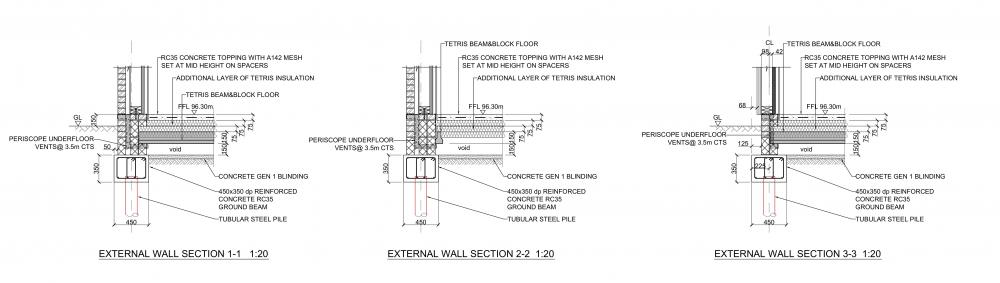
Thanks for all the helpful replies. Are there any thoughts on the thermal bridge aspect if the original details are used. The biggest concern is that the 140mm frame is sitting on 200mm wide blocks / bricks and hence there will be a section of the base which does not have insulation sitting on top??
-
These are just foundation details, but thanks for the observation.
-
I believe this is a mistake on the part of the SE. The insulation would stop at the blocks. The tetris system has closure blocks that fill the gaps between the beams and on top of this would be a block to get up to sole plate level. As it's shown in the drawing doesn't really make any sense. I've attached the standard tetris details for info - the SE has had these from the beginning. Standard frame company detail is to just have a single course of 140mm wide blocks and sit the sole plate / frame on top of that. They are used to the frame having a brick outer skin as this is how most of their projects are constructed. Concrete Options - TETRiS.pdf Construction_Details_-_TETRiS.pdf
-
Thanks, I'll take a look.
-
Interesting observation, thanks. The water table is quite high so a serious concern.
-
Thanks will take a look.
-
SE requirement based on ground conditions. I initially showed a preference for a solid floor but was told not possible.
-
Yes, I do, sorry. I meant as opposed to having a block / brick outer skin.
-
Hi, Our structural engineer has come up with the attached details for our foundations. I'm getting a bit of feedback from the contractors I'm talking to about the double block (200mm wide) arrangement that the timber frame sits on, most would prefer to change this to 140mm wide single blocks. There's also a concern from the timber frame company that the current arrangement is exposing a significant thermal bridge. For info, the frame is filled with Frametherm insulation and there is 40mm PIR on the inside face followed by VCL, 25mm service void and then plasterboard. We are using an insulated block and beam flooring system called tetris. On most elevations we are using timber cladding fixed straight onto the frame, a couple of elevations have a brick outer skin. As I see it, one challenge moving to a 140mm block is that on the elevations without the brick outer skin (e.g. Wall Section 3-3 on the attachment) the blocks will be exposed at ground level. There is the option to build a small decorative plinth or perhaps even using brick slips. Is there a standard detail for this arrangement? Any thoughts, comments appreciated. Thanks, Andrew.
-
We are in the process of discharging some of our planning conditions with a view to starting work fairly soon. However I've just seen a comment made with regards to our proposed drainage scheme (foul + surface water). Due to the constraints of the site we intend to discharge into a small stream that runs along the norther boundary of our site - both from the packaged water treatment plant and from the surface water. The discharge is via a pair of small Althon headwalls in the bank. I've been through all of the Environment Agency information and ensured that what we are proposing to do is exempt from any permit requirements. The stream runs all year round, we're not going to discharge more than 5m3 a day, etc. The comment I've just received is asking for "Confirmation of land drainage consent approval from the LLFA for the outfall connections from surface water and package treatment effluent into the watercourse." I must admit to feeling a little foolish as I though I had nailed the research in this area, but up to this point I hadn't even come across land drainage consent. It seems to be something granted by the Lead Local Flood Authority (LLFA). Some local authorities seem to have details of their website (e.g. https://www.cheshireeast.gov.uk/highways_and_roads/highway-services/flood-risk-management/requirement-for-land-drainage-consent.aspx) but our local authority don't even seem to want to admit that they are the LLFA (Cheshire West + Chester), let alone give any help. Has anyone navigated this minefield before, any tips, advice, potential gotchas that would help?
-
Brilliant thanks all. I'll mention the hex nut and show some manuals (thanks @lizzie). It's funny as I think this it's the emergency fire brigade access that has prompted this question. Of all the emergency services, I can't imagine a set of gates would keep them out for very long.
-
We are planning electric gates and an access control system. It's early days so details are sketchy at the moment but as part of our plans submission I've been asked the following from the BCO. Btw BCO is on holiday for a couple of weeks otherwise I'd ask - just trying to get answers to all the questions before her return. I've done some extensive googling around the subject but can't find anything either in terms of the requirements or solutions from the gate equipment suppliers. There does seem mention of a fire key which can be used to override the gates but this only seems to be used on much larger gated communities and such. Does anyone have any experience with this and if so, how did you provide emergency access to satisfy the BCO? Thanks.
-
I’m sure they do. Ours is hidden round the back but I do put it in the garage if we are going away. It has an alarm, which is of limited use, and a fob that can be removed to disable, although that’s mainly for safety. If they knew it was there, there would be nothing to stop someone nicking ours whilst we were out.
-
Our Robomow Rx20u (£450) is cutting the grass of our rental as I sit inside and type this. I hate gardening with a passion which is why I bought it. I set it off manually a couple of times a week as it doesn’t have a rain sensor like the big expensive ones. Lawn is about 250 m2 and has a very complex edge pattern. In terms of the cut it does miss the edges which is not ideal. I bought a cheap Makita strimmer which uses drill batteries and it takes me about 15mins once a month in summer to do the edges. Shame you can’t use a strimmer - edging shears would take ages. However, you could let the robot mower do the majority of the lawn and then just run the mower round the edges once a month. Should say also you’re not going to get stripes with a robot. I believe most of them just make random passes across the lawn like mine rather than an up / down pattern you would make with a mower. I love mine as it saves me from doing one of the jobs I most hate, money well spent.
-
That's for 220mm diameter bottom-driven steel cased cast insitu reinforced concrete piles driven to an assumed depth not exceeding 6.0 linear meters. The price was for 33 piles @ £7722 plus £900 mobilisation, so that's £261 per pile all in. I've actually since had a cheaper quote, to the same pile specification, of £130.00 per pile up to 4m with £30 per meter per pile add-on for additional required depth. Mobilisation costs are £1200 with this one, so if we needed to go down to 6m that would be £226 per pile all in. There was no mention of pre-augering in the quotes I received - don't know if that's implied or unnecessary. Our ground is definitely not firm / stiff. My structural engineer has taken it upon himself to re-engineer the entire piling layout for 150mm piles so I'll be gathering some quotes for those soon. I did find a great variety in the quotes I received, the highest being about £600 per pile.
-
They will come and inspect as the build goes. I'd suggest looking at one that does building control in tandem as in theory they should be able to co-ordinate inspections for both functions. I've just got some pretty competitive quotes from Protek for combined warranty and building control - http://www.protekselfbuild.co.uk.
-
Unfortunately I can't offer any experience or advice on the defects, but I can agree that I think you're right to be unhappy with them. I'd certainly not be willing to accept that as normal, especially given the price of windows.


