WWilts
-
Posts
782 -
Joined
-
Last visited
Everything posted by WWilts
-
Limestone spoil has some sandy soil in it (negligible clay). Meant to hold up 100mm slab. Some compaction of the limestone done. How to test if compaction was sufficient? Tried hammering in two improvised penetrometers: a) 4mm diameter metal b) 45mm square wood. Quite different results. What test would be sensible? PS Does the surface need to be near-level before the slab is poured?

-
"TD Silent" extractor fan on kitchen wall seems to be a reasonably good, quiet backup. Backup to a downward draft (recirculation) extractor on kitchen island. Anybody used a TD Silent extractor fan?
-
Kitchen on ground floor. Assuming that recirculation extractor will have limited extraction capability, how would one allow for stronger extraction as a backup?
-
Hoping to achieve externally mounted motor (less noisy), and discharge of extract to exterior. But not sure where to put ducts and what ducts (& whether underslab or not)
-
What do people do for downward extractor, 1) to duct the fumes to the exterior 2) to house the motor externally Trying to picture what ducts need to be put in at foundation masonry stage

-
Thanks, sent email with para 2.24 and diagram 7b of BR, AND mentioned the logic plus advice from "people who know". Incl suggestions re Hardieback board & Illbruck foam. Upon his head it is now
-
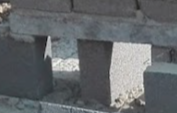
Thanks. 120mm width of opening where 110mm drain will pass under lintel from underslab to exterior, while resting on/just above concrete footing. Footing continues horizontally for 600mm external to wall. I suppose there will be a channel drilled into the concrete footing to form a haunch for the drain. Still a risk of movement/pipe breakage? If so, can make an issue of it Measured the openings under lintel, on either side of the partition wall. Left side 140mm, right side 170mm. 210mm would meet BR
-
Probably best to send the builder the BR text and diagram and leave it to him to decide next steps. Done that
-
Thanks. To push or not to push the builder re enlarging the space around pipe. Main consideration is whether the drains will function properly despite the narrower gap
-
Trying to assess how hard to push the builder. Lintelled opening 120mm for 110mm drain. In other respects good builder, but is resistant to redoing the opening. No backfill around foundation masonry there, yet.
-
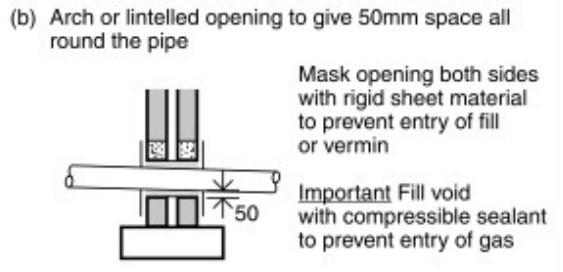
How important is the BR 50mm gap all around the drain where it goes through a wall? Is anything less than 50mm seriously unsatisfactory for us to live in? BR approved doc H 2.24, diagram 7b
-
Digging a deep trench and purchasing approx 16m barrier pipe likely to add £1k to cost compared to shalloduct. Shalloduct claim that water authorities accept it. Perhaps that claim is exaggerated. Water on site already, near footprint. Taking it into the house is hopefully up to us.
-
Longest underslab drain approx 11.25m Not too difficult to set its origin in the wall a bit lower than the existing. The exit from the opposite end of the footprint can be lowered by cutting concrete as suggested. Shalloduct is reputed to allow less than 750mm depth for water pipe https://www.bes.co.uk/shalloduct-water-service-pipe-insulation-835-x-32mm-19170/?gclid=Cj0KCQjw1dGJBhD4ARIsANb6OdmKISJLneP8bQfbEhDyABYg_nZDqb-ZvNFO6S_2zzFnjUNXHelrD4MaAjQjEALw_wcB
-
Cutting concrete for drains makes sense. 2 courses of concrete block (3 for inner) put in already around most of the perimeter. Conduit under concrete already in place for mains water, but that involves a circuitous route. Considering shalloduct and bringing the water in nearer where the services reach the footprint.
-
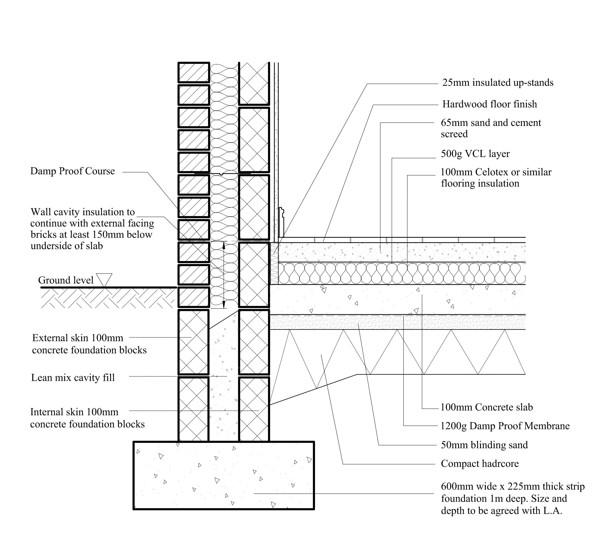
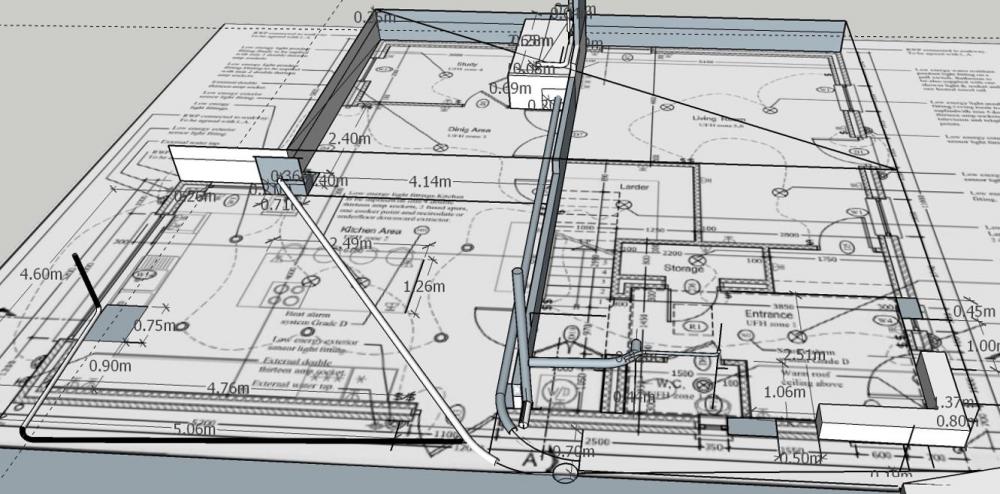
Just at the stage of foundation masonry being laid atop trench fill footings, with lintels in the cavity wall to allow drains to pass under slab. Not too late. It may be that the trench fill came up too high, relative to the permitted finished floor level (long story). Will know for certain by measuring level difference from a survey AOD reference point that has just been discovered. Not certain that the permitted ffl will require any lowering, but looking for ideas just in case. If & when there is a need to lower the ffl, what is the simplest way to do it? Would be good to keep a 1 in 40 drainage fall across 11 m width of footprint. Thickness from underslab sand blinding to flooring top surface is 317mm. Includes 50mm sand blinding at bottom and 65mm screed with under floor heating. Perhaps a channel could be drilled in the margin of the (deep) concrete footing to form a haunch for the lowest part of the drain? Alternatively, if the difference is small, perhaps switch to 40mm liquid screed that can take underfloor heating. And switch from 50mm sand blinding to 30mm?
-
Your proposed details might be rejected, and something quite different required. (Most planners have bigger decisions to worry about, too busy to go into these details.) If you have spent money installing the rejected details, Enforcement might make you undo the work and follow the new details. That is the worst case scenario. The more likely scenario will be that the planner spends a few mins (between big jobs) looking over your details. Approving them, with caveats where necessary. If they find something seriously objectionable they will let you know.
-
Keep the planner "warm" by saying how prices are escalating and you want to still deliver the dwelling to add to the local housing stock. Offer to be as helpful as possible, inviting any requests for clarification or information. You are Mr. Helpful. Then 4 weeks after your submission of details do something similar. 6 weeks after your submission send a "Deemed Discharge" notice using the prescribed format. Confirm that you have not appealed. Planner will have 2 weeks in which to respond failing which you will get "Deemed Discharge" automatically. Most planners will ensure that they respond before that happens. Make it easy for them to approve. Provide plenty of convincing info in your submission. Has been known to work.
-
Partition walls (not load bearing), ground floor. Option to mount TV, shelving etc desirable. Good acoustic separation needed. Options 1. Concrete blocks + plaster 12.5 mm both sides (concrete footings in place already but foundation masonry not yet built). Paint finish 2. Metal stud walls with Habito boards, paint finish. Above slab (or above screed with UFH?). 3. Timber stud walls with noggins or OSB3 for fixing stuff, plasterboard, skim, paint finish. Above slab (or above screed with UFH?) Most cost effective approach wins, but which option is it?
-
3mm foam? Not familiar with that idea
-
Accredited details used for SAP calculations.
-
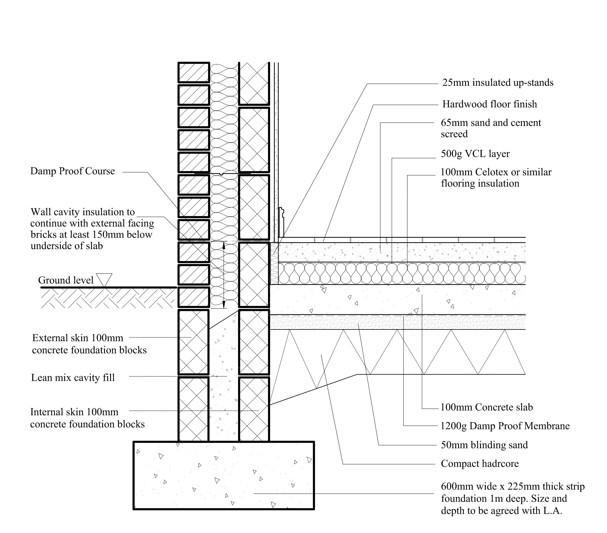
Thanks. What would be the U value difference for the perimeter upstand + inner leaf only please, aircrete vs concrete? Probably a negligible point, but interesting to nerds like me. The mortar of the inner leaf probably offends as much as anything else.
-
Thanks, great advice. Would increasing the overslab insulation from 100mm to 150mm (Celotex lambda 0.022) be a cost-effective option? Need to watch the budget. Noticed that heat escapes downwards through the inner leaf. Does Passiv standard recommend insulation horizontally to reduce that? Probably trivial loss in the larger scheme of things. Also, does anybody add internal insulation just above the usable wall area only?
-
Noted, tks. Not Passiv standards. Ground floor UFH, very unlikely to have carpets. Does the concern about 50mm perimeter upstand remain? EPS is said to be more compressible than PIR, allowing the screed to expand/contract.
-
Agreed solution. 50mm thick upstand, and for pragmatic reasons (materials onsite already) to continue with 7N concrete blocks for third course above footings. Point about underfloor heating leaking into cavity accepted. Aircrete is said to suck in moisture too, so concrete below damp proof course is preferred by builder.
-
Yes, 25mm