


WWilts
-
Posts
782 -
Joined
-
Last visited
Everything posted by WWilts
-
Does underslab water main still need to be 750mm deep?
-
Experienced groundworks subbie proposes water main entry point. (pics of ground floor, first floor, and both approx superimposed) Barrier pipe required if going under permeable driveway. Where would you put the entry point? My instinct was nearer the existing standpipe.
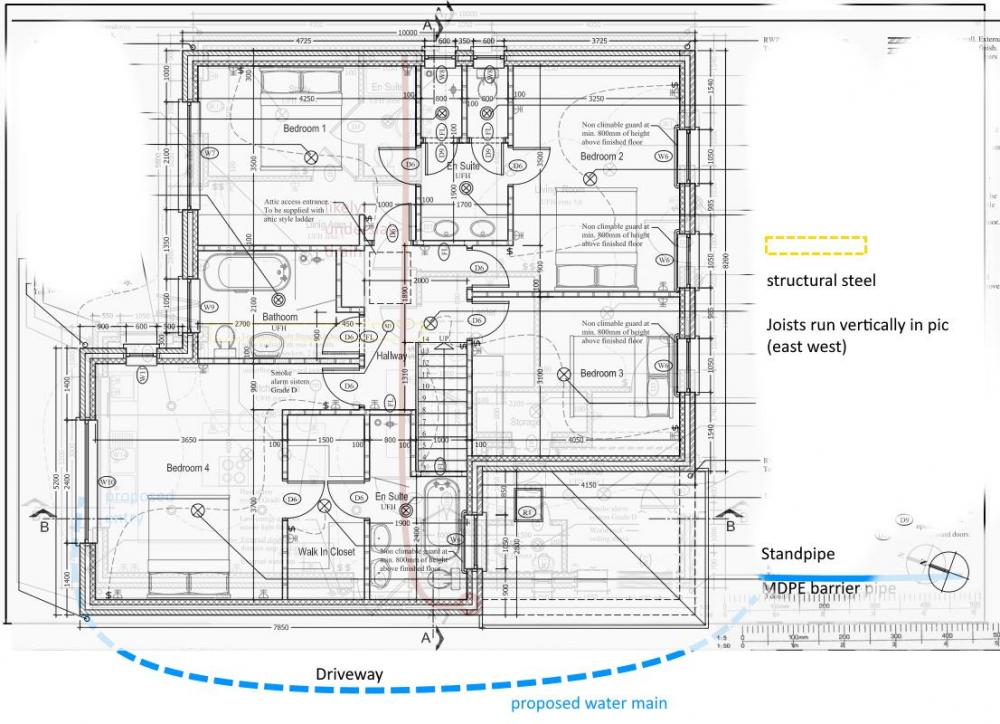
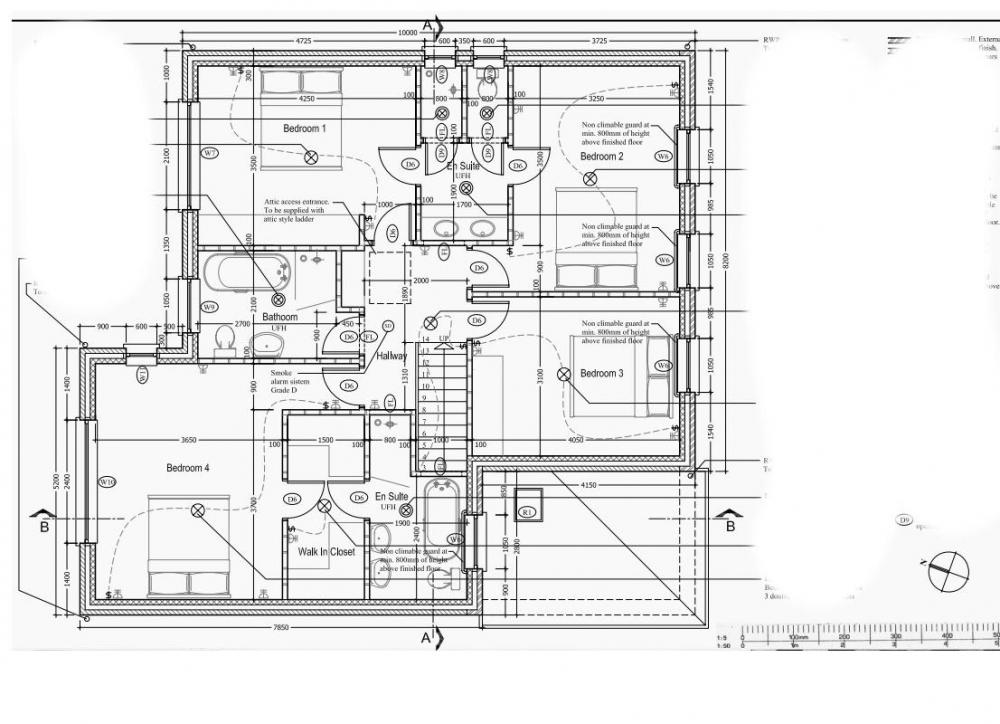
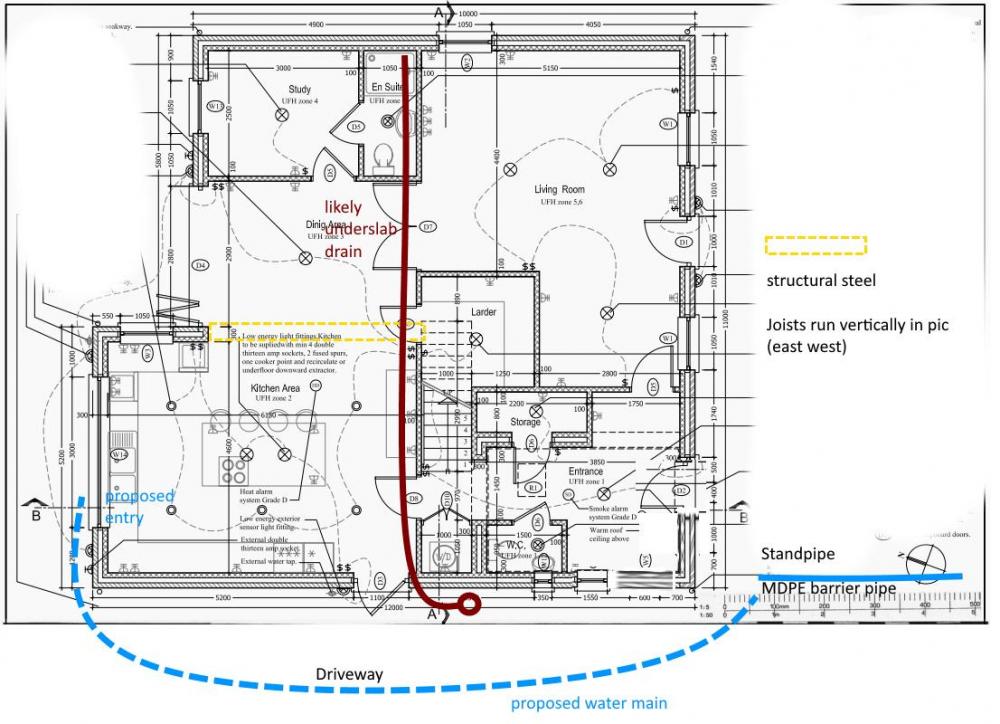
-
Apologies for the confusion. Those were minus signs not hyphens. The house is lower than the manhole invert, not higher. Hence gravity drain ruled out.
-
Came across Strate pumps, seems good technology for pumping sewage. Can be installed indoors or outdoors. But does not have a huge effluent chamber. Anyone used one of these on a new build? Can it pass Building Regs without a huge effluent chamber?
-
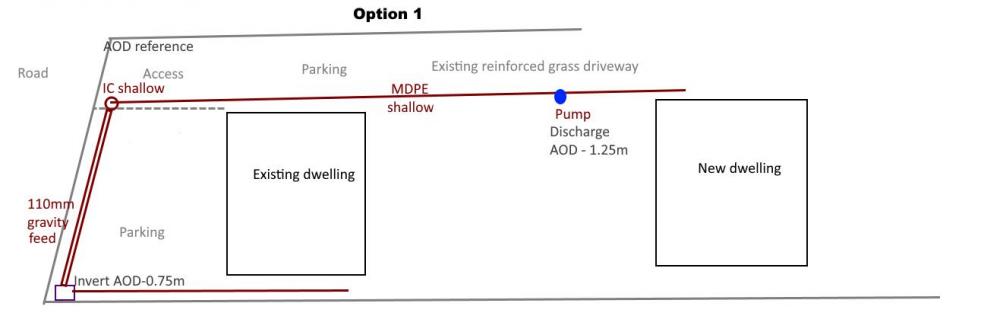
Thanks, understood. Will installation of curved MDPE be quite difficult? Agree that the opportunity to rod both directions (no curve in MDPE) is attractive.
-
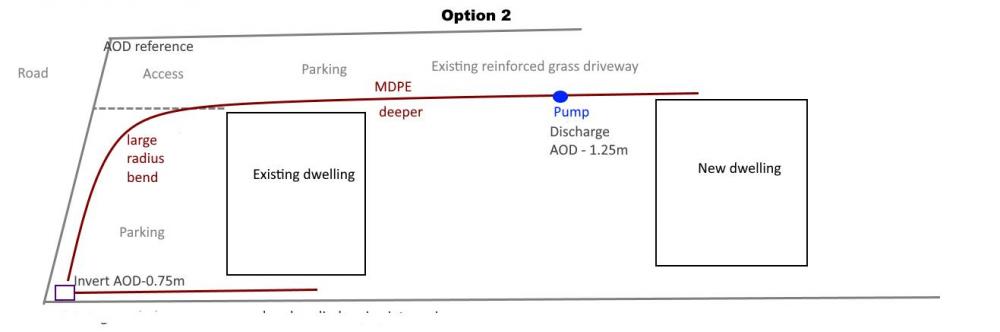
Just to make sure you mean option 2, it is the one where the MDPE has a large radius bend. Either option will include a chamber.
-
Yes, apologies. AOD reference level in this case is over 40m above AOD. So I should not have introduced this confusion
-
Yes, pump discharge level will be approx 0.5m BELOW the inlet of the inspection chamber
-
For avoidance of doubt, this is foul drainage (sewage). The existing manhole is likely to have a catchpit. Brick and concrete construction (over 100 years old). Not broken into yet. But upstream IC is brick with concrete bench discharging into concrete-embedded pipe (probably clay). Good point. Maximum pumping head (level difference) would never exceed 2m. MDPE length from pump to existing manhole would be less than 50m. Pump with 5m head might suffice. Tempted to put the pumping chamber nearer the new dwelling, would increase the MDPE distance by 10m and reduce the force of flow a little bit.
-
Would this variation on option 2 work? Inspection chamber to break the velocity before discharge into the existing manhole. The force of the pump discharge suggests that a large radius bend in the MDPE is not fatal.
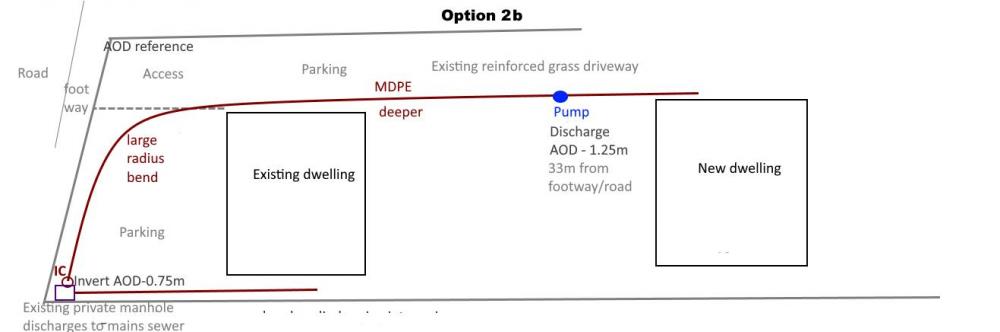
-
Which option would you choose, and why? Is Option 2 workable at all?
-
SW England. Mild climate, relatively. Not understood your meaning fully. Thermal bridge owing to exit of soil pipe is understood. Cold air rising in the building not understood. Decision is internal soil stack vs external. Termination through roof might occur with internal stack, although external rodding point with a branch to external vent pipe could help overcome this issue. External vent pipe if needing to be tall can go around the eaves, which project about 400mm or less from the wall face. Interested to understand the meaning so that it can be factored into the decision.
-
This was what the builder fears
-
https://www.netweather.tv/weather-forecasts/uk/winter/winter-history https://en.wikipedia.org/wiki/1981–82_United_Kingdom_cold_wave Perhaps something in the drains contributed, together with the temperature. Enough to make me rethink external soil stack. Still ruminating.
-
For various reasons including cost-effectiveness, an external soil stack & vent is preferred on a private elevation of the house. Builder fears the external stack might freeze. Might it really?
-
Comforting to hear that these are known to work well. What diameter of discharge pipe does yours use? 63mm or 90mm? It seems that enlarging the discharge pipe diameter beyond a point can be counter-productive
-
Looked into this. Apparently it is the non return check valve closing loudly. There are soft close versions available, it appears. Hope to find a reliable one.
-
How noisy / smelly would a domestic sewage pumping station be, serving one 4 bed house? Trying to locate it wisely.
-
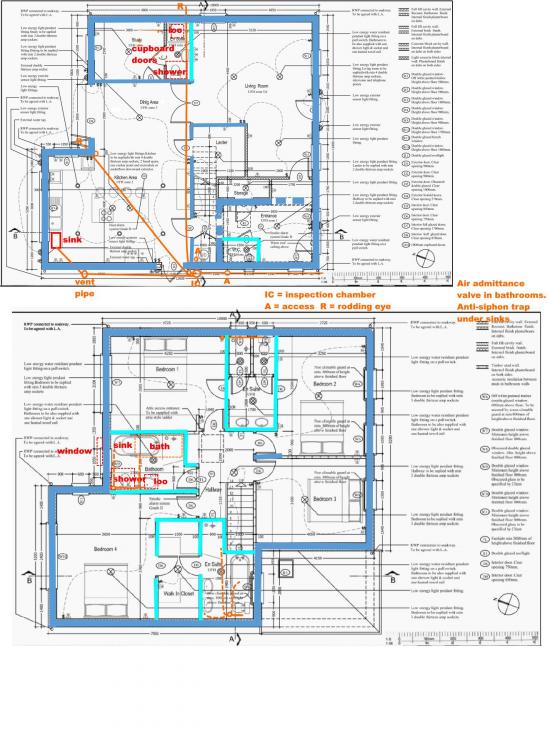
Soil vent pipe open to atmosphere - can it be come off the rodding eye at top (east)? Instead of the position shown on the pic. Underslab drainage: bed and bench in pea gravel, with compressible material on top, then concrete (where there is space beneath the ground floor slab). PS South (right) is the front elevation. East (top) elevation is relatively private and screened. There is a blank wall (no windows/doors) on the north (left) half of the east (top) wall. Pumping station likely to be near SW corner (bottom right). About 1200 ltr capacity tank with one (or perhaps twin) pump. Other comments/suggestions on the foul drainage are also welcome.
-
Hi @ProDave & other gurus Would ducting/trench be useful to run the SWA from 3 phase board to house? Sewage pump too will now be positioned near house. Currently there is an open trench and (separately) quite a bit of 100mm electrical ducting lying unused although paid for already. Ducting in trench currently extends from footpath to meter box kiosk only. The trench then continues on to near the house, carrying water barrier pipe / gas pipe / ducting for eventual telecoms or fibre cable / one spare duct.
-
Local aggregates supplier advised 40mm scalpings. Probably will go with that, unless there is a reason to avoid it.
-
Gas (non-ducted, builder says the gas connection people are happy for him to lay the gas pipe and without ducting) Electricity 3 phase 46kVA, ducted Telecom duct with drawstring (for future use) Spare duct with drawstring Is type 1 more cost-effective than either scalpings or type 3 MOT?
-
Planning trench for water about 900mm deep. About 600mm wide to take other services too. Trench runs along reinforced grass driveway that reputedly will suffice for heavy lorries too. Soil has about 300 mm topsoil, then rubble limestone for about 700mm, then bedrock. What backfill layers would work, to allow lorries to occasionally stray off the driveway onto the trench/verge? The concern is that the trench might simply slump. The other concern is cost of backfill. 37m trench length. Presumably water pipe will sit in sand, with 75mm cover of sand. The best idea I have had so far is strip the top soil first and pile it somewhere on site. Then use the rubble rock to backfill above the sand, topped by MOT type 3 or scalpings. Thin layer of decorative gravel. Ideas welcome, for a cost-effective approach.
-
Good point. Checked. Packaged pumping station allowed even inside building, according to BR (doc H) Good thinking. Will go for the near-foundation shallower option and see if we can find a pump with discharge outlet that takes 90mm MDPE.
-
Need an approx 1000 litre sewage pump. Chamber 1.5m deep, 1m wide approx. Invert for inlet approx 0.5m from top of chamber. Bedrock (limestone) at 1 m depth approx. Where do you think we should site the pumping chamber, encased in concrete? a) right where the foul drainage emerges from the footprint (shallower depth, very near foundations, with longer discharge pipe 63mm MDPE in pea gravel - about 40 m) b) some distance from the house, eg 5m away (deeper installation, shorter discharge pipe about 35 m) Pump malfunction is a consideration (stench). But also depth of installation.


