SimonD
-
Posts
1941 -
Joined
-
Last visited
-
Days Won
10
Everything posted by SimonD
-
You'll be surprised how even the smallest drip will cause pressure loss in a sealed system. Given it's a new system, this could be in any multitude of places which you can very carefully inspect. The other option is to pour some CT1 miracle seal into the empty radiator before you re-pressurise next time. Then see if it solves the problem.
-
Absolutely. At my recent pre-plaster inspection, the BCO commented on the high standard of workmanship and detailing on my build and said it was a breath of fresh air. He said I should have seen some of the developer and contractor stuff he'd been inspecting earlier - which was along the lines of a dogs dinner, the lot of it.
-
Now that's a sublime piece of carpentry there! 😁
-
This is why self-builders always move onto another build...eventually...even when they say they won't 😉 Just watch it, you've started down the slippery slope. Next it'll be a two-bed tree house in the forest somewhere and then before you know it,it's another passivhaus 😁
-
First, I think you need to go back to your Gas Safe Registered person and question why they've failed it because of this reading. Whilst the regs state a theoretically acceptable limit of a design pressure loss of 1mbar this can not be guarenteed in practice so in and of itself it is not sufficient grounds to fail a safety inspection on existing pipework. The important figure is the minimum required inlet pressure specificied by the boiler manufacturer, which is given within the MIs. With 18.87, you are nowhere near the minimum which with some boilers can be as little as 13mbar and with others around the 16.5 mbar mark. The only times a boiler is deemed to be unsafe is if the gas pressure has been proved to affect the safe operation of the appliance. Refer your Gas Safe person to IGEM-G-11 which they should know and have available on site. And finally, with such a specific measurement, the person has used a digital guage. They're know to be very sensitive,going up and down and under test conditions a varation of 0.25mbar is consider to be no perceptable movement so your measurements are so close to 19mbar anyway, they're not an issue at all. With the information you've given me, you don't need to incur any costs at all for pipework! Get a new Gas Safe registerered person who knows what they're doing. And yes, I'm Gas Safe Registered.
-
Hmmm, what does this place do to me? I'm going to take some images with my thermal imaging camera to see what's going on with our pans.
-
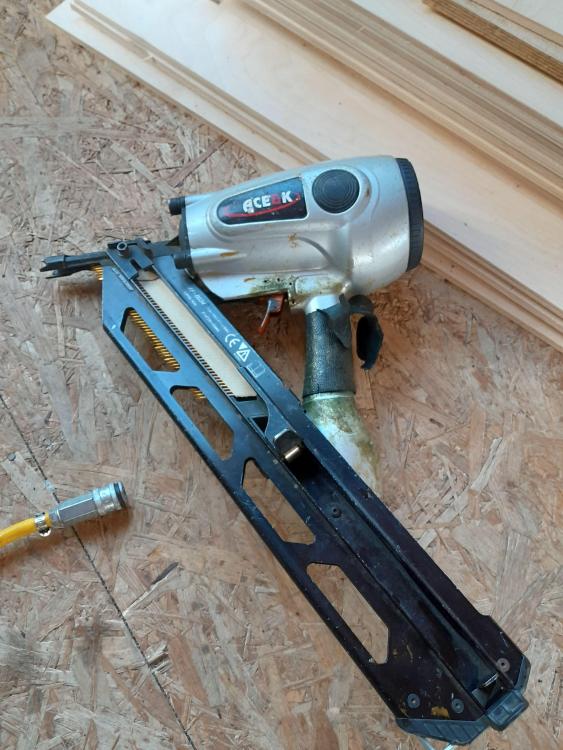
My absolute favourite tool of the build, one of a growing collection. Does everything from 90mm ring shank framing nails to full head stainless for cladding. Still need a hammer, mind you.:
-
Yes, absolutely agree. My point wasn't that one was better than the other. I followed the specification of my SE, who is a specialist in timber frame buildings, and especially glulam/steel hybrids, which is what we've got for our main structure. My main point was that despite the SE report, specifications and design, BCO still asked for bolts, which in my view is not correct but seems like an argument I could simply not get into because I had so many other things to contend with. However, organisations like NHBC allow for nailing or bolting, for example, and don't make any distinction between those differences other than to say the design should be followed. To me it's a bit like the debate between using screws to assemble a timber frame. I've seen builders locally ignore the design documents suggesting that screws are better than nails. Two carpenter/builders I spoke to about our project said they didn't nail (because that's old school apparently) but would screw it all together using 'high' quality Spax......
-
I don't think the distinction is in whether the pan is 'heavy bottomed' or not, but I do think it depends on the materials used to make the pan itself. We have a load of different pans ranging from very expensive stainless steel to cheap stainless steel with very thin bottom. Apart from one stainless steel pan that doesn't work at all, they all work very well on our induction hob. However, during our build we got a really cheap milk pan that was supposed to be induction suitable and it always throws up errors on the induction hod - it just doesn't like the pan. Looking at the pan, it appears that it is actually some aluminium alloy with some steel bits added to the bottom to make it induction suitable. I have recently dug out one of my proper carbon steel woks I used to use all the time, obviously designed for gas, and although it doesn't get the all round heat distribution up the sides,it actually works surprisingly well on the induction. So I think you just need to be careful about the material of the pans themselves.
-
You need something like these: https://www.ebay.co.uk/itm/173392601070?itmmeta=01HVPAS3JSCEQWW0W4N0S9MHA6&hash=item285f011fee:g:GZIAAOSw3iBbPIJ5&itmprp=enc%3AAQAJAAAA4Oi4iRCxolWsvQjUCvlAxPDUyJ3HyTZxdFxpdhyaGrAoHs2BVbE2YCn2QThLokXYEC63iTcC2vWnVJ6Z8c8XtTUQEpqojWLMkSweP4%2FWbGHz44bDxv0OzcpSHtlqM4LBJwbwFw5d7WIjF09hFcNMcxUImF3DCgqB2HPJ4i81AFdK8KSnbCX61prd6h70SYCFCD5%2BOz74t6WMDk0MpXif7XU0G2RfMLpHXxANb93zMKvw61hBHQcXspoZeXpAcf6%2FsvFLJ68Ka0ndH8XJaYzS%2FiNlk2S64HTwIa9kYkG4Zm9%2B|tkp%3ABk9SR9q55MrdYw Problem is you're like to lose the will trying to find the right size that fits yours.
-
Every hire company I've dealt with will either insist on seeing an insurance certificate to cover plant hire before opening an account and check that it has enough cover for the plant being hired, or they will offer you insurance, which will cost you. It would be pretty stupid for a hire company not to ask for proof of insurance in this business - one company i have an account with insisted on speaking to the insurers directly even after seeing the insurance certificate because they've been conned before. Question is whether you want to take on the risk of a piece of machinery worth at least £50k and any damage it could cause?
-
Interestingly our SE specified screws for all multi-ply members: "Screw together with 5mm dia screws at 200 mm centres, staggered top and bottom with 50 mm edge distance" I have to say I preferred the screwing method. BCO however, asked me to put bolts through the stair trimmers, probably because that's what he liked to see, so I now have both 🤷♂️
-
There will be quite a lot of input on this coming shortly, but first question is how big is the single room where you want ufh? Second question is how big is your boiler?
-
My Heat Pump Experience 2022-2024
SimonD replied to Green Power's topic in Air Source Heat Pumps (ASHP)
Yes, I think it must depend on a certain amount of qualifications but with a caveat that someone without the qualifications can still achieve it through professional practise development, which would be demonstrable in some way. I also think that any academic qualification has to be balanced by practical too. It's still a shame that someone who's completed an HNC followed by an HND is often still seen as inferior to someone having completed a degree, although I'm not sure if I think an HNC on its own is enough for engineer status without further experience. I don't think an HNC would be anywhere close, but degree equivalent being the minimum. I think in some countries they count study credits at graduate level. -
My Heat Pump Experience 2022-2024
SimonD replied to Green Power's topic in Air Source Heat Pumps (ASHP)
Yes, but to play devil's advocate, what constitutes understanding at a fundamental level? I know from when I was designing exhaust systems, fundamental understanding didn't exist due to the complexities of the situation and therefore intuitive understanding still played a significant role in design even when using available tools. It's similar to the understanding of finishes and clearances - when designing new things it's common not to know the required parameters which means experimentation and inquiry, and this process can often lead to a rethinking of the how and why. It just depends on the domain really but sometimes engineering is also about making something work without the understanding, initially at least. Blindly following a manual, instructions or a drawing is not really engineering, I agree. -
My Heat Pump Experience 2022-2024
SimonD replied to Green Power's topic in Air Source Heat Pumps (ASHP)
I think we've developed too much of a bias about degrees and the value they actually bring. I've met plenty of non-degree, non-formally trained engineers that will blow the socks of many engineering degree holders in both theoretical and practical knowledge. I also think we've developed a problematic prejudice towards manual work versus the degree holder. I hold a Master's degree, I studied aerospace engineering at degree level (but changed course during the degree as I got bored with the extent of mathematical modelling in front of computers) and then also studied acoustics, thermodynamics and fluid dynamics during a period where I designed exhaust systems. Now I am a heating 'engineer' installing heating systems, gas boilers, doing reparis and servicing part time - I actually find quite a lot of it very rewarding. Now, with all that being said, I do have an issue with the level of training and certification in the heating industry - I think it's appalling. But the problem with that is that is turns from protect to protectionism which becomes counterproductive. There would need to be some careful definition of what engineer actually meant and recognise various routes that can be taken to achieve this. Am I an engineer if I can take a lump of metal and form it to become a useful component part of a machine, whether as repair or new design, or am I an engineer only if I can sit in front of a cad/cam and produce design drawings along with some calculations? -
I don't think that's an airtightness product. I wonder whether the installers confuse thermal insulation with airtightness.
-
I use the Soudal SWS stuff specifically designed for windows & doors - https://www.soudal.co.uk/pro/products/expanding-foam/1k-pu-foams/soudafoam-gun-win-door-sws#v11114 But 4cm does seem like a pretty excessive gap - what is the gap at the top?
-
It's far easier to build a second wall with studs offset than it is to counter batten as you've suggested. Why was the wall not fully designed for this before the build?
-
why not just build a second internal stud wall using 38 x 140 studs? Job done.
-
Boiler control using the Drayton Wiser and opentherm.
SimonD replied to chris_x's topic in Boilers & Hot Water Tanks
https://support.wundasmart.com/en/question,64/open-therm -
Using a diamond core drill. any advice?
SimonD replied to saveasteading's topic in Tools & Equipment
I do 127mm cores fairly often, but by hand and without a rig. Just be patient, and like with metal, run the drill at a slow speed and let the diamonds do the cutting. Depending on how thick the slab is, bring the bit out every now and again to clear the dust. Just double check if the bits you're supplied with the drill or which you buy yourself are for wet, dry or suitable for either. I buy the Marcrist ones and they last pretty well. Oh, and make sure your unit has a good clutch! -
boiler behaviour,please let me know your thoughts.
SimonD replied to Post and beam's topic in Boilers & Hot Water Tanks
I was wondering about this. These boilers have the horrible drum hex with the high temp limit sensor at the back of the top of the hex. The flow sensor is separate on the flow pipe behind/next to the fan assembly. There could easily be a significant difference between these. But to me it seems odd that the error being thrown is essentially a 'no flow' condition rather than low flow. Technically, the boiler shouldn't need an external bypass, but there is no mention of internal bypass built into this boiler. I also wonder about whether the no flow situation might happen as the boiler switches over to DHW and this throws the sensor due to a brief moment of poor timing with the burner/diverter/pump and resultant flow velocity? However, the blocking fault should automatically clear as soon as dhw flow happens and the flow temp reduces, which clearly doesn't happen and the result is cold shower.. So back to either a design or component fault I suppose as whatever causes the fault, it should clear itself.. -
Yes, very high risk of someone putting a foot down there. Work should be suspended immediately! This I agree with. The standards on quickstage scaffolding are far too well design to shimmy up them instead of using ladders 😁
-
boiler behaviour,please let me know your thoughts.
SimonD replied to Post and beam's topic in Boilers & Hot Water Tanks
With the EPH controls you don't need to change your valves as it's managed through the controller wiring. So the 2 normally closed valves stay in place. Not on its own it doesn't. It needs the option diverter kit which has the dhw cylinder sensor - this is what gives you 2 flow temps, but for boiler modulation you then need the Easy control or weather comp.