Adsibob
-
Posts
3604 -
Joined
-
Last visited
-
Days Won
10
Everything posted by Adsibob
-
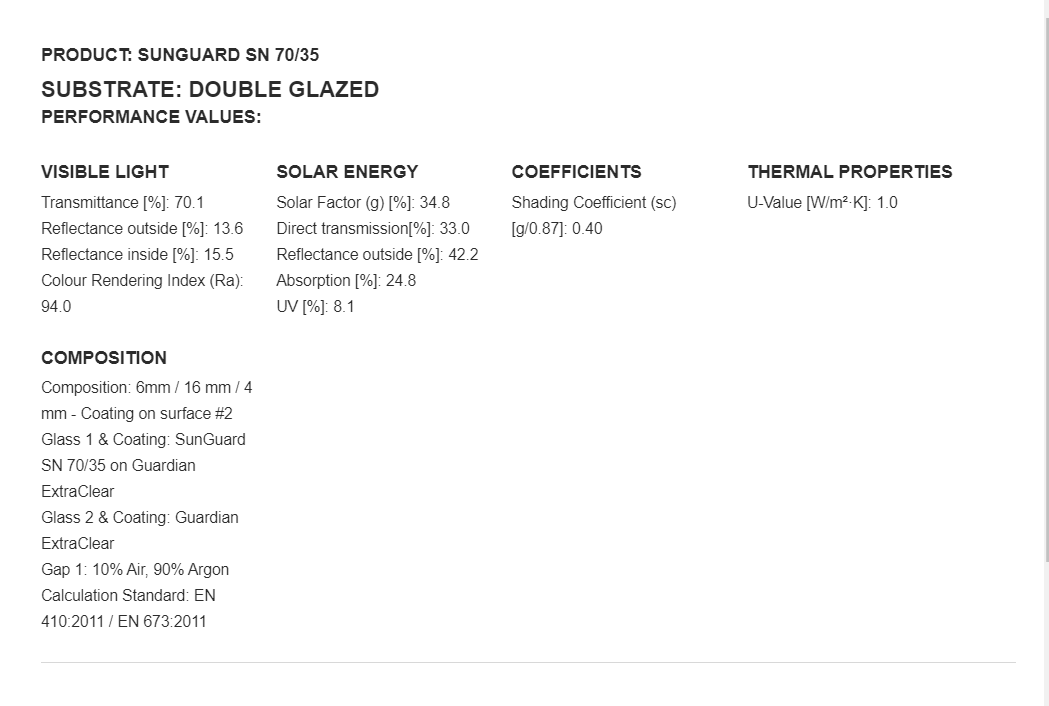
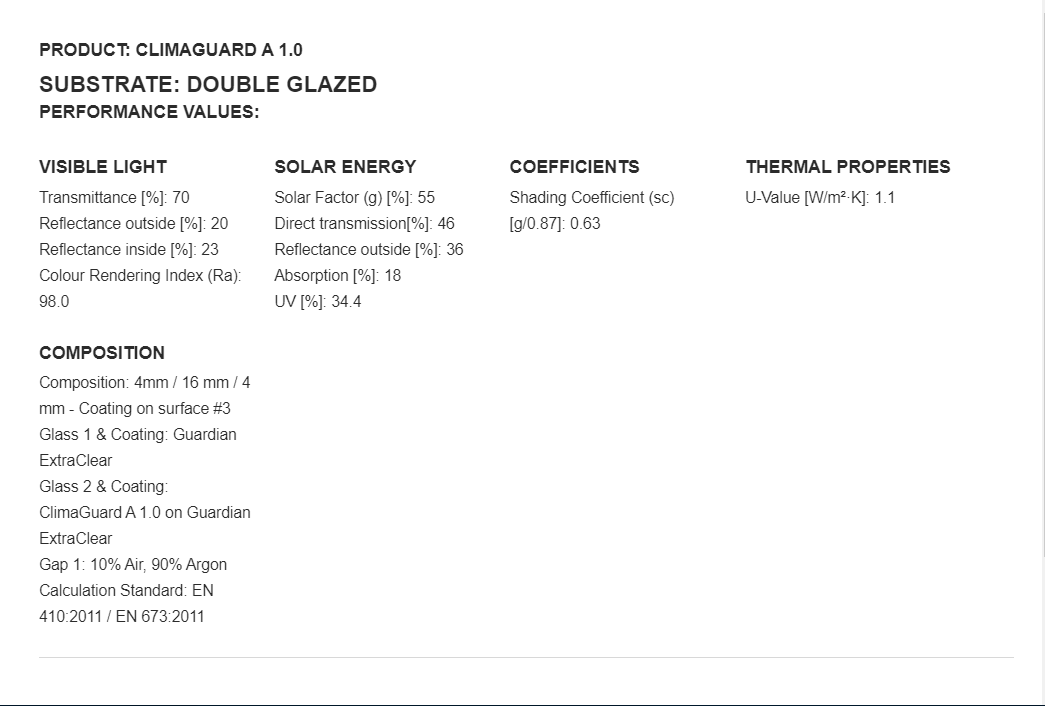
@Dan F this is helpful thanks. The supplier of some other windows, all double glazed (rear elevation at first and second floor, all west facing) is offering Sunguard SN 70/35 which he tells me comes with a coloured tint. I attach the specs, which if I am reading correctly show the g value of this glass is 0.348 which is between the 0.36g and 0.32g figure that Saint Gobain offers in the link you provided above. What is a little concerning, is that it looks like with the Saint Gobain one would have 84% of light if one when with their 0.36g glass, whereas with the Sunguard SN 70/35 transmittance is 70%. That strikes me as quite a difference, or am I focusing too much on this? The Sunguard SN 70/35 also has a slightly better U value at 1.0 vs the 1.1 of their standard glass option which is Climaguard A 1.0. The coloured tint is probably more of an issue for me. The colour rendering index of the SN 70/35 is stated as 94.0, vs their standard (Climaguard A 1.0) which has a colour rendering index of 98.0 with a g value of 0.55. Interestingly the transmittance is the same, at 70%. I attach the Climaguard A 1.0 spec as well. This supplier seems fairly flexible and has said there is no additional charge for switching from Climaguard A 1.0 to Sunguard SN 70/35, but that if I wanted something else there would be. He's also offered to bring samples of both Climaguard A 1.0 and Sunguard SN 70/35 when he does the survey, but this would be after i sign a contract and pay a deposit. I googled colour rendering index to see if I could see online the difference between 94 and 98, but clearly that would be testing the possibilities of remote learning beyond the possible. I couldn't find much other than to suggest that with both close to 100, they would produce quite close representations of the actual colours seen through the glass, with 98 obviously being more accurate, although if the rendering scale is logarithmic, then a 4 point difference could be quite massive If anyone has experience of this and can help me solve the conundrum before I have to sign the contract, that would be much appreciated!
-
Do you happen to know the building regs rules as to when you need a rooflight to be top hung to provide for a means of escape? I'm due to order my roof lights in the next week and hadn't factored this in at all.
-
With the pandemic (and possibly Brexit... not sure how much of a factor that is right now in the rooflight industry) I'm finding some companies are taking longer to supply rooflights than normal, which is obviously fair enough. Can anyone give me any tips on which suppliers I should get my veluxes from: I've been in touch with Velux direct, but they've been a bit slow. Some stuff on roofing superstore says "est. delivery 15-20 working days" but not sure how reliable that is given it's just an estimate. Sterling Build says "up to 12 working days" which is at least a bit more finite, though their price is a bit more expensive. Yard Direct says 4 working days for most products, but it's also a bit more expensive. Also, does it matter where I buy from to get the Velux reward vouchers?
-
 The problem with their modelling is that it is fundamentally flawed, in two ways: First, their website states that their model assumes people will moved every 20 years. That is accurate when looked at restrospectively, but as one of the points of this tax reform is to increase mobility, using retrospective data for this makes no sense. Secondly, the website assumes that removing SDLT will make property more affordable. That makes no sense in a market where property prices are dictated by insufficient supply to meet demand. Prices are established at the price that the competitive process results in. If people aren't being taxed SDLT, they will have more available cash for their purchase and the price will therefore be established at a higher price than before. That's why historically any good mortgage broker will make sure his client is factoring in SDLT before answering the question most people ask their broker "how much can I afford to borrow", simply because that depends on affordability, which depends on borrowing cost, which depends on LTV ratio, etc.
 -
MVHR and open fireplace
Adsibob replied to Ronan 1's topic in Mechanical Ventilation with Heat Recovery (MVHR)
Thanks @Bitpipe. Would you mind me asking which Miele / Siemens appliances you have? Architect suggested the same, but at least in the Bosch range there wasn't more than two or three decibels between the noisiest and the loudest. -
MVHR and open fireplace
Adsibob replied to Ronan 1's topic in Mechanical Ventilation with Heat Recovery (MVHR)
Just trying to understand how this would work with Building Control. Presumably, if my way of avoiding the requirement to have trickle vents on all new windows (distinct from replacement windows) is to say: well i don't need trickle vents because I've got MVHR, then the Building Regs inspector will want to see that the MVHR complies with Regs. In that case, wouldn't he fail me if it the door to the utility doesn't have the necessary gap and, worse still, has the additional door sealer? I guess I could postpone the installation of the door sealer until after the inspection, but he might still spot there isn't a 10mm gap beneath the 760mm door. Another question I had is whether having MVHR means one can have less rooflight openings. E.g. in our master bedroom we are having quite a large rooflight installed, it's about 1800mm by 900mm. This is a lot more expensive if I want it to be openable as opposed to fixed. Would having MVHR mean I wouldn't rely on that opening, hence saving money by just getting a fixed roof light? I read on another thread (it might have even been you @joe90 who said this), that in summer one is better off not relying on MVHR to keep the house cool and instead rely on opening the windows. -
MVHR and open fireplace
Adsibob replied to Ronan 1's topic in Mechanical Ventilation with Heat Recovery (MVHR)
It's been interesting following this thread. I'm in a similar, but different, position to @Ronan 1 in that I too want to avoid trickle vents on the windows, hate bathroom fans and thought that MVHR would solve that problem, but I also am a bit of a pyromaniac. I prefer wood burning stoves and was going to fit a Nestor Martin TQ33 which I am relieved to discover is "Closed Combustion Capable - This stove is capable of burning with external air via a connection pipe." Presumably that would satisfy the direct air requirement for it to be compatible with MVHR? The other fireplace we have is a gas fire (one of those with fake coal, made from volcanic lava rocks I believe); it doesn't get much warmer than a radiator, but it is nice to look at. We really don't use it that much but it would be a shame to get rid of it because it does make a nice decorative feature. Presumably there is some sort of removable lid/cover that I can buy so that the chimney flue is blocked off when this isn't in use? Ordering my windows soon, so need to come to a landing whether I can really go without trickle vents on the basis of having MVHR. Having now been persuaded by members of this forum that the noise of a well installed MVHR system itself isn't really an issue, I do remain concerned about the requirement to have an air gap beneath each door and the noise leakage issues that could create. @Bitpipe mentioned this was 7600mm2. So that's 10mm on a 760mm door and slightly less at almost 9mm on a much larger 860mm door. This seems quite substantial. Doesn't this result in sound getting through doors more easily? In particular, I have two concerns: The design of our utility room includes soundproofing because it is off our kitchen and our kitchen is open plan into the the living room/dining room/ Tv area. Almost the entire ground floor is open plan except for the utility room, guest wc and a small playroom. Due to the amount of laundry we do, the utility room could pollute the whole ground floor with sound. Part of the soundproofing design therefore incorporates a clever door seal to properly seal the door when it's closed. Obviously that wouldn't work with MVHR. So do I have to lose the door seal, if I want MVHR or is there a way around this. The bedrooms upstairs are off a central open string staircase which would be quite porous to sound. If the bedroom doors have a 9mm or 10mm gap beneath them, wouldn't sound from downstairs travel into them? E.g. loud TV downstairs being heard by kids/wife trying to sleep. I know a simple answer is to get headphones, but I rather not have to rely on that. Perhaps I'm reading too much into the gap - what's the standard gap at the bottom of a door when one doesn't have MVHR? -
Integrating an MVHR to our build
Adsibob replied to djcdan's topic in Mechanical Ventilation with Heat Recovery (MVHR)
Just to make things more confusing, I’m in discussion with a MVHR company that are recommending “semi rigid radial ducting”. -
MVHR and open fireplace
Adsibob replied to Ronan 1's topic in Mechanical Ventilation with Heat Recovery (MVHR)
Beautiful stove @joe90. Which manufacturer and model is that? -
@AdamJ welcome to the community. I’m curious to learn how you found your plot; I looked in London for over a year and then gave up.
-
See picture below. I did consider re-using but: the porch roof currently looks quite different to the pictured roof roof, and it seems virtually impossible to find tiles for the porch that would match the roof we are doing quite a lot of of work to the roof (inserting 3 large loft lights on the front side and full width dormer on the back), so I thought it would be a good opportunity to replace the tiles as we're not planning on going to the expense of scaffolding etc in the future over the last couple of years two tiles have fallen off and we've had to fix a leak as well, so not sure how I would go about assuring myself that the others won't fall off too or that there won't be more leaks in the future.
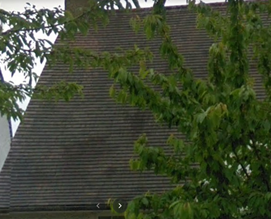
-
I'm retiling the roof of a 1930s semi. I don't really know where to start in terms of what I'm looking for in a roofing tile. My only limitations are: - a flat rectangular tile - made of concrete (although I could deviate from this if there is a good reason to) - grey in colour Some of the roof will be visible up close as we have a porch over our front door that will have a matching roof which starts at about only 8' from the ground, so it needs to look good. I need them delivered in early to mid March; I thought I had some time to play with but was slightly alarmed to see some tiles have 50-60 day lead times! Any tips gratefully received.
-
And a lot of jobs will be outsourced to robots! (Though I agree electricians and plumbers are safe.)
-
Thanks @PeterStarck. Where are your 3G sliding doors from?
-
I’m a litigator; it’s my job. And despite all the insurance premiums I have to pay, I don’t charge for travel time (although I know some lawyers do).
-
And there I was thinking the lack of response from the window industry was just a Covid thing! But this suggests they’ve always been like this!
-
That’s fair enough, but this is a company which claims to have an office near to where I live. Maybe it’s just a marketing thing.
-
I’m not actually going to suggest the lime product until he suggests something. I will then ask him to compare it to what he is suggesting. Re the “report”, and PI insurance, in my experience these aren’t very usable as the survey report inevitably ends up being caveated extensively. If his advice turns out to be wrong, proving that to the satisfaction of an insurer, or worse still a Judge, will be very difficult indeed. I’m currently suing a fully insured damp surveyor who messed up my parents house - nightmare of a case. And re the idea that I have to pay people for travel time... ? I’ve never understood that. If I lived somewhere inaccesible, I might understand, but I don’t. Nobody pays me for my travel time, despite having to commute an hour each way.
-
I heard back from Heritage House this afternoon. Unfortunately, they are fully booked for the next month and I can’t wait that long. They also wanted £1000 plus VAT which I thought was excessive given the house is in such a skeletal state following 6 days of 4 hardworking guys gutting it and exposing the foundations, that it should be quite an easy inspection for them. So instead I’m going with a chartered surveyor who has these qualifications: BSc (Hons); MSc; MMBEng; MRICS, but more importantly doesn’t like chemical injections and follows the breath-ability school of thought. I will tell him I’m quite keen on that lime company and see if he can work with them based on his findings at the property to specify something that won’t cost me any more than what the builder has quoted for before we discovered the water.
-
The thought of trying to find another aluminium sliding door supplier that can meet all my other requirements is now making me wonder about the solar control for the west facing sliding doors: in winter the solar gain will help keep the room warm. In summer, the whole point of the sliding doors is to open up the back of the house to the garden. Can anyone think of why in these circumstances I might regret not getting solar control for these sliding windows?
-
Was this for a flat roof or a pitched roof?
-
It's very far from a passive house. We are: taking a 1930s semi that has had zero work done to it since 1930, apart from some first generation uPVC double glazing installed (which converted the first floor rear bedrooms into saunas during last summer - which was itself a pretty hot summer for English standards!); completely gutting it extending the rear with a full width ground floor extension and a partial width first floor extension as well as converting the loft; replacing all the glazing as well as introducing 5 sky lights; and upgrading the insulation of the house with a new concrete or limecrete slab and 100mm of insultation in the floor, and then all old walls of the house (that are not being knocked down to make way for the extensions) are being upgraded with 52.5mm of Cellotex insulated plasterboard on the inside and 25mm of this insulating lime based render obviously all of the ground floor rear wall and the extended portion of the first floor rear wall will be a cavity wall to current building regs. All other walls in the house are NOT cavity walls. Appreciate that one can always put in thicker amounts of insulation, but we don't have the space for it. In terms of solar gain, my main concerns are: the rooflight in the flat roof of the first floor rear extension which will be the roof over part of our master bedroom - the architect has specified as 2000mm wide by 1000mm deep, to match the 2000mm width of the window this sits by. I think this is too big, so will probably keep the 2000mm width for aesthetic reasons but reduce the other dimension to 750mm or 600mm the aluminium 2G sliding doors we will install in the new ground floor rear extension which will look out onto our west facing garden. These are pretty big, aproximately 3.7m wide by 2.15m high, which together with a large window that is also on that elevation (also 2G) mean the west facing wall of that ground floor extension is almost 65% glass. the rooflights and veluxes in the loft which are west facing (i'm not too worried about solar gain from the east facing ones, as I think that will help warm up the space in winter more than it will bother us in summer). On the sliding doors for instance, I asked the supplier about adding solar control glass to reduce the G value and the only options available are tinted. Is that always the case? As you will see from the attached picture, the tints look pretty dramatic! Doc1.pdf
-
Thanks @PeterWAccording to this only the paid for SketchUp studio does "thermal comfort analysis" and "daylight analysis". Or have you found an equivalent feature in their free version?
-
No, he hasn't. I asked him to and he said that normally one would get a specialist consultant to do this because mapping out the seasonally changing arc of the sun vis-a-vis the obstacles that cast shade on the house is quite technical and would require some modelling. Not sure if he is overcomplicating things or not. Can anyone refer me to some (hopefully free) online calculators that can take inputs such as room size, window size, glass spec, window orientation, latitude coordinate of property etc. so that I can try and work this out for myself?
-
True, but only a theoretical risk in my opinion. As long as there are plenty of wealthy countries run surpluses (e.g. South Korea, the Netherlands, Switzerland, Singapore) there will always be demand for cheap debt. Even after the rating agencies downgraded the UK's sovereign debt rating from the top quality rating to the next rung down (I can't remember when, it was two or three years ago due to brexit and the fall in the pound) it was still incredibly cheap to borrow.