


S2D2
-
Posts
437 -
Joined
Everything posted by S2D2
-
Thanks for the feedback, it does seem like a revert to 7.5p is inevitable unless winter price rises kick in soon. Time to revisit the PV forecasts.
-
Essential standby equipment, energy use and solutions
S2D2 replied to ProDave's topic in General Alternative Energy Issues
41W, 67W including fridge freezer. It used to be 27W before some convenience additions. I have no use for a printer or Freeview box, on-demand covers everything. NAS is very low demand so is just a hard drive on the raspberry pi. @ProDave measuring each device would be useful, without knowing details of your setup I'd guess spinning disk drives make up a good chunk of the power draw, SSDs would reduce this. The problem with off grid is 100% availability and diminishing returns, the capital investment to absolutely guarantee this circuit doesn't go down for a few hours over a few weeks of winter would probably negate any savings. I would be interested in the performance of the very cheap wind turbine mentioned though. Edit: Just noticed the mains charge backup, this may make the system viable if you assume something like 25% will come from the mains charger, counteracting the diminishing returns -
How are you finding the October rate? I've just checked and looks like currently the 15p flat rate would be better? Haven't done the sums over the month yet though.
-
My chosen solution for a similar situation was PIV - I couldn't justify the running costs of MVHR with such a leaky, albeit reasonably "not too bad" house. I have block + beam + block walls so was less worried about moisture escape, though my previous house was timber frame and used PIV to similarly good effect. Installed above double height stair void and temperature is vaguely noticeable when passing but far warmer than outside on a low setting and nothing that makes me wish it wasn't there, I don't loiter on the stairs. Air quality much improve at a subjective level, I never bothered measuring it as I considered the problem solved.
-
As usual it depends, but probably if your focus is maximising return on investment. Optimising for offsetting your usage is more nuanced and requires you to factor in consumption, as in the thread I linked. This has the benefit that you'll be reducing that usage for as long as the system lasts, whereas export rates can disappear overnight. For my usage and proposed system preferring increased winter generation leads to a better usage offset but optimising for total annual output is more financially beneficial (at current rates and MCS install). It depends on your priorities.
-
On my units about 2mm, dictated by the thickness of the little rubber dampers that sit on the non-hinge side and make the door close silently. The hinge is adjusted to match this so the door sits flat.
-
I should probably have qualified further, I was comparing SSE vertical mounted (gable end installation) to 35° WSW (roof install) so a bigger difference than your comparison. Based on your data carry on with the optimal pitch. Also worth noting that if you plan to export at current rates (£0.15) it tends to dwarf any other small optimisations to just maximise total generation.
-
Electric ovens with lower peak energy demand
S2D2 replied to Nick Thomas's topic in Kitchen & Household Appliances
Strange that air fryers are so popular this is how things are branded now - as far as I can tell it's just a fan oven/microwave combi. I have an AEG one, works well as a microwave or a fan oven. It can do both at the same time but we never do, microwave hot spots aren't helpful for a dish that calls for oven cooking in my experience, though I haven't experimented much. If you cook a lot of jacket potatoes then maybe. I got it to avoid having a microwave on the worktop and to act as a second oven when required, which it does well. -
If you have a DCC connected smart meter, see here for sizing the battery: I was looking at panel orientation rather than E/W split but found when using a battery vertical mounted panels saved the most on energy bills for my specific location/consumption - you sacrifice summer export to generate more in winter. Same principle here with south facing panels generating more in winter, that will have a much bigger impact on energy bill savings than extending the generation window slightly when the system has a battery.
-
Food Waste Caddy built in to worktop - Smell?
S2D2 replied to puntloos's topic in Kitchen Units & Worktops
Yeah that's why ours is left on the worktop with no lid, not the best aesthetically but way less faff, just chuck things in. We have one with a removable inner shell so fitting a new liner is very quick and looks neat. Milk etc wouldn't work with that though so if the newer waste disposals are better (as others have said they are) it may suit your usage more. -
Food Waste Caddy built in to worktop - Smell?
S2D2 replied to puntloos's topic in Kitchen Units & Worktops
I inherited an old waste disposal unit when we moved in to this house. It took an infuriating amount of effort to keep odour free, new ones may be better. I ripped it out in the end and we use a counter top caddy with compostable liner. I leave the lid off because trapping moisture or heat in the thing speeds up decomposition (spent coffee pucks). Nothing smelly, cooked or animal based goes in and it stays odour free until emptied into an outside compost bin twice weekly to weekly. Keep the container small to avoid the temptation to stretch this longer. Caddy is just quickly rinsed before adding a new liner but can go in the dishwasher if it gets grubby, the liners prevent this well. Makes great compost for the garden as a bonus. -
Large workshop, very cold, mulling over what might work
S2D2 replied to Roger440's topic in General Alternative Energy Issues
Rockwool is breathable, so (relatively) warm humid air will rise through it (slowly). If your tin roof is below the dew point of that air you will get condensation on the underside of the tin. You are already seeing this overnight on your pictures. The ventilation air current mixes with the warmer moist air to carry the moisture to outside, keeping the tin and insulation dry. This is what you gain. Spray foam solves the problem because it is not breathable, so the warm air does not meet a surface below it's dew point. A dehumidifier solves the problem by decreasing the dew point, again preventing the air from meeting a surface below it's dew point. -
https://cpc.farnell.com/search?st=Euro to uk adaptor Free delivery needs a spend of £17.50 though so no good for one off very cheap items.
-
Large workshop, very cold, mulling over what might work
S2D2 replied to Roger440's topic in General Alternative Energy Issues
No, the ventilation is underneath the tin roof, above the insulation and so the heated envelope below is practically unaffected by it, other than a small increase in heat loss from the upper surface of the insulation. The diagram I linked should hopefully demonstrate this. You then condition the air inside the heated envelope as appropriate as it no longer flows freely to outside, the relative humidity of which will be reduced as you have heated it. -
Large workshop, very cold, mulling over what might work
S2D2 replied to Roger440's topic in General Alternative Energy Issues
If you can provide a 100% airtight seal to stop any internal air meeting the underside of the tin then yes, you will not require ventilation. This is likely to be very time consuming and expensive to achieve, airflow is usually a much easier win to counter condensation, but it's entirely your decision. I am biased because I've had severe condensation issues in the past (resolved by ventilation) as outside humidity is usually >80% around here. -
Large workshop, very cold, mulling over what might work
S2D2 replied to Roger440's topic in General Alternative Energy Issues
Good to get clarification that insulating the building is the way forward, sorry if I missed that in an earlier post. I don't think I'm being clear about leaving the eaves ventilation open, I'm talking about something like the left hand side of this picture: So the room is closed to the eaves but the roof is not. How you would achieve that with the kind of spans involved in that roof I have no idea but removing all ventilation from roof level will inevitably lead to condensation on the roof as it has nowhere else to go. Breathable roofing felt would be a suggestion to stop fibres dropping, but again how you make that practical is an open question. Might be worth getting a quote for spray foam and a quote to install a flat ceiling with new steels that you could pile rockwool on top of but again the scale is your enemy for keeping prices down. You're probably looking at north of £2k in rockwool just for 200mm then fixtures, felt etc. on top. Hey, at least the walls are easy! -
Large workshop, very cold, mulling over what might work
S2D2 replied to Roger440's topic in General Alternative Energy Issues
Don't be in a rush to close it up if it is there, it's an easy opportunity to get air temps equalish either side of the tin if the ventilation is sufficient, thereby eliminating condensation risk. You'd then build up your insulation layer underneath this gap. Insulating over would do the same by keeping the original tin warm but I'd want someone to sign off wind loading on a roof that size before proceeding. Have you put your postcode in the availability checker? Not available anywhere near me. If you can get it it'll be the old stuff fully bagged - nothing stopping you from ripping the bag off though for normal, breathable rockwool. Easy win on the walls with EPS beads, you'll want to do that before the roof as you'll lose access to the top of the cavity. Really consider your usage first as this won't come cheap due to the scale. Do you need to keep materials warm or just yourself? The heated jacket option mentioned earlier would be orders of magnitude cheaper if it's a workable solution. Cars were mentioned, if running for even a short period the ventilation required for fumes would render the insulation useless for a good chunk of time. -
Large workshop, very cold, mulling over what might work
S2D2 replied to Roger440's topic in General Alternative Energy Issues
Looks like it, it is now only one sided which avoids the plastic-bag-full-of-water issue: https://www.knaufinsulation.com.au/product/space-blanket @Roger440 do you have ventilation at the eaves there? If so you could leave a ventilation gap like a loft conversion and have a layer of wool under that? -
Large workshop, very cold, mulling over what might work
S2D2 replied to Roger440's topic in General Alternative Energy Issues
It doesn't mention it on this listing but afaik this used to be the stuff wrapped in plastic foil. Touted as the perfect mix for loft insulation but the vast majority of the time ended up a sweaty uninsulating mess as it's nowhere near breathable enough for most homes so just pooled water. Used to be many, many reviews with condensation issues that I notice have vanished from that listing... -
I wouldn't worry, you have a much higher electric load than I modelled (no MVHR, gas boiler) so I think your selected system will perform well, especially if you combine it with overnight cheap price charging of the battery with weather prediction to top up when the PV can't deliver enough. If you don't mind me asking what was the quote including installation? I'm trying to validate my cost functions at the minute!
-
Do you have any existing consumption data (or a DCC connected smart meter) that could be used to model PV/Battery performance in the finished build? I could never make the powerwall add up when I looked, have you considered other brands? I was also surprised how significantly battery clipping (fully charged causing export) decreased ROI when modelling with half-hourly data, it really does drive the choice of battery to avoid an excessively long ROI:
-
The best I've seen recommended are the Iris fans or a basic sprung shutter such as https://www.tlc-direct.co.uk/Products/BG4BS.html Mounted towards the outlet it should have an advantage over the iris type (no cold air circulating the length of the duct above the ceiling) but I'm yet to see anyone state they've used one to good effect, plus I always assume pressure driven mechanisms will be noisy - outdoor wind can still open it. Interested to see what you come up with given you can monitor the change with the thermal camera.
-
Baseline usage is already as low as I can get it, 30W constant around 50w including fridge freezer. Some of the peaks can be shifted - dishwasher, washing machine, but I've highlighted issues with that above, plus it's not really something I want to have to think about and would reduce the ROI for that benefit. I don't have any error margin data for either dataset, you could estimate for PV but it would be gigantic given how variable the data is. All data stored UTC and in the images above displayed in BST so accurate between series.
-
I revisited this as the PV data can be interpolated to 30m values to see what the impact of improved fidelity was. Around 5% reduction in utilised PV by moving from 1h windows to 30m windows. This trend would continue as the fidelity increases, so there's probably at least another 5% reduction in utilised PV missed by this model. Much more significant is the error introduced by averaging PV data. If I instead take only the 2020 timeseries utilised PV drops by around 23%. It's intuitive as to why, I was smoothing out daily irregularity by taking an average, which has a big impact on utilisation if we look at the same day as my original image: Poor midday sun causing a large draw from the grid. This helps support a case for batteries; even when shifting load to mid day you might just get unlucky with PV generation, I don't want to have to predict the cloud patterns before setting off the dishwasher. As a result, utilisation for a 3kWp system with no battery drops even further to 31% making it very hard to justify any kind of ROI on PV only when export rates are either 0 or require thousands extra for MCS. I added a crude pre-combi water tank model and with such low utilisation it does become just about viable based on some estimated costs, still keen to hear from anyone who has installation costs for this. More accurate information could be gained by running each year's PV data in turn and averaging the outputs. So with batteries having a few advantages, including offsetting the much higher electricity cost over gas, I went down the route of optimising such a system. With higher PV generation a pre-combi tank could be added as well, but I am space limited on the number of panels I can install. Some rough equipment/install cost estimates (Not MCS) and 133 data points later gives me the following optimisation space: Ignore Excel's bizarre labelling, y-axis is Battery (kWh). The optimal value being around 3.65kWp PV with a 4.56kWh battery. Adding a tank to this system would only save ~£79 a year so fairly hard to justify the extra expense. Does anyone have reference quotes for a similar system to double check my cost functions?
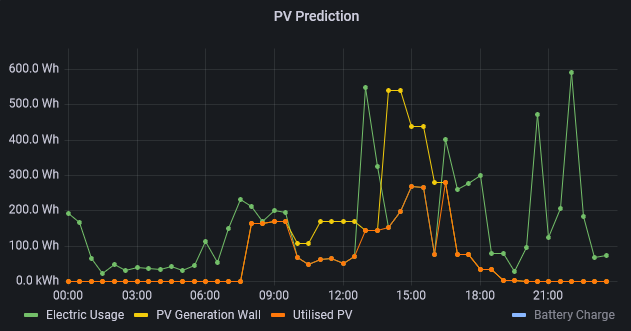
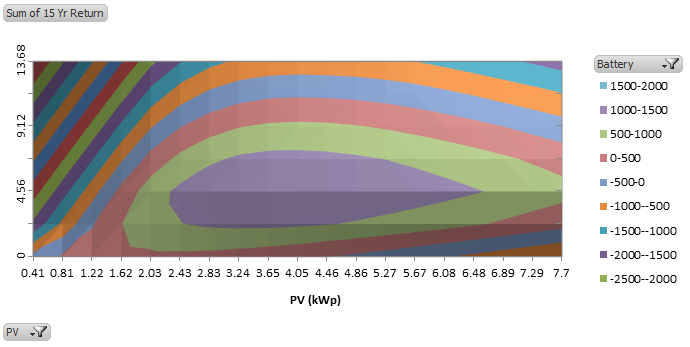
-
I've seen the pre-combi tank recommended on here but don't really have a handle on installation costs. Can anyone who has done it give a ballpark figure? Because mains gas is still relatively cheap (ironically) it only saves about £90/year on the 3kW system. Add in annual maintenance of UVC and the ROI seems big, but I'm making unfounded assumptions and should price it up instead.


