Carrerahill
-
Posts
2132 -
Joined
-
Last visited
-
Days Won
10
Everything posted by Carrerahill
-
You can get a device which some manufacturers call a export limitation system, it is basically a module which sits in before your DB and stops export, you buy it and wire it in and program in a dead stop, i.e. nothing. Each panel is made up of a quantity of PV cells, like a battery, the more you add the higher the output voltage and the more current they can generate, so in a panel you might already have say 80 PV's - when you connect 2 of this same panel together you have actually just linked 160PV cells together. Now if you block the light to 1 cell that cell then might fall below the threshold of incident light at which it generates, it becomes, like a battery, a dead cell and takes the whole connected string of cells with it down to it's level, which in a large string could mean 5 or 6 panels worth. There are options, optimisers and microinverters, optimisers take in each panels output, optimises the generation and adds it to the string, then the single inverter then does it's business as usual. If a panel stops generating due to a shadow or a dirty great crow sitting on it then the optimiser essentially ignores the panel and excludes it from the string. Then there are micro inverters, a box about the size of a VHS tape, maybe a bit smaller, and it has a + and - connection, panel goes directly into it and it has a AC output, you just wire them to a main AC bus or wire them all back to a terminal board etc. at that you can then have your solar monitoring module. The micro inverter is my preference because it makes each panel and MI become it's own little generation plant. A fault on one panel or inverter only takes out one panel. The ROI is getting closer now, my thinking is that we do ROI calcs using the present energy costs, we should be doing them with costs 1-2 years from now, had we all put in solar 2-3 years ago we might be laughing now, but then of course it was more expensive then. I think we might be at the tipping point.
-
I would pull it down, but that is me and I could rebuild it in block and bigger. I took down a 6m long 2.7m wide brick garage at our current house and replaced it with a much bigger block garage in a better position, it wasn't even worth trying to save. Depending on your funds and abilities it may make sense for you to pull the roof off, upgrade some of the structure and add a proper pitched roof and tile it, I looked at that option once for a Marley prefab like yours, years ago but reckoned I could do it for £500 in materials and a few weekends. People will buy a prefab like that. Buyer dismantles and collects.
-
Go for maximum generation capacity you can afford and feel you can benefit from - remember that a PV array could be done in increments. I use a little micro inverter so I can add 1 panel at a time and if I want to make 1 array different products from another or high peak output capacity panels I can simply add those by sizing the inverter accordingly. First solar panel is going on the shed, the next 5-7 on the garage and the following 5-7 on the house. Work starts ASAP really. I set it all up temporarily and generated 1.25A with one panel at 15:00 with some low winter sun! I will take that! You can stop export, if I am honest I would rather use my own generated power rather than export it given the rate I was offered, 3p v's the 23p I pay, so I am not planning on exporting, you can get inverters and controllers that know what to do with excess, 1 chap I know dumps it into huge hot water buffer tanks. If on a very sunny day when his buffer tanks were up to temp and all the laundry and what not was done then his system just does nothing. Might seem wasteful but he has never had this eventuality yet. He clearly sized his generation capacity to suit his use. Battery storage is the next option, not something I am currently even thinking of but would think about it when electric is 40p a unit and I am wasting it during the day. If you could afford to store all your solar, then go for that option. But size your system wisely and don't let a PV company size it because they are of course going to say you need more than you really need. But remember, you can always add!
-
Roof ceiling joist strengthening.
Carrerahill replied to alexbr's topic in Lofts, Dormers & Loft Conversions
Ask him for a detail or sketch and for fixing details and types. -
Exceeding maximum fall for sink waste pipe?
Carrerahill replied to MJNewton's topic in Waste & Sewerage
You could always stick to standards then drop it on 45's more abruptly somewhere to stay within regs. With sinks, any solids should be very small and lightweight, say coffee grounds, so I don't see too great a fall being a huge issue, but there does remain the chance that solids will be left behind by fast flowing water abandoning its solid friends. The benefit of vertical falls is that yes it increases waste speed for a moment, but the water/solid velocity remains within spec on the horizontal (diagonal), with everything moving faster on the verticals together before continuing at a solid clearing rate. -
Mike, something I have been thinking about of late, we do intend to move on from our current house probably within 5-6 years. The issue is that as soon as I "disconnect" my devices from the house and cancel the broadband, effectively the house just becomes a building with hardware in it. I have moved broadband once since I moved into this house and when we changed router I just renamed the SSID so all the devices seamlessly transitioned over, I could always stick in a cheap £25 router with the same SSID and leave it as the smart home router with instruction on how to connect it all up. One option was to make it a selling point, then leave really simply instruction as to how to adopt it, second was to put in a standalone controller of some sort or, keep quiet about it and remove all the hardware (I have wiring boxes setup that all I would have to do is remove devices and join light switches to the circuit rather than I/O terminals on controllers. The system would work standalone "dumb" but it means they would have basically lots of light switches switching relays rather than just having a light switch!
-
What a shame! That's sad!
-
Lost with DALI/KNX Lights (single room)
Carrerahill replied to J1mbo's topic in Networks, AV, Security & Automation
So do you have a KNX system for control via HomeKit you want to interface to a 24V DC LED tape? Looks like you have an added stage of the DALI interface, so were you planning on going KNX-DALI Driver-LED Strip? You could do this so many ways. You could drop the DALI and go KNX or mains dimmable via KNX mains module to a 24VDC PSU and lose the added complexity. What is the power supply rating and how many meters of tape and what is the W/m? I tend to spec power supplies and drivers etc. with about 20% spare capacity to reduce load and hopefully heat, leading to a longer lifespan. -
Sort of but you really should balance the phases better, but yes, I would put the inverter onto the phase with the most day time demand. I suppose domestically you could just pretend you are only on a single phase supply, and ignore balancing but it would be better if you could keep the phases as best balanced as you could, i.e. similar load on each.
-
He has no car.
-
Probably more like 77A as PF would not be 1. You are now beginning to see the issues that the network operators are having to contend with. There is a document called ESDD-02-012 which gives the SPEN ratings for supplies for various house types, for clarity this is not fuse size but supply rating, in other words how they work out how many supplies they can give from a given substation. A 5 bed property with gas heating is given as 2kVA - that is about 8.7A at 230V - that is what they are allowing. They used to give you 18kVA - but they realised that at that figure they didn't have enough capacity on the grid, so they just decided to drop the rating. This 2kVA is known as the After Diversity Max Demand. ADMD. They apply this city wide and sort of hope everyone is not charging EV's in the evening when they get home or making dinner... no wait... they are... why is no one talking about this? Oh, I remember because they are banning gas and petrol and diesel and the facts don't suit their narrative. Electric future... maybe in 2060 but not the next decade. They will start to make U-turns soon. Gas prices are only high because they want to use gas for electric generation as coal is too dirty, that is even before we all ditch petrol and diesel and gas domestically.
-
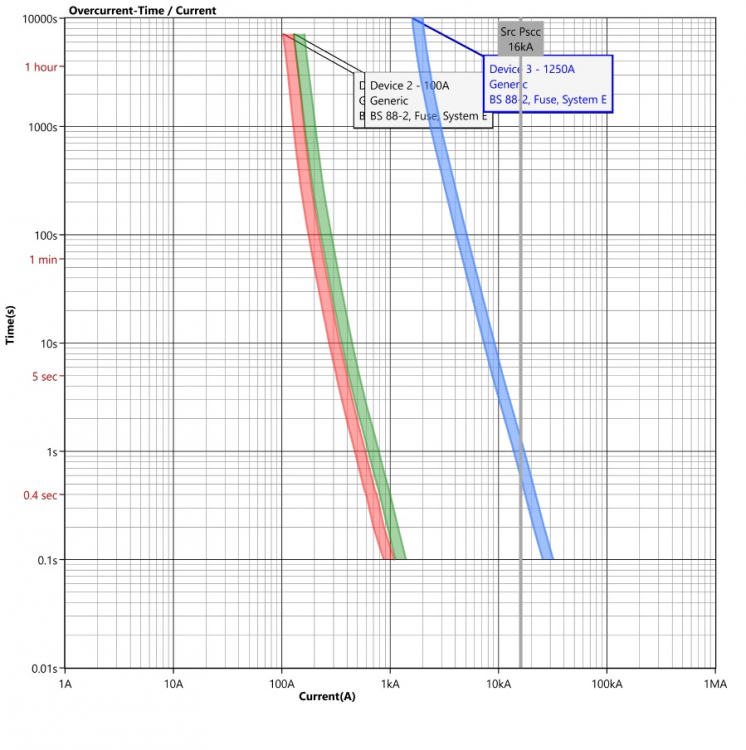
It depends to be honest, but unless you are planning on sitting at high current for a long time you would probably be fine on an 80A even for 100A unless it was for days straight. You really only have a big issue after about 120A where even then you would get about 1000seconds before it goes. However, your main isolator would now be overloaded unless you happen to have a 125A - doubt it. So you need to be careful here, but the cut out and the cable are probably not going to be an issue for you, more your own electrical equipment. When they joint an LV lateral cable which runs from your cable head to the LV street network there is no protection at the joint, the local upstream protection will be at a substation outlet and could be 1250A or maybe 3000A, sometimes more in cities, so the cable might be jointed in the street and be say a 10m run of cable, so the BS88 fuse needs to sort of work in reverse to protect the lateral cable. Often in new builds I have spotted 80A BS88 but I suspect you could slip a 100A BS88 in no sweat, i.e. if the cable is 25mm, which will be concentric. It would be possible to draw about 150A for a limited time on the cable without any damage, it is all about current x time. Here is a quick protection study I did for an 80 (red) and a 100 (green) fuse and a 1250 (blue) upstream fuse - note that it would take over 1 hour at 100A really for both the 80 or 100 to trip - you will note that the 1250 would even allow 5000A to pass for about 100s.
-
M is over the top yes - German indoor mounted ASHP's for example, two 50kW gas boilers. More pumps than a cruise ship.
-
Yup, and it just increased this morning as he wants a centralised ventilation system. Full KNX systems, multiple gas boilers and heat pumps, with full commercial level changeover and redundancy, chillers and air handling units, sub-panel power distribution with local DB's each with power monitoring and control, fire, CCTV and alarm system of spec and quality I would expect in a high end office complex. Digital door locking and access control to external doors, the list goes on.
-
Depends on so many things, how big is your house? What do you want it to do? How lazy are you, are we talking turn the lights on and off, switch on the heating? Doesn't exactly need a nerve centre to deal with that. I have a level of smart home control in my house, mainly for external and internal lighting circuits. I was going to tie the boiler into it too, but I stopped when I realised that I have a system that works and works well. So I decided not to be so stupid and leave it all alone. I might add some more stuff, we have blinds in our living room that when we change the blinds I would like to automate so that when we are on holiday we can create the look of presence. I like toys if I am honest, but I am also wise with my money so I draw the line, it needs to give be real benefit. I am working on a clients house at the moment, they want toys, so we are designing in about £750K of M&E toys. He doesn't need much of it, but he can afford it and it will be good fun I suppose as he is an tech specialist who likes toys.
-
Roof ceiling joist strengthening.
Carrerahill replied to alexbr's topic in Lofts, Dormers & Loft Conversions
All of them or you will have too big a spacing for fixing PB then will end up with sagging plasterboard! You are beginning to sound like a contractor trying to cut costs at every turn! ? -
Roof ceiling joist strengthening.
Carrerahill replied to alexbr's topic in Lofts, Dormers & Loft Conversions
So start there and sister them all with level 2x4's - quite a common way to level a ceiling. You can also counter-batten and shim but that is probably more work, but cheaper. -
Roof ceiling joist strengthening.
Carrerahill replied to alexbr's topic in Lofts, Dormers & Loft Conversions
If it was me, and I had gone this far, I would attach 2x4's to the side of the existing, levelled throughout. Find the lowest point and measure everything from that. A laser level would be your friend here. -
Get it professionally designed and follow the design, when the neighbours garage starts to collapse or settlement issues cause bad cracking or some other structural disturbance you will wish you had spent the £800 as it could easily cost £8000+ to fix something that goes wrong.
-
Is corrigated flexible toilet waste pipe ok?
Carrerahill replied to Porthole's topic in Waste & Sewerage
More or less every toilet in the land is connected with a piece of this - they are sold as flexible pan connectors, ideally it would have been dead straight but these flexible pipes are to allow flexible fitting like this, even in a bang on install I would expect a piece of flexi to go from the soil pipe to the pan. When I took our old toilet pipe out the flexi was remarkably clean, what you think of as solid doesn't' remain solid for long... -
Get a washing machine saddle drain kit - basically it clamps onto your existing pipe, comes with a tool to drill it, clamps up and gives you a spigot for an appliance. Something like this (check sizes - this one will do 32mm): https://www.screwfix.com/p/washing-machine-drain-out-kit/75883?tc=IB4&ds_kid=92700055281954514&ds_rl=1249404&gclid=CjwKCAiAz--OBhBIEiwAG1rIOuiK91cRQElwKOv1jY3ZPU8g53_G_WA6lEV8otmElobXLBxm-1RxIxoCnGAQAvD_BwE&gclsrc=aw.ds I installed one of these for a neighbour, sort of a temporary solution but it's not actually that bad as a long term solution either, quite well made and has an optional NRV built in. Or, if you feel adventurous, remove a section of pipe, solvent weld in a T, and add a new waste, you get pipe end versions which are designed just to go onto the end of a waste pipe.
-
ASHP tripping electric....HELP!!!
Carrerahill replied to Chriswills's topic in Other Heating Systems
Yes. -
ASHP tripping electric....HELP!!!
Carrerahill replied to Chriswills's topic in Other Heating Systems
Work out what the relay operates, whatever it controls is almost certainly your faulty bit. Good troubleshooting! What is the current rating of the relay, might give us a clue as to load type. Could be a heater coil, when they break down they can leak to earth, could be a motor, circuit issue, you might be lucky and find only the start/run capacitor has failed and leaking to earth, which is quite common actually. Could of course be worse and a motor issue though. I would try another cap first. -
ASHP tripping electric....HELP!!!
Carrerahill replied to Chriswills's topic in Other Heating Systems
It worked fine for 12 years so unless a motor has seized or about to die, which I don't think it has/is, then I cannot see the current suddenly increasing above the rating of the 12 year old MCB. If a higher current breaker was the fix then I would be more concerned about what was actually wrong further down the line and could the associated cabling then handle the increased current. As the OP said it ran longer with the earth pulled off the RCD this indicates leakage due to a failing components or moisture ingress. This fault, therefore, does not appear to the current related. Current and earth leakage are two different things. -
Photo please, make and manufacturer, type B, C... has no impact on the physical shape and size just the breaking characteristics. Could it be that the manufacturer has altered the styles and you have an earlier and later one. Wylex changed theirs a year or so ago and the old ones will fit the new, but the new not the old, but the old boards are no longer sold so shouldn't be a big issue. Things like that.