IanR
-
Posts
1841 -
Joined
-
Days Won
6
Everything posted by IanR
-

Manifold system versus hot return system
IanR replied to Russell griffiths's topic in General Plumbing
Why not run all the hot service from a manifold(s) and put the return loop up to the manifold only. Keep the manifold(s) hot (controlled with presence sensing), then use the smallest pipes you can get away with to the supply. Works really well for me. 22mm to manifolds 15mm / 10mm to Showers / taps. Return loop 15mm. To keep the runs as short as possible from the manifolds, I used 2 separate hot manifolds. -
MVHR and log burner
IanR replied to Tetrarch's topic in Mechanical Ventilation with Heat Recovery (MVHR)
I don't believe you could install a vent that could be closed off. -
Hello! And, err... our appeal was dismissed :-(
IanR replied to garrymartin's topic in Planning Permission
New houses have an estimated lifespan of 60 years. I'm not sure how that's calculated as it seems short to me, so perhaps that's 60 years to a major renovation? There's an argument that the LPA should not just be considering transport today, but for the life of the house. New car sales in the UK are currently 25% "Plug-in" (BEV + PHEV), ie. zero or ultra low emission. By 2035 that will effectively be 100% zero emission (Labour is talking about going back to 2030). Before 2050 there will effectively be no non-zero emission cars on UK roads. (yeah, I know there will be a few) While you can't force future occupiers to move to zero or ultra-low vehicles the government is with national legislation and councils are accelerating that change with low emission zones and new properties are making that an easier change with driveways and chargers. -
MVHR and log burner
IanR replied to Tetrarch's topic in Mechanical Ventilation with Heat Recovery (MVHR)
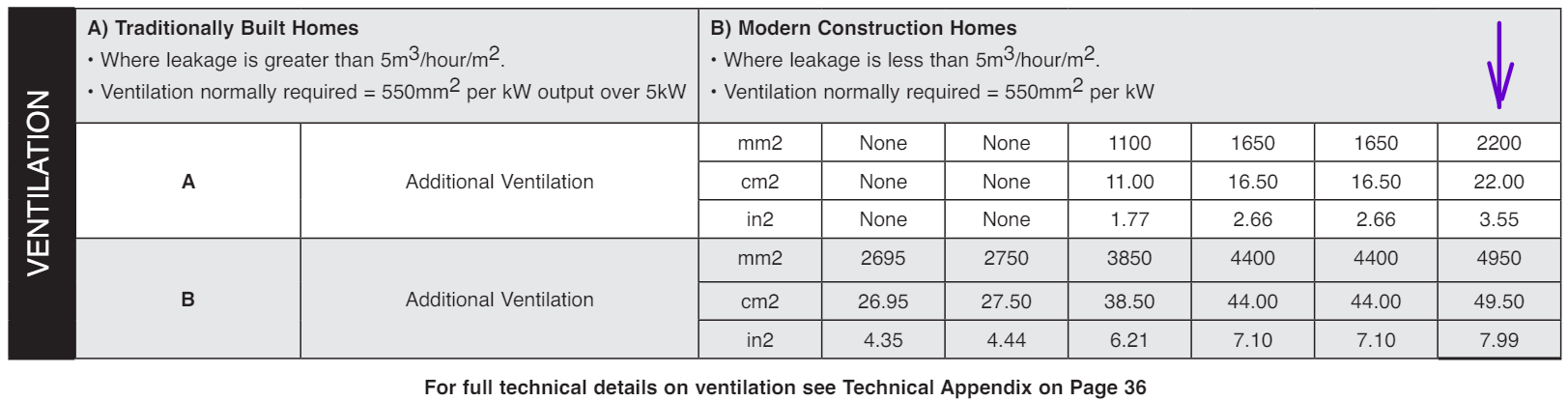
"very" will mean different things to different people, but assuming you expect it to be better than 5m³/m².h @ 50 Pa then you need to install the additional ventilation which for your unit needs to be equivalent to a 10cm x 5cm clear hole to outside. With that additional ventilation installed, you'll then need to perform the the "full spillage test " they mention, with all extracts and ventilation running on max. If it passes Building Control should not have an issue.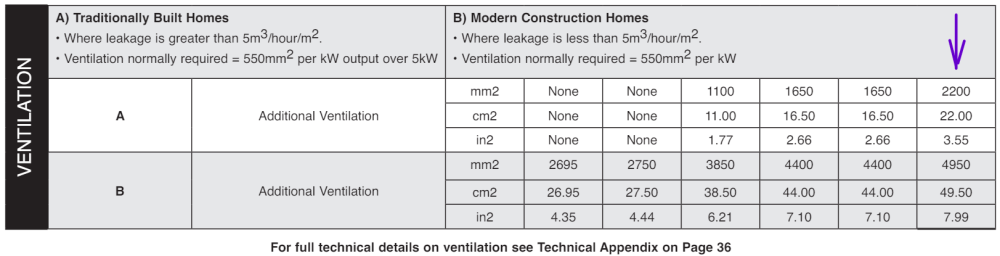
-
MVHR and log burner
IanR replied to Tetrarch's topic in Mechanical Ventilation with Heat Recovery (MVHR)
The Riva 76 mentioned in the OP takes its air from the room. If it were a room-sealed WBS, this would be a different discussion. I'm not sure I understand this point. If there's sufficient natural ventilation to not require MVHR, then the heat recovery is ineffective. The HR is only achieved on the additional, unrequired ventilation, so the MVHR increases the loses of the house and will require additional heat input to mitigate. Which is completely fine, but there are lower cost alternatives, especially for retrofits. MVHR in itself does not provide any energy saving, it's an enabler for high airtightness (<3m³/m².h @ 50Pa). It's the airtightness that brings about the energy saving. As a relatively expensive install (especially retrofit) and with continuing day-to-day running costs it's not easy to achieve a return on the investment. This aligns with my thoughts, MVHR starts to make sense with an airtightness of approx. 1.5m³/m².h @ 50Pa (~1 ACH). Unless you plan to get to this level then hitting 3m³/m².h @ 50Pa with trickle vents and individual dMEVs (with HR if you like) in wet rooms, is the more cost effective option. -
Not really, plenty (vast majority) of +1,000 acre farms have been purchased on the open market, not being in anyway related to feudalism.
-
But as a cost of development, it lowers the price of the land. It's not paid on the profit of the development. Indirectly, the land price covers the CIL. There is a tapered relief for CGT. As with most Taxes there are offsets. I think you are referring to "Titled" Estates. It's a small percentage of farmed land. The vast majority of farmers have purchased their land on the open market.
-
With CGT and CIL, which recovers £600,000 - £1,250,000 per hectare, it's pretty heavily taxed now.
-
Because at each generational change in ownership 40% of the value of the land would go to the state. Existing farming families would have to sell large portions of their farmsteads to pay the IHT, reducing the size of farmsteads making them unsustainable leading to their sale. There's not that many buyers for commercial (+500 acres) farms. You are suggesting that cereal production is 100% profit. Reality is most years it's an accounting loss. It is not possible to finance the land and make a profit from it after paying finance.
-
MVHR and log burner
IanR replied to Tetrarch's topic in Mechanical Ventilation with Heat Recovery (MVHR)
Unless your airtightness is better than 3m³/m².h @ 50Pa you don't need mechanical ventilation, adding MVHR will just increase your ventilation more than is required, lose additional energy (recovering 80% - 90% at the cost of running the fans) and cost you maintenance on the filters. Kitchen and bathroom extraction is far simpler. -
Gaps just at the peaks of the sheets isn't sufficient. If you've not got counter battens to create a full width gap, top to bottom you could try to get the ventilation moving laterally (in line with the battens) but you'd need to change the detail at the verges, your current cuppings are stopping any ventilation. Perhaps you should sketch your build up to make sure its understood. My comments are on the assumption you have a warm roof and don't have a vent gap between insulation and sarking.
-
MVHR and log burner
IanR replied to Tetrarch's topic in Mechanical Ventilation with Heat Recovery (MVHR)
What's your planned airtightness? If you have sufficient "natural" ventilation to feed the Wood Burner, I'm not sure you'll get any benefit from MVHR. Unless I've misunderstood the Riva 76 taking primary air from the room. Maybe the answer is to save your money and not fit MVHR. -
What are the 50mm battens on? Do you have counter battens or are they on a solid deck? Have you got a continuous gap from ridge to eaves?
-
Not sure why it's been attributed to Clarkson, It's just this update
-
Large MVHR recommendations.
IanR replied to ChrisDL's topic in Mechanical Ventilation with Heat Recovery (MVHR)
iirc the PassivHaus certification has a max noise requirement, so assume it will be similar to other domestic units. I've got nothing to compare it to, but I'd call it quiet. On boost @ 60% is the only time I hear it, and that's if I'm in the room adjacent. I used all Airflow ducts, manifolds, terminals etc. except connection to outside which require Ø250 ducts, where I used Lindab. -
Large MVHR recommendations.
IanR replied to ChrisDL's topic in Mechanical Ventilation with Heat Recovery (MVHR)
I'm happy to recommend the Airflow Duplexvent Flexi DV1100. It's the smallest of their Commercial PassivHaus units rated at 1100 m³/h. I'm only at 465m² foot-print, but have a 1650m³ internal volume. Airflow offer a free design service and then give you their recommended BOM for you to go and get the best price you can from their distributors. RRP is quite high, but discounts can be found amongst their distributors. The distributors get more favourable terms with Airflow based on their volume. For me Travis Perkins were cheapest, they had no idea what the were supplying, just went off the Airflow BOM. -
Insulated Concrete Slab Garden Office - Questions
IanR replied to Ticky's topic in Garages & Workshops
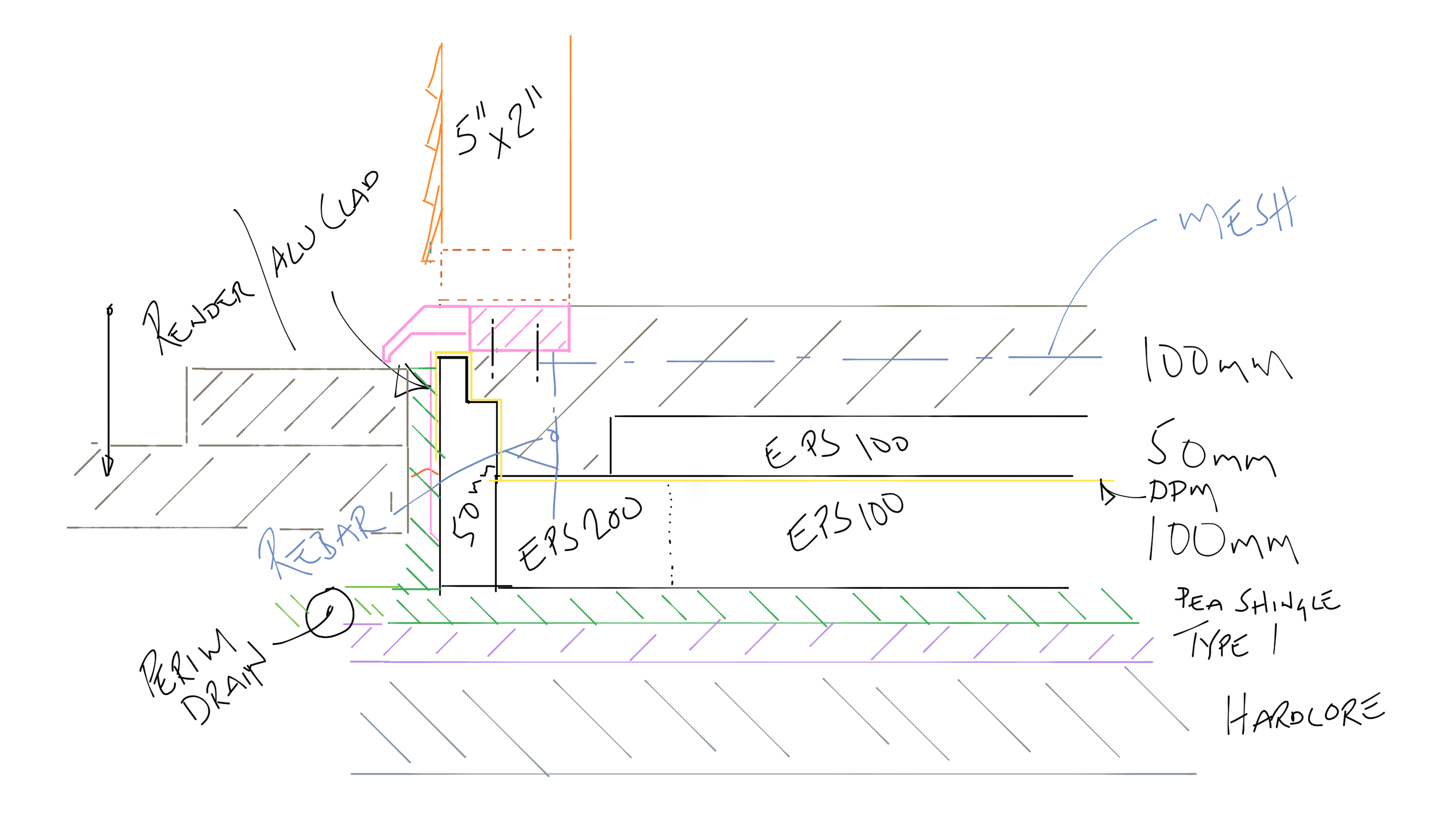
There's a number of different options, depending on what you are trying to achieve. If you planned a heated floor (UFH) that would be used all winter then it's worth considering something more complex, but if you do not plan to heat the floor then a cold bridge along the bi-fold frame to floor is less of an issue. The simplest option, to get a low threshold for the bi-folds would be to recess the raft to create a shelf for the bi-folds to sit in (cutting away the EPS upstand as required) and have a local step on the outside with a drainage path between the back of the step and the side of the raft. To take this much further you'll need to share more info on plan for upper structure, planned surface outside the bi-folds, generic section of bi-fold frame and where the bi-folds drain to.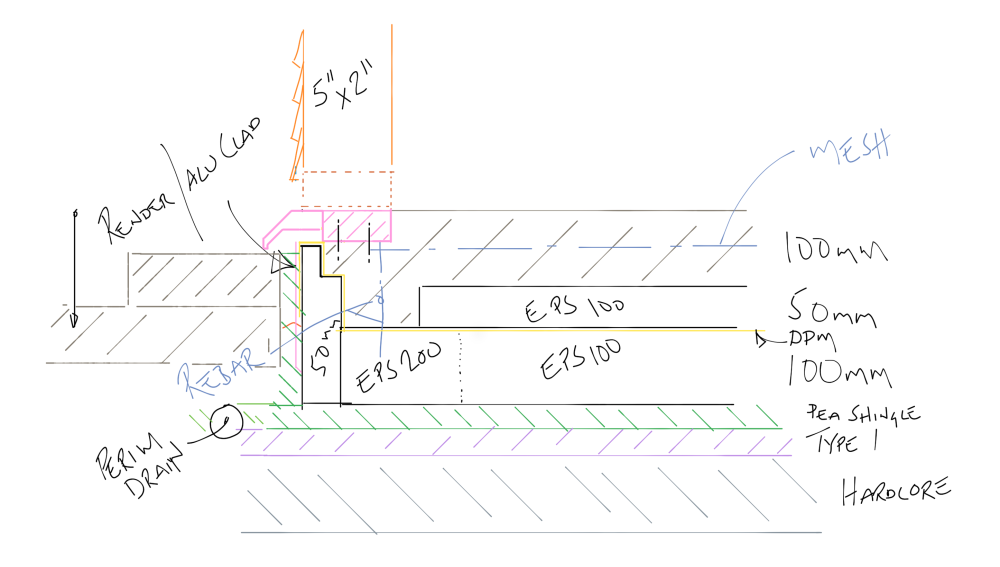
-
Not complete rubbish. I used foil-back PB, which is vapour impermeable, although you end up with some gaps in it for sockets, switches etc. and fixings for PB on the externals walls and roof were specified as 150mm spacing. Payne Insulation were happy with that and there's no noticeable bowing of PB panels or of fixings popping. My (I-Joist) studs were at 400 centres - 600 centres would probably leave the PB insufficiently supported.
-
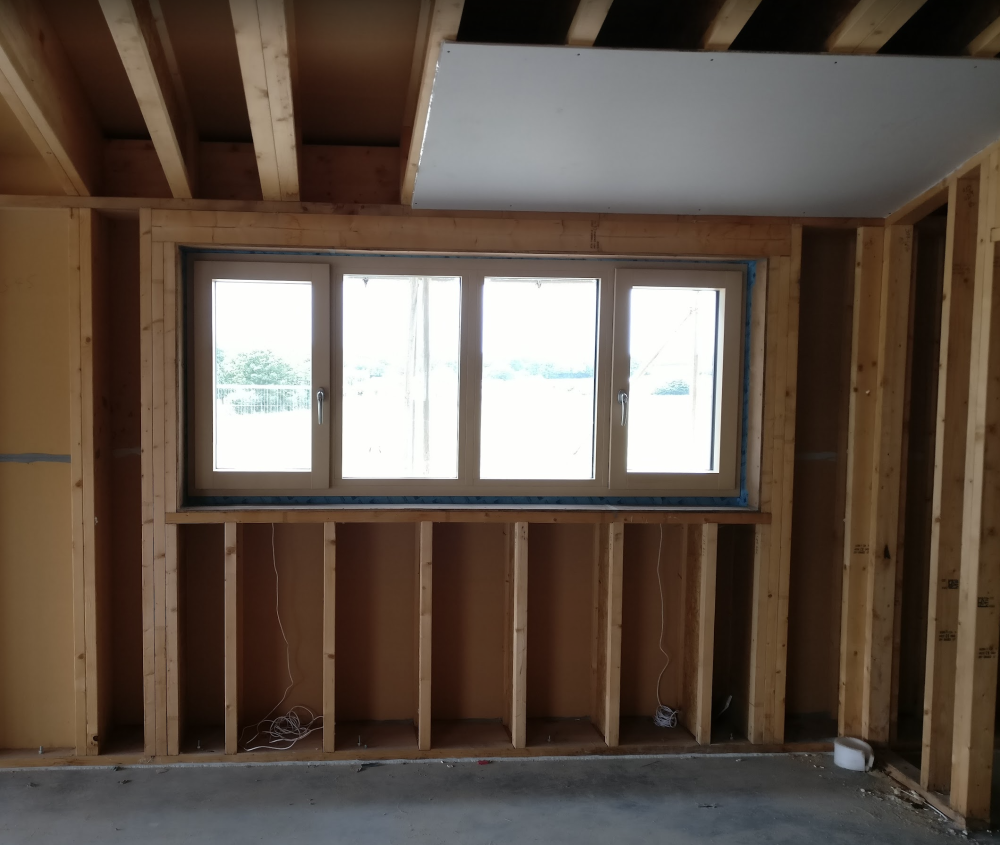
Ah, yes, depends on build up. Not an option for my "Value Engineered" structure, that doesn't include a service void across 95% of the external walls and roof. PB closes off the structure, so needs to be in place for the insulation fill. If you're including an OSB inner layer (+ battens) + PB, then yes, holes in the OSB only and can probably close of with stapled net, before boarding.
-
I've got 300mm walls and 350mm roof, filling an I-Joist Structure. Yes, would definitely do the same again. Thermal performance and acoustic performance exceeded expectation and are a large part of the resultant perceived high comfort levels. I was a little concerned about cutting Ø100 holes in the plasterboard at the top of every void, thinking the re-work of these may pop the plaster after a few years, but not one is noticeable after 7 years. Just remember to keep the discs you cut out.
-
Price would go up roughly pro-rata with increase in cavity thickness, if that's what you mean. They fill to a density, something between 55 - 60 kg/m³ iirc, so the thicker the wall the more bales of cellulose they require. I used Payne Insulation from Norwich - they did a really good job.
-
You've specified 600 centres on your studs, what happens to your U Value if you specify 400 centres?
-
No, breather membrane is correct, it's your cement particle board I believe. It's for wet areas, so assume vapour closed. Between it and your vapour barrier (@ 5) no moisture can get out.
-
Yep, since Ubakus can't determine how much of an issue it is. If there's a potential issue you then need to move to something like Wufi to determine how significant. Lack of drying reserve could be too high vapour resistance on both sides of the build up, so if moisture gets in it can't dry out quick enough.
-
PIR/PUR has good insulating properties per mm of thickness, but on its own is poor for sound attenuation and doesn't provide the best decremant delay. SIPs don't particularly make good houses, they're popular with volume builders as they reduce the skilled labour requirement on site. SIPs and PIR/PUR insulation are better when combined with a masonary skin as it improves the overall decrement delay and sound deadening, but less good with a lightweight structure. SIPs/PIR/PUR do offer a U Value advantage in a given wall thickness. By comparrison, celulose and rockwool are less good insulators (per mm of thickness), but do offer a better decrement delay for a lightweight structure. There is more to thermal perfomance and comfort than U Value alone. ie. to make an exageration a 1m thick stone wall has a much poorer U value than a 25mm thick PIR board but the temp profile inside the room will be very different. The PIR will react very quickly to outside temp changes but the solid stone wall will hold the two-week average temperature. The phase shift of your build up is just under 9 hours. I might accept a little compromise to the U Value (given that your side walls are width restricted) to swap out a material that gives a slightly improved phase-shift, to try and lift that to 12 or 15 hours. This would also likely come with improved sound performance. Since your front and rear walls are not thickness compromised, perhaps they could have a different build-up? ie. only compromise where you feel you have to.