
JohnMo
-
Posts
12465 -
Joined
-
Last visited
-
Days Won
179
Everything posted by JohnMo
-
Your heat pump circulation pump will come at 3 or 4 degrees like it not to perform frost protection to look after itself. The only freeze protection needed is from a prolonged (several days with no electricity and sub zero). Oil boilers themselves never have (almost all) never run with glycol or anti freeze valves.
-
As above just don't do it. It's not needed, makes your pump run harder than it needs to and heat transfer isn't as good. Just do inhibited water. I haven't even bothered with anti freeze valves. We just run weather compensation so everything is always active. So as you don't live anywhere that gets several day long power cuts and it's stays well below zero at the same time nothing much is going to happen.
-
Best thing is take your time. Get your plans right first. Even if you need to go back to planning to make changes. Step back, write down what you want and what you don't. Look at the following aspects Foundation level how are you going to do it Walls many different ways to build so get that sorted in your head before you go too far. Roof are you having vaulted ceiling, this changes how the roof is built. Insulation and airtightness, this then helps you decide on ventilation and heating system. Layout of house, it's very easy to make a massive house, if you are not careful. Use you current house, what is good and bad, what are room sizes like, ok, too big or small etc. how does the layout work or not? Write stuff down, revisit what you write down, is it still true. Once you know what you are doing don't change.
-
No reason at all, but are you just making things complicated?
-

Unlimited hot water with 4 bathrooms - is it possible?
JohnMo replied to Indy's topic in Boilers & Hot Water Tanks
I like using ChatGTP but you have to integrate if that is really the best solution, and at the end, ask if it's the simplest solution, most often it isn't. It's fine for having a conversation and bouncing ideas about, but easily goes of on tangents and can get numbers very wrong and therefore give a wrong solution. Test and test again. When you have a solution that looks ok. Post that solution in a new conversation and ask if it's the best solution to do xyz. You may get a completely different answer. It needs to know lots of details, to get a good solution. -
Fabric and ventilation heat loss calculator
JohnMo replied to Jeremy Harris's topic in Heat Insulation
Just taken another look at the figure used and it's not the heat load in kW, it's the number of kWh per year expressed as kWh per m² per year. So cannot be used directly to size the heat pump. To make an estimate based on predicted energy input. So 16.7 (from EPC) x 250 (m²), say 4200kWh, if you then divide by degree days, let's use 2900 (will vary by location and house design), that's 1.4kW. Which is pretty close to what you calculated I believe? Your heat demand at -3 is around 1.4kW. So ideally you are looking at a 4 to 5 kW heat and certainly one with great modulation. You would have one that size purely for DHW heating. But with a demand that low, do you really need a heat pump? If it's not being installed for free, I wouldn't bother. A couple of storage heaters? Simple use a time of use tariff. If you already have UFH installed - Willis heaters? -
Trickle vents with intermittent fan are sh!te. I am not saying to use intermittent fans I am saying MEV or dMEV. These run all the time. You will have door undercuts as well. Manual trickle vents just get shut by home owner and never opened ever again. Basic process is, no one home humidity activated trickle vents (installed in dry rooms only) close to minimum settings, fan run(s) at lowest speed. All done automatically. People come home sit and watch TV or go to bedrooms, the trickle vents sense a rise in humidity after a given time, and will start to open. This allows a flow of air across the room, air will migrate to to closest fan, it will sense humidity and speed will be increased. As people move about the house this process alters, to suit which rooms or activities are ongoing. Nothing wrong with a well thought out ventilation system, implemented well.
-
Credit/Debit Reward Cards, Discounts etc
JohnMo replied to Ferdinand's topic in General Self Build & DIY Discussion
Do you realise your quoting advice from 9 years ago - is the information still true today? -
Fabric and ventilation heat loss calculator
JohnMo replied to Jeremy Harris's topic in Heat Insulation
You need a couple of hrs for DHW heating. So for 4.35x24, so 105kWh per day. To do that in 22 hrs, 105/22, is 4.77kW not 7.5kW. According to the Cool Energy datasheet for the 6kW unit, at -3 outside it has max output of 3.8kW at 35 Deg flow temp. So isn't big enough for your calculated heat load of 4.35 or 4.77kW. So the only option they seem to have for you is a 10kW unit. The Cool Energy unit offered has a minimum modulation of 3.89kW, which is fine. But at 7 degs outside (based on 4.35kW) your heat demand will be around 2kW, so would cycle on off about 50% of the time. Cycling like that is OK, for off time hits CoP, a unit that tick away most the time has great CoP and almost no standby costs. A Panasonic 5kW puts out 5kW at -3 and will modulated lower at 7 degs Just been reading up on Hisense 4.4 ASHP, made by Hitachi, will do 5kW at -7 and modulate down to 1.85kW at 7 degs. And only £2k incl VAT (Heat Pump Warehouse).- 204 replies
-
- 1
-

-
- heat loss
- ventilation
- (and 4 more)
-
Fabric and ventilation heat loss calculator
JohnMo replied to Jeremy Harris's topic in Heat Insulation
So a big heat pump for house load. The smaller 6kW one isn't big enough at -3. So not the best fit for your heating system. -
Good call
-
It's actually made in Italy. But definitely not big here.
-
Just had a look at what info I can get. Unless there was a blip, but battery and inverter didn't see anything strange or pick up on it. So circulation pump went off at 05:39 (grid volts 241.6, 50Hz)then restarted 05:40, at 05:46 it tried to start DHW heating again and everything seems to have tripped at 05:47 (grid volts 246V)
-
dMEV or MEV, humidity activated trickle vents or wall vents. Demand based running on MEV or dMEV, this would be on humidity as minimum but you could co2 if really wanted. Fresh air only where and when needed. Minimal heat loss via ventilation. I posted a couple of years ago a report on a block of flats, all built a to an identical spec except for ventilation. One MVHR the demand activated MEV. Heat loss was almost the same, running cost for me way lower than MVHR, one fan no filters to change - zero maintenance.
-
Woke up this morning and ASHP was off. Screen off etc. cycled the isolation switch and it came back to life. Got on with doing DHW. Looking at the history it had a "Overcurrent PFC inverter 1". Prior to shutdown it had been doing some floor heating and was 15 mins into doing a DHW heat cycle. The wind speed last night was high 60mph and very gusty. So not sure it got hit with a blast of wind or there is an underlying issue. Anyone had similar or have any thoughts what to check?
-
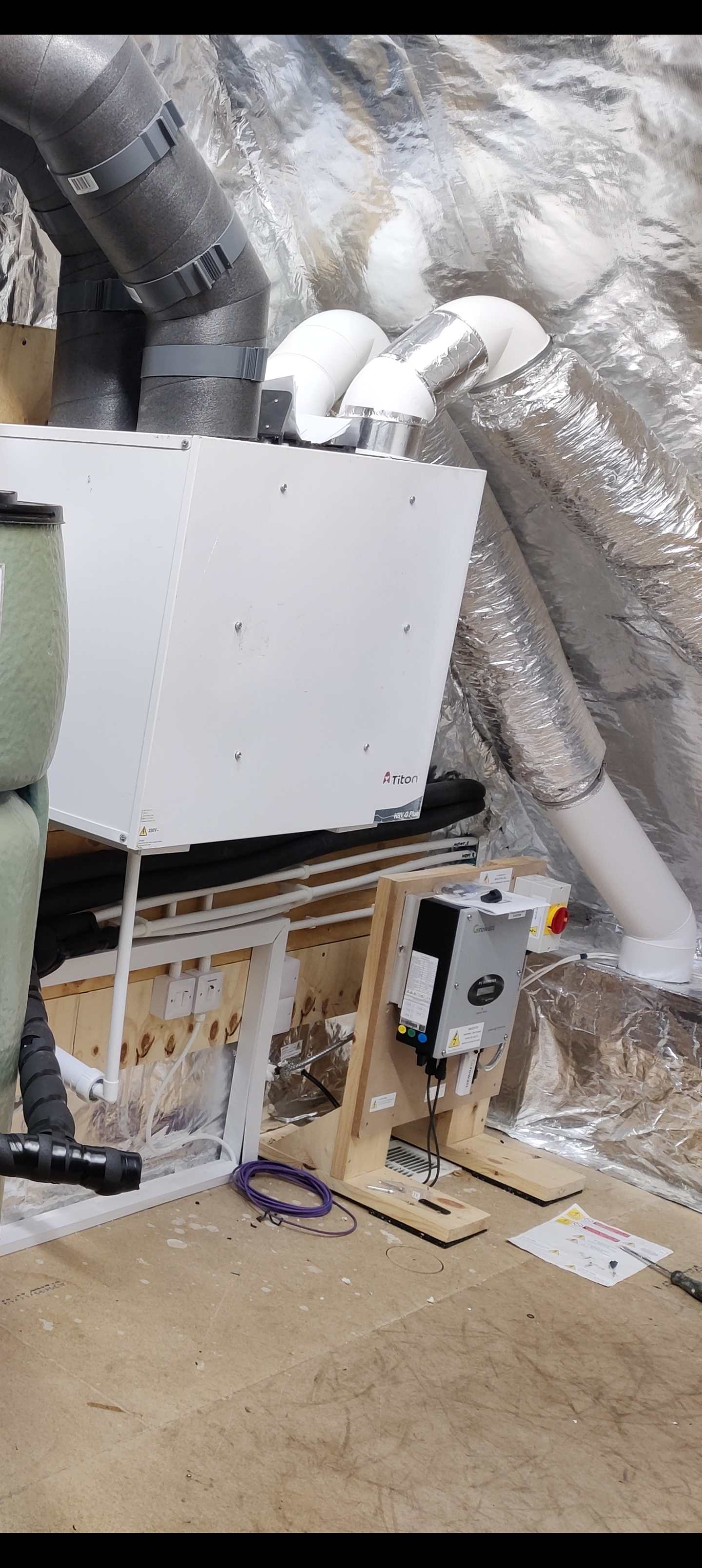
I have Ubbink between unit and outside. And solid plastic stub and a couple 45 Deg at MVHR and manifold ends. Silencer is nearer 1m long, now I look at a photo.
-
Still doesn't make it cheap - PV generation likely to be nil, when you have your heater on. It will draw 400-500W. So will soon deplete battery with anything else on drawing load.
-
Your steel needs to be insulated as the only thing between the steel and open air is a ridge tile. The way to look at insulation is it should be a continuous layer that wraps around the house. Take a drawing and a pencil, draw a line through the insulation and without lifting the pencil can you draw a ring around the whole house - you can only draw through insulation (windows and doors are classed as insulation if installed correctly, so should straddle the insulation). If you hit a section where you cannot move on without lifting the pencil you have a cold bridge to rectify. Your steel beam is an issue and also how the new and old sides of the roof join. Would need a bigger section of the drawing really. Your other area to look at I suspect is how does the warm roof join your cavity insulation or wall insulation if different.
-
Really depends on you current flow temp range. Is it a 50m² floor area extension? If it's that floor area, a single loop is unlikely, more likely 3 or 4 loops. Really need more details on the specifics
-
I have a similar silencer, but it's 2m long. But all other ducts attached to MVHR unit are foam.
-
It could be the solid duct as it goes through the ceiling, the ceiling structure allows it to bridge the flexible element from a vibration perspective. The vibration then gets amplified in the hollow manifold. Put a couple of heavy books on the manifolds if the drone stops that is the issue. The fix may be as easy as some heavy sound deadening on the outside if the manifold - similar to that inside a car door to make it more solid.
-
They are just flow setters - so doubt they will help just unbalance current settings. Your plenum manifold is the same as mine so may not be an issue.
-
How is the MVHR unit actually mounted and where. Is the MVHR mechanical linked to the manifold by anything other than the silencers? Are they both hard fixed to the same wall for example? It could be vibration noise. Air movement noise generally isn't a droning noise, assuming you and I call a droning noise the same thing. Air house more Ssssssss.
-
I did investigate for quite a while. And concluded an ASHP was way better. CoP generally wasn't great, very little proper technical information from manufacturers. Systems used to be approved for grants, but upon proper testing grant status was removed shortly after. Some of the rest data I could find had units running at a CoP in the 1s and 2s. Insulation and a wooly jumper. UFH in a garage - are you sat there reading a book ?
-
Nice spreadsheet But it makes designing the MVHR overly complex.