


JohnMo
-
Posts
13292 -
Joined
-
Last visited
-
Days Won
200
Everything posted by JohnMo
-

Mixergy and combi boiler integration?
JohnMo replied to bontwoody's topic in Boilers & Hot Water Tanks
Cylinder heated purely by solar, when the heating is off. It got up about 65 degrees yesterday. I also intend to add solar thermal, have everything in place just need to find time to hook it all up. -
Eaves vents for supply and extract
JohnMo replied to Rich97941's topic in Mechanical Ventilation with Heat Recovery (MVHR)
As long as you have the access shouldn't be an issue. -
Mixergy and combi boiler integration?
JohnMo replied to bontwoody's topic in Boilers & Hot Water Tanks
Pretty much the same set up as me, I'm using a Watts solar valve. https://wattswater.eu/catalog/safety-control-accessories-for-heating/valves-for-solar-applications/thermostatic-kit-solarkit/ My heating buffer operates at 25 to 30 degree range during the heating season, so a phase change store is no use to me. Plus my cylinder only cost £150. -
Think you may have lost the plot, making a simple reliable ventilation system in to something it's not. Sounds like a recipe for failed ventilation system, that also does little or no cooling as the flow rates are way to low to be effective.
-
Mixergy and combi boiler integration?
JohnMo replied to bontwoody's topic in Boilers & Hot Water Tanks
I have tried various layouts. It either preheats, but if above 43 it does not go to the boiler at all. Last week I set it up so the cylinder was heated by the boiler (same as system boiler), but abandoned the trial as I used way more gas compared to the system as described previously. My average gas consumption was around 4kWh per day even with the sun out, when heating as per a system boiler. The last 3 days I have used 0.6kWh in total as preheat, as per mode 2 above. -
Mixergy and combi boiler integration?
JohnMo replied to bontwoody's topic in Boilers & Hot Water Tanks
Have a similar system installed. I'm using an open vented 180l thermal store. Basically I have the following. Combi boiler, with a large buffer, with domestic hot water coil. Basically a Thermal store. Run in two modes or can also run modes 1 and 2 together. Mode 1 heating season, a 2 port buffer for the central heating. But any water heading towards the combi is preheated by the buffer, leaving combi less to do for DHW. Mode 2 off heating seasons, solar PV heat heats cylinder via a diverter. To get the best out of the system you need a solar diverter valve and thermostatic valve. Mode 2 works like this. If water from cylinder is above 43 deg, it is sent directly to the thermostatic valve and on to the taps, if below 43 deg, it is forwarded to the combi before going to the thermostatic valve. Prior to installing the solar valve, the boiler would still fire any time you opened the tap, as it saw a cold slug of water, so gas consumption was still a couple of kWh with a hot cylinder. Since valve installed gas consumption is 0 to about 0.5kWh most days a poor solar day a couple of kWh. Simple sketch, it's the same cylinder in both drawing just split the system to make it simpler to understand.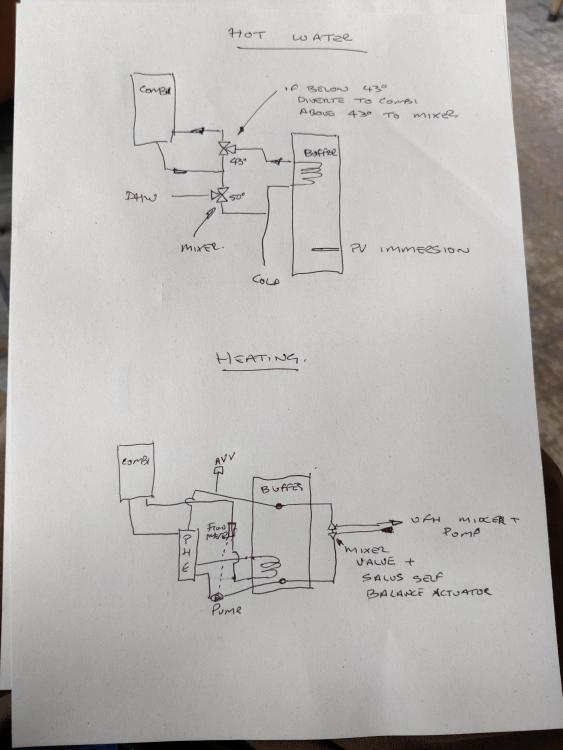
-
Toolstation Elgin has bylaw 49 in stock 11 lengths, Inverness has 1. When I bought it last it was climaflex.
-
B&q do climaflex, I know Elgin had stock at the weekend, maybe Inverness have stock also?
-
Just chamfer the timber to get an off the shelf duct piece through - job done. 10mm or so chamfer for 200-300mm done.
-
Would think without a check valve, as mains pressure decreases, there will be a backward flow through the softener, as pressure increases againe flow would go forward. The motive force for reverse flow is the diaphragm in the accumulator. With a check valve water will pass through the softener once and then cannot return.
-
MVHR specification
JohnMo replied to Rich97941's topic in Mechanical Ventilation with Heat Recovery (MVHR)
It's not normal to extracts in hallways, this would normally be a pass through area. So you supply a dry room the air flows through that room through corridor and across a wet room to the extract. Master bedroom flow looks low, I would bump up to 40-45m3h, also bump up the lounge. Wet room flows look a little low also. You need to get the flow and return rates the same, so the system is balanced. I set mine as follows Passivhaus house asks for 0.3ACH, Scottish building regs 0.5ACH. worked out the room flows at passivhaus flow rates, prorated the flows up to Scottish building regs flow rates, to give an overall 0.5ACH. After sign off, I can easily slow the fan speed down to get 0.3ACH. I would delete the extracts from the hallways, only extract from the workshop and plantroom. An airing cupboard if you do anything should be extract not supply, as its for drying damp things out. Once you have sign off, you will find that with a big house in cold weather your relative humidity may be low, unless you have a house full of people. As you are really over ventilating the house. Passivhaus say on a large low occupancy house 0.25 ACH may be the correct figure. -
MVHR specification
JohnMo replied to Rich97941's topic in Mechanical Ventilation with Heat Recovery (MVHR)
You need to add boost also, if you haven't done so already. You need to look at min and max flow rates and size bigger than you think you need, so next size up ideally. Otherwise the system will have too much fan noise. You want the fan running as slow as possible while meeting your flow requirements. Flow is the same for supply and extract, the manufacturer figure is either the extract or supply rate, as they are both the same. -
I need the same sort of thing so watching with interest.
-
Renting a garage for off-site storage?
JohnMo replied to puntloos's topic in Project & Site Management
I bought some stuff pre Brexit others at the start of the first lockdown. I had, MVHR a full system, UFH pipes and all system components, gas boiler, cylinder, solar panel, inverter and mounts for panels, a car and two motorbikes in my garage - couldn't move it was so stuffed. Got the roofer to preorder and store Spanish roof slates, until I was ready, which he did. Asked the kitchen people to pre order everything, they said they had, but in reality they didn't, so we had a 6 week delay fitting the kitchen. Only things left on site, were in a loft space with hatch key taken off site each day. Except for floor insulation 400m2 of 100mm sheets, a couple of shovels and wheel barrow - the wheel barrow was the only thing stolen. -
Quotation for plumbing on new build - Help needed
JohnMo replied to Paene Finitur's topic in General Plumbing
Think you can look at the parts as half the job, the rest could be labour. But in the mix you have bathrooms, is that parts and labour or just labour in the quote, how many bathrooms and what's in each. Lots of variables. So you have a kit of parts, assume someone has to supply all the interconnected pipework, zone valves and other stuff to make system and the radiators etc. So you really need to go over each line item in the quote, assess if the plumper supplied parts or if they were free issued, what was missing from the free issue parts and were a cost adders, labour associated to that line item. Identify the changes and why -
If your well insulated you can really do what ever spacing suits you. We did 300mm in a 100mm of concrete and 200mm PIR below. Flow temp on the coldest day is below 30 degrees, so ready for a heat pump if I wanted. Most the time closer to 25 degrees. Closer pipe spacing helps reduce your buffer size or even the need for a buffer if you can a heat pump small enough.
-
Building in the Scottish Borders with Dan-Wood
JohnMo replied to LegoHead's topic in Introduce Yourself
Not sure if you have done the percolation test yet, but it make a huge difference to the size of the soakaway. So that is the first thing to get hold of. Also remember that SEPA has to approve the treatment plant and soakaway design to issue you with a permit to operate it. They wanted the full results of the test and the qualified the person completing the test from us. -
Also be careful with overheating, we are further north than you, and the roof extended over our living room windows, but in the evening we get the westerly sun coming in and can overheat the room very quickly if we are not careful with the blinds.
-
Our differences was around £15k. We originally planned uPVC double, then we started looking and didn't like what we saw. So went wooden framed triple glazed made a couple of miles from the house.
-
Looking at one of your previous threads it says you looking to build 100 to 120m2. If that's still the case your heating demand for the whole house could be as low as 1 to 1.5kW. You should get good built in airtightness from the Sip if your still going that route. Which Scottish building regs will drive you to MVHR. What is really important is getting the boiler sizing right, in nearly all cases they will be hugely oversized. So plan from the offset for a big buffer. If you are doing UFH you should make sure you can flow at low temperatures - 25 degC or so. Don't zone your heating use thermostat as limit stops not temperature controllers. Otherwise you will get short cycling of the boiler and big lpg costs.
-
Your size is ok if electrical stuff behind plasterboard, if there is plumbing 50mm makes life easier. On a ceiling if you are doing down-lights 50mm means the led driver will fit in the cavity.
-
Things I made sure of before I started the build. Takes from the below are 1. plan on paper, 2. Alway go for the simplest way - keep it simple. Don't build technology into a building that may not be supported in a year's time. 3. do not change design unless there is a really good reason. Your mental attitude needs to be looking forward, how do I get from A to B and C and so on, once A is done it's done move on. Don't ask for too many opinions, as you will get 101 opposing views, that all valid in their own way. The order I did things Made sure layouts where right, we went to the beach and draw out the house in the sand to make it flowed right, scrubbed bits out, added bits, did this a couple of times. Sorted where we wanted light switches etc. Did as much upfront as possible to limit any decision making or more importantly changes during the build, tried to keep things as simple as possible, no clever or complex stuff built in to the fabric of the building. No paid for learning curves at my expense. Still a 1001 things you are asked during the build, but that's the nature of building a one off. Discussed with contractor how they were going to do the build process. Realised pretty soon, they didn't want us on site during the build and we would be invited a key stages only. So knocked that idea on it his head and went self managed, mostly self build. Changed build method to ICF, so it was easier for me to do the walls. Had plans redrawn and new Warrant (Scotland). This caused a 2 month delay. Explored myself internally what I could and couldn't do on the build, and what would be given to others to do. In the end we had we had the following changes to initial design, after building work started CAT5 cables installed in all rooms - an add on to electrical scope. Made sense while electrical work was being done. Changed from main water to private borehole, due to the stupid high price Scottish water wanted. Posi joist roof rafters instead of cut roof. Joiner suggestions to save time on site. Worked really well. Changed the roof insulation to spray foam. 2 day job instead lots of days. This made sense with the posi rafters as all gaps are filled. Reduced the size of a hall cupboard, to make hall feel more generous. That was one my scopes of work, so saved time and materials. Upgraded windows from double to triple glazed. Expensive upgrade.
-
Bitten off more than I can chew but persevering
JohnMo replied to OutdoorsDolly's topic in Introduce Yourself
Why buy a house when you don't know what you plan to do with it. Are you putting the cart before the horse? -
Just look for an Ames taper. I paid around 3.5k for labour only, I supplied all materials. But on 192m2 bungalow, main living room vaulted 6.5m high, all other rooms had an angled ceiling approx 3 to 3.5m in most rooms down to 2.5m for some of the smaller rooms. So not the easiest job.
-
HELP---Attic truss or Cut Rafters?????
JohnMo replied to Renegade105's topic in Roofing, Tiling & Slating
Our original plans were cut joists, but the joiner recommended posi-joists/rafters. Came cut to the correct length and shaped ends, no trimming on site. Longest rafter circa 9m, all manual handled in to place. I then added counter battons to give 350mm cavity. Mine was spray foamed; as I couldn't find a cellulose installer anywhere close to me.



