
JohnMo
-
Posts
12471 -
Joined
-
Last visited
-
Days Won
179
Everything posted by JohnMo
-
Yes choose one system or the other. Not all dMEV units are equal. The Greenwood mentioned above was my second make, the first was quite noisy. Always seem to be plenty of Greenwood units on eBay for good prices. I looked when I was designing my house quite liked the Duco system https://www.duco.eu/uk-ie/products/mechanical-ventilation
-
You would be surprised how little a condition based system does. trickle rate for bathrooms/WC/utility is 5l/sec (21.6m3/h) and kitchen at 8l/s (28.8m3/h). Boost is only in the rooms requiring it So house 3 bathroom, utility and kitchen, trickle rate 115.2m3/h Ventilation heat loss = Qv = 0.33 × Air volume x ΔT 0.33 * 115.2 * 24 = 0.9kW at -3 OAT 90% efficiency MVHR at Scottish Building regs rates would, be 0.23kW at -3 OAT. So 670W difference dMEV advantages - No filters, heat exchangers and duct to pump through (supply and extract, only extract fans not supply fans. No filters to replace. Cheap to install, I paid £35 for my fan, used in my summer house.
-
dMEV units run all the time at a low rate.
-
No, do one or the other not both. Wouldn't bother with PIV. dMEV would be my choice or MEV. But you want to make sure it extracts the minimum amount of air - based on internal conditions. You need the following for it perform as required. 1. All internal doors need to be undercut (around 10mm clearance to floor covering). This allows cross ventilation. 2. You need inlets in dry rooms, trickle vents or otherwise - but you need these to automatic open and closed based humidity 3. Your dMEV or MEV unit needs to automatically boost based on humidity. Greenwood CV2GIP are silent, draw next to no power, can by connected and controlled by a 3 core cable only. You can get heat recovery bathroom fans, but they just ventilate the room they are in. You also get reversing fans with heat recovery but start to get expensive, as you need them in every room. Heat losses is minimised by only ventilating at minimal rates as required.
-

Beefy ridge beam check and plan to reduce size
JohnMo replied to NandM's topic in RSJs, Lintels & Steelwork
We didn't -
Beefy ridge beam check and plan to reduce size
JohnMo replied to NandM's topic in RSJs, Lintels & Steelwork
Ask why not a glulam beam (or similar), at least you don't get a massive thermal bridge. This is mine being lifted in with a pretty small tele handler, think that beam is about 11-12m long.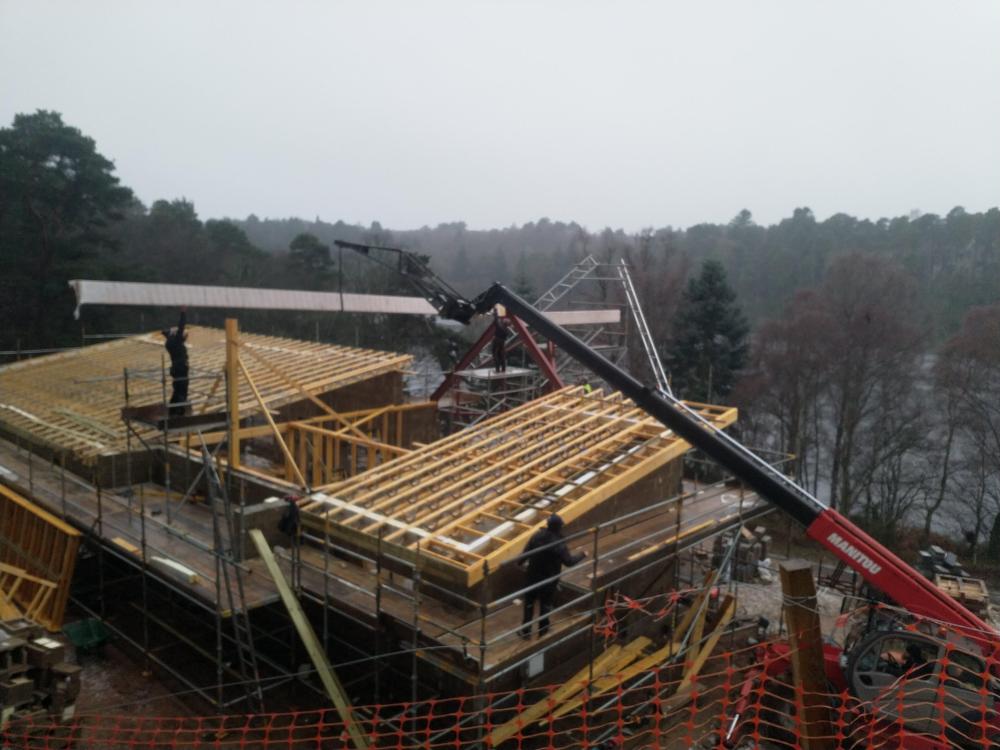

-
boiler behaviour,please let me know your thoughts.
JohnMo replied to Post and beam's topic in Boilers & Hot Water Tanks
A combi boiler uses a flow switch on the DHW to startup the boiler. It either isn't seeing enough flow or is a defective flow switch. Do you have a combi save devise installed, if you don't know you probably haven't. Is it the same for all taps or outlets, i.e. it never starts up? I would go around each outlet and log what happens to the boiler. Also your flow temp for the central heating seems very high. -
Why do people need such colossal houses?
-
Only referencing the actual hardware install, not the utility side of things.
-
I just make mine run at near to full chat for heating the house, set point of 35, knowing that the heat pump will only achieve 33 before the thermostat thermostat trips it. Depending on house temperature and heat loss due to outside temperature, I will have an hour and half run or 12 hours run time. Now all at 13p per kWh, with battery. Even if you want to run for long periods at low temp modulation helps, but as long as the water capacity engaged is there you get runs over about 10 minutes and power consumption doesn't really take a hit. Example I run a single fan coil in our garden room, it puts out about 500 to 1000W. My wife wants it warm in there until lunch time. So although the house is satisfied for heating, I keep the house UFH pump running and use the thermostat for the house to move the set point of the UFH electronic mixer from 35 to 28. This almost closes the mixing valve, but give me a working water capacity to enable the ASHP to run for about 20 minutes at a time, while only providing around 500W to the fan coil from a 6kW heat pump (min output 3.5kW), the house buffering the rest. This gives an almost constant temperature in the summer house. All done without a buffer, the volumiser I installed is now isolated, as it bought no advanced.
-
Gee you are all being taken for a ride. An ASHP install on a new build should cost no more than a £1000 more, than a decent gas boiler install on PDHW. And that's without any grants. Plus there is is no such thing a permitted development arguments, that seem to go on, with most threads on here, as permitted development does not apply while under planning permission.
-
Why would you need an MCS certificate? Got my prices from City plumbing
-
You could do without the grant for that or less. Full price ASHP £2.5k, cylinder £1k, bits and bobs £500. I ran my cables the electrician charged me 2 hours for termination and testing. I did the plumbing, but a plumber for two days max
-
Are you getting quotes bigger than £10k for a new build?
-
Supporting the insulation rather than the pipe?
JohnMo replied to garrymartin's topic in General Plumbing
Sorry for life is way to short for that. First hit on google search - multiple sizes are available https://www.bes.co.uk/rubber-lined-mild-steel-zinc-plated-clip-47-to-51mm-16770/ -
If you take the typical MCS install, they take the £7500, charge full retail for the heat pump, new cylinder, a bunch new radiators, a couple of mile of 28mm copper and then about 20 man days labour. Soon get to £10k. Typical boiler installation, take old boiler off wall, clip a new one one, couple pipe mods and any you go. 1 to 2 days
-
To get most advantage of ToU tariff you really need UFH and use as a storage heater. So a thick screed is good 100mm +/-. It takes a long time to heat and cool down.
-
ASHP with underfloor heating project question
JohnMo replied to Trojan's topic in Air Source Heat Pumps (ASHP)
The downward heat loss is a function of the floor U value, the delta temperature of the floor and the space below multipled by the area. So space below assume 20 degs, your flat temp assume 20 degs. Area 40m2. So UFH assume mean flow temp is 35. Your 0.75 R value, and U value is 1/0.75 so is 1.34 Downwards heat loss UFH 1.34 x (35-20) x 40. Is 804W, then multiple by 24 to loss per day and by 0.27 to get cost per day £5. With a heat the CoP will be around 3, £1.70 Radiator, fan coil etc. Temp Delta between your flat and downstairs zero so zero downward heat loss. Having UFH will cost you you around £1.70 per heating day. So about £320 a year. -
LG Therma V mono block Air Source Heat Pump
JohnMo replied to ProDave's topic in Air Source Heat Pumps (ASHP)
You can get around the DHW temperature probe with an on off thermostat and two resistors. I works and is working currently for me. https://forum.buildhub.org.uk/topic/36003-pt100-cylinder-probe-wireless-connection/ -
You can do gas. We started gas and 3kW of PV. Gas boilers are difficult if you have a low energy requirement house, as they are just too big. Now we have 7+kW PV, battery and ASHP. March is still heating season for us, but electric import yesterday was £1.60, today looks to be 65p (best cost days so far this year). Heating run overnight on both nights. That is only possible because we have the battery and can run E7, cost effectively. With the good and bad days of the winter, the battery and E7 have been £386 cheaper than running the house on just normal rate electric and a similar amount cheaper than gas and electric last year. Looking to make even greater savings during the summer. (I don't get paid for exported electric)
-
Think you are all trying too hard, tried various ways of doing WC, so far the most accurate (house temp stability) and cheapest to run is a set flow temp and a good 0.1 hysteresis thermostat. Cooling just flow at 15 to 16 degs, which is above dew point generally and you get a CoP of about 6 or 7.
-
ASHP with underfloor heating project question
JohnMo replied to Trojan's topic in Air Source Heat Pumps (ASHP)
Now take your calculations to the next level and work out the downward heat loss. -
ASHP with underfloor heating project question
JohnMo replied to Trojan's topic in Air Source Heat Pumps (ASHP)
DHW heating doesn't really help, because the heat pump either does heating or DHW not both at the same time. Modulation isn't really too much of an issue. As long as you have enough water capacity open the heat pump will cycle, but not short cycle. The biggest issue will be supporting the flow required for all the loops you have. So will be worth checking. A 4kW heat pump will have a max flow rate of about 0.7 to 0.8m3/h. A couple of fan coil units may be a better and easier solution to implement. -
I just use a filter on the down pipe https://www.celticwater.co.uk/downpipe-filter-rainus/
-
Why wouldn't you just use the controller that comes with it. If doing UFH basically run long and slow or if on a longish time of use tariff like E7 and batch charge, having a battery helps keep flow temps low as you can run longer and still keep cheap tariff effective. Anything else is just making it complicated for the sake of it.