


JohnMo
-
Posts
13308 -
Joined
-
Last visited
-
Days Won
200
Everything posted by JohnMo
-

Self built hybrid heating and hot water system
JohnMo replied to JohnMo's topic in Boilers & Hot Water Tanks
Just completed a proof of concept on the boiler flow temp switching. Started boiler via the hybrid relay manually, as a DHW heating cycle started. Boiler temperature is held back in line with the temperature curve for WC, boiler thinks it is 7 degrees. Once flow from ASHP gets to 40, WC switches off and boiler ramps up. When heating cycle is complete, WC relay remained energised, (wrong logic) supposed to be de-energised until hybrid mode re-calls for the boiler start. Found I had an OR instead AND in the switching logic. Quick correction, all good. Boiler seems happy having WC on one minute off the next and back again. So now have a combi boiler converted to PDHW (or X plan), for the cost of a relay. -
Do you need to remove, just cut them flush? Get them back to sort height difference? What issues are you thinking?
-
We went woodcrete ICF because it's an easy DIY option. Very little support required for the concrete pours. Build 6 rows high, fill with concrete 5.5 blocks high - repeat. Basic tools required. Good U values out the box.
-
We were typically using 5 to 9kWh each day via a panel heater during Nov (we got down to about -7. However we are now hooked into to house heating system.
-
Two ways to operate a heat pump with under floor heating. 1. Sized very closely to the heat demand, set up weather compensation and the let the heat pump run unconstrained by thermostats. It will then feed as little or much heat to the floor as required. Not a fan of any thermostats (may be one), so no actuators needed on manifold no mixer or pump. 2. The other way is to batch charge floor, you need a decent depth of screed and heat losses from house need to be low. Most situations the first way to run is best. Basically run long period at a low flow temp. You just heat the floor, you can also cool it. All depends on what you end having to pay after your £7500 grant. But I just did a self install without grants. You want plenty of insulation in any floor with UFH to lower the downwards heat losses.
-
You may be better with something like this, mitsubishi also do a unit similar. https://www.fastlec.co.uk/vent-axia-hr100r-heat-recovery-unit-top-access?gad_source=1&gclid=CjwKCAjwvvmzBhA2EiwAtHVrbysI1KZhxMFLHDd61I0ydleDArURhiPIGBSQXvY7pyoGALmP2ScJWxoChQ0QAvD_BwE
-
That's a big loft access hatch. 1200 x 600mm. First unit I came to will fit with plenty of room for hands etc https://www.titon.com/uk/products/ventilation-systems/heat_recovery_mvhr/hrv-1-25-q-plus/ Are you just ventilating the space shown? As that is a very low flow requirement about 45 to 50m3/h for supply and extract?
-
MVHR and log burner
JohnMo replied to Tetrarch's topic in Mechanical Ventilation with Heat Recovery (MVHR)
Sorry missed read - my bad -
MVHR and log burner
JohnMo replied to Tetrarch's topic in Mechanical Ventilation with Heat Recovery (MVHR)
Not really sure what you are saying. Agree with the above, but you made a comment about your room sealed boiler being in a room only a supply vent. But a room sealed appliance, has no interaction with the room. It is only connected to the outside, taking combustion air from outside -just the same as a stove with external air supply. -
MVHR and log burner
JohnMo replied to Tetrarch's topic in Mechanical Ventilation with Heat Recovery (MVHR)
Not sure that is the argument. It's not at all to do with MVHR really, it's about where the stove gets the air and good airtightness houses. The house and outside air pressure are assumed to be equal and the flue draw is about 10 to 20 pascals. If the house pressure becomes lower than outside, even by a few pascals the flue draw is lost and it's becomes easier for combustion gas to spill into the room. It becomes an issue when the air supply is convoluted MVHR ducts have a pressure drop of 20 to 100Pa and the 49cm2 is spread across the whole house not next to the stove. Most other appliances either gas or oil, can be switched off quickly if you need too, a stove burns until it runs out of fuel. @Alan Ambrose why are you saying ignore the rules, but going on to say trade it in and get one with external air supply? Seems an odd stance. -
MVHR and log burner
JohnMo replied to Tetrarch's topic in Mechanical Ventilation with Heat Recovery (MVHR)
A room sealed means the boiler takes air from outside the room. The combustion process and the air for it, is sealed from the room. It takes air via the flue. -
MVHR and log burner
JohnMo replied to Tetrarch's topic in Mechanical Ventilation with Heat Recovery (MVHR)
Not sure I could agree with any of the above. Follow manufacturer guidelines - nothing else, get a hetas installer and get them to complete the tests. -
Self built hybrid heating and hot water system
JohnMo replied to JohnMo's topic in Boilers & Hot Water Tanks
Parts used 1. A large 40 plate PHE, this could of easily been a close coupled tee. Already had this cost zero 2. 8 pin 230 volt relay. Already this cost zero 3. 4x Shelly plus 1 relays and 4. 2x Shelly plus 1 add-on and 5 temp probes (using for commissioning and one for control) items 3 and 4 £120 5. Plumbing bits and pipe. Around £100 Everything else was already in the system. 6. A resistor already has a box of 1000. Costs circa £220. Control logic Settings within heat pump sensor out a 230v signal. Shelly relay energised by the ASHP. Then via a Shelly scene, both boiler relay, CCT relay energised. A further relay used to select two boiler flow temperatures. A scene again controls this - hybrid relay on and ASHP flow temp below 40 low temp mode, above 40 high temperature mode. Need to wait for next heating season to test UFH hybrid mode. Any questions fill your boots and ask away. -
Self built hybrid heating and hot water system
JohnMo replied to JohnMo's topic in Boilers & Hot Water Tanks
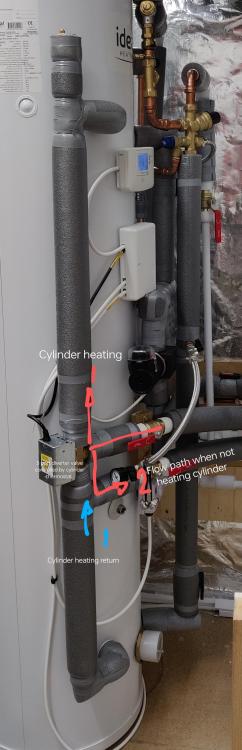
Phase 2, part 3, UFH hybrid mode The following differences occur when doing hybrid UFH. CCT pump is started, warm water passes through PHE and is heated via boiler. The water then goes to the cylinder diverter (not energised) so by passes the cylinder and goes to the downstream tee at the CCT. This water flows through the UFH loops as normal just a bit warmer. A few things needed to be added to make the above work The 3 port diverter at the UFH and CCT pump needed to be electrical separated and controlled together and seperately. So on DHW heating both are energised, for hybrid UFH mode only the CCT is energised. So power supply from ASHP now goes to a standard 8 pin relay. When energised the 3 port valve is energised and the CCT starts via separate circuits. A Shelly relay is energised when ever the ASHP hybrid Shelly is energised. This voltage by-passes the 8 pin relay powering the CCT pump directly. Next a summary of the additional bits added and the control logic. -
Self built hybrid heating and hot water system
JohnMo replied to JohnMo's topic in Boilers & Hot Water Tanks
Phase 2, part 2, Basic requirements are 1. single zone house and summer house, 2. no buffer 3. keep as simple as possible 4. no mixer or pump on UFH. Original plumbing had a return booster pump from the UVC as piping was too small and long for the heat pump circulation pump alone. This is the plumbing at the UFH. ASHP supplies hot water from the left to the CCT and pump and to a 3 port diverter. Normal operation mode ASHP and hybrid mode for cylinder heating is exactly the same. DHW heating, ASHP puts a 230v signal out to move a three port valve. This supply is used to start CCT pump also. 3 port valve when energised opens lower port and closing upper port. This flow goes to the return back to ASHP teeing into the UFH return pipe. The CCT pump running takes hot water at the first tee and pushes it to the cylinder coil, via the PHE and cooled water comes back to the second tee, goes to the 3 port diverter and back to ASHP. At the cylinder there is a second 3 port diverter. This is controlled by the cylinder thermostat. This diverter will be used in hybrid UFH mode. UFH on, flow goes to 3 port valve (not energised), up and to top UFH rail, then out of the UFH to bottom rail and back to ASHP. No zone valves, pumps or mixers. The summer house is close to the ASHP and the flow to that is simply teed into the flow and return with 15mm Hep2O pipe. Next Phase 2 part 3 hybrid UFH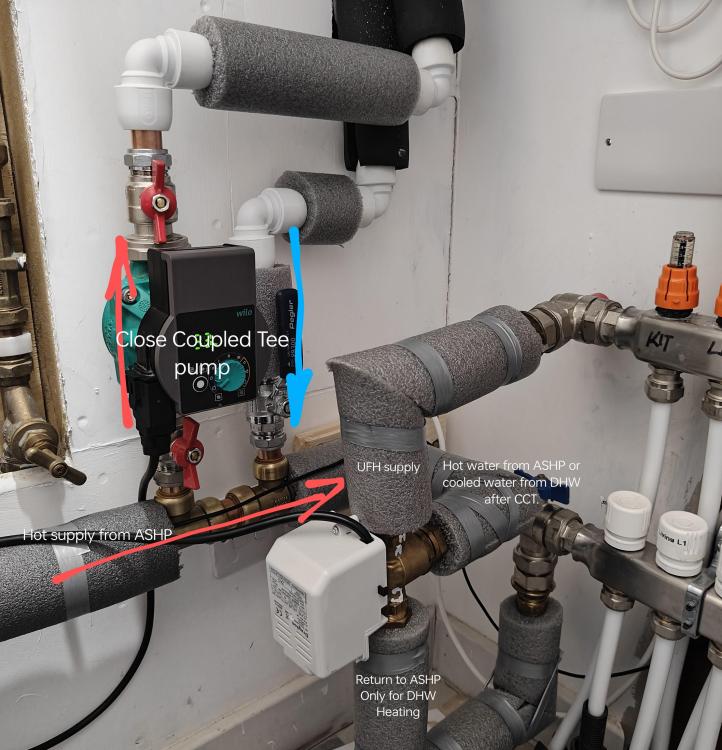
-
Do you have a typo on the application?
-
Self built hybrid heating and hot water system
JohnMo replied to JohnMo's topic in Boilers & Hot Water Tanks
Phase 2, part 1 One issue that had me scratching my head was, how do I get the boiler, using only the central heating connections, to flow at two different temperatures one for DHW heating and the other for UFH. DHW set to 60 and UFH set to a max of 35. So using it priority hot water demand mode (PHWD). Reading the installer manual for the boiler, it states weather compensation is only active when an outside sensor is attached. Meaning a set flow temp when not attached. So tried a resister (simulating 7 degs outside) on the outside temperature sensor connector. Connected boiler thinks it's 7 degs outside and disconnected nothing shows. So switching a resister in and out of circuit should give two different flow temperatures, by selecting an appropriate WC curve I should be able to flow at 35 degs for UFH and then 60 degs for DHW. So PHWD can be activated by switch in a resister (or outside sensor) Controlling the resister switching in and out. Shelly relay and a Shelly relay add on with temperature sensors was used. So the logic is quite simple. Hybrid relay on and flow temp below 40 - the resistor is in line for low flow temperature. Hybrid relay on and above 40 degs - the resistor is taken out of circuit to enable high temperature flow for DHW heating. Plumbing coming next -
Link not working?
-
Plus glazing, door and ventilation heat losses. Doesn't sound much, but you need to tomes by by 75x4524 (kWh per day) or let it get cold over night and panel heater takes a fair while (hours) to reheat. If it takes a kW to heat that's close to £6 a day on a cold day.
-
Thread I did last year if any help
-
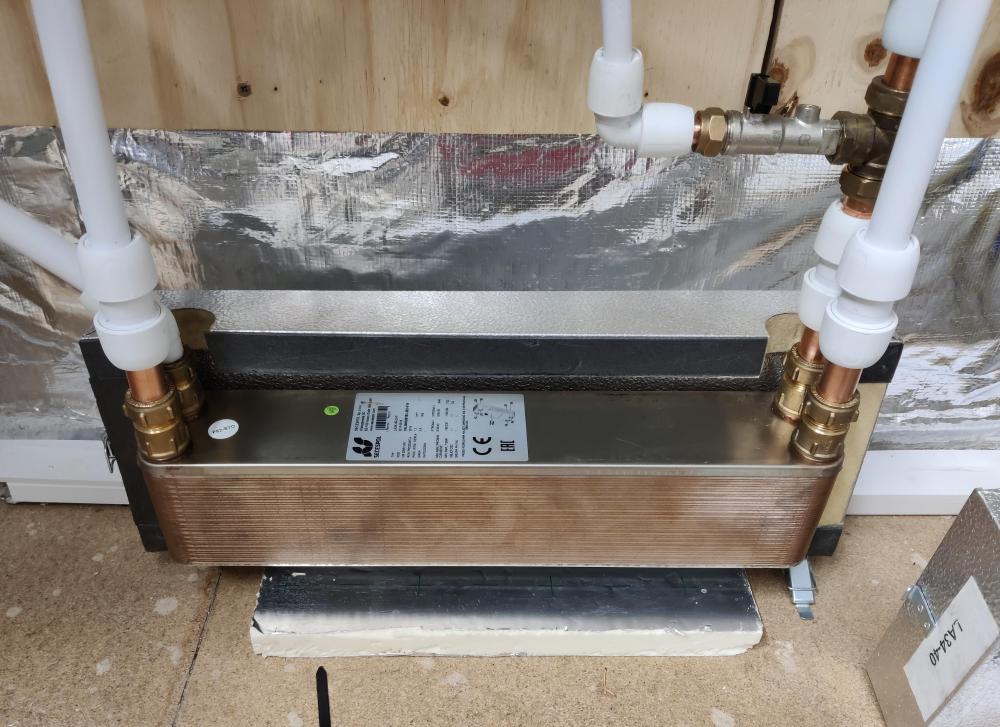
Plenty of information on ASHP is available on this site and very little on hybrid heating systems, i.e. boiler and ASHP. A few manufacturer designed hybrid systems are also available. When we built our house it was with an Atag gas combi boiler. We then installed an ASHP mostly for cooling, but it also heated our house well last winter and provided hot water via an UVC. The system below could easily be replicated by anyone wanting to install a hybrid heating system meaning little or no changes to heating system such as radiators. So the Atag boiler only 2 years old has sat idle for the last year. For periods where the CoP of the heat pump, means gas is cheaper why not marry the boiler and heat pump together. Most of the off shelf solutions, rely on the gas boiler doing the hot water, not what I wanted. Most the time the ASHP is way cheaper than gas (especially with solar). So makes sense to do hot water via the ASHP most of the time. Most ASHP already have all the control logic for hybrid mode built-in - mine does. I have a few location issues which makes the implementation a little more complex than I could be. Boiler and UVC are about 20m plus away from the ASHP, with UFH in the middle. The solution I chose to use has the boiler on a separate circuit to the ASHP. Combi DHW tails are not connected to anything and the isolation valves closed. Phase one Get hybrid hot water heating. Had a 40 plate PHE sitting doing nothing, so inserted in the flow line from the ASHP close to the UVC, the other side to combi boiler heating circuit. Set max flow temp to 60 on the gas boiler. I can change the rate at which the boiler adds heat (gradient), set to a max of 2 degs every minute. Initial run was all manually done to check concept. With ASHP only the reheat time of the UVC is around 40 to 45 mins, with boiler engaged about 20 to 25 mins. During test, I monitoring the ASHP and gas boiler and both work well together, neither running away temperature wise. Now how to automate. All control logic is in the ASHP, to use a boiler as a secondary heat source, you can set different outside temperatures for the following control schemes - 1. ASHP only, 2. ASHP leading, boiler following, 3. boiler leading ASHP following 4. boiler only. ASHP controller supplies 230v as a control signal to the boiler. But boiler is 20m plus away from the ASHP. So used a Shelly relay at the ASHP end and a remotely controlled Shelly relay at the boiler end. Set up a scene in the shelly app, switched live to ASHP end Shelly energised the boiler end Shelly relay. All worked fine. Set the hybrid mode (ASHP leading) to start at 7 degs and a delayed start of 10 minutes for the boiler, after cylinder heating starts with the ASHP. PHE, boiler on left side ASHP on the right. Phase 2 UFH - coming next.
-
MVHR and log burner
JohnMo replied to Tetrarch's topic in Mechanical Ventilation with Heat Recovery (MVHR)
For primary AND SECONDARY air. Not all are so check before you buy. Soap stone is a good addition as it slows down the output but also keeps giving heat for many hours after the fire is no longer burning. -
A shelly devise which has power monitoring?
-
MVHR and log burner
JohnMo replied to Tetrarch's topic in Mechanical Ventilation with Heat Recovery (MVHR)
Don't use or replace the stove. Worst case is you but an always open vent somewhere, defeats the intended purpose of MVHR. if you don't you could have carbon monoxide spillage into the house etc, not good. A silent smell-less killer. -
Have you thought about wall insulation? You will need it, if heating in the winter. An important thing with these timber buildings is they expand and contract quite a bit. There should be nothing on the build that constrains this. So nothing without expansion and contraction room between timber sections, floor and ceiling, nothing strapped to wall without sliding fittings. My brother in law has huge cracks in his because of this.




