


JohnMo
-
Posts
13296 -
Joined
-
Last visited
-
Days Won
200
Everything posted by JohnMo
-

Internal wall connection to ICF
JohnMo replied to metalgear2k2's topic in Insulated Concrete Formwork (ICF)
Isn't that just introducing a thermal bridge? Or is the majority of the insulation on the outside? -
Internal wall connection to ICF
JohnMo replied to metalgear2k2's topic in Insulated Concrete Formwork (ICF)
We did ICF and the internal walls are all stud - is this an option? Ours do not touch the the ICF walls. -
Ecodan immersion replacement - help
JohnMo replied to Tadpole's topic in Air Source Heat Pumps (ASHP)
I use this in home assistant to start immersion and stop immersion - may not be the best automation, but works alias: Immersion On description: Immersion on at 97% and 1000W triggers: - trigger: state entity_id: - sensor.givtcp_soc to: null - trigger: state entity_id: - sensor.givtc_pv_power to: null conditions: - condition: numeric_state entity_id: sensor.givtcp_soc above: 97 below: 101 - condition: numeric_state entity_id: sensor.givtcp_pv_power above: 1000 - condition: sun before: sunset before_offset: "-02:00:00" actions: - type: turn_on device_id: immersion relay entity_id: 90c9027a99ba569016742b380d47d115 domain: switch - action: notify.mobile_app_xxx metadata: {} data: message: immersion on mode: restart Then use another automation to switch off alias: Immersion Off description: Immersion on at 95% triggers: - trigger: state entity_id: - sensor.givtcp_soc to: null conditions: - condition: numeric_state entity_id: sensor.givtcp_soc below: 96 - condition: sun before: sunset before_offset: "02:00:00" actions: - type: turn_off device_id: immersion relay entity_id: 90c9027a99ba569016742b380d47d115 domain: switch mode: single -
First year with a borehole supply (recently moved in)
JohnMo replied to Kuro507's topic in General Plumbing
Our is around Conductivity is 305 microsiemens TDS is 145 ppm Your dissolved solids is higher than ours and the conductivity also higher. Both indicate the amount of stuff in water that isn't water. This is generally dissolved minerals and when you heat the water they form back to solids (scale) We also get deposits and have to descale the kettle every six months or so. We reduced the effects by adding a BWT combi care in the water feeding the hot water cylinder. The cartridge gets replaced once per year. We get the system serviced once per year, they check everything top up as needed. If it's run out it maybe the unit is too small for your consumption. -
How to mount an external door when using an insulated slab?
JohnMo replied to zzPaulzz's topic in Timber Frame
I would be tempted to cut way EPS, at threshold. Make a channel to drop Compacfoam (60 to 70mm wide and about 100mm deep) in and then bolt to the concrete. That would give you something structural to rest the door threshold on, it could then be screwed to the Compacfoam. Back fill the gaps with expanding foam and cut back with dried. -
Out of interest what is over the overlay boards and what is flow temperature?
-
I just did the G3 training, half a day in a classroom. Allowed me do my own install and services.
-
Help with first solar PV system shopping list using Victron kit
JohnMo replied to Alexx's topic in Photovoltaics (PV)
Sounds a very expensive system. Lots of components - simple is normally best. With lots of batteries why bother with the export side at all? Anything can be done, sensible to do it, is another question. You pay to join after providing structural design etc. don't expect to make much money. It is very post code dependent. So don't hold your breath on that one. -
how long before tiling over new 75mm screed
JohnMo replied to Post and beam's topic in Floor Tiles & Tiling
75 days is a long time. That's why I did my 100mm before the walls. Plenty of time to dry. But still had too much moisture to put wooden floor down without epoxy membrane. -
Using an existing ASHP hot water supply to heat a pool
JohnMo replied to peekay's topic in Air Source Heat Pumps (ASHP)
Gone are the days it got filled and you just on with it, if the sun warmed it great. If your heating you may need to treat it also, as it will soon start to smell. Plus be pretty unhealthy, as you will be optimal temperature for legionella and other bugs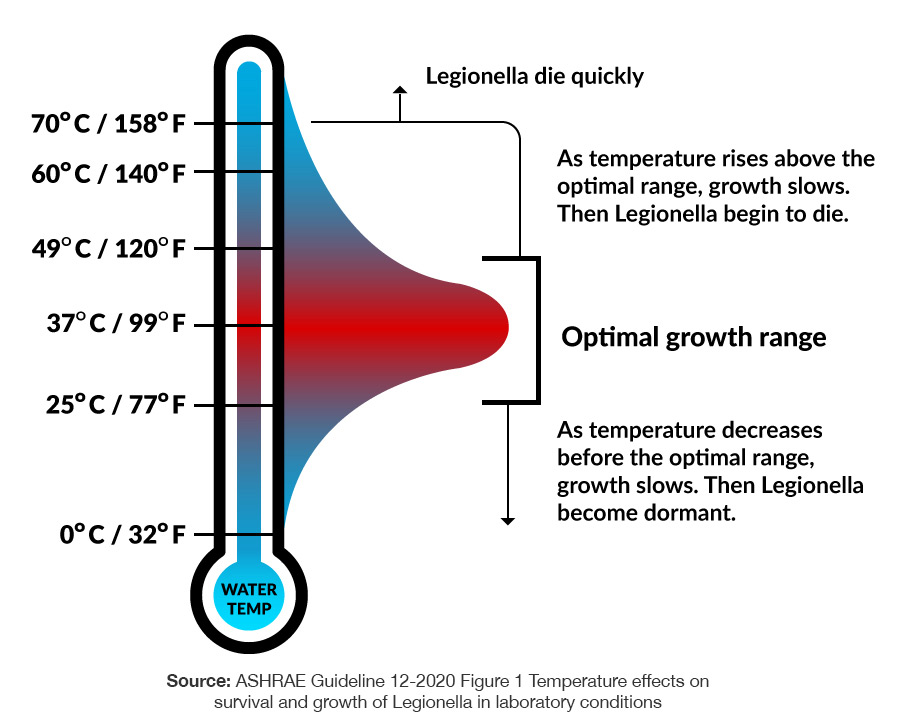
-
Ecodan immersion replacement - help
JohnMo replied to Tadpole's topic in Air Source Heat Pumps (ASHP)
Have you done the basic test try to run off the mains directly? The cutoff is part of the thermostat, so if that has been replaced either the immersion is broken (test as above) or it's not wire correctly. -
Ecodan immersion replacement - help
JohnMo replied to Tadpole's topic in Air Source Heat Pumps (ASHP)
I have found over the last year or so, when you have a battery a diverter isn't the best. Reason, your battery is fully charged before you start to export, then the diverter will start dripping electric to heat to immersion. I have found using the battery power works way better. Firstly you get full immersion power every time it switches on. I don't get paid for export so I want to make best use it and let the least amount get by. So I use a measure of state of charge and PV power, so for immersion to start battery has to be at 98% and if PV is generating 1kW the immersion is switched on and stays on until the battery depletes to 94%. I also use similar to get ASHP to run at a higher demand temperature. -
Pressure loss isn't an issue, it's driven by the longest single loop, rather than the accumulation of all the loops. Just think it's a zero thought design - that's what we did on the last 10 jobs - cut and pasted into yours. It will not be easy to balance, because the output of each floor emitter is the max it can be for a given floor area. The analogy being designing a radiator system to fit max wall space available not the heat output required. As you will see on my plan each room output is set to match the heat required, this allow very easy fine tuning of room temperature by a slight alteration of loop flow rate. It's also good for buffering the floor because the heat output matches what you need, once buffered your room temp becomes a combination of heat loss and floor temp. Low temps are good for CoP, but that isn't the whole story. My average CoP over this winter is about 3.6. which isn't that great - but, I only run in cheap rate or powered by PV. Both cases I want zero cycles while there is a demand for heat. Run a very simple WC curve starting at 33 and finishes at 36. Generally when running the CoP is 5 to 6 in the day and about 4 at night. The rest of the time I use the floor as a buffer to stop a summer house from being cold, so circulation pump runs 24/7. Have run full WC and generally I run just over 30 at -9, the rest of the time 28ish. But it's way cheaper to run on cheap rate or excess PV at elevated flow temperature. I get cycle times of about 6 hrs no what the outside temperature
-
Sorry just double checked it is 475mm - ideal HP cylinder
-
An UVC runs hot until the cylinder is depleted, the thermocline rises up the cylinder as hot water is consumed. So a 200L cylinder has approx 200L of usable hot water. A thermal store comes in two varieties, internal coil and external plate exchanger. The internal coil requires most the cylinder water to be several degs hotter than the DHW output. As the top half of the cylinder cools to say 45 degs, the coil heat transfer rate drops and you effectively has no hot water. An external coil performs better, but not as well as an UVC. Add a draw for UFH and you soon run out of hot water for the taps. I have used both and wouldn't go back to a thermal store, to many one way conversations with wife on why has the hot water gone cold AGAIN. Thermal store think big or don't think about them at all.
-
That would get my vote also, would also consider putting MVHR in there as well. 210L slimline is only 400mm diameter.
-
Big is best, with a ladder built in. All our Christmas stuff goes up there - it makes killing yourself, a little less likely.
-
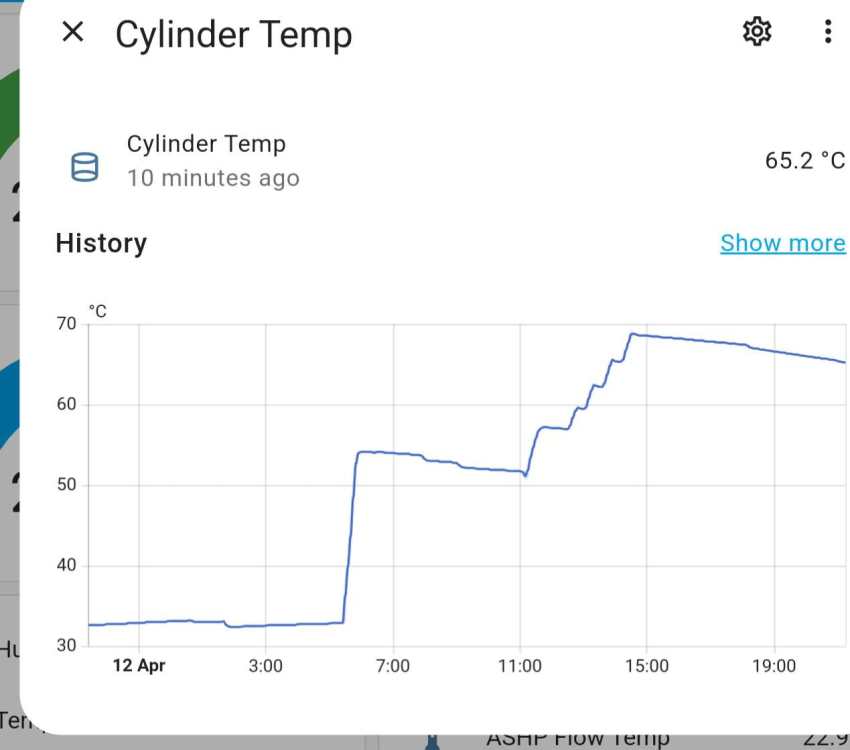
We have a 210L heat pump cylinder this is the temperature profile today. Before 7am it was heated to the 53 degs, temp dropped doing wash up etc. At 11am excess solar PV heated to nearly 70. The drop around 1900 was me having a shower. The temperature sensor is in the bottom third of the cylinder, so loads of hot water left. So a 150L heater to decent temperature should be an issue. But the hotter you heat the quicker it looses temperature so you maybe better a slightly bigger cylinder heated slightly cooler? But if you are thinking heat pump in future, just install a heat pump UVC now and won't connect the heating coil, then do a 180 to 210L. Thermal store if connected to heating could be in the region of 300-400L to be useful.
-
I didn't, hadn't come across it. An alternative to the garage, is an insulated shed near the house between ASHP and house. It maybe better than an uninsulated garage, it may allow much shorter pipe runs, the cylinder could live there, and be closer to heat pump. The expansion for cylinder and heating could be in there as well. Or form an insulated space in the garage. We have an insulated shed between heat pump and house, expansion vessel, heat meter etc are in there. Shed insulated on floor, roof and walls, all pipes are covered in 25mm insulation. We also have our well treatment filters in there also. No issues even down to -9.degs. A couple of things to consider with long runs between cylinder and heat pump. 1. Cylinder temperature, are you using a temperature sensor connected to heat pump, and signal strength? 2. Or a thermostat. Think about wiring runs. Other thing is the three port valve location that will determine where pipes have to run
-
Running electric UFH sounds super expensive. Why not a good old storage heater, that least you charge up on cheap rate. A simple direct UVC can be charged to about 70 degrees and should last all day between heating. Run it on a smart tariff or good E7.
-
We did OSB and then laminate floor over It was pretty rubbish - screed over sounds much more sensible, full contact with pipes and aluminium, should perform much better.
-
Just a matter of working through the insulation values of the floor above the pipes and see how that affects your flow temperature. If the flow temperature stays sensible that's your answer.
-
But isn't bucket loads of tonnes of concrete or screed a big enough buffer already? Thermal conductivity for concrete ranges from 0.8 to 2.5 W/(mK), thermal conductivity of water is 0.598 W/m·K at 20 °C. So the floor should suck heat away as quick as you can give it, as long as you have delta T between floor and the water. So why would you need or want a buffer? Aren't you just adding inefficiency by doing that? An additional pump, possibly distortion on each side of the separation? Leading to increased flow temperature, for little or no advantage.
-
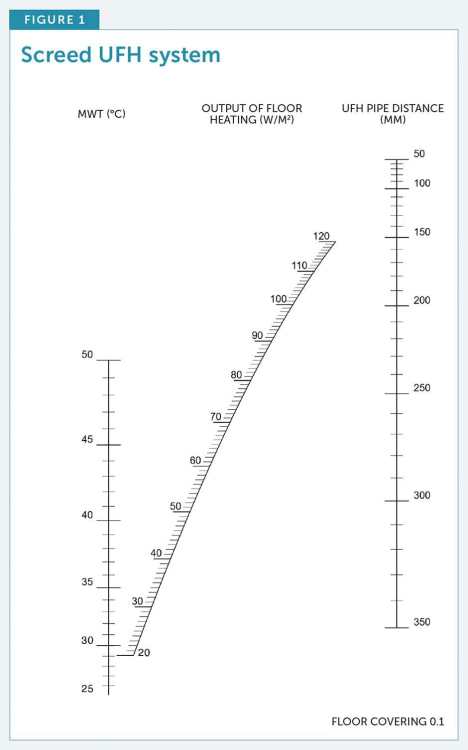
Sounds a big heat pump. But ok for batch charging. Simple table for working out flow temp based on room heat loss. Just draw a line between centres and W/m² to get mean flow temp. One you get low W/m² flow rate doesn't change dramatically with pipe centres changes. You may have to extend the W/m² line downwards. Remember a heat pump flows a min 25 degs in heating mode. Most the time the average heating temp is closer to 7 degs than design temp, so half the heat input is needed. MWT is mean water temp, so mid point between flow and return temp.
-
Cylinder Choice, Heat Pump, Gas and Oil Boiler
JohnMo replied to JohnMo's topic in Boilers & Hot Water Tanks
We (2 off us) have 210L, 50% of the time it's heated once the other 50% twice a day. But currently, although heated this morning its been further heated to 68 degs via immersion (excess solar).




