DevilDamo
-
Posts
1483 -
Joined
-
Last visited
-
Days Won
6
Everything posted by DevilDamo
-
The angle of the stairs cannot be anymore than 42 degrees though hence why I wasn’t sure why you asked the question? The W.C. pan is positioned on the stair side so not sure how much noise you’d expect to hear through a W.C. door and block partitions unless somebody shouting when they have run out of toilet roll is what you’re referring to? ?
-
 Your best bet (which has kind of already been mentioned) is to instruct a technician/technologist/architect to put your ideas into reality because once the regulations have been implemented, that will transform your design and put things into perspective.
 -
Generally speaking, the layout works well. You could increase the width (and depth) of the W.C. by pushing into the Utility slightly, say another 300mm as the Utility would still be a decent size. You could pull the doors to the front Bedrooms down to (for example) the line of the wardrobe to Bedroom 3 and still utilise glass balustrading where those partitions are no more. If you wanted to make the staircase look and feel more grand, you could have an 1800mm wide opening at the top, which would also increase the width of the Master En-suite. This would obviously slightly reduce the width of the Bedrooms on the right hand side including their wardrobe space. Not entirely sure on the questioning or reasoning behind @puntloos comments though, irrespective if the floor to ceiling heights were 2.4m and the max. angle of the stair being 42 degrees!?! The W.C. concern is a new one to me as well because aren’t the majority of new build W.C’s located within the Hall that is near or opposite to a Living/Lounge area?
-
So are you basically asking whether there’s any cost saving in upgrading as opposed to a new build?
-
Ok. I have an office in Surrey and have contacts for both engineers and contractors but of which would work with me. I’d normally initiate the process and get them onboard as and when required.
-
It could be an option but would have to review it in more detail to see if that would be a suitable alternative. There’d obviously be no point going down the cranked steel route if the ceilings have to come down. It’s probably more for an engineer to look into in conjunction with a builder. Perhaps you could mention it to your contacts? Are you actually in Surrey or was that the first ‘cranked frame’ link you found?
-
Ok it makes a little more sense. The roof over the large window may have the skeilings but the front projecting part with the smaller window doesn’t have a skeiling does it? Are you only looking to convert the main roof or the front part as well? There may be an option in adopting cranked steels and supporting your new floor off that. But that also comes with its practical and cost implications.
-
Yes, more or less. Fire doors to all rooms that provide the protected staircase, mains linked with battery back up smoke detectors to Halls and Landings and a heat detector to the Kitchen area.
-
I’m still a little confused. Do your first floor rooms have skeilings along their external walls? Ceiling joists would normally connect at the rafter feet and therefore stopping the roof from spreading. Are you saying the ceiling joists do not connect and are actually positioned lower than rafter feet?
-
Correct. Three-storey houses would need to meet the BR’s in terms of structure, fire and thermal so a decision would need to be made sooner rather than later because with it being a new build, you’d make those provisions now. Any loft/second floor that provides any habitable accommodation would need to meet those requirements.
-
What are your floor to ceiling heights? Why is the roof to the single storey rear element so high up? Is it to do with ceiling heights hence my comment above? There may be a slight access/design issue with the door between the Landing and Bedroom 3 assuming the front projected part is still to have the lower eaves? The line of the wall between the Landing and Bedroom 3 doesn’t appear to be shown correctly. The Landing side of that wall lines through with the internal face of the front wall to Bedroom 2 but does not line through with the internal face of the front wall to Bedroom 5. If you’re going to use the loft as storage, then you can do what you like to access it. The roof could also be designed with a slightly simpler structure. If however you’re going to use the loft for anything else that resembles a habitable area, it will need to meet BR’s in terms of structure, fire and thermal. If you are going to use the loft as habitable, you’d normally look at having four Bedroom’s on the first floor and a fifth/Games room on the top floor. Who has designed this house because in another post, you mentioned your wife is the architect or were you referring to that as her making the decisions and having the final say?
-
Minimum stairs in a new build - 42degree?
DevilDamo replied to puntloos's topic in New House & Self Build Design
I was referring to the front Bedroom (within the projecting part). The plan attached a couple of posts up noted this as Bedroom 4 but your latest extract shows Bedroom 4 in the top left. What’s the latest plan for the front part of the house, in particular the first floor? -
To save costs in having to push back the retaining wall or have the new rear wall of the extension act as part retaining, how about extending to within 900mm of the retaining wall, which will maintain a path around?
-
Minimum stairs in a new build - 42degree?
DevilDamo replied to puntloos's topic in New House & Self Build Design
It doesn’t look like the door from the Landing to Bed 4 will work, unless you don’t mind the corner of the door being chamfered to suit the roof profile of the front gable? It also sounds like you’re pretty much decided on the spiral staircase irrespective of the advice you have been given so will not comment on it anymore. -
Minimum stairs in a new build - 42degree?
DevilDamo replied to puntloos's topic in New House & Self Build Design
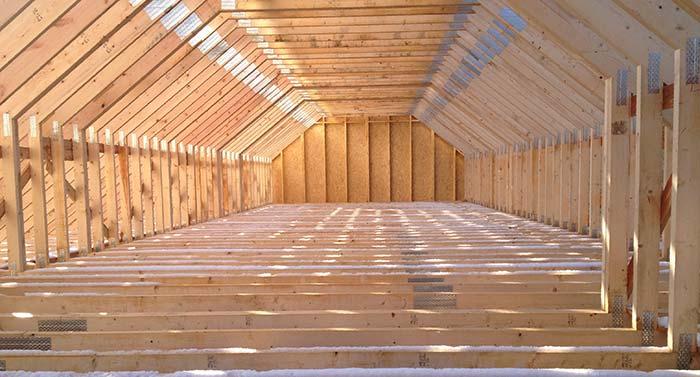
Your architect must have produced a workable section in order for the elevations to have been produced? The section would show the exact build up of all the various elements... their structure, insulation and internal finishes. This would really start putting a perspective on how much space you have, in particular at second floor/loft level. I assume the cross sections you’ve provided are as you said just generic ones with the software you’re using as the floor to ceiling heights, first and second floor thicknesses along with roof build up do not appear to be relatable or feasible? In terms of the roof structure, your two options would be cranked steels with cut timbers (First image) or attic trusses (Second image). Whichever option you/the architect/the engineer go with, the rafters would more than likely be 220-225mm deep, which excludes any insulation required to the underside.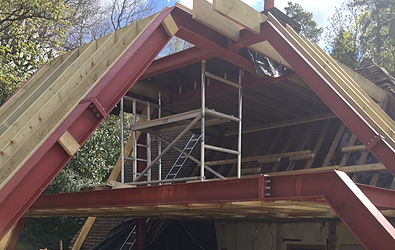
-
“Telebeam” is what @PeterW mentioned above ?
-
Minimum stairs in a new build - 42degree?
DevilDamo replied to puntloos's topic in New House & Self Build Design
You would still see most of the rooflight (in its current position) if the new stair followed the existing. The rooflight could be re-positioned or re-sized to sit directly and centralised on the actual void, which would provide more benefit. A section, a cross section through the building. It was just to see what floor to ceiling heights you had and how much usable space there’d be in the loft by the time you’ve taken into account the 900mm high dwarf stud walls. It’s not impossible to move furniture up and down spiral staircases because if they couldn’t, they wouldn’t be designed or manufactured. You’re obviously restricting the use by reducing the width and 600mm... that’s the width of a kitchen/utility worktop. It’s so narrow for a stair of any kind. Some furniture can pose issues with your normal width doors but bear in mind, the normal minimum of those are 762mm with some being 686mm which are both wider than what you have stated. Also bear in mind you’d normally have direct straight through access with a door or you may have to deal another corner/turn once you’re through a door. With a spiral, you’ll have those restrictions for approx. 2-6-2.7m high. I think it does really boil down to your intended use for the loft. If it is just going to be a glorified storage area, then do what you feel is best. If however you’d like to provide some additional habitable accommodation up there in the form of a Bedroom or Games room, then you’d want the access up to it as traditional as possible and therefore flowing with the existing stair. I also assume the roof will be formed with cranked steels and lose cut timbers or were you going down the (attic) truss route? With the latter, there may be a few issues in trying to achieve that full height vaulted look. But of course, that is for a truss manufacturer to advise upon. -
Why has your SE stated all the existing ceilings need to be removed? In your normal loft conversion, the existing ceilings are retained and new floor joists are positioned between and fixed to the sides of the existing but maintaining a gap between the bottom of the new joists and existing ceiling. There may be some minor disruption and localised re-decorating but that’s generally the extent of the disruption. If you have a height of 2350mm from the top of the floor boards/deck to the underside of the apex, then you should have room to achieve a complaint conversion by the time you’ve upgraded the floor joists and rafters. If you said this dimension was 2200mm, then I’d suggest to not bother, unless of course there was scope to replace and re-pitch the roof.
-
Change to design after permission granted
DevilDamo replied to Field_of_Dreams's topic in Planning Permission
Ok. If you were to proceed down the VoC route, you’d have to pay an application fee of £234.00 with a determination period of up to 8 weeks. Your other option is to submit a revised Full application as you’d be exempt from having to pay the application fee but would still have a determination period of up to 8 weeks. Just a note on the “free go” is that the revised application would need to be submitted within 12mths of the previous and you haven’t used up a free go on the ‘site’ before. -
Minimum stairs in a new build - 42degree?
DevilDamo replied to puntloos's topic in New House & Self Build Design
With this stair void, are you suggesting this will be exposed all the way up to the underside of the rafters? If so, you can still achieve this same look and feel with the new stair over the existing. Imagine the current stair from ground to first... just take that up from first to second, which will provide you with an additional room or access to two rooms. Do you have a section through the building? Spiral staircases are ok in certain situations but where they’re really more exposed and made a feature. They’re a pain to move furniture up and down and in some instances, actually take up more space than a traditionally designed staircase. The one you showed is 600mm wide, which is really tight and is something you’d normally see and use for a wine cellar. You’d want a width of at least 800mm to make it flow and work better. -
Minimum stairs in a new build - 42degree?
DevilDamo replied to puntloos's topic in New House & Self Build Design
Are these your current proposals? If so, I’m confused why there would be no loft void at the top of the new stair if it was to follow the line of of the one below as you’d end up in the middle of the house/roof? You’d also still have a stair void/atrium but just not as big. It’ll still be a grand entrance along with a feature stair and wouldn’t look like an after thought, which is what I think you’d end up with if you went down the alternating tread or spiral stair route.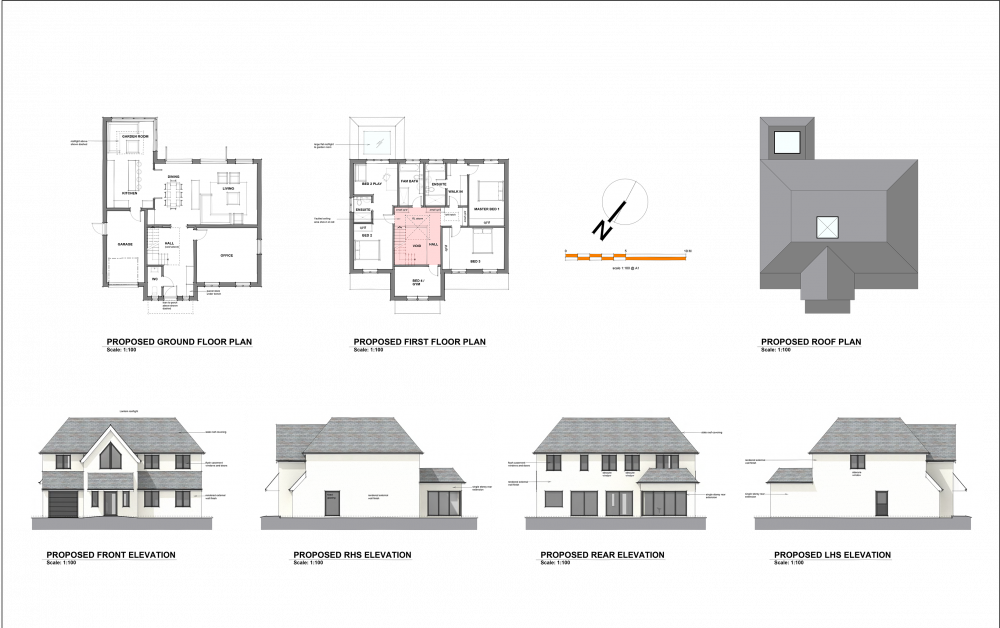
-
Change to design after permission granted
DevilDamo replied to Field_of_Dreams's topic in Planning Permission
A Section 73 application is a Variation of Condition application, which is completely different to a Non-material amendment application. The application fee, process and timescales are different. Just out of interest, what type of application was the original, Householder or Full? -
Minimum stairs in a new build - 42degree?
DevilDamo replied to puntloos's topic in New House & Self Build Design
If it’s going to be storage area, then not an issue. If it’s going to be more like a habitable room/area either now or later then it will need to comply with the BR’s for structure, fire safety, thermal, electrics, etc... With it being a new build, you’d build out the loft as it it was to be a habitable room now as it’ll be a lot more work not to mention expensive dealing with it later. I saw your other thread with the floor plans. Why can’t the new stair up to the second floor follow the design and layout of the one below? -
Minimum stairs in a new build - 42degree?
DevilDamo replied to puntloos's topic in New House & Self Build Design
The fact it’s a new build dwelling, you should have no reason but to comply with the regulated stair design, i.e. max. 42 degrees, depths of landings as wide as the stair, 2m headroom, etc... Where the BR’s provide the reduced regulated requirements, i.e. space saver stairs, 1.8-1.9m headroom, those should only really be used for loft conversions so those to an existing house where space is limited. As @Temp mentioned, it’s really going to be down to Building Control and various Council’s along with Approved Inspectors may have slightly different views. -
Newbie extension question
DevilDamo replied to Deanj1971's topic in House Extensions & Conservatories
Apologies, have just seen this. I have actually answered the question for the OP on another forum ? @Deanj1971 You’d definitely get away with a 9ft wide extension running the full length/depth of the dwelling. You mentioned about the porch being original and therefore using that to increase your width allowance. Although that could be technically correct, it does get a little problematic and confusing due to the position, size and shape of the porch. Planning and the PD rules for front side and rear extensions may come into play. Your best and safest bet would be to extend half the width of the dwelling excluding the porch. However, you shouldn’t have any major issues if you did try and seek formal Planning and all really for the sake of an additional £103.00, should you choose to secure a CoL.