PeterW
-
Posts
18480 -
Joined
-
Days Won
207
Everything posted by PeterW
-
 Definitely worth giving SWAT Engineering In Bournemouth a call
 -
Is it gable barge boards or a hipped roof ..?? If it was me I would use the Freefoam UPVC and also strip the bottom couple of rows of tiles off and put over soffit vents in and underlay trays. The edges of the underlay have probably had it so trays will keep water out and make sure it ends up in the gutters. Box ends are fairly easy to do in one vertical piece if you buy the double ended boards - think they come in 400 and 600mm deep. Looks tidier than using a horizontal joiner. There was a decent post by @Onoff on a flush barge board - think that was Eurocell though.
-
OK so this is an install via the Green Heat scheme ..? That’s different as they may be purchasing directly and not via distributors. These guys have stock of a lot of the mainstream units for delivery - any reason you want Ecodan ..?
-
Gonna need some photos ..!! Manufacturer would be helpful too ...
-
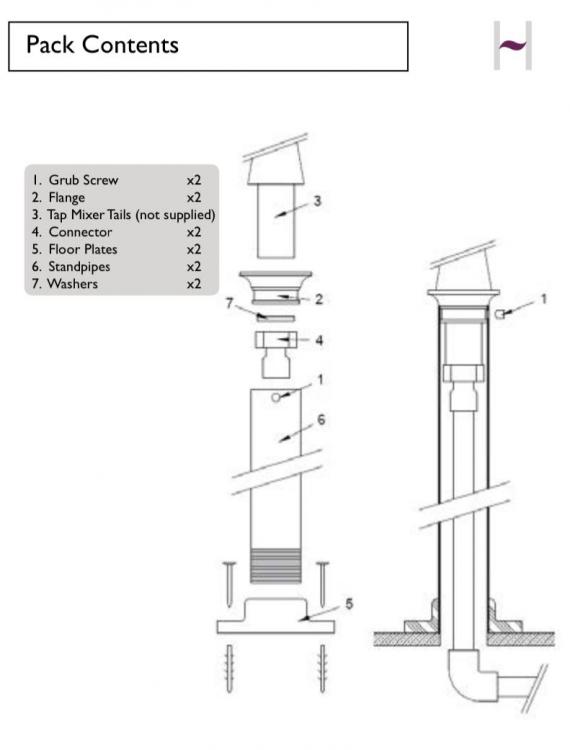
Ok ... is it a Watersmith one ..? Should be a pack of fitting with it, got a tap connector plus other bits ..? Should go together like this ..
-
I mean the header that he refers to here .. The frame header is integral to stopping the jamb moving if he’s not got anything decent to fix it into which is what he is saying. Assuming @ProDave has decent double frame either side then the fixings are holding his jamb back.
-
the shroud is probably something like 1.5mm stainless or chromed pipe - perfectly suitable for water to go through. Alternative is they are something like this ..? They need a copper pipe up the middle. https://www.screwfix.com/p/watersmith-heritage-bath-standpipes/3166P If it looks like it’s welded or seamed clothes rail then they may have fobbed you off with something else though ...
-
Multi Pro Fireboard Kingspan insulation - Testing Required
PeterW replied to NewToAllOfThis's topic in Building Regulations
You would need to contact Resistant to ask them for this. The board itself is A1 fire class but it’s BBA certificate is for fire resistance on internal walls. I’ve not seen a full composite wall test needed and you are using it as a racking component so it is in line with the certificate for that, but not sure the A1 fire class is also for when it is used in a racking situation Are you close to a neighbour hence why he is asking ..? Doesn’t entirely make sense as the external cladding is the point of fire spread. -
Measure the pipes and you’ll find they are probably a “standard” size such as 28mm or 32mm OD. They are expecting you to fit a compression backplate or similar to the sub floor and then the stand pipe fits into that. Water goes up the inside of the standpipe, no flex required. Photos and make / model of the taps also useful.
-
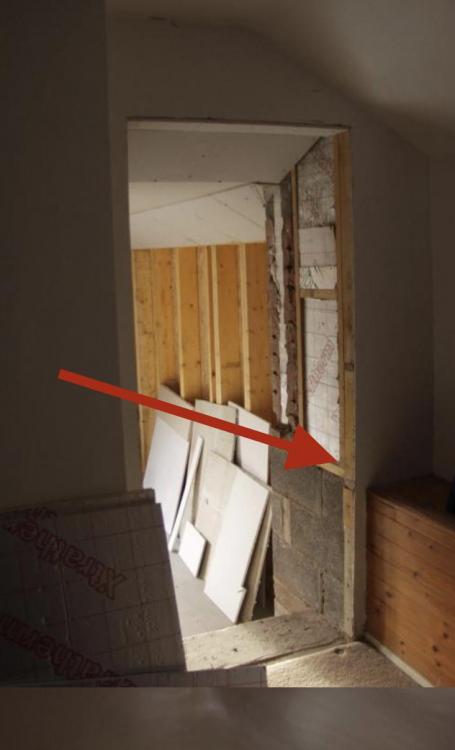
Header is irrelevant. So I would be carefully cutting back the plasterboard to get to the timber that is arrowed in the picture below, and then screwing the hinge side to that. Looks nice and solid.
-
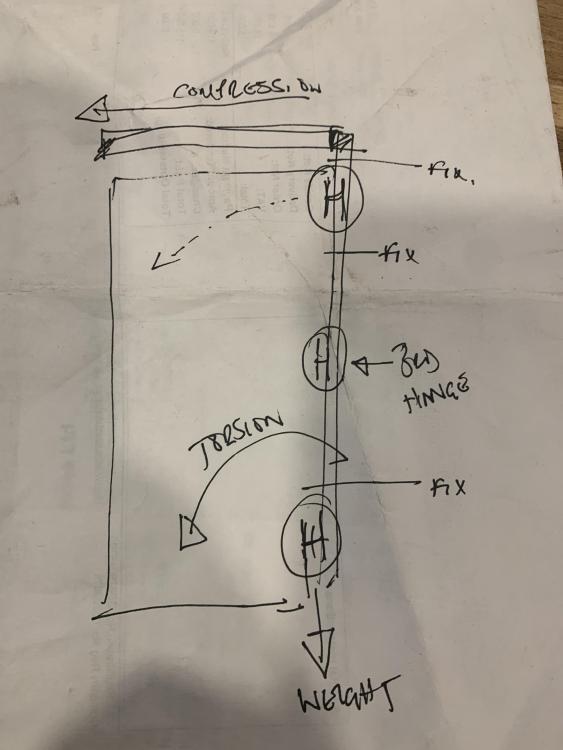
Vector forces through the frame - the weight on the hinges is unequal, so the door is trying to rotate about the bottom corner when it is closed.. The hinge side of the frame is being restrained at the top by the compressive strength of the header. Hence the suggestion by @Onoffto replace this with ply weakens the frames resistance to turning so it is relying on the screws and fixings to hold in place. This is why adding a third hinge helps as it restricts the turning moment on the top hinge and the pull on the frame. When the door is open it’s the frame fixings in shear that are stopping it twisting off the wall - hence the need to use a decent frame fixer into something solid. Two will hold a door, 3 are ideal, above and below the top hinge and above the bottom hinge ... Suffice to say .... Get the door, fit a frame and crack on ..! Unless you’ve just scored a nice 3” thick solid oak door off a cathedral, you’ll not have any issues ... Frame nice and plumb and square and you’ll be done in no time.
-
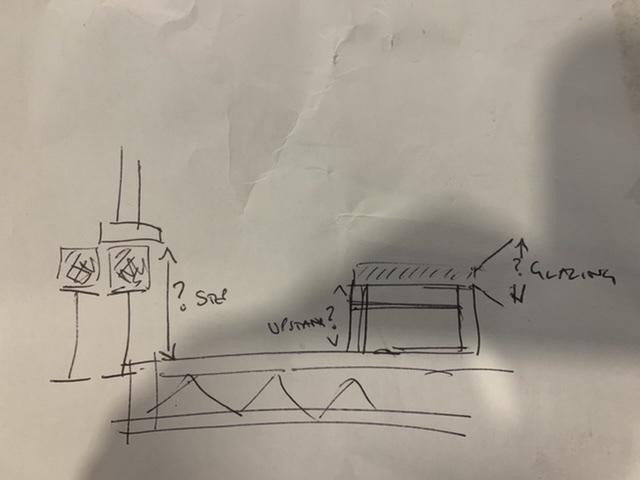
ok - can you fill in the gaps on this picture ..? Depth to the bottom of the doors/step Depth of upstand Depth of Glazing
-
OK so Building Control may require you to have lockable doors with a restraint bar if that’s the case as it will fail building regs. Better to get the planning approval now for use and then do it all in one go.
-
As the drawing from @joe90 that shows the difference with the frame types. The force on a frame is tiny - you can use the same frame for a 40kg fire door as you do for a 7kg egg box MDF door, the difference is the hinges and how well you screw it to the frame. If you’re making a door you may as well make the frame. Use 5x1 Planed All Round timber and then use the rest for your door ledges and brace, and then clad it with T&G floor board assuming you’ve got a standard cottage door.
-
Including a gable end you would need to budget £30/m around here for that.
-
Ok so that is a different type of construction and not a classic warm flat roof. The OP has non permeable insulation as part of the build up.
-
Ok so that will barely fit at standard frame and door, you need a door that you can trim possibly a few mm off both edges. A standard frame may fit but (big but..!!) you’ll need to get a rebated frame as they get their strength from the thicker side of the framing. This is an example of a rebated frame, you can get them from Jewsons but ask for a Rebated 5 inch Internal Door Lining https://www.wickes.co.uk/Wickes-Softwood-Rebated-Door-Casing-33-x-131mm-x-2m/p/200332# May be easier to trim the wall opening to get this to fit, and tidy up afterwards.
-
It is very relevant !!! If you don’t have a big enough gap it’s pointless. Middle ..??
-
1) yes it’s a frame kit 2) no it’s just an example of one - you can get them everywhere 3) no idea until you measure up Go get a tape, measure where the door is supposed to be fitted at top middle and bottom and post the answers, and then let’s do the next steps.
-
Is there a sarking or OSB layer in there somewhere ..?
-
I’m trying to make sure we are referring to the same thing ..!! The problem with the “frame kits” as you refer to them is they are a standard size. They will take a door at 838mm or 762mm. The trenching cuts in the head dictate this. If you aren’t going to be able to use the standard sizes then it’s quicker and cheaper to do what @joe90 and me are saying and make your own. So let’s start with basics. Measure across the gap where the door is going at the top, middle and bottom and post the dimensions.
-
Can’t recall but If anyone has played with it then it will cause issues as you’d need to reset to factory to start again. Model number would be useful
-
Is that in their T&Cs about switching ..? Or is it when you are a customer so you can’t switch between tariffs ..?
-
MVHR - list of questions/thoughts
PeterW replied to mjward's topic in Mechanical Ventilation with Heat Recovery (MVHR)
airflow is so low, and the exhaust will be mixed from non heated rooms such as kitchens and utility rooms that the increase in output temperature will be borderline 1-2c at most. With a maximum 85% efficiency you’ll be getting very little additional heat effect back. -
Just be wary of railing heights if that is an accessible roof. There looks to be 3 1/2 courses of blocks so that parapet is 780mm less any allowance for the insulation and decking. To meet regs it will need to be a minimum of 1100mm so you either need another 2 courses of blocks or some type of railing on the top of that wall.