


Fallingditch
-
Posts
217 -
Joined
-
Last visited
-
Days Won
1
Everything posted by Fallingditch
-

24v Inverter Requirements for 240v Horse Clippers
Fallingditch replied to Fallingditch's topic in Energy Storage
24V is operational fulltime at the stables - so how about two solar panels in series with a conditioner or whatever? And where do you buy this stuff from? -
For the last two years, I have used a pair of 12v batteries and some 24v LEDs to provide power to some off-grid stables. Every now and again, I take the betteries home and charge them up. This setup has worked a treat My partner has to clip her horse's coat regularly. With a set of mains powered clippers - no problem. But since going off grid, and having bought a battery powered cordless clippers, they are not man enough for the job. So I'm thinking of going back to 240v clippers, and installing a 24vDC to 240VAC inverter. Thing is, there are a lot of inverters out there at a lot of different price points - can anyone advise me on what I need to be specifying here? Maybe even suggest some brands?
-
You've explained it all really well - but excuse my ignorance - I'm missing something ... Are there any skews at the ends of the main sections of the roof ? around the end of the tiles next to the larch larch fascias? are those tiles simply held down by their own weight?
-
Overhanging tiles on roof - not.
Fallingditch replied to TheMitchells's topic in Roofing, Tiling & Slating
Nick I understand (I think) how on a gable wall slates can be laid on mortar and overhang 50mm so as to get rid of the rain without being ripped up by gale force winds. But I don't understand how on the non gable wall you stop the slates being lifted? (which is what the dry verge does, I think?) Excuse my ignorance here but am trying to understand the pros and cons of dry verges ! -
Architectural Aluminium
Fallingditch replied to worldwidewebs's topic in General Construction Issues
I am trying to work through the slate roof detailing on my block and block and Marley eternit weatherborded rectangular footprint house. Every article or reference I read assumes the existence of soffits, fascias abd bargeboards - then I read this post ! So I guess the question is Terry, was it the Kytun 'custom folds' you referred to meant that soffits and fascias were not required? -
I came at this from another direction. First question is, what's the maximum demand for Domestic Hot Water? for many of us on the forum its two concurrent showers and maybe a hot tap. That gives you two options to deliver it: either from a single domestic boiler rated around 28kw or from from a tank full of the stuff (which could be a Thermal Store or a DHW Cylinder) You get the energy into the tank using electrical energy from your solar panels and/or ASHP. Typically you bring the tank up to the temperature you want by means of a smaller capacity boiler. (You could actaully keep the tank at a lower temperature level and use electrical top up heaters for your showers and baths). There's a significant disadvantage to tanks full of hot water however, and that's how to stop them leaking heat 24x7. JSHarris had this issue - he tried applying additional insulation but that didn't work and he still had an overheating problem - especially in summer. At that point he took the tank out and replaced it with a Sunamp phase change energy store, (which is very similar in function to a tank of hot water but much smaller and leaks a lot less heat). If (like me) you decide "my house is very well insulated. I am not going to need a great deal of energy to run it. So instead of focussing on using the minimum amount of energy I will take the simpler option and stick a boiler in" then the 2nd question becomes "what fuel?" I too don't have mains gas but I have cooked with and been heated by cylinders of LPG for many years and I'm perfectly comfortable with it as a fuel. My last LPG Boiler was still running strong after 14 years with (ahem) very litlle servicing. NickfromWales has posted several times on what in his experience the best boilers are, and they support LPG out of the box. I also have to stay I've also lived with oil boilers and am not impressed. Noisy, smelly things, and definitely no good for cooking! So a 28kw Vaillant LPG Combi boiler and a gas hob in the kitchen it is for me. That then leaves the question of Solar Panels. If flogging the generated energy back to the grid has become uneconomic and you don't have a hybrid car to charge - in winter and the colder periods of spring and summer, you use it to heat the house. That leaves summer - and then its an economic question - shall I spend around £1.5 k on a Sunamp to store the energy and reduce my water heating costs? Even run an air conditioner to cool me down? One final point about the showers. To run two concurrent showers, you really want to install a cold water accumulator (unless you have consistently high mains pressure). The accumulator (c. £500.00) will give you stable water pressure ate all times and this means your boiler will drive your showers (flow rates available on request) Let me emphisaise that the approach I am taking would not be to everbody's liking (the siting and replacing of 4 x 47kg cylinders for example). But I thought that explaining my reasoning would be useful to others.
-
New build is well underway. It's a fairly modern design (well inside anyway). We don't have wardrobes, chests of drawers etc, but we do have a fair bit of stuff to store. While researching kitchen construction, I realised that the market for quality hinges, drawer runners, soft closing mechanisms etc is dominated by German (Blum, Hettich) and Austrian (Grass) companies. As discussed elsewhere, it's entirely practical to construct what appear to be quality kitchen units based on bog standard carcasses, but using these quality fittings. Thing is, these suppliers also describe how their fittings can be used to build wardrobes, drawer units etc etc, and I have to say I like the idea of soft closing drawers in the bedroom. So, has anybody constructed bedroom furniture in this way? Recommended? Is it an expensive option? PS there's plenty of youtube videos showing how all this stuff is assembled and it sure looks doable - but has anybody actually done it ?
-
24V DC or 110V AC or 240V AC in the garden?
Fallingditch replied to Fallingditch's topic in Lighting
Thanks for responses -
I need to install LED floodlights around my site (which will then become garden floodlights). There is probaly 100m of cable to lay between (say) 6 floodlights, two or three switches and two or three PIR detectors. In a previous garden, my experience with 240V AC and underground cables was not good (frequent tripping of circuit breakers although it was a previous owner who had managed the installation). As many of us will know, Chineses floodlights are readily available specced both at 85V - 230V AC, and also at 24V DC (where the choice is not so great). Having said that, I have installed some 24V DC at an off grid location and they worked really well. So the question is, should I standardise on 240V AC? or transform down and run at 110V AC? (primarily for safety reassons) or stick with myexperience and go with 24V DC? Or maybe this is the wrong question! Maybe I should be focussing on how to install power cable safely underground, and speccing the system so as to minimise the cost of the electrical cable!
-
Structural Steel Fabrication - how wide to search?
Fallingditch replied to Fallingditch's topic in RSJs, Lintels & Steelwork
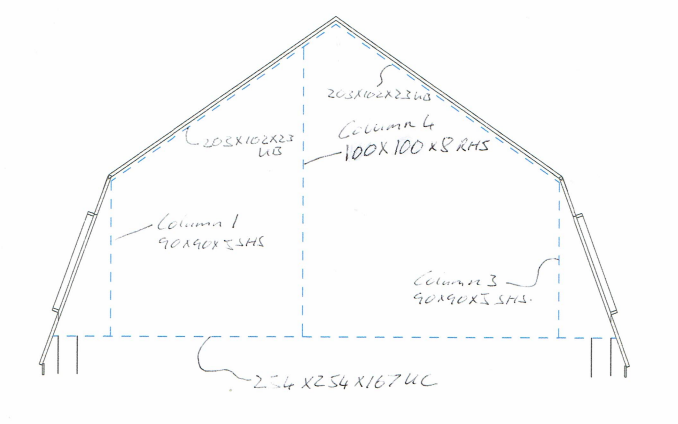
Thanks that's really useful ! The span is 8m wide. " have they provided any flange or joint information ? " - no, but thanks for the tip I will now ask " assuming it covers erection? " - no, craning extra (but we'll be using someone else for that) We have been back to the Structural Engineer. He has now given more details on the spec and suggested that we can use a smaller UC (since we can accept a greater deflection). Price has now dropped significantly - more like £3.5k ... So next steps are for me to get the revised spec, determine what the weight of it is going to be, and then I'll have a better idea of competitiveness ... -
We're in NE Essex. Our Structural Engineers have specified two 1.5 tonne steel trusses to support our gambrel roof. Somewhat surprised to see that our local fabricator has quoted a figure which doesn't give us much change from £5k. I have no idea of how much trusses cost - but have to say was somewhat surprised by that fugure (hey, what do I know). Question is, should I be looking for a fabricator much further afield? (I remember reading about a steel framed extension in Islington which was fabricated in West Yorkshire and lorried down). Tips, anyone?
-
Suppliers - ducting
Fallingditch replied to PeterW's topic in Mechanical Ventilation with Heat Recovery (MVHR)
Was it this page? http://www.ebuild.co.uk/topic/14687-very-cheap-mvhr-units/page__st__60 this site? https://www.roofingsuperstore.co.uk/product/ventilation-ducting-semi-rigid-duct-50m-lfpe-lindab-indomo.html -
Xtwostore.com for European plumbing pricing
Fallingditch replied to AliG's topic in Bathrooms, Ensuites & Wetrooms
If you search in Google "xTWO, Gießener Str. 42, 35410 Hungen, Germany" - they get mixed reviews from purchasers #justsayin -
Having spent a fair bit of time reading through old posts, I thought it would be really useful to actually capture some of the most useful content, written by people who have actually installed theses systems themselves. NB there are a number of different suppliers of the components required. These suppliers will often offer a no obligation, free design service. Some custom builders take advantage of this service, and loosely work from that base design rather than a blank sheet of paper. Horses for courses. Firstly, JSHarris from Sept 2015 "It is, without a doubt, far easier to DIY an MVHR fit using semi-rigid ducting and a radial system ... in terms of ease of design and fitting radial semi-rigid wins hands down. Where it loses out is price, as the cost of the ducting, fittings and plenums is more expensive than a non-radial rigid duct system ...The only other downside I can think of is that adjusting flow rates when commissioning the system is a bit of a pain, as you keep having to move between changing the restrictor rings in the plenum and re-measuring the critical terminal." " The spec was pretty easy, as all I needed to check was that I could get the flow rates needed for the critical rooms (those subject to building regs max extract rate requirements) without exceeding the max velocity limit in the ducting of 2.5 m/s. In practice you can go over 2.5 m/s when on boost I've found, as the duct noise doesn't start to get intrusive until around 3 m/s. These flow rates were just from the building regs requirements in Part V.As a double check I looked at the whole house trickle ventilation rate from building regs, but that turned out to be unimportant in terms of system design if you have terminals in every room, as the flow velocities in the ducts are very low for trickle ventilation.I designed the layout of the terminals so that the air had to travel the longest path from the terminal to the extract point in each fresh air feed room. In those rooms the extract point was the door (specifically the gap under the door) so the fresh air terminals were fitted diagonally opposite the door in most cases, and usually in a corner that might otherwise be a stagnant air pocket. I didn't bother with detailed duct loss calculations, as I started doing them for the high flow ducts (kitchen, bathrooms) and quickly realised that for a house of our size the ducting was more than capable of delivering the flow rate needed without incurring either high losses or excessive duct air velocity.I ended up just running the ducts by the easiest route and doubling up on the kitchen extract duct (two parallel ducts to the same terminal) to ensure I could reach the high extract rate on boost. In practice I'm pretty sure that a single duct run would have been OK.I fitted the manifolds as close to the MVHR as possible, to minimise the length of 150mm duct needed. I doubt this is really critical, as a 150mm duct will flow a lot of air, but it was pretty easy for me to put the manifolds close to the MVHR. They need to be somewhere where you can get easy access, as when setting the system up you'll be fitting throttle rings to the ducts in them. Some of my shorter ducts are throttled back to the smallest hole in the ring, which is something like 20 to 25mm diameter, so that may give a feel for how little air is moving through these ducts most of the time.I set the system up with a hot wire air flow meter set into a 100mm diameter bit of duct attached to a 150mm duct adapter to make a home made cone to fit over the terminals. I put some felt around the bit that would be pressed to the ceiling to get a better seal and to prevent scratching the paintwork. The flow meter I used was a Testo (the previous version of this model: http://www.testolimited.com/testo-405-thermal-anemometer ) purchased from ebay secondhand for around £30, but still in cal. This made it useful for leak testing around the house as well, as the sensing probe is small and very sensitive to low air flow rates. Here's a photo of my test setup: Ventilation test method.JPG 10.35K (not accessible) I adjusted the flow restrictors to get the right rates on boost to start with, to comply with building regs extract requirements from kitchen, bathrooms, utility and WC, then balanced it on trickle ventilation rate by adjusting the flow rates on the fresh air feed ducts. To fine trim it and get the feed and extract matched I adjusted the fan speeds slightly in the MVHR, so in trickle mode one fan is at 25% the other is at 28%, just to overcome a small imbalance overall.Setting the MVHR up was a bit tedious, with a lot of running back and forth and changing throttle rings, but at least a radial system isn't as interdependent as a continuous duct system, where adjusting one terminal upsets the flow rate of other terminals that have already been adjusted on that duct run. There is a tiny bit of interaction on the radial system, but very little I found, and it only affected the boost rate extracts.The whole house ventilation rate on trickle was measured both by summing the individual duct rates and also by measuring the flow in the fresh air feed and exhaust air ducts. These are 150mm diameter, so I drilled a small hol in the side of them, big enough to take the flow meter probe (about 12mm I think) and measured the velocity in those ducts directly. I then calculated flow rate from that and compared it to the sum of the individual measurements to make sure they were about the same.I found that the flow rates fluctuate a fair bit with very small outside air changes, so you have to average a few readings to get something meaningful. Even a light breeze will cause the ventilation rates to change by 50% or more up and down over a period of a few seconds, as the pressures in the ducting are pretty low and easily affected by small changes. Ideally you'd do the testing on a dead still day, but they are few and far between, even in our sheltered location." SecondlyDeclan52 from November 2015, working from a component Suppliers plan: "As far as installation goes, when you have signed the deal and paid for the goods you will get a plan showing you the duct layouts and where the vents need to go. Just make sure you get accurate measurements of the unit and make sure it will fit. There are access holes on the top and side on mine so you use what ever one suits your build. Double check it fits as his duct run layout will be from this spot. You will have 4 pipes to and from the unit. Feed and exhaust from outside so you will need vent tiles or wall vents whatever way you are connecting to the outside. The other two are the fresh air back into the house and the extract from the house. You will have a larger diameter pipe maybe 150mm from the unit to a manifold maybe a meter long depending on your layout. From the manifold then it will have a duct going to each extract. They basically twist and clip in very easy to do. I had the full 50m reel downstairs between 2 trestles and a pole through it and just pulled the duct along to where it needed to go. Leave a bit extra just in case and you can trim it to size when it's all in and secured. Measure all where your duct ends are and record this so when you are cutting the holes in the ceiling you know the exact spot where they are. You can use a hole cutter or a pull saw whatever suits you. Keep the system off till all the work is done or it will get clogged up with sawdust and all the other airborne materials. Get his flowmeter and adjust the vents to suit. Some adjust at the manifold others on the ceiling. It's def not a hard job to do just arkward as you are wrestling with a 20m length of duct that never seems to want to go where you need it to go. Get all your ducting in first before the plumbers or sparks arrive as it will make your life easier. Both plumbers and sparks will want to be first to make there routes easier but look after number 1 and get in first. If the ducting and manifold are in a cold area like the eaves you will have to cover the ducts and manifolds with the like of rockwool or you will get condensation in them And finally, Bitpipe, from March 2016: "Just completed the plenum side of my installation using 65mm internal radial duct, through luck more than design I've pulled it off but there were more than a few head scratching moments. So, where to start I used BPC who did a design (which I loosely followed) and supplied all materials. Our frame was already locked at this stage so I had to work around what was there and some issues only became apparent when the frame was up. If you're still at design stage, give first thought as to where the MVHR unit goes, you want to minimise the runs (typically 160-180mm steel radial duct) from this to the external vents (which should be on the same wall to minimise unbalancing due to wind. 1.5m horizontal separation is the recommended minimum. Then think very carefully on where the distribution boxes go (one for extract and one for supply, usually sit them next to each other) - note that these vary greatly depending on the manufacturer, some are boxy, some are long and flat. Some have ports on all sides, some just on one. You want to get them reasonably central so that you minimise very long runs but this may not be possible. Some are designed to sit in between pozi joists but this does not always mean you will have room to get the 65 or 75mm duct connections to them as it can get very busy. You may need to create a cupboard (or sacrifice one) to house these and the duct. You'll also need to get the 160-180mm steel duct to these also. Think on how you'll get vertically to different floors, wardrobe or cupboard space is usually the answer. Then try and eliminate any physical barriers to running the flexi duct from the plenums to the distribution boxes, such as steels (spec penetrations now ) or gluelam beams. They will pass happily through pozi joists and you can get a reasonably tight bend on them if required but it then makes them very tricky to pull through, watch out for pinch points where you may have many ducts going through. Supply plenums usually sit in the corner of the rooms diagonally opposite the door and extracts above showers, or WCs or about 1m from extractor hoods in kitchens. We have double runs to extracts and single to supply. Good idea to consult with your sparky and plumber to make sure you're not going to make their life too difficult (i.e. foul a line of downlighters with a plenum). It's difficult to leave slack in the ducts for later alterations - always possible to shorten a run but not extend it. When installing, locate the plenums first and then pull the duct through from the distribution box location to there. My system just required the end of the duct to be neatly cut and an O ring slipped over the first rib and then pushed home & clipped in. WD silicone spray is essential to lubricate everything. Leave a decent tail at the distribution box end and mark the ducts with a sharpie so you know what's intake vs extract. I used 50m rolls of duct and put a piece of supported 2x4 through the centre before uncoiling as it can get tangled very easily. If you can draft a few mates to help then this really speeds things up as each tight bend needs manipulated to get the duct through. Watch out for nails through the joists from above and below too. It can get very congested when all the flexi duct comes together and I spent quite a bit of time rejigging ducts so they would connect to the distribution box neatly. I've not cable tied anything just yet, will probably use builder strap to keep them up out of the way and cable tie each connection to the distribution boxes as these don't have clips. The plenums are rock solid. Just starting on the 180mm duct now, I've already put 600mm sections in the wall for the intake/extract so they could be insulated & rendered around. BPC have given me loads of 180mm duct (i'll likely use 1/3 of what they supplied) plus 45 and 90 bends and some springy flexible duct also to make the final connections to the MVHR. And the golden rule is to get in first before the other trades nick the space" Thanks to all.
-
(Good explanation from JSHarris, 2014. My emboldening.) There are differences between air conditioning, air cooling, MVHR and natural ventilation, and they are all to do with air quality.Broadly speaking, we have three main measures of air quality (ignoring pollutants). Air temperature is the one we mainly think of, as it is immediately felt in terms of comfort level. Next is probably humidity, as this mainly determines our rate of body heat loss to the surrounding air (by decreasing our natural evaporative heat loss from perspiration when humidity levels are high). Last, but not least is CO2 concentrations. We tend to feel that rooms are stuffy when the CO2 level rises much above 800 to 1200 ppm (outside air will typically be a little under 400 ppm). The reason for the latter is that blood acidosis controls our resting breathing rate, and this is determined by blood CO2 concentration. When this rises (because our lungs aren't able to get rid of CO2 as effectively due to the increased partial pressure of CO2 in the surrounding air)then we tend to breathe a bit deeper and faster, and to falsely feel that the air has less oxygen, so we feel it's a bit stuffy.Proper air conditioning ensures that incoming air is both cooled and humidified, and that CO2 levels are around the same as those outside. It's used commercially, but is uncommon in domestic and vehicle systems. Air cooling is the most common "air conditioning" system we encounter, in buildings and in cars. This both cools the air and dehumidifies it, and it's the latter effect that tends to dry the air and cause symptoms of nasal congestion, dry skin and even exacerbate conditions like asthma.Conventional MVHR doesn't appreciably change the humidity level, nor does it change the CO2 concentration, so is perhaps the healthiest way of ensuring good, through house, ventilation. I've been measuring the RH, temperature and CO2concentration in our bedroom for the past year, and found that even with a window open the ventilation is grim. By 4 am the RH will often be around 65% and the CO2 up around 1400 to 1600 ppm, way over the comfortable limits. As soon as the bedroom door is opened these levels drop. MVHR does ensure that there is a constant flow of fresh air across a room, which should keep both the RH and CO2 level close to those outside.Air cooling, in the form of a typical "air con" unit, or the active air to air heat pump we have, will maintain comfortable CO2 levels, but will reduce the humidity. This is very obvious with our set up, as within a few minutes of it going into active cooling mode you can hear the condensate dripping down the waste pipe. Luckily, the air flow rate from the MVHR isn't enough to overcome the extra humidity introduced into the house from breathing, showers, running taps etc, so I've never seen it drop below about 45%.Finally, natural ventilation means accepting whatever the air temperature and humidity is outside. CO2 isn't an issue, as that will be a reasonable level of around 400 ppm. The main problem with natural ventilation is the lack of temperature and humidity control. We really want to keep the house in the 40 to 60% RH range, and the temperature within our personal comfort zone (and that depends on the individual, and the nature of the building). Our new build feels comfortable at 19 deg C, and too warm at 22 deg C. Our current house feels cold at 19 deg C, and just about OK at 20 to 21 deg C.
- 1 reply
-
- 1
-

-
Posted 25 March 2016 - 03:58 AM Hi folks, I know it's frowned upon in an airtight house with MVHR but myself and my wife are very keen for an externally ducted cooker hood for our new build. We both like to cook and currently have a recirculating hood and tbh its hardly worth turning it on, so end up opening the kitchen window. So, this evening I have been looking into hoods/ducting. The plan is to have our induction hob on an island so have been looking at down draught extractor hoods like these - http://www.besthoods...raft-extractor/ I know they are pretty expensive but our open plan kitchen, dining, living area will have a vaulted ceiling so can’t really have one of the overhead hoods. Another positive I can see would be that I would assume these would have better airtightness than a conventional hood when not in operation....does anyone have any experience of this? Another thing I stumbled upon that may help with air tightness was this draught excluder grill - https://www.naber.de...rkasten-s04014/ Has anyone installed one of these? Also, with regards to ducting from hood to external wall this may prove tricky with the hood/cooker being on the island. My only thoughts are to run the ducting down from the island, under the slab to a kitchen cupboard unit (located beside an outside wall) and then up to a reasonable height before going through the external wall. This method would involve at least three 90 bends and roughly 3m distance before cooking smells would be extracted outside. Does it sound unrealistic for me to expect a good form of effectiveness from this? #2dampindevon Posted 25 March 2016 - 09:47 AM Have a look at berbel.de they have a wall box which could be ideal, no idea of price and they also do some rather lovely extractors just don't let the wife see them #3ryder72 Posted 25 March 2016 - 10:10 AM I am in the same position and we will be installing a powerful ceiling recessed extractor with external motors. Cooking it too important to us to compromise. I am really not convinced downdrafts are the best extraction solution. For starters, there is the physics of rising heat. Then there is the complexity of ducting - it invariably involves multiple 90-degree bends, each one reducing extraction efficiency and increasing noise level. Unless one can use circular 150mm dia ducting (highly unlikely given it has to run under a slab) space restrictions demand use of flat channel ducting. Use 6 inch equivalent ducts (I would highly recommend Naber products) and an external motor will be the way to go but all of this puts up the price. I would also steer clear of Best products. From my experience, I would only trust Gutmann or Bora hoods for downdrafts. Rest of the products on the market are commercial products designed to jump onto a design bandwagon. Is a suspended hood not an option? These can be easily attached to vaulted ceilings and many manufacturers offer chimey sections that you can get cut to the right angle by a metal fabricator. #4ryder72 Posted 25 March 2016 - 10:11 AM Berbel is a very good product but their after sales presence is the UK is very sketchy. #5rossek9 Posted 25 March 2016 - 12:53 PM dampindevon, on 25 March 2016 - 09:47 AM, said: Have a look at berbel.de they have a wall box which could be ideal,no idea of price and they also do some rather lovely extractors just don't let the wife see them Yeah I came across the berbel wall box as well but the £420 price tag is something that put me off. It's seems excessive to spend upwards of £1k on a extractor hood and another £400 on a mechanical vent tbh. #6rossek9 Posted 25 March 2016 - 01:11 PM ryder72, on 25 March 2016 - 10:10 AM, said: I am in the same position and we will be installing a powerful ceiling recessed extractor with external motors. Cooking it too important to us to compromise. I am really not convinced downdrafts are the best extraction solution. For starters, there is the physics of rising heat. Then there is the complexity of ducting - it invariably involves multiple 90 degree bends, each one reducing extraction efficiency and increasing noise level. Unless one can use circular 150mm dia ducting(highly unlikely given it has to run under a slab) space restrictions demand use of flat channel ducting. Use 6 inch equivalent ducts (I would highly recommend Naber products) and an external motor will be the way to go but all of this puts up the price. I would also steer clear of Best products. From my experience, I would only trust Gutmann or Bora hoods for downdrafts. Rest of the products on the market are commercial products designed to jump onto a design bandwagon. Is a suspended hood not an option? These can be easily attached to vaulted ceilings and many manufacturers offer chimey sections that you can get cut to the right angle by a metal fabricator. Glad I'm not the only one not willing to budge on external cooker extraction. It's something my wife and I feel pretty strongly about given previous experiences. The problem we have it that our vaulted ceiling will have a ridge height of 4.5m so the extractor hood would need to have a chimney length of upwards of 2m. Given this will be on the island I can't see this being stable with no wall fixing points available? We did have thoughts to make up a floating overhead hood fixed to either outside wall so the duct could run through this. The length of this from outside wall to outside wall would be 4.6m though and if this envolves additional steels due to weight this may increase costs more than a down draught hood. Do you think this option would be better further investigated? The other worry we have is a floating hood connected to both outside walls may impact a bit on the open plan nature of the space. Thanks for the advise on hoods to look for. It's really not something I have done a huge amount of work looking into yet but if ducting needs to be run under the slab then I need to make decisions on this at the outset. #7rossek9 Posted 25 March 2016 - 01:13 PM ryder72, on 25 March 2016 - 10:11 AM, said: Berbel is a very good product but their after sales presence is the UK is very sketchy. The price difference between the barbel and one I've linked above is around £300 as well, which is a consideration. #8JmS Posted 25 March 2016 - 01:18 PM Ryder72, what products are you using external motors wise. By external do you mean external to the house? I am still working out how to find a closer/damper for our kitchen Thanks James #9jsharris Posted 25 March 2016 - 01:23 PM It is worth bearing in mind that a house with MVHR is VERY different to one without. I've experienced the near-useless performance of a recirculating cooker hood, and ended up fitting the external vent kit. However, I friend has a recirculating hood fitted in a well-sealed house with MVHR and she finds that it works extremely well indeed. I think the main difference is that the hood removes the fat and oil vapours and the MVHR on boost is very effective at removing the stale air from the kitchen, so the net result is that the performance of the cooker hood is far better than might be expected. Fitting an external vent will make a very big difference to the heat loss. When working it pumps out warm air that then needs to come in from somewhere, and if you have MVHR it will become massively out of balance and so will lose a great deal of efficiency (you'll find that all the fresh air feed ducts start feeding cooler air into every room). The other issue is that it is near-impossible to get an effective seal on an extract duct, so not only will it be a cold bridge when not in use (and hence a condensation focus) but it will also be a constant cold air leak into the house, or warm air leak out of the house, and in any sort of a breeze may well unbalance the MVHR. If it were me, then I'd look at designing the house to be "fitted for, but not fitted with" a cooker extract duct. In other words I'd fit the ducting (but not put the hole through the wall yet) and fit the wiring and necessary mechanical supports, but fit a recirculating hood that can be converted to an extract hood just by making a hole in the wall. Live with it for a while with it working as a recirculate only hood, and if you find that it doesn't work well enough then look at externally ducting it. Based on the performance of my friends recirculating hood in a house with MVHR I'm convinced one isn't needed at all, especially when you can boost the MVHR to get cooker hood type extract rates from the kitchen anyway. Edited by jsharris, 25 March 2016 - 01:24 PM. #10ryder72 Posted 25 March 2016 - 11:07 PM I will be using Gutmann. Experience of working with at least 10 brands of cooker hood manufacturers I have reached the conclusion that no one makes his as well as gutmann in general. The hood will have an external motor able to operate at 1200m3 per hour and should be able to handle a griddle, wok and a 6 zone hob without a problem. Jeremy I am aware of the potential problems of mvhr and I have seen mvhr systems work with houses and serious cooks and the two instances I have seen had evidence of stale air and lingering cooking smells. We are going to link our cooker remote to a high level slot window that has been specified as electrically opening so the operation of the hood will trigger the hood opening as well to allow another source of air into the house and aid the air flow. Ceiling recessed hoods are unfortunately not switchable products that can go from recirc to vented and with the external motor it will be a decision made quite early iin the process. #11ryder72 Posted 25 March 2016 - 11:09 PM Rossek9 I don't know what to suggest. I can recommend a bespoke extraction manufacturer who are good but not cheap. PM me if you like #12rossek9 Posted 26 March 2016 - 01:43 AM Thanks for the posts jeremy and ryder. I think this needs further thought from myself. I do love to cook a curry on a friday night and the smell of fried onions lingers for days in our current home, even with the back door open, window open and recirc hood on!!! This has been what has promted our want to go with an externally vented hood. I have looked at the gutmann hoods ryder but cant see any prices.................if you need to ask, you cant afford one, comes to mind. Still like the idea of the floating hood, which may not be too much for a joiner to fabricate up and might add a nice focal point (or so the wife says). Also, I thought today this may also be ideal for running the breakfast bar lighting rather than having pendents coming down from the vaulted ceiling. #13ryder72 Posted 26 March 2016 - 07:56 AM rossek9 - Here is an idea - get a timber frame clad in or veneered oak/walnut made by a carpenter and install the hood within it. Suspend it down from the ceiling on steel wires. Run a commercial grade 6-8 inch insulated flexi duct (the type that has a metallic finish on it to) from the top of this boxing to your ceiling and vent out through an appropriate outlet. Ensure that this vent isnt going to be a restriction to your desired flow rate. If the industrial look works for you, then this solution will work. Gutmann is supplied only through specialist retailers due to the professional grade of their product so you are unlikely to find it online. #14bitpipe Posted 26 March 2016 - 10:49 AM We've specced a Siemens recirculating hood over the hob in our kitchen and I've installed a dedicated MVHR extract vent about 1m in front of it. Our MVHR unit has a 'cooker hood' mode that's activated via a dedicated terminal so it will go into a pre-programmed boost mode automatically while the hood is running. This vent currently has a single duct run, there is another extract in the kitchen that has two duct runs, so there will be plenty of extract capacity in that area. I'd really advise reading Jeremy's post carefully - if you're spending the time, effort and money to ensure that the house is airtight then you're massively compromising this by effectively making a big hole in your wall that completely bypasses your heat recovery system. Personally, I'd not frame this decision as a simple style choice that's 'frowned upon' by outsiders (like installing a 70's avocado bathroom suite ) but a pretty significant building design decision that will fundamentally impact the performance of your house and needs to be considered carefully and if necessary compensated for in your overall heating and ventilation design. Edited by bitpipe, 26 March 2016 - 10:50 AM. #15Nickfromwales Posted 26 March 2016 - 02:58 PM This is the reason I've started to look at incorporating an electro-mechanical damper / shutter in my house extraction setup. No back draught and no convection heat loss when the fans off. About as good as a middle of the road solution as you'll find imo, and even more so for a PH where extraction is required in excess of the mvhr rates. @bitpipe. Do you mean your mvhr only boosts extract at the kitchen terminal? Most boost the whole house iirc. Regards, Nick #16PeterW Posted 26 March 2016 - 03:02 PM I'm amazed no-one has come up with an extractor hood that has heat recovery in it ..! One that used carbon filters and also some thing like the copper wire exchange system that the Viking House vent does so you get the best of both worlds. And as nick says, a decent flap system to stop the drafts when it's off... #17ryder72 Posted 26 March 2016 - 04:23 PM The Naber or Berbel pressure actuated vents work well and prevent a back draught. I think the problem with building a heat exchanger into a vented hood is that heat exchanger plates will reduce flow rates and as Jeremy said, imbalance the MVHR. For this reason I came up with what was a 'simpler' mechanism of automatically opening a window with the hood. I know its not as scientific as it could be, but for us the house would be a 'fail' if any cooking odours lingered and its a risk we arent prepared to take. German companies working on this are working on plasma ionisation filters where the grease filtered air gets passed through some sort of chamber which breaks down odour causing molecules and pumping air back into the room. It is an expensive product. #18stones Posted 26 March 2016 - 04:27 PM Jeremy has previously commented on the impact his home made ozone generator had in clearing cooking smells. Could this be a possible solution (used in moderation of course)? #19jsharris Posted 26 March 2016 - 04:49 PM stones, on 26 March 2016 - 04:27 PM, said: Jeremy has previously commented on the impact his home made ozone generator had in clearing cooking smells. Could this be a possible solution (used in moderation of course)? That's a good point. I didn't build the unit to do this, but there is no doubt that a small amount of ozone does get rid of smells very quickly and effectively. Simple ozone generators for use for short periods are pretty cheap; I'm using the parts used in these as the basis for the ozone system that oxidises the ferrous iron and manganese in our borehole water. The only problem with the simple ceramic plate ozone generators is that the corona plates get very hot, and when they heat up the ozone generation drops and their life is shortened. The better designs fit heat sinks to the plates, which helps, but for occasional use (for 20 minutes or so at a time) the simple units with just a fan cooling the plate and distributing ozone are very effective. We have a small, battery operated, ozone generator in our fridge. It only comes on in short bursts, and the battery lasts a long time, but it's very effective at controlling smells. Before we had it the fridge would often smell quite strongly if there had been some particularly smelly cheese or seafood in there, now it never has the slightest smell of anything. Not altogether a good thing, as the effectiveness of the ozone masks the smell of things like milk going off. Edited by jsharris, 26 March 2016 - 04:50 PM. #20stones Posted 26 March 2016 - 04:57 PM Just had a quick look and as you say, they do seem cheap.. Generating capacity seems to dictate price. This one for example http://www.ebay.co.u...YMAAOSwr7ZW6PpY indicates 600mg an hour. I've no idea if that's a meaningful amount or not. I would only want to be running such a device for short periods to clear any lingering odours. Would something like this one do the job or would I need something with a bit more capacity? #21jsharris Posted 26 March 2016 - 05:05 PM They all tend to massively over-state their output, as they test them on dry oxygen as the feed gas, so when run on air at normal humidity levels they tend to deliver a bit less than 1/5th of their rated output. I can say that my 7g/hour rated unit is far too powerful to use in a room. After a minute or so your eyes are stinging and it's painful to breathe the air, there's that much ozone in it. That makes me think that a much smaller unit like the one linked to may well be adequate, depending on the size of the room. I did play with the idea of adding ozone to the MVHR fresh air feed, as a way of helping to remove lingering smells, and may well look at doing it when I've got a bit of spare time. There is a great deal of misinformation on the web, and almost a cult of "ozone therapy", but there is no doubting the powerful oxidising and deodorising effect that it has. #22PeterW Posted 26 March 2016 - 05:20 PM I've ordered an ozone generator for my rainwater tank to both kill off some of the nasties and also to do a first stage on the cleaning before it heads through the filters. It's a cheap and cheerful one and all it has is an aquarium pump and then the ozone tube. I'm going to put a silica gel packed drying tube in the flow as they work better apparently on dry air. Also considered if two tubes in series was better than one. Adding one into a cooker hood would be pretty simple I expect and the tube would be in a pretty decent airflow to cool it when it's on - only noisy bit is the air pump. #23jsharris Posted 26 March 2016 - 06:38 PM They definitely work better with dry air. My set up for injecting ozone is a small air pump that blows air through a 4" water filter housing, with a refillable inner cartridge that is supposed to be used to hold activated charcoal. I filled it with colour indicating silica gel beads and bought enough beads to fill two cartridges, so I could be regenerating one whilst the other is in use. Dry air is then fed to a home made ozone generator, using a two ceramic plate unit that I've modified, so the plates are bonded to a big alloy heatsink to keep them cool. There's a sealed chamber over the plates, so the pressure is maintained. The air+ ozone is then fed down a long length of 8mm HDPE pipe to a venturi mixer at the well head, that creates enough suction to draw in just about the right amount of air and ozone every time the pump turns on (the ozone generator only runs when the well pump runs). The oxidation takes place in the whole pipe run back to the main GRP aeration tank, which has an air/ozone bubble maintained at the top, by virtue of a dip tube that goes part way into the tank and has a float type automatic air bleed on top. This vents off excess air/ozone and water is drawn from the bottom of this tank, along with particles of ferric iron resulting from the oxidation reaction. The particles get filtered out by the backwashing sand and oxidising media filter, that also oxidises any ferrous iron or hydrogen sulphide that didn't get treated initially. In practice we now get very good quality water, with no taste of smell, from a well that delivers pretty smelly water with a lot of iron in it. The key seems to be just oxidising out the stuff you don't want in the water, and the ozone definitely helps with that, by significantly increasing the ORP of the water right at the point where it is pumped up. #24rossek9 Posted 26 March 2016 - 07:21 PM ryder72, on 26 March 2016 - 04:23 PM, said: The Naber or Berbel pressure actuated vents work well and prevent a back draught. I think the problem with building a heat exchanger into a vented hood is that heat exchanger plates will reduce flow rates and as Jeremy said, imbalance the MVHR. For this reason I came up with what was a 'simpler' mechanism of automatically opening a window with the hood. I know its not as scientific as it could be, but for us the house would be a 'fail' if any cooking odours lingered and its a risk we arent prepared to take. German companies working on this are working on plasma ionisation filters where the grease filtered air gets passed through some sort of chamber which breaks down odour causing molecules and pumping air back into the room. It is an expensive product. The berbel states on its website that the insulation value is 0.95 W/m2K of the wall box. I can’t seem to find anything on the Naber but will have a further look tonight. I fully understand everyone’s comments regarding extraction and mvhr being unbalanced so it’s something I really need to think about in more detail. We are a long way off deciding on hoods tbh (amended planning for our house design was submitted last week), but it's something I don’t what to overlook and regret further down the line. I think we have come to the decision that if anything we will look to design an overhead hood incorporated into some sort of hovering beam/joist arrangement. I’m not sure if in explaining my vision here very well but I have an idea of how this work look in my head. Maybe by the time we come to second fix some hoods may be designed that connect into the mvhr but don’t clog all the ducts with grease/fats/oils.......fingers crossed Edited by rossek9, 26 March 2016 - 07:23 PM. #25gravelld Posted 26 March 2016 - 08:22 PM ryder72, on 26 March 2016 - 04:23 PM, said: The Naber or Berbel pressure actuated vents work well and prevent a back draught. Back draught is not the only problem. Interested to hear about proper positively closing, airtight closers. #26RoundTuit Posted 26 March 2016 - 09:53 PM I'm also tending towards external extraction even with mvhr. I'm hoping that the relatively short, sharp period of extraction during cooking won't upset things too much, but the price of decent in-ceiling kit is a bit steep. Has anyone tried to diy it? A good in-line fan (hard wired to a multi-speed switch), as many led lights, as you want, and some sort of grease extractor on the intake (I guess that's the tricky bit...)? #27ryder72 Posted 26 March 2016 - 10:01 PM Naber vents are pressure actuated at 150Pa on the 150mm dia system. It's a mechanical system. #28bitpipe Posted 26 March 2016 - 10:22 PM Nickfromwales, on 26 March 2016 - 02:58 PM, said: @bitpipe. Do you mean your mvhr only boosts extract at the kitchen terminal? Most boost the whole house iirc. Regards, Nick No, not that smart as all extracts go to the same distribution box and the extract port of the unit - i think it's to do with the duration of the boost cycle, will check the installation instructions Edited by bitpipe, 26 March 2016 - 10:22 PM. #29jayroc2k Posted 27 March 2016 - 11:58 AM Just to weigh in on external extraction with MVHR (I live in one). All depends on your lifestyle and cooking habits. If you are home during the day, cook non smelly and non fry foods (mash, rice, occasional stews, potatoes and veg), you will be fine depending on the MVHR. For this scenario - arrive home in the evening and cooks a lot - cook exotic foods (Indian, carribean, Asian) - open plan kitchen In the above scenarios, waiting for hours for the MVHR to clear the air will mean a smelly living space until it's bed time (not pleasant). I will strongly suggest you externally extract. An imbalanced MVHR or inefficiencies are a small price to pay for having the open all windows to compensate or sit with the lingering food smells every evening. #30ryder72 Posted 27 March 2016 - 04:09 PM I would say we definitely sit in the latter category. A large open plan area of approx 80m2 leading to a double height vaulted area. Cook a wide variety of food every evening and weekends and entertain regularly including a lot of grilled meats. Based on this, I am not prepared to take the chance that smells dont clear out immediately and effectively. To counter MVHR imbalance to the greatest extent possible, I have opted for a self opening window triggered by the hood operation which to an extent should make no difference to the MVHR operation. Admittedly this may cause a lot of heat loss when the hood operates and there may be a thermal bridge along the duct (I plan to put in a 150mm round section duct lagged externally and connected to a pressure actuated vent) but this is a price I am willing to pay. The heating system is an oil boiler coupled to a thermal store, so I dont think we will have any problems countering the heat loss. #31declan52 Posted 27 March 2016 - 04:39 PM I have my extract straight out via a spring loaded system on the duct. My kitchen, dining room is approx 60sqm.Not the best option but it works for me. Its on the list of things to upgrade so when a better option becomes available for not silly money i will change it. I have a mhrv vent approx 1m from my hob and it will eventually get rid of the steam but by the time it does the smell will have started to annoy me. It is vented via a 150mm duct wrapped in rockwool the whole way to a vent tile on a sheltered part of my roof. It was simply a trade of for me between getting rid of the smells, I love cooking curries etc from scratch, and some heat loss. Had a recirculating hood in my last kitchen and it was dire. Windows always had to be opened even the back door when it got really bad. Edited by declan52, 27 March 2016 - 04:39 PM. rossek9 likes this #32rossek9 Posted 27 March 2016 - 05:45 PM Ryder and Declan, We are in the same boat as yourselfs. Open plan area is 60m2 with vaulted ceiling and to add to that curries/asian/stir fries are the norm in our house. In fact, our wok just lives on our 5 ring hob as we use it every night. declan52, on 27 March 2016 - 04:39 PM, said: I love cooking curries etc from scratch, and some heat loss. Had a recirculating hood in my last kitchen and it was dire. Windows always had to be opened even the back door when it got really bad. Declan, this could have been written by me!!! We have to do the exact same thing atm If we dont install an external extract hood with something like the Naber mechanical vent and I end up opening our big sliders everytime I cook, I dont see how this makes any difference to the mvhr balance anyway. Would same me the cost of a hood and mechanical vent though. #33jsharris Posted 27 March 2016 - 08:17 PM Opening a door or window has little effect on MVHR balance, unless there's a gale blowing. Turning a big extract fan on has a massive effect, as the suction from the extract will probably be many times the flow rate from the MVHR. The effect will be to draw many times more air through the fresh air feed side of the MVHR, whilst reducing the flow through the extract side, so the heat exchanger simply won't be doing much and loads of air that's hardly been warmed at all will flow into every room with a fresh air vent, cooling all those rooms down. If the extractor is of industrial size, you may well find that the living rooms, bedrooms etc all get a bit noisy from the big increase in fresh air being drawn in through ducts and terminals that will have been sized for a much lower flow rate. In order to reduce the impact of this, then it would be very sensible to open a window or door in the kitchen, and close the internal doors from rooms fed with fresh air, to reduce the whole house pressure drop that the extractor will create otherwise and hopefully reduce the negative impact of the MVHR imbalance. #34rossek9 Posted 27 March 2016 - 08:26 PM jsharris, on 27 March 2016 - 08:17 PM, said: Opening a door or window has little effect on MVHR balance, unless there's a gale blowing. Turning a big extract fan on has a massive effect, as the suction from the extract will probably be many times the flow rate from the MVHR. The effect will be to draw many times more air through the fresh air feed side of the MVHR, whilst reducing the flow through the extract side, so the heat exchanger simply won't be doing much and loads of air that's hardly been warmed at all will flow into every room with a fresh air vent, cooling all those rooms down. If the extractor is of industrial size, you may well find that the living rooms, bedrooms etc all get a bit noisy from the big increase in fresh air being drawn in through ducts and terminals that will have been sized for a much lower flow rate. In order to reduce the impact of this, then it would be very sensible to open a window or door in the kitchen, and close the internal doors from rooms fed with fresh air, to reduce the whole house pressure drop that the extractor will create otherwise and hopefully reduce the negative impact of the MVHR imbalance. Thanks for keeping me right jeremy, still trying to learn all these things........and fast!! Edited by rossek9, 27 March 2016 - 08:30 PM. #35jsharris Posted 27 March 2016 - 09:00 PM If you want to see the effect for real, try and blag a visit to a house that's being pressure tested, with a blower door/window. The blower will be a lot less powerful than a decent kitchen extractor, you can barely feel the flow through it at the fan. However, if you go around the house trying to find leak points you will often hear them howling, even at the very low pressure differential used for testing, just 50 Pa. I have a home made blower that I used to help find leaks and better seal our old house. It uses a car electric radiator fan with a variable speed control. Even on our relatively leaky old house, that fan, running quite slowly, will make all the keyholes howl. If the house was to the sort of airtightness level that a new house would be then the noise from even tiny leaks will be surprisingly loud. #36bitpipe Posted 28 March 2016 - 10:28 AM This is a great thread and giving me food for thought - our kitchen / diner / living is open plan (but has a modest 2.4m ceiling height throughout. House layout is roughly square. Living, dining & study (which has a door) all have fresh supply in each corner and the kitchen has two extracts - one double ducted in the corner and one single ducted between the cooker hood and oven on the opposite wall. I'm going to see if I can add an extra exhaust duct run to the hob vent just to maximise its extract capacity, I have a spare extract port on the distribution box - failing that, I may just move one duct from the corner extract to the hob extract unless that would cause an issue?
-
#1NeilW Posted 02 June 2014 - 06:57 AM Looking at the Building Regs rules for ventilation it looks like the minimum air flow rate is governed by the floor area of a building. So that seems to suggest that if I go to a warm roof design, even if that area is essentially storage, then I increase my ventilation requirements substantially over the equivalent 'cold roof' design. And there doesn't even seem to be any reduction for ceiling height. I want the MVHR to operate in the loft space, since it is likely to become a bit of a heat well and it'd be useful to be able to purge that, or recycle it as required, however 20.2l/s seems like a lot. So I have the ludicrous situation now where the volume of air at Passivhaus ventilation rates (0.3ach * volume) gives me a ventilation requirement of about 35 l/s, and the Building Regs ventilation rate (0.3l/s * floor area) giving me a requirement of 62 l/s Is there a way around this? Can you offset your air-tightness test result for example. #2DamonHD Posted 02 June 2014 - 07:14 AM As has been suggested here before don't you simply have to make sure that the Regs rate is achievable but then (say) with automatic CO2/RH%-driven modulation of flow rate actually have an average much more like PH requirements? Rgds Damon #3NeilW Posted 02 June 2014 - 07:57 AM That's what I had in mind before the loft came into it. Now it appears I need a 77% uplift in ventilation just to pass building regs which seems like overkill #4jsharris Posted 02 June 2014 - 05:42 PM You need to read and interpret the regs carefully, and remember that they only apply for the ventilation system test; there is no requirement to use these rates once the house has been tested. Take our house, for example, which has a warm roof and vaulted ceilings, so has a much greater volume than a typical cold roof house, and has a floor area of 130m². We have to meet two building regs requirements. The first is the minimum whole house low rate from the 0.3 l/S/m² floor area requirement at the base of table 5.1b, which gives 39 l/S, or 140.4 m³/h. As the house volume is 342 m³, this equates to a ventilation rate in ACH of about 0.41, below our design ventilation rate of 0.43 ACH. This rate has to be achieved with the MVHR on its normal occupied house minimum speed setting (more on this later). The second building regs requirement relates to the maximum ventilation rate in some rooms. In our case we have a kitchen, two bathrooms, a utility room and a downstairs WC. The flow rate from these room with the MVHR on maximum needs to be: KItchen = 13 l/S Bathroom 1 = 8 l/S Bathroom 2 = 8 l/S Utility room = 8 l/S WC = 6 l/S Giving a total with the MVHR on max boost of 43 l/S, or 154.8 m³/h. This is still only an ACH of 154.8 / 342 = 0.45 ACH, so even on max boost we're still not overly high. It's worth noting that for many MVHR units with multiple speeds, the lowest speed isn't the official continuous rate for an occupied house. For example, ours has four speeds, with speed 2 being the occupied house continuous rate and speed 1 being reserved for airing the house when its unoccupied. Speeds 3 and 4 are the boost speeds and the building regs max rates are tested at speed 4. I'm finding that running at speed 1 is fine and easily exceeds the building regs requirement for the floor area, and ventilates adequately even though the volume of our house is large relative to the floor area (a conventional house of 130m² would have a volume of around 312 m³, whereas ours is around 10% more because of the warm roof and vaulted ceilings. Another point is that some MVHR units (like ours) have fully programmable speeds. I can set the fan speed for speeds 1 to 4 to anything between 0 and 100%, independently for extract and supply, so I can tweak the speeds to those we feel comfortable with. What you do with the system after the building regs ventilation test is really just up to you, there's nothing to stop you winding the speeds down. Edited by jsharris, 02 June 2014 - 05:45 PM. #5Calvinmiddle Posted 02 June 2014 - 09:18 PM So for our house of 120m2 the minimum whole house low rate ventilation is 120*0.3 = 36l/s And the maximum ventilation rate will be: Kitchen 13l/s Utility 8l/s Bathroom 8l/s Which totals 29l/s. But how does that work with the boost being less that the normal mode?? Especially as only these three rooms have extract vents so the min whole house rate of 36l/s will be coming out of these rooms. Do I just need to make sure each rooms extract rate is more than the rates above? #6jsharris Posted 02 June 2014 - 09:46 PM The two issues are separate in building regs. The specified room extract rate for wet rooms and kitchens can be with the MVHR at max boost. The whole house minimum ventilation rate (from the floor area usually, but check the number of bedrooms rule in table 5.1b) is with the MVHR in normal ventilation mode (which may not be it's lowest setting). You just need to meet both of these. The extract rate is measured at the extract terminals in each of the applicable rooms, with the MVHR at full boost. The whole house rate is measured at the external ventilation terminals, after the system has been balanced so that extract and supply are more or less equal. You only need to exceed the minimums in the regs, so if you find that your whole house rate at the normal continuous setting is 50% more than the regs require that's fine (but perhaps a bit wasteful of energy). The same goes for the room extract rates at full boost, these are the minimum fugures, so exceeding them still gets a pass. #7NeilW Posted 03 June 2014 - 08:26 AM The idea I have in mind is to put an extract and an inlet in the loft at opposite ends of the building and just have the extract in the loft balance the inlet for building regs purposes. The MVHR is going to be in the loft, so adding an extract to it near the device doesn't seem that onerous. If the rate is measured externally, then that should do the trick. The rest of the house can then be balanced more normally. In volume terms the loft adds 33m3/hr at a 0.4ACH value, but the area adds 73m3/hr at the 0.3l/s building regs minimum. #8NeilW Posted 03 June 2014 - 08:27 AM jsharris, on 02 June 2014 - 05:42 PM, said: se of table 5.1b, which gives 39 l/S, or 140.4 m³/h. As the house volume is 342 m³, this equates to a ventilation rate in ACH of about 0.41, below our design ventilation rate of 0.43 ACH. How did you get to 0.43ACH as the design rate for the ventilation? #9jsharris Posted 03 June 2014 - 04:45 PM If the loft isn't habitable space then its floor area doesn't need to be included in the overall area used to get the minimum continuous ventilation rate. The same goes for my eaves storage areas, they are inside the heated envelope but aren't habitable spaces, so aren't included in the Part F calcs. The 0.43 ACH is a figure selected because it seemed a reasonable compromise. 0.45 ACH is about the target figure that organisations like BRE say you should aim for (in effect, as they don't express it in quite the same way) and the max allowable for PH is 0.6 ACH, so, as the volume of our house is large for the number of occupants, I chose a figure that was slightly lower than the generally accepted rate. #10stones Posted 03 June 2014 - 05:25 PM Jeremy, Out of interest, did BC demand a ventilation system test by an independent body / company. When we built, we specified in the warrant plans the system we would use and the ventilation capacity it had. No test required. #11jsharris Posted 03 June 2014 - 05:51 PM I did my own testing and submitted my test report to my BCO. Not heard back as to whether it was unacceptable, so I'm assuming it's OK. I just bought a Testo airflow meter and made up a conical hood to measure flow velocity through a 100mm diameter section of duct. Fairly easy to do, but quite tedious, as every time you adjust the flow in one terminal you upset the flow rates in all the other terminals. All told I spent around half a day running around adjusting the flow rates to get them both compliant and relatively quiet. There's no requirement in Part F for any independent body to do the compliance testing, just a suggested format for the way that it's presented and the need for the air flow meter to be calibrated to the appropriate standard (mine was bought second hand, but was still in calibration when I did the tests). I didn't follow the suggested report format exactly, but did include some photos of the test method used and the instrumentation. #12mishad Posted 30 September 2015 - 06:52 PM Blatant thread necro but anyway: Looking at Part F Appx A it appears to say that the 0.3 l/'s is based not on moisture but VOC discharge rates. Which suggests that it's related to chipboatd, carpets and soft furnishings and the like, rather than occupancy. And thus that it should drive the minimum (trickle) ventilation rate, not just the maximum possible rate. Is this (VOC exposure) a real concern? Is anyone aware of any other research in this area - are PV-style designs really exposing the occupants to increased VOC levels? #13jsharris Posted 30 September 2015 - 07:22 PM VOC emissions depend wholly on what you choose to put inside the airtight barrier (which is often also the VCL), so is usually pretty much nothing to do with the main fabric of the house. My guess is that 90% plus of the VOCs will come from paint, furniture, fixtures and appliances, with the majority of those dissipating pretty quickly over the first few weeks post-build/purchase. The "new" smell associated with many things is just VOCs outgassing, but few of those will either be harmful, or at levels likely to cause any impact on health. There is an awful lot of BS associated with volatile emissions. People obsess about stuff like formaldehyde (which is so volatile that it evaporates away very quickly indeed) so won't have chipboard etc in the house, and yet those same people will happily have a woodstove and generate high concentrations of far more harmful carcinogens which they and their neighbours then breathe in....................... #14mishad Posted 30 September 2015 - 07:40 PM Yes, it did seem a bit excessive to require 90 l/s for a 300 sqm 4/5 bed house! Treating that as a "boost" rate is much more reasonable (and "only double" the min high continuous rate of 13+8+8+8+6=43 for kitchen+utility+2bath+wc). #15gravelld Posted 30 September 2015 - 08:37 PM I've got the same problem mishad, same numbers too. I ran it past BC but they didn't really appear to understand the regs themselves (this is all under new dwellings in the regs but my case is retrofit). They said that's the continuous rate required. Seems excessive. #16notnickclegg Posted 01 October 2015 - 08:11 AM stones, on 03 June 2014 - 05:25 PM, said: Out of interest, did BC demand a ventilation system test by an independent body / company. When we built, we specified in the warrant plans the system we would use and the ventilation capacity it had. No test required. According to our MVHR supplier, the calculations they've provided will be sufficient to satisfy building control. We'll see... Jack #17jsharris Posted 01 October 2015 - 08:34 AM My BCO accepted a report, with measurements, that I did. Not hard, really, as I had to measure all the flow rates at the terminals anyway to set up and balance the system, so it was just a matter of writing them down, taking a few photos and writing up a test report. There's no requirement in the regs for this report to be written by a competent person (as in someone who has some form of accreditation), so it's a pretty easy DIY job if you have access to a flow meter. #18notnickclegg Posted 01 October 2015 - 09:08 AM jsharris, on 01 October 2015 - 08:34 AM, said: There's no requirement in the regs for this report to be written by a competent person (as in someone who has some form of accreditation), so it's a pretty easy DIY job if you have access to a flow meter. Our electrician has a flow meter and a bit of experience with such measurements, so that's our fallback plan. Jack #19jsharris Posted 01 October 2015 - 09:17 AM notnickclegg, on 01 October 2015 - 09:08 AM, said: Our electrician has a flow meter and a bit of experience with such measurements, so that's our fallback plan. Jack The MVHR will need to be measured during balancing and commissioning anyway, so just use those figures. You can't install one properly without measuring the flow rates at the terminals and adjusting the flow to get both the intake and exhaust rates the same overall (essential for performance) and you need to measure the flow rates from the key extract rooms to ensure you meet the BR rates and also to get the balance right from room to room. #20notnickclegg Posted 01 October 2015 - 09:24 AM Our MVHR unit is self-balancing (you can actually define a slight positive or negative pressure if desired) so that's one less thing to worry about. Allegedly our design takes into account run lengths, hard bends (basically preformed rigid bends that the flexible ducts fit into) and terminal types, so I currently plan to just do some basic tests to make sure everything seems to be within the expected range. I anticipate making adjustments based on our experience with the house after we've moved in. Jack #21jsharris Posted 01 October 2015 - 09:35 AM There's no such thing as a system that doesn't need setting up. The fans may well self-balance for overall intake/exhaust, but there is no way of knowing what the flow rates actually are at the terminals unless you measure them. They will be way off the calcs, that I can say for sure, as I calculated ours carefully, taking account of all the duct runs and bends and some of the terminals were 50% or more out. #22notnickclegg Posted 01 October 2015 - 09:41 AM I hadn't really planned to do any measurements other than the bare minimum to make sure that the relative rates at the terminals were in the expected ballpark. Might have to spend a bit more time on it. Jack #23djh99 Posted 01 October 2015 - 10:15 AM I think I've got the same system as you, Jack. I just plugged it in and it worked. Job done. #24notnickclegg Posted 01 October 2015 - 10:24 AM It's a Brink Excellent 400 Plus. Jack #25jsharris Posted 01 October 2015 - 10:35 AM Sorry, but having spent a lot of time measuring the TRUE flow rates I think you will find that the system isn't anywhere near optimised. All the Brink does is balance the external intake flow rate with the external exhaust flow rate. It cannot, and does not, establish the flow rates to each room, and there is absolutely no way of knowing if a particular terminal, by a quirk of layout, is "hogging" all the flow. Add in that as soon as you make a minute adjustment to the flow in one terminal you change the flow in every other terminal (because of the slight pressure change this causes) and then add in the fact that if the Brink is set to self-balance when trying to do these adjustments it will change the overall flow rates in response to changes in resistance, and you have a recipe for a badly balanced and inefficient system. There is a set order to make adjustments, and this is to get the individual terminal flow rates right, with the same fan speed on the intake and exhaust (so any auto balancing turned off) and then measure the overall intake and exhaust and see how far out of balance it is. If it's out by more than about 5% or so, then re-adjust the terminals equally to get the whole house rates close to being in balance. Only then do you fine tune the balance by allowing the auto balance to adjust the fans speeds, or manually adjust the fan speeds to do the same thing. Setting up the system makes a big difference to efficiency and reduces overall energy use, and is essential, in my view. #26djh99 Posted 01 October 2015 - 11:53 AM We'll just have to agree to differ then, Jeremy, we're quite happy with ours. Mine's a 300, Jack, and FWIW I should have got a Plus too. #27jsharris Posted 01 October 2015 - 01:02 PM Sure, no problem with differences, but this isn't a difference of opinion, it's choosing to ignore the way MVHR systems should be commissioned, according to building regs. domestic_ventilation_compliance_guide_2010.pdf 1.75MB 6 downloads If you don't at least check the terminal flow rates at two different fan speed settings (because some flow effects are velocity dependent) then you have no way of knowing if you've got your system running efficiently. You could easily be way off the spec SFP, for example, just because the auto adjust is running the fans at a high differential rate in order to try and balance the whole house intake and exhaust. My system runs with one fan on 25% and one on 28% for balance at the normal background rate, for example, just to fine tune the whole house balance so that the flow rates are the same at the intake and exhaust. The Brink does this automatically, but how big is the differential? If you've not set the terminal flow rates to balance the rooms and then balance the whole house, the auto balance system may well be trying to make up for the gross errors by running at higher than efficient differential fan speeds. My experience is that calculating duct and terminal flow rates gets you to within around 50% of the true flow rates after installation. That's a big error margin, but is mainly a consequence of some of the quirks of incompressible flow in ducting, particularly where you may have a any bends leading up to the manifold that creates a velocity profile across the duct that then favours some of the radial connections over others (this is a significant reason for semi-rigid duct measured rates to differ from calculated rates). In my case, for example, it so happens that the two very short bathroom extracts were originally running at around 30 to 50% below the calculated flow rate, and the kitchen extract (which is the longest run by far and has a double duct connection) was running at nearly double the calculated rate. It turned out that the manifold doesn't distribute air evenly, and tends to pull more from the point where the kitchen ducts are connected. Just simply adding restrictors to the kitchen extract got that to around the right rate and this then caused the pressure in the manifold to drop which in turn increased the extract rates from the bathrooms. It's not arduous to check and adjust the flow rates, it's required by building regs (there is a written procedure for demonstrating compliance if you have a whole house mechanical ventilation system) and you have the assurance that the MVHR is running as close to the spec SFP and efficiency as you can get. I chose to set our system up so it is running most efficiently at the low speed background ventilation rate, and have accepted that it is nowhere near as efficient when running at boost rate. This is because at boost rate the flow velocity in some parts of the system starts to upset the individual room balance, the most notable effect being one fresh air room terminal that increases flow rate by around 80% for a 50% change in fan speed. The cause is a shift in the velocity profile across the manifold, something I am sure all radial systems have to some degree. Edited by jsharris, 01 October 2015 - 04:33 PM. #28Calvinmiddle Posted 20 October 2015 - 01:20 PM Just trying to work out my Ventilation rates Got that we need 0.3L/S per m2 of floor for the reg, and also that we need a min of 13l/S for kitchen, 8l/S for bathroom and 6l/S for utility on the boost Put this spreadsheet together and I'm concerned that the ACH of 0.39 is on the low side, over half the house has vaulted ceilings up to 3.6m in height so our volumn is pretty high. I'm wondering do I need to increase the ventilation rate a bit to get the ACH up. Ventilation Rates.pdf 8.64K 3 downloads edited to add attachment and typo Edited by Calvinmiddle, 20 October 2015 - 03:12 PM. #29jsharris Posted 20 October 2015 - 03:01 PM I'm pretty sure that 0.39 ACH is OK, we run at about 0.43 ACH and that seems fine. You can always tweak the rate up a bit by altering the fan speeds slightly if you find it's too low after installation. Practically, it's the occupants that need ventilation anyway, so a lower ACH on a larger than normal house with the same number of occupants should be fine. I doubt that any house without a ventilation system, one that relies on trickle vents for example, would get anywhere near this sort of ventilation rate. My experience with measuring CO2 , humidity and temperature in a bedroom with an open window showed that there was a very low ventilation rate, less than about 0.1 ACH at a guess, as the CO2 build up was pretty much that in a sealed room. I think that the building regs are a bit unfair on MVHR, really, as the ventilation requirements are, I believe, very much more demanding than those from a house with no MVHR and just trickle vents Edited by jsharris, 20 October 2015 - 03:02 PM. #30Calvinmiddle Posted 20 October 2015 - 04:00 PM jsharris, on 11 March 2015 - 08:15 AM, said: Don't run 75mm ducting at 2.5m/S if you can help it. It's best run at around 1.5 to 2 m/S in my experience. Double up ducting to high volume flow areas (the terminals allow two pipes to be fitted in parallel). Note on another thread you mention running ducting at 1.5 - 2 m/S. Trying to work out what this is in terms of m3/h to see if I can increase the ventilation rates a bit more. 75mm ducting has an internal radius 63mm which gives an area of 0.0031m2 So running at 2m/S gives 0.0031*2*3600 = 22.32m3/h Or at 1.5m/S = 0.0031*1.5*3600 = 16.74m3/h Am I working this out right? Also for the boost setting it is clear that the min rates are in excess of the building regs max rates, so what have people done for the boost setting on their MVHR, we have an internal humidistat, and 2 time delay switches, one in kitchen and one near bathrrom with the idea that the boost would be hit if cooking or having a shower or if the humdity reached to high a point. Do you set the boost flow rates at? Is it a fixed % of the normal - say 150% or something else? Edited by Calvinmiddle, 20 October 2015 - 04:01 PM. #31jsharris Posted 20 October 2015 - 04:13 PM The calcs look OK to me. Our boost is controlled by a programmable humidistat (cost around £40, with a remote probe) and it senses the RH in the extract plenum. It has a programmable threshold, hysteresis and timer on period after the RH reduces below the off point. Boost on our system is 75% of maximum fan speed, background continuous ventilation is around 25% fan speed. 100% fan speed on ours can be manually switched if needed, or I could programme the MVHR so that the humidistat boosted to 100% if we find we need to. Also, our MVHR has a programmer, rather like a central heating system, so can be programmed to run at different rates or target temperature (it has a built-in ASHP) if needed, plus a quick press "party button" that gives a set time boost if you have a lot of visitors. #32Calvinmiddle Posted 20 October 2015 - 05:16 PM So does that mean you go from 140m3/h on background ventilation to 420m3/h on the boost? Or 0.41 ACH to 1.23 ACH Or does the fan speed not have a linear relationship to the extract/supply rates? Just worried about the speed of the air through the ducts on the boost, the restriction rings don't work with the Airflex distribution ducts, so using acoustical room values http://www.bpc-direc...eq=133|9041168| Edited by Calvinmiddle, 20 October 2015 - 05:22 PM. #33jsharris Posted 20 October 2015 - 05:45 PM Pretty much. The duct velocities are over the 2.5m/s normal limit for duct noise reasons when it's on boost, but not enough to be objectionable, especially as it doesn't spend long on boost anyway and it's still a lot quieter than either a bathroom or kitchen extractor. I don't have the figures immediately to hand, but seem to remember we had velocities of around 5m/s in some ducts on boost. Edited by jsharris, 20 October 2015 - 05:48 PM. #34Calvinmiddle Posted 23 October 2015 - 10:32 AM Jeremy Do you think these duct speeds look ok? Think I'm happy with the background rate, jsut thinking about the boost rates. MVHR Flow rates v2.pdf 9.87K 6 downloads #35jsharris Posted 23 October 2015 - 12:27 PM I think you'll find those flow velocities are OK in practice. My experience is that, although all the design guides say that you should keep flow velocity below 2.5m/S too keep noise levels down, you can exceed these velocities in a radial ducted system without creating any noticeable noise problems. It may be because isolation is better, or perhaps it's because there are no joints or sharp bends with radial ducting, but it does seem fine at higher speeds. When our system is on full boost I'm sure most of the noise (not that there's much) comes from the transmitted noise of the fans through the ducting, rather than flow noise in the ducts themselves. This is born out by the massive noise reduction we had when I fitted big silencers to the feeds to and from the manifolds.
-
Formerly, "What's The Best MVHR Ducting To Use?" Started by mikesharp01, 27 Aug 2015 03:42 PM Am working up details of our new build design with our architect and am looking at the range of ducts and duct sizes available. I can do the sums on the air flow needs OK but I am getting mixed advice about the type of duct to choose. What are the advantages / disadvantages of them all? We, the architects have not done MVHR before either, are thinking the semi rigid ducting is the way to go for what I suspect will be a radial system as this seems to offer a number of advantages but I am not sure. What do people think is the right way to go or is it an ask 9 economists and get 10 answers sort of a problem? (TFA is 140Sqm) #2joe90 Posted 27 August 2015 - 03:51 PM Well this is something I have thought about. I like a radial system (Jeremy has one, and he will have done shed loads of homework) it enables throttling to be done at the plenum so noise is less of an issue. I have heard/read that 125/150 mm ducts are best but I will watch this thread with great interest. #3wmacleod Posted 27 August 2015 - 04:15 PM I got a load of rigid 125mm galv bits cheap a few years ago in anticipation of my install and still ended up going with semi rigid radial as it is so much quicker/easier to install. I think most folk are going down the radial route now - it is more pleasant to work with and should have fewer leaks over the lifetime of the system. #4jsharris Posted 27 August 2015 - 05:59 PM It is, without a doubt, far easier to DIY an MVHR fit using semi-rigid ducting and a radial system. It's the reason we went for it, as it need virtually no design work, other than some really basic stuff like getting the terminals in the right place and making sure any high flow rate terminals that are a long way from a plenum have double ducts. Pretty much everything can be adjusted at the plenum ends to balance the system. The joints are all dead easy too, just push-fit with rubber seals and a locking clip. So, in terms of ease of design and fitting radial semi-rigid wins hands down. Where it loses out is price, as the cost of the ducting, fittings and plenums is more expensive than a non-radial rigid duct system. My view is that the saving in not needing to do detailed flow calcs (which you have to do with a stepped size rigid system) plus the much quicker and easier fitting makes radial ducting a no-brainer for DIY. The only other downside I can think of is that adjusting flow rates when commissioning the system is a bit of a pain, as you keep having to move between changing the restrictor rings in the plenum and re-measuring the critical terminal. Against that is that, unlike a conventional system, there is very little interaction between inlets/outlets, which probably compensates for the running back and forth when adjusting things. #5vk2003 Posted 27 August 2015 - 06:19 PM Feeling a bit thick here, but could someone elaborate on what a radial design is? I know our mvhr was installed using rigid metal ducting (I was very firm in specifying a silent system...) #6jsharris Posted 27 August 2015 - 06:49 PM A radial system uses smaller ducts from each room terminal (sometimes doubled up for higher flow rates) that lead back to a central plenum chamber that provides air at the same pressure to each duct, and acts as a silencer. In general radial systems use a lot more, smaller diameter ducting, but have the advantage of being inherently quieter (as the noise generating stuff is retained back at the plenum chamber). Conventional ducting depends very much on getting the detailed design right, and is inherently noisier on boost, as the flow control (and hence restriction) is at the terminal end, and it's the restrictor that makes most noise. Both can operate equally well, but a radial system is simpler to design and install, and more tolerant of minor design errors. #7mikesharp01 Posted 27 August 2015 - 07:04 PM Dear All. That clinches it then radial / semi rigid it is, just need to source all the bits. Like the PAUL FOCUS 200 for our project @ 91% (Before adjusting) its got a great efficiency. Will press on designing for 75mm pipes everywhere. Thanks Jeremy et al. #8wmacleod Posted 27 August 2015 - 07:07 PM vk2003, on 27 August 2015 - 06:19 PM, said: I know our mvhr was installed using rigid metal ducting (I was very firm in specifying a silent system...) Just to add, radial systems are less prone to cross-talk problems (sound travelling through the ducts from room to room rather than fan noise) which can be an issue depending on your layout. #9jsharris Posted 27 August 2015 - 07:08 PM We bought all our stuff from CVC Direct, just for convenience. The same product (HB+) is sold by several vendors and production has been licensed to other companies, for example Polypipe sell exactly the same stuff under their Domus brand name. #10mikesharp01 Posted 27 August 2015 - 07:50 PM Thanks for that Jeremy, interestingly my other half wants a central vacuum system and we had looked at other suppliers so a single source opportunity here. #11Alphonsox Posted 27 August 2015 - 07:58 PM A central vacuum may not be the best idea for a high spec home. http://www.ebuild.co...cuum#entry96869 #12tonyshouse Posted 27 August 2015 - 08:09 PM Rigid spiral ducts for me and central vac is great too. #13djh99 Posted 27 August 2015 - 08:31 PM There are some differences between the various brands. I went for a Brink MVHR unit and associated Ubbink semi-rigid ducting. The system uses preformed insulated ducts from the MVHR unit through an attenuator into the plenums (or distribution boxes) and then through the D-shaped radial ducts. The main difference between this and some other versions is that they first design the system (in a few iterations with you) and run it through some software that calculates the restrictor ring sizes that are needed for each duct and tells you where you need double ducts etc. Then you install it all, which is relatively easy through metal web joists, although getting all the radial ducts to come together nicely at the plenums is 'interesting'. Once it's all finished, you just plug the MVHR unit in and the job's finished*. There's no need to balance anything or do any commissioning, because the MVHR unit is self-balancing and has set flow rates, and the precalculated restrictor rings ensure the correct flow through each duct. * n.b. after testing that it works, make sure to turn the MVHR off and put the temporary plugs back in all the duct openings until the construction work is finished, to avoid getting carp in the ducts and MVHR filters. #14jsharris Posted 27 August 2015 - 08:45 PM Ours is actually the Brink/Ubbink/HB+ ducting. The pre-calculation option has very large errors, I found, as if you have a lot of bends in some ducts and relatively few bends in another duct the balance gets thrown out a lot. For example one of the longest critical duct runs (as in one that had to meet a BR required max flow rate on boost) was the kitchen. The calculator said we needed double ducts, but the reality is that we could have got away with a single duct easily, as there are very few bends in this run. Conversely, some runs with sharp bends are surprisingly less effective than they should be. Finally, my addition of 38mm waste pipe ducts in a straight run from the extract plenum to the upstairs toilet cisterns flows far more air than they should, according to theory. I can only assume that very smooth bore plastic pipe has a far lower resistance to flow than the standard calcs assume. Edited by jsharris, 27 August 2015 - 08:47 PM. #15mikesharp01 Posted 27 August 2015 - 08:58 PM Why to the cisterns Jeremy, have not come across that in my reading so far or did I miss it in one of your blogg entries? #16Alphonsox Posted 27 August 2015 - 09:08 PM mikesharp01, on 27 August 2015 - 08:58 PM, said: Why to the cisterns Jeremy, have not come across that in my reading so far or did I miss it in one of your blog entries? #17jsharris Posted 27 August 2015 - 09:11 PM mikesharp01, on 27 August 2015 - 08:58 PM, said: Why to the cisterns Jeremy, have not come across that in my reading so far or did I miss it in one of your blog entries? I discovered that the air space above a toilet cistern is directly connected to the flush ring round the edge of the bowl, for as long as the toilet isn't being flushed. So, of you connect the MVHR extract to the cistern air space, by opening up the unused second flush inlet hole to accept a 1 1/2" waste pipe, you can have continuous, low level suction all around the edge of the toilet bowl. This neatly extracts noxious odours at source, and stops them escaping into the room, they just get sucked out via the extract. For best effectiveness it's best to close the seat immediately after use and flush, as that way the vast majority of noxious odours go straight out through the MVHR extract. In our case, adding this to the upstairs bathrooms was very easy, as both had toilets with cisterns built in to the bathroom furniture, and both backed on to the eaves dwarf wall behind which all our services run, so putting in a discreetly hidden system was easy. #18mikesharp01 Posted 27 August 2015 - 09:36 PM brilliant, should be possible in our design as provided the 38mm pipe can be run through the service void as all the bathrooms are above or adjacent to the plant room. Balancing by changing rings seems like a problem looking for a solution, surely someone has developed a simple adjustable iris ring approach that would be simpler. #19vk2003 Posted 27 August 2015 - 09:44 PM Thank for the explanation Jeremy. I don't believe mine is a radial system. Funnily enough our MVHR was done by Total Home, who I have to say were very professional, and have done a good (looking) quality installation. Shall have to see how it is when commissioned, which should be happening in September. Our build is finally drawing to a close, and we will be in by the end of October #20Nickfromwales Posted 27 August 2015 - 09:44 PM mikesharp01, on 27 August 2015 - 07:50 PM, said: Thanks for that Jeremy, interestingly my other half wants a central vacuum system and we had looked at other suppliers so a single source opportunity here. Central vac is a great idea and a terrible reality. I wouldn't have one if it was fitted free. #21mikesharp01 Posted 27 August 2015 - 10:20 PM Work to do on central vac idea by the sounds of it, what is so wrong about it Nick #22Nickfromwales Posted 27 August 2015 - 10:31 PM The hoses for a start. Long, heavy horrible things which drag against corners and paintwork. Big noisy cumbersome central unit. Tools and plate / union where hose meets wall don't last. One hose really needed per floor. Going to change the hose from outlet to outlet to vac a whole floor. Loads of outlets needed to make the hose less like a firehose. That means more ducting, cabling, labour. Oh, and you'll end up just buying a dyson after all the above which will make you want to pay someone from a rugby background to kick you when you've finished kicking yourself and have become tired from all the kicking. Then your wife will kick you some more when she realises that the money could have gone towards a nicer kitchen. And breathe.................. Shall I go on Regards, nick. #23notnickclegg Posted 27 August 2015 - 10:33 PM jsharris, on 27 August 2015 - 08:45 PM, said: Ours is actually the Brink/Ubbink/HB+ ducting. Ubbink is, at least in the UK, pushing their newer semi-circular cross section version of this. It has a completely different connection system to what I understand is used in the HB+ system (they definitely don't turn and click, for example). The narrower design is great for squeezing through narrow spaces but I found the drawbacks overall were such that I'd never use it again. The main issue was that the non-circular cross section means ducts want to only bend in horizontal or vertical plane, not both. This means that you can't easily change vertical level by a small amount while sweeping around a curve, for example, because the end of the duct twists, leaving you unable to plug it into the next connector. I found this characteristic unexpected and utterly infuriating. It's also quite a bit more expensive than the HB+ stuff, I believe. Jack #24ConstructionChannel Posted 27 August 2015 - 10:49 PM Nickfromwales, on 27 August 2015 - 10:31 PM, said: The hoses for a start. Long, heavy horrible things which drag against corners and paintwork. Big noisy cumbersome central unit. Tools and plate / union where hose meets wall don't last. One hose really needed per floor. Going to change the hose from outlet to outlet to vac a whole floor. Loads of outlets needed to make the hose less like a firehose. That means more ducting, cabling, labour. Oh, and you'll end up just buying a dyson after all the above which will make you want to pay someone from a rugby background to kick you when you've finished kicking yourself and have become tired from all the kicking. Then your wife will kick you some more when she realises that the money could have gone towards a nicer kitchen. And breathe.................. Shall I go on Regards, nick. you missed emptying the now massive drum of carp it has sucked up! #25Nickfromwales Posted 27 August 2015 - 11:28 PM I knew there'd be more downsides. Just thought that the first 8 should suffice. #26mikesharp01 Posted 28 August 2015 - 08:07 AM What is so bad about it Nick - I think we get it and has anybody got any experience with polypipe DOMUS radial? Edited by mikesharp01, 28 August 2015 - 09:10 AM. #27djh99 Posted 28 August 2015 - 09:05 AM notnickclegg, on 27 August 2015 - 10:33 PM, said: Ubbink is, at least in the UK, pushing their newer semi-circular cross section version of this. It has a completely different connection system to what I understand is used in the HB+ system (they definitely don't turn and click, for example). Yes, that's what I meant when I said D-shaped. It's definitely not the same as the HB+. The software explicitly takes account of the resistance of all the bends that are included in each run, so I don't know why there would be a problem. I haven't seen any such problems. In our case the main concern with the design was achieving the low flow speeds required by the Passivhaus standard and that was what dictated our double run to the kitchen, for example. Quote The narrower design is great for squeezing through narrow spaces but I found the drawbacks overall were such that I'd never use it again. The main issue was that the non-circular cross section means ducts want to only bend in horizontal or vertical plane, not both. This means that you can't easily change vertical level by a small amount while sweeping around a curve, for example, because the end of the duct twists, leaving you unable to plug it into the next connector. I found this characteristic unexpected and utterly infuriating. I agree the duct sometimes has a mind of its own. The best technique I found was to use plenty of the restraining clips where necessary, using extra blocks and noggins on the joists to provide suitable spots to place them. It only really matters at the ends of the run where it plugs in to a connector; it can be left to happily do its own thing over most of the run. Oh, and I found it was much easier to install when the ducting was warmer. It made it more flexible and willing to follow instructions! Quote It's also quite a bit more expensive than the HB+ stuff, I believe. I regard it as one of my more successful choices. #28Trw144 Posted 15 September 2015 - 09:27 PM jsharris, on 27 August 2015 - 05:59 PM, said: It is, without a doubt, far easier to DIY an MVHR fit using semi-rigid ducting and a radial system. It's the reason we went for it, as it need virtually no design work, other than some really basic stuff like getting the terminals in the right place and making sure any high flow rate terminals that are a long way from a plenum have double ducts. Pretty much everything can be adjusted at the plenum ends to balance the system. The joints are all dead easy too, just push-fit with rubber seals and a locking clip. So, in terms of ease of design and fitting radial semi-rigid wins hands down. Where it loses out is price, as the cost of the ducting, fittings and plenums is more expensive than a non-radial rigid duct system. My view is that the saving in not needing to do detailed flow calcs (which you have to do with a stepped size rigid system) plus the much quicker and easier fitting makes radial ducting a no-brainer for DIY. The only other downside I can think of is that adjusting flow rates when commissioning the system is a bit of a pain, as you keep having to move between changing the restrictor rings in the plenum and re-measuring the critical terminal. Against that is that, unlike a conventional system, there is very little interaction between inlets/outlets, which probably compensates for the running back and forth when adjusting things. Jeremy, can I ask how you specced and setup your system - I have trade account with Lindab and ship items in every month from Denmark so am looking to go your route. However, I obviously need to size, plan and commission the system somehow? #29jsharris Posted 16 September 2015 - 08:05 AM The spec was pretty easy, as all I needed to check was that I could get the flow rates needed for the critical rooms (those subject to building regs max extract rate requirements) without exceeding the max velocity limit in the ducting of 2.5 m/s. In practice you can go over 2.5 m/s when on boost I've found, as the duct noise doesn't start to get intrusive until around 3 m/s. These flow rates were just from the building regs requirements in Part V. As a double check I looked at the whole house trickle ventilation rate from building regs, but that turned out to be unimportant in terms of system design if you have terminals in every room, as the flow velocities in the ducts are very low for trickle ventilation. I designed the layout of the terminals so that the air had to travel the longest path from the terminal to the extract point in each fresh air feed room. In those rooms the extract point was the door (specifically the gap under the door) so the fresh air terminals were fitted diagonally opposite the door in most cases, and usually in a corner that might otherwise be a stagnant air pocket. I didn't bother with detailed duct loss calculations, as I started doing them for the high flow ducts (kitchen, bathrooms) and quickly realised that for a house of our size the ducting was more than capable of delivering the flow rate needed without incurring either high losses or excessive duct air velocity. I ended up just running the ducts by the easiest route and doubling up on the kitchen extract duct (two parallel ducts to the same terminal) to ensure I could reach the high extract rate on boost. In practice I'm pretty sure that a single duct run would have been OK. I fitted the manifolds as close to the MVHR as possible, to minimise the length of 150mm duct needed. I doubt this is really critical, as a 150mm duct will flow a lot of air, but it was pretty easy for me to put the manifolds close to the MVHR. They need to be somewhere where you can get easy access, as when setting the system up you'll be fitting throttle rings to the ducts in them. Some of my shorter ducts are throttled back to the smallest hole in the ring, which is something like 20 to 25mm diameter, so that may give a feel for how little air is moving through these ducts most of the time. I set the system up with a hot wire air flow meter set into a 100mm diameter bit of duct attached to a 150mm duct adapter to make a home-made cone to fit over the terminals. I put some felt around the bit that would be pressed to the ceiling to get a better seal and to prevent scratching the paintwork. The flow meter I used was a Testo (the previous version of this model: http://www.testolimi...rmal-anemometer ) purchased from ebay second-hand for around £30, but still in cal. This made it useful for leak testing around the house as well, as the sensing probe is small and very sensitive to low air flow rates. Here's a photo of my test setup: Ventilation test method.JPG 10.35K 17 downloads I adjusted the flow restrictors to get the right rates on boost to start with, to comply with building regs extract requirements from kitchen, bathrooms, utility and WC, then balanced it on trickle ventilation rate by adjusting the flow rates on the fresh air feed ducts. To fine trim it and get the feed and extract matched I adjusted the fan speeds slightly in the MVHR, so in trickle mode one fan is at 25% the other is at 28%, just to overcome a small imbalance overall. Setting the MVHR up was a bit tedious, with a lot of running back and forth and changing throttle rings, but at least a radial system isn't as interdependent as a continuous duct system, where adjusting one terminal upsets the flow rate of other terminals that have already been adjusted on that duct run. There is a tiny bit of interaction on the radial system, but very little I found, and it only affected the boost rate extracts. The whole house ventilation rate on trickle was measured both by summing the individual duct rates and also by measuring the flow in the fresh air feed and exhaust air ducts. These are 150mm diameter, so I drilled a small hole in the side of them, big enough to take the flow meter probe (about 12mm I think) and measured the velocity in those ducts directly. I then calculated flow rate from that and compared it to the sum of the individual measurements to make sure they were about the same. I found that the flow rates fluctuate a fair bit with very small outside air changes, so you have to average a few readings to get something meaningful. Even a light breeze will cause the ventilation rates to change by 50% or more up and down over a period of a few seconds, as the pressures in the ducting are pretty low and easily affected by small changes. Ideally you'd do the testing on a dead still day, but they are few and far between, even in our sheltered location.
-
Follows a reproduction of a useful discussion held on another forum starting November 2015 - for reference. (This is something of an experiment). #1ragg987 Posted 10 November 2015 - 04:05 PM Now selecting MVHR and it turns out not to be so straight-forward, so hoping for some input and experiences. House is to PH standard, 330m2 over 3 stories. The options are coming in as (all include installation and commissioning): Silavent HRX with 2 units and radial ducts approx £8,000 Sentinel Kinetic Plus with 2 units and branch ducts approx £11,000 Paul Novus 450 single unit estimated at £20,000 (the equipment supply only exceeds £8,000) So what am I really getting for spending the extra money - why not just go with the cheapest option? Has anyone any experience with Silavent? Would really appreciate any input into this - I am aware of ducting diameter, type etc and impact to system efficiency and potentially noise control - my question is more geared towards why would I spend the extra £xx and what is the benefit? Edited by ragg987, 10 November 2015 - 04:06 PM. #2Alphonsox Posted 10 November 2015 - 05:23 PM That looks very expensive to me - I am not sure where in the country you are building but for comparison we were quoted around £3500 for our £270m2 build using one Sentinel Kinetic (cost £1100 each). This included £1200 for installation which we decided was too much and decided to do ourselves. #3HerbJ Posted 10 November 2015 - 06:13 PM It is very expensive. I have a house of almost exactly the same size and I have a proposal for design, supply, installation and commissioning of the Paul Novus 450F with latent heat exchanger for £10,500. The supply only costs are £3300 for the MVHR Unit and £2779 for the ducting and ancillaries. #4ragg987 Posted 10 November 2015 - 06:18 PM Would you both mind giving me names of your suppliers? I don't know if forum etiquette permit public naming so perhaps as a personal message. I am in Aylesbury, Bucks. #5Alphonsox Posted 10 November 2015 - 06:29 PM No issue - We used BPC ventilation, not sure if they offer installation in England but worth asking http://www.bpcventilation.com/ #6declan52 Posted 10 November 2015 - 06:33 PM I went with bpc as well and got a sentinel b plus and all the ducting for £1500 odd. I installed it myself. About a days work and my build is 220m Search for each make online and you will see the guys doing your prices have their hand well into you. #7ragg987 Posted 10 November 2015 - 06:41 PM Thanks declan52 and alphonsox - not come across BPC and have just requested a quote from them. They cover all of UK according to the website. #8ragg987 Posted 11 November 2015 - 01:37 AM Just comparing the above prices (supply only) declan52 £6.80 / m2 Sentinel b herbj £18.50 / m2 Paul Novus (i have assumed a 330m2 house) alphonsox £8.50 / m2 Sentinel Kinetic Quite a spread, so back to my original question what value would the £18 unit have over the £7 unit, is it really worth the difference? (I appreciate this is a gross simplification as no account taken of the options specified) Edited by ragg987, 11 November 2015 - 01:38 AM. #9Alphonsox Posted 11 November 2015 - 10:04 AM I don't see much difference in spec between the two MVHR units. Both claim to recover around 90% of the extract heat energy. The Paul unit will extract more m3/hr which may lets you use one rather than two units which will probably reduce running costs. The only other difference I can see is that the Paul unit is Passivhaus certified and the Vent Axia isn't. Whether this is worth anything to you depends on whether you're going for certification. #10wmacleod Posted 11 November 2015 - 10:25 AM ragg987, on 11 November 2015 - 01:37 AM, said: Just comparing the above prices (supply only) declan52 £6.80 / m2 Sentinel b herbj £18.50 / m2 Paul Novus (i have assumed a 330m2 house) alphonsox £8.50 / m2 Sentinel Kinetic Quite a spread, so back to my original question what value would the £18 unit have over the £7 unit, is it really worth the difference? (I appreciate this is a gross simplification as no account taken of the options specified) I wouldn't focus on costings as each install can be very different - some folk won't have extract or supply vents in every room, reducing their costs. Others may have cheaper rigid ducts but spend a lot of time installing compared to faster fitting of more expensive semi rigid. Work out your airflow requirements first, then you can use the SAP Q database to compare the different MVHR units. The Paul unit is likely to have cheaper running costs for shifting larger amounts of air compared to two smaller units I suspect. Whether or not it can ever come close to repaying the difference in capital costs is another matter. http://www.ncm-pcdb....chpod.jsp?id=17 #11notnickclegg Posted 11 November 2015 - 10:26 AM Going from memory, the four main things I came up with in my selection of a Brink unit were: noise levels efficiency Passivhaus certification (we weren't sure whether we were going for that or not, but wanted to keep our options open) automatic balancing I'm still not sure whether I made the right decision. I'm pretty sure we could have got 90% of the performance for 60% of the cost, but live and learn. I would also definitely go for a single unit it you can get away with it. We have a Brink 400 Excellent Plus for our 290sqm house. I believe they've recently released a 450 model which I'd expect to be capable of managing a 330sqm house. Incidentally, I had a couple of sellers (of Passivaus certified products, of course!) tell me that the Passivhaus performance requirements for things like noise and efficiency were more stringent than the UK standard. The efficiency numbers bear that out - our unit has higher efficiency according to the UK SAP calcs as compared with the Passivhaus numbers. Jack #12DeeJunFan Posted 11 November 2015 - 10:34 AM The PAUL is passivehaus certified. The rules within PHPP state that is the unit isn't certified you nee to take 15% off the efficiency. So a unit with a 90% rate would drop down to 75% I think it only really matters if you are going for certification. Most important thing is to size the unit for your build. #13crozier84 Posted 11 November 2015 - 11:22 AM I've just had a look at the quote I received from BPC for my 250m2 house. For the Vent Axia Kinetic plus B; For ducting, fixings etc - £1,190 For Heat Recovery system - £1,200 1st Fix - £900 2nd Fix - £300 Commisioning - £150 Total - £3,740 Declan, do you reckon it is pretty straighforward to install yoursel? I wouldn't say I was the handiest but between me and my brother who is a plumber we could handle it? #14Alphonsox Posted 11 November 2015 - 11:45 AM How easy the install is depends very much on the structure of your build. In the main building we have Posi-joists on the first floor and double battened ceiling upstairs. The install was pretty took us a couple of days but critically we didn't have to cut or drill anything to run the ducting. We also have an annex with insufficient ceiling space for the radial ducting - This is causing us headaches at the moment but BPC have been very helpful. #15bitpipe Posted 11 November 2015 - 12:12 PM ragg987, on 10 November 2015 - 06:41 PM, said: Thanks declan52 and alphonsox - not come across BPC and have just requested a quote from them. They cover all of UK according to the website. I am considering going with BPC also - they are NI based and my understanding is that they supply but not install in mainland UK (I'm in Berks). They will rent you a flow monitor for commissioning (£40) and sign off the install to satisfy BC. #16wmacleod Posted 11 November 2015 - 12:28 PM Just over £1000 for ducting and fixings is not a lot. For a 250m2 house I think you would need to double check exactly where the vents are going to go and making sure they have allowed enough ducting for each run, over estimate this rather than under because you invariably find obstacles that need routing around and that can use a lot more pipe than shown on plans. Bear in mind that some wet room extracts may need two runs of pipe per plenum as well. BPC don't sell joiners either so you will have wastage on each 50m roll of ducting. #17ragg987 Posted 11 November 2015 - 01:28 PM Update spoke to BPC and they say installation (non-ireland) is via partners only or they will provide sign-off as bitpipe says. Awaiting a quote. Chap I spoke to says that PH units are less leaky (air) and hence stronger / heavier due to the standards, but he thinks there is no long-term advantage PH vs not. Hopefully will have more in a few days. Thanks for the feedback and link to the database. DeeJunFan, on 11 November 2015 - 10:34 AM, said: The rules within PHPP state that is the unit isn't certified you nee to take 15% off the efficiency. So a unit with a 90% rate would drop down to 75% I read this as "if not certified we will err on the side of caution and assume it is not very efficient in working out the PHPP". I don't think it means that non-certified units are 15% less efficient. #18declan52 Posted 11 November 2015 - 02:39 PM POPULAR crozier84, on 11 November 2015 - 11:22 AM, said: I've just had a look at the quote I received from BPC for my 250m2 house. For the Vent Axia Kinetic plus B; For ducing, fixings etc - £1,190 For Heat Recovery system - £1,200 1st Fix - £900 2nd Fix - £300 Commisioning - £150 Total - £3,740 Declan, do you reckon it is pretty straightforward to install yourself? I wouldn't say I was the handiest but between me and my brother who is a plumber we could handle it? That price is a bit better than before. As far as installation goes when you have signed the deal and paid for the goods you will get a plan showing you the duct layouts and where the vents need to go. Just make sure you get accurate measurements of the unit and make sure it will fit. There are access holes on the top and side on mine so you use whatever one suits your build. Double check it fits as his duct run layout will be from this spot. You will have 4 pipes to and from the unit. Feed and exhaust from outside so you will need vent tiles or wall vents whatever way you are connecting to the outside. The other two are the fresh air back into the house and the extract from the house. You will have a larger diameter pipe maybe 150mm from the unit to a manifold maybe a meter long depending on your layout. From the manifold then it will have a duct going to each extract. They basically twist and clip in very easy to do. I had the full 50m reel downstairs between 2 trestles and a pole through it and just pulled the duct along to where it needed to go. Leave a bit extra just in case and you can trim it to size when it's all in and secured. Measure all where your duct ends are and record this so when you are cutting the holes in the ceiling you know the exact spot where they are. You can use a hole cutter or a pull saw whatever suits you. Keep the system of till all the work is done or it will get clogged up with sawdust and all the other airborne materials. Get his flowmeter and adjust the vents to suit. Some adjust at the manifold others on the ceiling. It's def not a hard job to do just awkward as you are wrestling with a 20m length of duct that never seems to want to go where you need it to go. Get all your ducting in first before the plumbers or sparks arrive as it will make your life easier. Both plumbers and sparks will want to be first to make their routes easier but look after number 1 and get in first. If the ducting and manifold are in a cold area like the eaves you will have to cover the ducts and manifolds with the like of rockwool or you will get condensation in them. #19notnickclegg Posted 11 November 2015 - 03:43 PM Great advice Declan. With I'd had it before I did mine! declan52, on 11 November 2015 - 02:39 PM, said: It's def not a hard job to do just arkward as you are wrestling with a 20m length of duct that never seems to want to go where you need it to go. Get all your ducting in first before the plumbers or sparks arrive as it will make your life easier. Both plumbers and sparks will want to be first to make there routes easier but look after number 1 and get in first. I'd add one caveat: drainage runs in particular might have restrictions as well, so ideally get your plumber to note any critical areas and agree on what you both need before either of you starts work. We had a nightmare getting around a couple of drains. Everything would have been a lot easier if we'd discussed routing with the plumbers beforehand. Jack #20declan52 Posted 11 November 2015 - 03:49 PM Forgot about them bits. If you have pipes from toilets etc then you might need to move to the next joist spacing. Where ever in your house the fuse box will be there will be a lot of cables in that area so that would be another one to avoid.
-
Extra length cavity wall ties for wide walls
Fallingditch replied to Fallingditch's topic in Brick & Block
It's three storey. I used Hilliard Tanner to do the reinforced insulated slab and the overall structure. It came back with 215 inner leaf. Re the outer leaf. You are right it's only there to hold up the cladding. If I was doing it again I would certainly have applied for planning with a single skin with EPS and render. Who knows they might even have said yes! And it might have been possible to make render look like weatherboarding.... Anyway now Arctic white weatherboarding is now a condition... -
So a lot of work is going into trying to achieve airtightness. Not least, the assumption that a reasonable standard will be achieved,a and that therefore an MVHR system will be really needed (which is why I posted this here!) But for all those people who have managed to build (fairly) airtight houses, how have you managed to provide cat access? (There is an Austrian company offering Der Petwalk Solution but that's got three noughts on the end!) Experiences please?
-
So far, the best price in the mid priced, high performance, triple glazed alu clad windows stakes is IdealCombi. We have specced 38m2, mostly opening. Price at this time is £380 psm What has given them an edge however has been the price they have quoted us for front and rear doors, and for the large sliding french doors. (We wanted a modern entrance door, but the budget wouldn't stretch to the sort of money it costs to install a high end top quality entrance door.) Has anybody installed IdealCombi? Happy with the result?
-
Where did you source them from, can I ask?
-
Structural Warranty Quotes
Fallingditch replied to swisscheese's topic in New House & Structural Warranties
I actually went with C-R-L in conjunction with Assent who will inspect for warranty as well as executing Building Control. Trade Direct/SelfBuild services needed two weeks to quote (and I didn't have the time). Ark didn't seem to be that interested in the Self Build market. Got a cheaper quote from Premier, but then found out that they might have issue with my reinforced concrete slab (apply/give money/await engineers assessment/engineer says no or asks for premium). Guess the moral is - shop around. -
I have completed the ground floor inner leaf of my three storey, fairly secluded house. So as to get Planning approval, it is designed to look like an East Anglian tide mill. It will be clad in white fibre cement weatherboard, with the third storey living space in a gambrel (Dutch Barn) slate roof. It’s in flood zone 3a. It’s designed to be flood resilient (even though there’s no evidence of it flooding, ever) which means that it must be built in a way that if 300mm of seawater washes in, it won’t do too much damage while it’s there. For that reason, it's primarily being constructed of double skinned blockwork with 200mm EPS in the cavity. I didn't want to pile so foundations are a reinforced insulated concrete slab designed by TSD (even though we are on London clay).I did consider a single skin structure, but the requirement to clad the building in weatherboard meant that I concluded that an external block skin was going to be the most practical way of holding the cladding up. I am using Ytong aerated concrete blocks on thin bed mortar. I hope this will lead to better airtightness - they are also be easier to handle, shape and and lay. Ytong were the only option above two storey (greater compressive strength.)Walls will therefore be 215mm inner, 200mm EPS and 100mm outer - total width 515mm. Construction sequence is: build inner skin parge outer face of inner skin (airtightness) fasten EPS to outer leaf of inner skin (airtightness) build outer skin close up against EPS insert (say) 375mm wall ties through outer leaf, EPS and into inner leaf Long wall ties like this can be very expensive (for example, those from a company called Helifix might be £3.50 each ...). So I am looking for a more cost effective supplier. I also don't know how many I should be fitting? Ideas? (There was a posting In Another Place entitled "Helical Retro Fit Wall Ties" - I guess that's probably still relevant?)

