


Annker
-
Posts
231 -
Joined
-
Last visited
-
Days Won
1
Everything posted by Annker
-
Great, thanks for the tip!
-
Thanks for the response, I dont seem to get any notification of responses, not even the bell icon above. Anyway I provided my local merchant with my timber list for the project. I'm not sure should I call them a TM who also stocks building materials or a BM who specialises in timber. Their online trade price for 18mm b/bb CE2+ hardwood ply is an eye watering £52/sheet, hence me starting this thread. However, when presented with my timber list (value ~£4k of timber) they can supply the ply at £36/sheet. I need ~40 sheets of ply, They are a good yard and competitive with sawn timber so I'm happy at that price.
-
Just wondering if anyone has made a saving on a bulk order of plywood/osb? I need ~100 sheets so imagine there should be a saving to made if I shop around. Its so expensive wondering if anyone had any success in making a saving procuring sheet material from alternative sources to BM's?
-
Should we put a sink in the island or against the wall?
Annker replied to CalvinHobbes's topic in General Plumbing
Thanks for the prompt. Actually I do recall now that indeed they work plainly awful. -
Should we put a sink in the island or against the wall?
Annker replied to CalvinHobbes's topic in General Plumbing
I've to make the same kitchen design layout choices myself in a few months time. The recirculating hob/MVHR combo is a tidy solution but I have a vague recollection of hearing that it (recirculating extraction) isn't that effective, so for me dedicated hob extraction to the outside is my default as I know that works. -
Should we put a sink in the island or against the wall?
Annker replied to CalvinHobbes's topic in General Plumbing
The issue with having the hob in the island is it makes extraction a more of a problem.. You will either have hood extraction hanging from the ceiling potential ruining slight lines or an expensive downdraft extraction which will require the ducting to be buried under the floor. Secondly the route the extraction ducting will take will be longer and more torturous vs having the hob on an external wall. -
Solid wall Internal Wall Insulation (Warm Batten) design
Annker replied to Annker's topic in Heat Insulation
I have considered a parge coat. Given I've ~130 sqm of walling to cover, it would be a significant addition cost so I am debating if it is required Firstly, the internal face of the walls are plumb floor to ceiling but there are discrepancies in flatness. So a parge coat would fill out those discrepancies and hollows that otherwise may exist and I imagine could provide space for moisture to gather. Secondly, as you say a parge coat would fill any brickwork joints, and there are a few joints that aren't fully filled. However is the parge coat required to provide an airtight barrier? Going down the vapour closed route the PIR layers, and their perimeter, will need to be meticulously sealed, that is critical for the system to work. I need to ensure that provides an airtight layer. I wonder if I can consider a parge coat would optional second line of airtightness defence that I dont need to spend money on, or perhaps I should consider it as a critical component. -
Solid wall Internal Wall Insulation (Warm Batten) design
Annker replied to Annker's topic in Heat Insulation
The existing internal wall lining on the externals wall is lath & plaster, all of that will be removed so the proposed IWI will be on to barefaced brick. -
Solid wall Internal Wall Insulation (Warm Batten) design
Annker replied to Annker's topic in Heat Insulation
@Mike Yes I agree that a vapour open system put together with natural fibres fairs better should significant amounts of moisture penetrate the external brickwork. My hope is that that favourable site conditions (well sheltered semi-d, lime pointed brickwork, floor levels ~300mm to 900mm above external GL) and a conscientious install of the VB should eliminate or at least minimise moisture levels within the wall being raised to a level that will cause issues. I have read elsewhere alright that Ubakus is not that comprehensive. I played around with the outside temp & humidity values to somewhat compensate for that. It was interesting to see that with the outside temp set to -10 degrees the model with 60mm PIR remined condensate free. However condensation was indicated in the model with 60mm wood fibre (screen grab below) Not sure if that observation has any validity/relevance.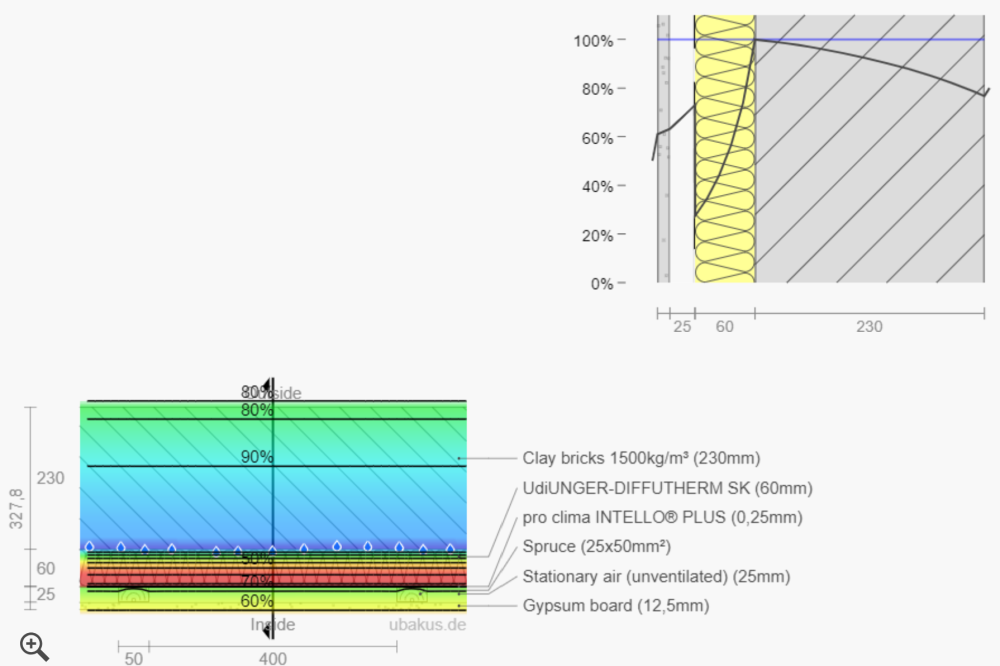
-
Warm batten internal wall insulation mitigations
Annker replied to FrankHouse's topic in Heat Insulation
@FrankHouse Understand this is an old post but if you get the @ notification I would love to know if you went ahead with the IWI as outlined in your post and if so how it has performed? -
Solid wall Internal Wall Insulation (Warm Batten) design
Annker replied to Annker's topic in Heat Insulation
Thanks for the response @Iceverge I am fortunate with regard workmanship/QC as I am a carpenter by trade (consider myself to have an eye for detail) and I will be doing the work with my own team. And I also have an appreciation for the level of attention that correct installation of an airtightness membrane requires. As my original post I have endlessly read every facebook group posts, forums, etc in researching IWI options. PIR got eliminated for consideration early on, almost entirely due to the absolute contempt the heritage/lime community have for it. Obviously they have a bias but it can be hard to ignore. That led me down the path of vapour open/breathable system, however not being a die hard conversationalist I still wanted to integrate the buildability of modern solutions into the mix. I also follow a house renovation channel on youtube which recently uploaded a video of a hybrid system called SWIP, and that in short is how I ended up with the bastard solution above with a foot in each camp if that makes sense. There is so much conflicting opinion regarding IWI that I'm ready to pull my hair out with analysis paralysis! . I personally have not had, or seen a PIR IWI cause damp/mould, and it is a system I would prefer. I feel there is too much broad strokes when discussion the various systems. The only differences debated are of the systems themselves; relevance of where (location, orientation, aspect) and how (workmanship) is ignored. So I must say its a relief to hear some experienced hands form this forum give a vote for PIR! I have modelled the PIR solution on Ubakus, and to me it looks ok. Humidity doesn't approach saturation point which I imagine is the most important thing.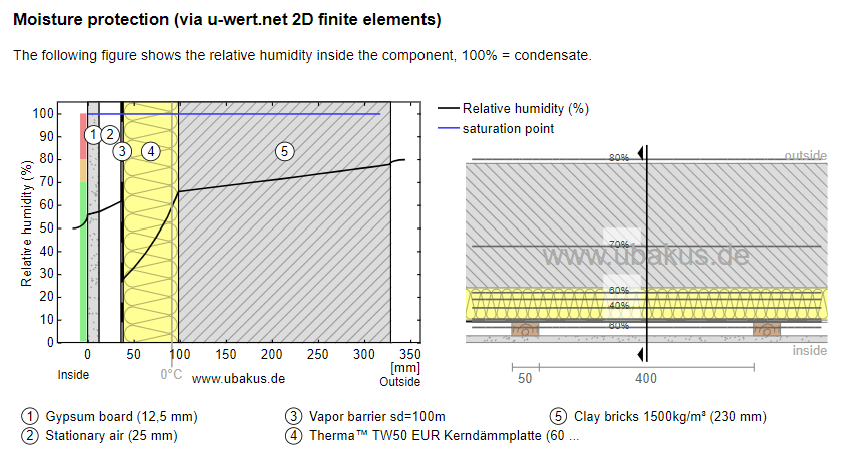
-
Removing wall bricks ready for RSJ
Annker replied to Bladders's topic in House Extensions & Conservatories
Typically needles penetrate the building in the room above the room where the steel is being installed. Yes they are disruptive and result in more remedial works but they are a significantly more robust and safer method of providing temporary support vs strongboys particularly in wide openings such as yours. No doubt strongboys and back propping joisting is used also by some, ultimately it's your call. -
Removing wall bricks ready for RSJ
Annker replied to Bladders's topic in House Extensions & Conservatories
Yes you certainly will need temporary support of the external leaf. That is a significant opening and if I understand correctly has two storey of brickwork above it. Similarly I'd question supporting the inner leaf by solely propping the existing joisting. Sounds to me like a job for needles penetrating both leafs. -
Solid wall Internal Wall Insulation (Warm Batten) design
Annker replied to Annker's topic in Heat Insulation
Thanks for the response. I know you have posted a lot on the subject and believe me I have read reams of material on the subject and still can't confirm my spec! Agreed that hygroscopy may be an issue with gypsum and my initial thought was that gypsum could not be used in vapour open system but as my original post it is a recommended detail from Back to Earth. Surely given where the PB and skim layers are located in the build up condensation should not be an issue. Modelling shows the Dewpoint within the insulation albeit it is towards the warmside; perhaps you saying the concern is if the Intello membrane allows vapour to travel outsode to inside should relative conditions drive it so? -
Dear all, I am looking for some design critique on a IWI design which I am planning to install in my Victorian semi-d renovation project. The existing walls are 9" solid brick with original lime mortar jointing and the house is sited in a relatively sheltered urban location in Kent. Following weeks of reading the wide array of opinions regarding installation of IWI to a solid walled house I have arrived at the buildup below with two different insulation options: Internal to external Breathable paint finish Gypsum skimcoat Gypsum Wallboard 12.5mm Service cavity 38mm x 50mm battens @ 400mm c/c Intello plus VCL 60mm Breathable Insulation layer OR 60mm PIR foil backed Insulation/VB layer 225 solid brick wall *Existing The design follows the "warm batten" arrangement. Preference is for a vapour open design and use breathable insulation, however I am unsure what specific type product could be used in that instance. I imagine the insulation would need to somewhat resist compression from the battens so perhaps batt type format. HAs anyone used a glass or mineral wool slab in a similar situation? Wood fibre is a candidate but it is pricey. I believe a vapour closed design has more risk in terms of trapping moisture within the buildup, however PIR insulation with its relatively high compressive strength lends its well to the warm batten design so this option is easier to spec material wise. After much reading I am satisfied that a gypsum plasterboard and finishing coat can provide a satisfactory degree of vapour permeability, hence their inclusion. Some will disagree (some who worship at the Lime Alter will be horrified) however there are studies that suggest that gypsum is more "breathable" than lime. I actually spoke to a tech/sales member of staff of a well known eco & natural BM and he (of his own accord) said he regards gypsum as entirely suitable in some IWI system build up, in fact they have it specified in some of their IWI solution on their website.
-
Exactly this. Sure the entire world is sitting on liquid molten material and its going nowhere (save a few earthquakes!)
-
10mm gap along both plywood to plywood junctions and the perimeter of the room. Plywood doesn't expand along the length or width of the sheet to any degree that requires consideration in this scenario. I used Hardwood faced ply as opposed to softwood faced shuttering ply. In the absence of the floor having any direct fixing to the underlying substrate, it is prudent to lay up the subfloor with materials that remain general flat rather than warp if you look at it sideways like shuttering ply The floors I was installing were generally all hardwood T&G flooring, secret nailed and occasionally may have some inlay work. And for that particular installation I would rate plywood above OSB. I feel plywood has a more robust surface for installation; nailing, marking out on etc.
-
I've installed hardwood timber floors in many houses using the floating floor method and it performs exceptionally well. I actually revisited a house over christmas where this was done in 2006 and the home owners reported the floors are as stable as the day the were installed, I believe 17/18 years is a sufficient test duration! I believe the buildup was: 18mm oak T&G boards 12mm hardwood ply (laid half bond at a 45 degree and screwed to the ply layer below) 12mm hardwood ply (laid half bond and loose over the PIR) 120 PIR Sheet DPM Concrete subfloor
-
Shower tray - subfloor prep
Annker replied to crispy_wafer's topic in Bathrooms, Ensuites & Wetrooms
Caberdek is sound for laying the tray on. The joints are susceptible to water damage, however looks like they have been jointed with PU glue so that largely negates that risk. -
@jayc89 I'm back reading this thread and informative as it is still remain none the wiser and undecided regarding which IWI build up to use in my house refurb, with existing walls as yours. Did you complete the job yet? IIRC reading another thread you did opt for the warm batten/PIR and gypsum build up. If so can you let me know how you eventually settled on that particular build-up and how it is performing?
-
@Keeko Interested to know how you got on with the floor insulation job?
-
Useful pricing/estimating software
Annker replied to Annker's topic in General Self Build & DIY Discussion
Project isn't a refurb it's a full strip out renovation and extension (cost~£250K), regardless the whole idea behind the thread is to use this software to do what a QS would. There isn't a builders merchant in the country that would spec and build out a quote for the job. -
Useful pricing/estimating software
Annker replied to Annker's topic in General Self Build & DIY Discussion
Ah come on we aren't in Venezuela economic territory yet! Regardless, professional Estimators face the same issue and it is simply handled with a % inflation factor built into the forecasts. -
I just wanted to share/hear user experience of a pricing/estimating software I've found as I believe it could be very useful to members of the forum. A essex small builder I follow on youtube uploaded a video using it to price an extension and I was amazed by it. It's called Price a Job. Additional it can do structural calculations and other PM tasks but it is the estimating module that I find interesting. First off to say I have zero connection to the company. The company behind it may be connection to Canada, the developer may be east european, the website looks basic but the software is very good and wholley tailored to the UK. I don't yet have a subscription to use it but I think I will sign up for a month to put a cost plan together for my victorian renovation and extension. You basically model your building in the software similar to doing so in sketch up but it has a drop down menu to assign a material selection for each element and each material has a UK market rate cost assigned to it, I think prices are updated weekly. I don't know how that is done or how accurate the prices are but you can input your own rates if preferred. Similarly labour cost are calculated for the construction of each element. Once the model is completed so is the price estimate. Perhaps there are other companies that I am not aware off offering similar software but I wasn't aware of this until the youtube builder demonstrated it. I imagine it been developed for builders to put together quotations but I believe it may be a great way to price up a single project as there is no 12 month commitment. Interested to hear what other think of this software.
-
Thanks again for the feedback. Yes reducing the depth of the service cavity is certainly a strong possibility as the TF will comprise of an office and a bedroom, as such there will be fewer services to accommodate vs say a kitchen or bathrooms. Noted also regarding continuity of membrane at joist level. Although the set back of the band joist (aside, I would term rim joist) is not an arrangement I've seen previously. I guess the sheathing continues over the insulation at that point to ensure both the GF and 1st floor TF panels are tied together. I think lining the respective studs through and strapping with 1000mm galvanised straps would be required also.


