Annker
-
Posts
219 -
Joined
-
Last visited
-
Days Won
1
Everything posted by Annker
-
@MikeSharp01 A couple of years ago I was struggling to find a supplier for beads and then found these guys 30 mins from me, located in Kent and have a good range. https://www.ghsupplies.co.uk/plastering-and-drylining/metal-beads/qic-reveal-beads/
-
Fine tuning my IWI Solid wall (Warm Batten) design
Annker replied to Annker's topic in Heat Insulation
Fair play to you for taking the time to make this, much appreciated @Iceverge, I haven't watch it yet but will do this evening. -
Fine tuning my IWI Solid wall (Warm Batten) design
Annker replied to Annker's topic in Heat Insulation
Yes its pricey but anything done at this stage will certainly be cheaper than rectifying works after decoration is done, its along that line of thinking that I'm happy to sell on my already purchased PIR at a loss. WRT to using RK38. Do you use it neat by its self or with sand as a replacement for the lime in the parge coat. -
Fine tuning my IWI Solid wall (Warm Batten) design
Annker replied to Annker's topic in Heat Insulation
I've seen that system/video. I think the princple is broadly OK but I hope to be able to produce a more robust install myself and at a lower price. -
Fine tuning my IWI Solid wall (Warm Batten) design
Annker replied to Annker's topic in Heat Insulation
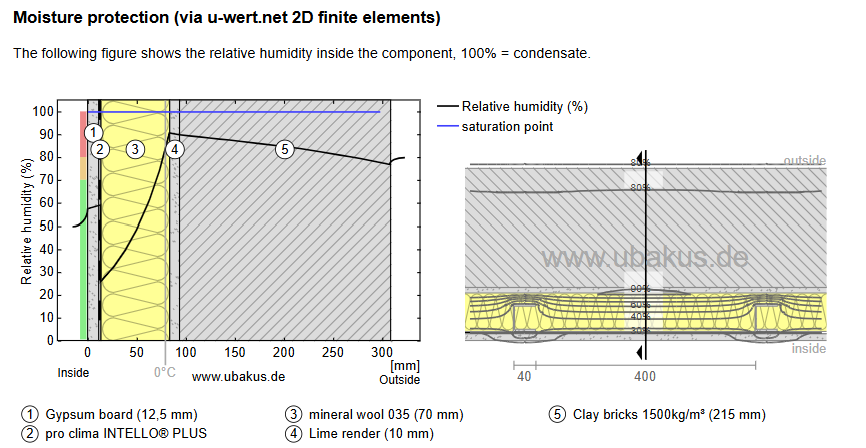
I'm unsure if an Open Vapour buildup should be modelled in Ubakus, but when it is it shows a condensation risk. Is that what we should expect and accept on the proviso that been vapour open the condensation can dry to the inside? Same buildup but with the inclusion of Intello Plus VCL. @Redbeard I believe you were suggesting the inclusion of a VCL?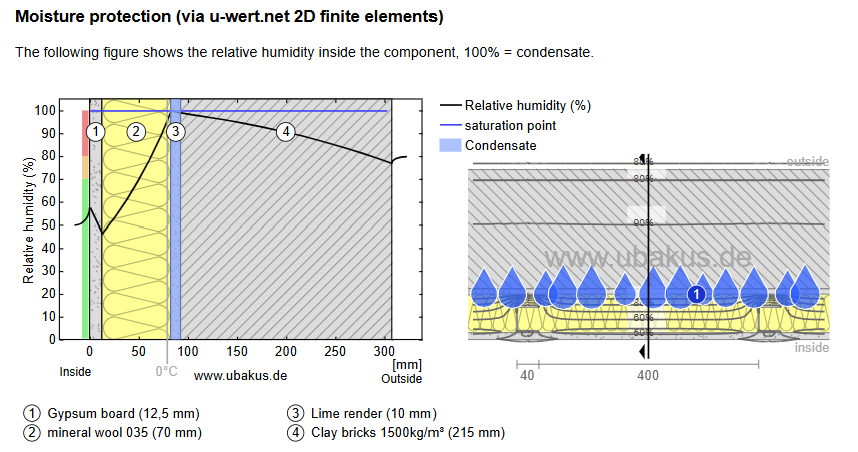
-
Fine tuning my IWI Solid wall (Warm Batten) design
Annker replied to Annker's topic in Heat Insulation
I'm coming around to mineral wool option, it would mean selling the PIR but that can be done at a minimal loss. The brickwork doesn't take fixings too well, so the studwork will be fixed at floor and ceiling level, no intermediate fixings to the brickwork, also the floor to ceiling height is ~3m, so that all points me towards using metal studding. With that in mind I'm unsure how mineral wool batts could be kept in place, tight against the face of the brickwork. Fitted in between studs will mean an absence of insulation behind the studs; hence a gap for condensation to occur (this will be the case with either timber or metal studs). I suppose mineral wool could be simply packed behind the studs or perhaps first install a full layer in landscape format, fix studwork and then infill studwork. -
Fine tuning my IWI Solid wall (Warm Batten) design
Annker replied to Annker's topic in Heat Insulation
Thanks for the explanation Mike, useful. So the parge coat primary deals with internal born moisture issues. It stops moisture transportation (by airtightness), limiting internal born moisture being drawn into the wall build up? The preference of mineral wool/fibre insulations over PIR, is primarily associated with external born moisture issues. Mineral wool/fibre insulation's provide better drying to inside of any external borne moisture that makes its way to the interface of internal face of the brickwork and insulation layer? Am I on the right track with thinking those are the principals? -
Fine tuning my IWI Solid wall (Warm Batten) design
Annker replied to Annker's topic in Heat Insulation
@Iceverge I'm trying to get my head around the parge coat, specifically its position in your build-up. Isn't it "cold side" of the insulation layer and therefore internally borne, warm moisture laden air can past through the mineral wool and potentially condense behind the mineral wool on the relatively cold surface of the parge coat/brickwork? Or perhaps the ideas is the breathable mineral wool allows that condensate to evaporate back into the room? -
Fine tuning my IWI Solid wall (Warm Batten) design
Annker replied to Annker's topic in Heat Insulation
A had a previous thread where I outlined my general design. This was your comment I was referring to: That's an interesting project/thread you'd linked above, I hadn't come across that one. To me the source of the dampness seems to have been the condition of the roof line and those cracks in the render, and the cement render largely contributing to its persistence. Would a mineral wool or natural fiber based IWI fared any better in that situation? I cant see that it would myself. Regardless insulated plasterboard dot and dabbed on to sand and cement walls and a lack of any airtightness (as you point out) I feel is pretty far from my own build up. And on top of it all the house is in Kerry, Kent were I am is the Costa de Sol by comparison, (and I say that as a Galway man!) The risk of damage to timber within the wall is something I'm concerned about, I guess its a risk all IWI solutions to varying degrees, seeing as they all lower the existing wall temperature. I do like your suggestion to seal in the joist ends with airtight paint, possibly airtight tape wrapped around the joist could perform similarly well should someone indeed use PIR!🤠 Do you think it would be wise to also inject boron into the joist ends, and timber lintels as I also have a serval of these present. -
Fine tuning my IWI Solid wall (Warm Batten) design
Annker replied to Annker's topic in Heat Insulation
Just wondering if some specific instance has come about that has you against PIR? I ask because previously your opinion was that PIR would be fine in this situation. Appreciate that you are just offering an opinion that I'm asking for, and its welcomed! -
Fine tuning my IWI Solid wall (Warm Batten) design
Annker replied to Annker's topic in Heat Insulation
Yes, I meant to clarify that the PIR will be the VCL. And yes insulation infill between the studs is an option but then continuity of the insulation layer is lost and its also more faffing to fit and fit well. My vote would be for a continuous uninterrupted, say, 50mm insulation layer; rather than a, say, 90mm insulation layer between stud that may also be a bit gappy. Although I have made no calculation to support that opinion! A word of caution regarding running services (specifically cabling) within PIR. Anecdotally at least I hear that running electrical cabling within PIR may present a fire risk. I've researched the hell out of IWI in a solid walled building, and the one thing I'd say is take absolute opinions and desk study theory's with a pinch of salt, there are many ways to skin this cat. No two properties are the very same and there is clear evidence that an approach that worked/failed in house A has been shown to work/fail in house b. For example, site location and aspect play a significant role but are frequently overlooked A house built on a well sheltered site on free draining sand in Kent is going to be less sensitive to dampness than one built in a marshy Welsh valley. -
Fine tuning my IWI Solid wall (Warm Batten) design
Annker replied to Annker's topic in Heat Insulation
Not sure if you missed it but my initial design is warm batten, meaning the battens are fixed on the warm side of the insulation layer. I wouldn't be too keen having the battens cold side of the insulation as I think you are suggesting, correct me if Im wrong! I'm familiar with gyplyner however the issue with it in my situation is that it is required to be fixed to the wall; in contrast to my proposal of metal studs which don't necessarily need fixing to the wall; floor and head track fixing will suffice. That looks like an interesting project you have there, spacious and I think the arrangement you have designed will work well. Ventilated cavity is a good option although one I dont have space for on my own project. -
Fine tuning my IWI Solid wall (Warm Batten) design
Annker replied to Annker's topic in Heat Insulation
Posting a revision to my thinking on my particular warm batten arrangement. Detail aside there is a potential installation issue that has been at the back of my mind, and that is the fixing of the battens through the PIR sheets and into the brick wall. There are a few tricky steps with this: Quality of the fixings. I had planned to use concrete screws which depending on substrate can either get a good fixing, a loose fixing or blow out the substrate; dry clay bricks are particularly prone to blowing out and that is the substrate in my situation. Positioning of the fixings: Ideally the fixings are centred on bricks, this will be difficult to achieve given the PIR sheet will be installed against the brickwork hiding all the joints and bricks Compromised VCL Drilling through the batten and PIR with a hammer action masonry bit will certainly blow out the back of the batten and PIR. I suppose this damage to the VCL could be reduced by drilling a pilot hole with timber spade bit until the brickwork face is reached but regardless the drilled hole through the VCL is a potential moist air route. Plumbing the battens Where some battens need to be pulled out from the wall to plumb this again will contribute to the likelihood of moist air routes Giving the above I'm considering how this alternative arrangement may work: PIR is fixed to brickwork face solely with low expansion foam. Metal studding (stood away from the PIR by 10mm or so) provides the framework to carry the plasterboard. Metal studs are fixed solely with a floor track and head track (perhaps a strongback is added) thereby no fixing penetrate the VCL. Appreciate any critique of this method. The PIR has been purchased (bought some months ago during some manner of flash sale) so even though some disagree with its use it has not to be used, plus the fact that the job needs to get done asap now. -
Solid wall Internal Wall Insulation (Warm Batten) design
Annker replied to Annker's topic in Heat Insulation
One issue I dont have is moisture passing through the walls from outside. The brickwork is the house bone dry, you cannot imagine how dry. If I handle the bricks (I've knocked through many openings) for a day the skin on my hands opens up, the bricks literally pull the oil from them and we're not talking office boy hands here either 😂 -
Solid wall Internal Wall Insulation (Warm Batten) design
Annker replied to Annker's topic in Heat Insulation
Good job I mentioned the ventilation WRT TF and brick facade as that is the arrangement in my extension. Another topic I'll have to research! -
Solid wall Internal Wall Insulation (Warm Batten) design
Annker replied to Annker's topic in Heat Insulation
This is very similar to a TF with brick outer leaf, however their is no requirement to ventilate the cavity in that particular construction. Am I correct to assume the reason to ventilate in the retro-fit version is due to the difficulty in ensuring the continuity of the VCL? -
Solid wall Internal Wall Insulation (Warm Batten) design
Annker replied to Annker's topic in Heat Insulation
Hi John I wasn't getting notification to the thread or your response. Walls were lined with battens, lathe and plasters and the effectiveness of this arrangement is one I've given thought on. I've concluded that doesn't provide any ventilation as in all instances the bottom foot or so of the air gap is packed with plaster resulting in no air gap at all. Yes the plaster is lime based and breathable, but how breathable is a foot of it and it's certainly was not providing any ventilation route. Well that was the observation in my experience other houses may differ of course. -
I believe that some of the other Norxxx suppliers also manage their entire offering; verses Velfac's and Rational's distributor model. Quotations in this package seem to be generated by a Black box, and I can only speak of my returned quotes and that is Norrsken being almost 50% more expensive than the field.
-
I had a quote from Norrsken, expensive installation costs that were ~x2.5 verses all other suppliers, and that on top of more expensive supply costs, do seem like a good company to deal with though. Has anyone used/had dealings with Ideal Combi? Seem competitively priced.
-
Fine tuning my IWI Solid wall (Warm Batten) design
Annker replied to Annker's topic in Heat Insulation
Iceverge, thanks for the comprehensive explanation of the parge coat much appreciated. As you can imagine the external face of the brickwork being laid flat results in any discrepancies in brick dimension showing on the internal face. In my mind to ensure that the parge coat is a continuous layer it would therefore need to be laid on quite thickly, perhaps in practice this wouldn't be an issue maybe a wet slurry mix would be the better option in that situation. I'm aware that PIR has its risks and they (along with many other factors) have all fed into my decision to go with this method. Understand the low vapour permeability of the PIR but don't agree that in my situation any moisture would be trapped behind the PIR permanently. The brickwork is bone dry, lime mortar pointed and I cannot see how that will change as it hasn't in the 1.5 that the brickwork has been bare, house unoccupied, windows missing, guttering leaking etc. Therefore the brickwork will provide a drying face to wick away moisture should in develop behind the PIR. I have considered a variant of your suggested design, are you familiar with the SWIP IWI product/method? The issues I have with it is that the battens are cold side of the insulation layer and VCL; with the warm batten method I am using both those issue are removed. Settling on a IWI design for this solid walled house has been the most difficult design decision. I'll be steering well away from pretty victorians for my next project. 🙁 -
Fine tuning my IWI Solid wall (Warm Batten) design
Annker replied to Annker's topic in Heat Insulation
Thanks for commenting @Redbeard I've read your previous well thought out posts re IWI and can appreciate your preference for woodfibre however I have had to dismiss its use in this particular project. Can you explain what mix is a parge coat in this instance and how to apply it. I had previously thought of a parge coat to be similar to a sand and cement scratch coat (trowelled on to say a minimum 10mm thickness), however I believe I read somewhere that ia parge coat is a much wetter mix and is brushed on with perhaps a broom or bristled brush almost like a thick lime whitewash? In any event I'm certainly onboard for full perimeter bead/cross hatching of the PIR boards. -
Fine tuning my IWI Solid wall (Warm Batten) design
Annker replied to Annker's topic in Heat Insulation
I believe for MHRV to perform anywhere near its design it requires an air tight building envelope, I'm restoring my existing sash window incl draught proofing them however I don't expect they will be airtight and they would at least hinder the performance of a MHVR system I see targeted extraction working better in my house; good extractor hood over the hob, well thought out extraction in bathrooms and utility. -
Fine tuning my IWI Solid wall (Warm Batten) design
Annker replied to Annker's topic in Heat Insulation
Its a very difficult subject to find agreement on. I've gone back to brick and will not be applying a parge coat. A poster above suggested to omit PIR between the joists and apply hemp plaster, I'd like to know more on how that works but other than that I'm fixed in the spec. I am satisfied, as much as I can be, in this approach for the following reason specific to my situation: Property is a semi-d situated in a well sheltered location on a well drained site. Over the past year even with some very leaky guttering I have not seen any visable internal penetrative dampness on the bare brick walls Many houses have employed this method without issue and I imagine the majority of those without much consideration/research of the finer installation details. I plan to ensure kitchen and bathrooms have top performing mechanical ventilation to at least remove this source of moisture to outside the building. Also a main driver is I need to get this done now, I've spent too long mulling over the pros, cons and risks of IWI, etc I have a wife, child, mortgage and ongoing temporary accommodation/rent, need to get the job wrapped up. -
Fine tuning my IWI Solid wall (Warm Batten) design
Annker replied to Annker's topic in Heat Insulation
I'm yet to start this particular job. The plan in my mind at least, is that low expansion foam will momentarily hold the PIR in position, the installed battens then primarily securing the boards in position. The service cavity may as you describe solely accommodate cabling etc, although I believe it could packed with rockwall if targeted u-valves required. IMO the batten thickness needs to be minimum 35mm. Where the batten it is positioned in the build-up (warm side of VCL) I don't believe it needs to be tanalised, regardless I am using a tanalised batten. -
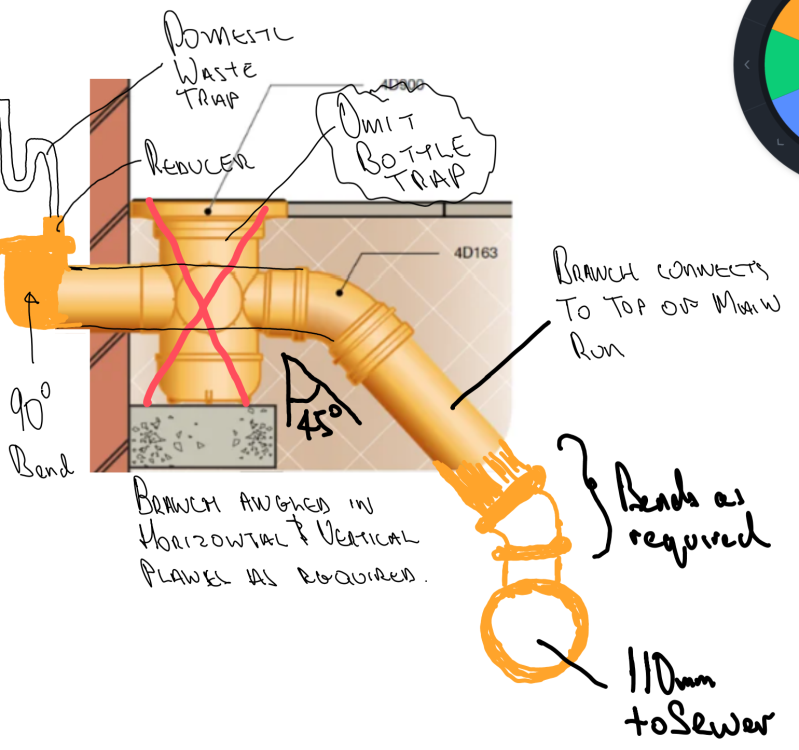
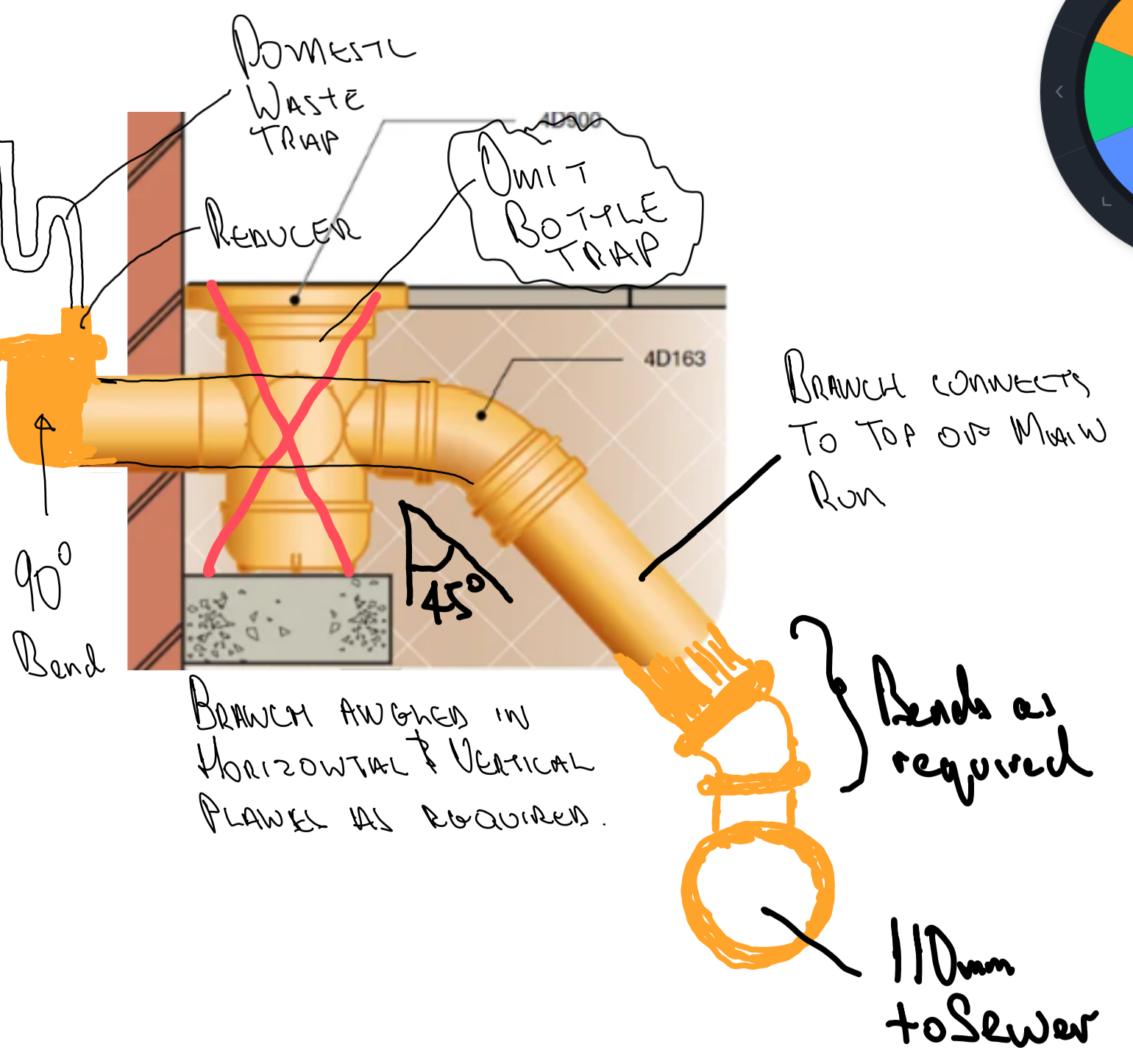
Thanks Dave That's very useful to know, helps my design along. So I imagine my other arrangement will remain for RWPs and the version below (if I have interpreted correctly) will works for domestics