
dnb
-
Posts
581 -
Joined
-
Last visited
-
Days Won
10
Everything posted by dnb
-
Low loss headers and plate heat exchangers for air source heat pumps
dnb replied to dnb's topic in Boffin's Corner
Thanks both. Some good things to think about. No, I don't. This is a thread about PHE and LLH not the system design itself. The amount of zones is irrelevent to coil vs PHE vs direct. If the house is hot enough, it is hot enough regardless of divisions. For the record, UFH on the ground in 3 zones, towel rails in the 4 bathrooms, FCU to put heat into the A/C ducting for upstairs and MVHR. It is all sized so that 40 deg C flow temperature works down to -1 deg C outside. They are already separated. The PV is installed, certified and generating. I want to make best use of the free electric, so I can't leave them in total isolation and consider justice done to the house design as a whole system. It would be like fitting a 50CCA battery to my V8 TVR and expecting it to start. (Truth be told, fitting a 10,000 CCA battery probably wouldn't make it start reliably, but that's another story.) See later for an example. I know I can be a bit "Dirk Gently" about the fundimental interconnectedness of things... This is my worry. But surely a coil in tank suffers from a similar drop in CoP as the tank warms up, but it's more disguised because there may be a temperature gradient building in the tank. Already done. Assume the answer is "Many" litres. Which is why I know I have to decide how the compromise falls when choosing a heat pump! It all has to work properly in the reasonably forseeable worst case when all said and done. That's good to know. It rarely gets below -4. I didn't really want antifreeze everywhere in the heating system and only being one leak away from the DHW hence the additional PHE. The destratification is a concern. Tank baffles etc sound like nice ideas but probably not something that works well enough in the real world so I would have to carefully consider the times when the tank would accept heat if I went this way. Not impossible, but another constraint/compromise for the mix. I wasn't planning on immersion heaters except as a reversionary mode (i.e. heat pump failure) I would ideally need 6kW (to make full use of all the PV at peak) and it makes little sense to me to use something with a CoP of 1 when I could use something with a CoP of say 2.5 and use the PV to partially power it. To give an example, let's say the PV captures 1kWh in the time it takes to heat the tank. The ASHP could heat the tank from cold to full using 3.5kWh [using an average COP of 4.17 calculated by numerical integration WRT return temperature from a very optimistic Samsung datasheet], but I got one of those kWh for free, so I pay for 2.5kWh. If I did the same with an immersion heater I get 1kWh for free, but I now pay for 3.1kWh to get the tank to the same temperature. The CoP I used doesn't really matter as long as it is above 1 the maths always favours the ASHP unless I can afford to wait all day to see if there is enough PV to get a full tank. And then the PV has only helped with DHW whereas it could have offset both DHW and heating and taken advantage of the ASHP CoP. I do like Willis heaters. I have one driving the temporary heating now. But wouldn't it need pumping thereby defeating the point? -
I have been evaluating options for my heating and DHW provision over the last few weeks. Things have changed (probably for the better) since I started the project several years ago and there are now more options but the physics remains the same - low temperature heat provision is more efficient, even with a new R290 heat pump. I have a few candidate high level designs from various people, at a range of prices and a variety of designs. Some are simple designs, others look like they might need a dose of simple adding. Unless of course the comlicated is adding some efficiency or reliability I haven't yet considered. I am now trying to evaluate things so I get the best value, and ideally take advantage of the government grant - I believe the house meets all the requirements. Add to this that I am trying to take best advantage of 6.5kW of south facing solar generation. Using solar to run the heat pump, acknowledging I can't modulate it via PWM like an immersion heater is an acceptable solution since there are very few scenarios where the COP of the heat pump drops to unity, and the immersion heater on its own can't supply all demands just on the yearly expectation of solar power. This adds a requirement for some kind of buffer (or batteries, but I can't make the cost vs return maths work yet). A couple of the designs contain a low loss header or a plate heat exchanger on the heat pump side of things. The literature on plate exchangers indicates they are nominally very efficient at their job, but it puts an additional pump in the scheme, and makes a temperature difference from primary to secondary outside of the tank. Is this something to avoid? The low loss header puzzles me - the internet suggests they need very careful design to not be lossy. Is this a way of trying to avoid/reduce the need for buffering? I've managed to make (on paper at least) a near passive house with a heat demand of 16 to 17 W/m^2 depending on who's modelling you believe - mine says 17.2, the EPC says 16, but rounds down - but I do have a significant DHW demand so I am trapped between a 5kW heat pump that will do the heating well but struggle for time with DHW or a 12kW pump that could conspire to short cycle like mad just doing heating if it's cold but not freezing. Most of the above is background so that the context of the actual question is evident. I like a good deal of the solution involving the plate heat exchanger but am keen to check for devils in the detail. Are plate heat exchangers actually bad for heat pumps and efficiency if they are properly sized and insulated? I am in 2 minds because coils in tank don't seem particularly efficient either in some cases, but maybe this balances out and coils are cheaper, but this depends on how much I believe in tank stratification, whether I want to mix antifreeze into the heat pump water or whether I drive the heating directly from the heat pump. The usual thing... Ask 3 people get 3 different answers... I assume the low loss header is not the right answer for me, although it does meet some of my requirements to separate usage from generation.
-
The Steico Joist technical guide might give some clues. I believe it covers use as walls - I plan to build my garage this way.
-
I completely agree. We should be able to access the standards to ask questions like "Why is it like this?" and "How did you test that?"
-
I did apply and was given permission for a 6.5kW array on a single phase but since it was Covid time they didn't send me a critter. As for EPC, this made it an easy A on the old scheme. Something like 105 to 112 depending on how the heating gets scored.
-
Design Access Statements and AI. A first look
dnb replied to ToughButterCup's topic in Planning Permission
I found it didn't know the difference between kW and kWh either. But it did know that Wolfram Alpha was better than it at calculus. -
Microcontroller based power switching revisited in 2024
dnb replied to TerryE's topic in Boffin's Corner
Thanks for confirming I'm not going insane there (let's leave all the other evidence aside). But as you say, if there were a real need for impeccable timing then there are other optons - I'd return to my digital electronics roots and use VHDL and an FPGA. It works well enough in my case to disable interrupts when certain operations are about to occur, and as you did made the interrupt code as simple and short as possible. -
So I don't further derail this thread I'll ask a new but related question. I'm looking for an alternative to the Pi Pico combined with a W5100S chip mainly because I don't like Python and the rest of my home automation project is coded in Javascript. The hardware on the Pico and W5100 is absolutely fine so if there's an option of a Javascript environment for it that has a bit of support then all is good. Kaluma looks like it will be pretty good if it gets further, but it's not got support for everything I want yet - I don't want to engage in low level development work because there are too many other things I need to do. I am led to believe something ESP32 based (like the Shelly devices) might have both the JS option and a wired Ethernet option. I'm hoping someone can point me at a demoboard much like the W5100S-EVP-Pico, but for the competition, and where I might find some details about what the version(s) of JS for it can be persuaded to do. I can't drop wired ethernet from my list of requirements - the project is not suited to WiFi. Native POE would be a significant advantage although strictly I can manage without. Thanks for any insight. I'm a bit out of the loop on current microcontrollers - I stopped playing with them seriously when the AVR Mega16 was all the rage!
-
Microcontroller based power switching revisited in 2024
dnb replied to TerryE's topic in Boffin's Corner
Agreed. And I do enough of this at work to last me a lifetime. (And I have to train the next generation of engineers to look after it too - the design lifetime extends long after my retirement and the customer doesn't like budgeting for spares...). I'll stick to writing a few bits of software to glue things together. It's about all I get time for these days. If you want a demo, let me know. I have a few of them running linked as a bank now. They are proving to be very good pieces of equipment so far. If I can avoid it I will. It is one of two lanuages I have tried that I just don't like. I find many aspects of the language to be absurd, and my experience is that it is a terrible thing for teaching people to code. I am finding that the Pico code I write in C/C++ works reliably but the Micropython code suffers from marginal timing issues and general low level unreliability. Not a problem until I want something to run for weeks at a time. Aside from that, I agree that the Pico is an excellent microcontroller for general use, but it's a shame that theres no acceptable Javascript option yet, although the internet says it is being worked on - there's some merit in everything being in the same language because it makes my head hurt less. (Matlab, Ada and Perl in the office, JS and python at home if I'm not careful. I'm amazed anything works at all some days.) -
Discharge of this condition. How much detail did you provide
dnb replied to Post and beam's topic in Planning Permission
I think, sadly, that this sums it up perfectly. I'm an engineer so by nature extremely cynical. I fear that while the intentions are good it's open to the usual abuse that a template document purchased for a couple of hundred pounds satisfies their requirements and then everyone carries on exactly as they like. -
Microcontroller based power switching revisited in 2024
dnb replied to TerryE's topic in Boffin's Corner
Not @Mike but I have implemented a very simple script on my Shelly 3 Pro to sequentially power the pump and heater in my temporary Willis UFH based on receiving a "heat demand" signal from the house controller over Ethernet. It works well enough but it's only a toy example. I haven't yet had time to see if I can send it temperature data from an external source so it can manage the heating all by itself. For what it's worth I'm in the "avoid single source" camp, and strongly prefer open standards with more than one vendor support. (And can't yet see the benefit of paying extra for many of the "smart" applicance currently available) My current plan is to aim for a complete UK/EU based COTS hardware solution where I trust the UKCA/CE marking and write the necessary software to manage interfaces and provide a few algorithms should I need to, avoiding any language that can't count properly and can't make up its mind how it works from version to version. So far I've got DMX for lights working pretty well using tablets and phones as switches, RS485 based Modbus pulling data from the solar inverter and a very odd RS232 link to control the MVHR - it seems Vent Axia didn't implement any meaningful software beneath their "BMS port", so I have used the (well documented on GitHub) option of getting a computer to pretend to be a remote control. Next is to look at Modbus controls for my preferred Samsung heat pump. The rest should be temperature and pressure monitoring and there are plenty of ways to do this. It would appear that for the basic functions I want to end up with there is no particular need to control discrete relays - data based comms is doing the work so I am relatively free to use whatever automation software is around or write my own. I may change my mind as to the requirement for controlling discrete relays when I look again at how to reconcile the excessive hot water demands vs small space heating requirements... But right now I am calling it a win to have most of the need to switch hardware directly designed out. -
1938 Thought we'd stopped buying things that need fixing!
dnb replied to Jaeger_S2k's topic in Introduce Yourself
Welcome to the forum. I am wondering if it is possible to grow out of buying things that need "a bit of work". I keep doing it, but I am a few years less wise. No. Not crazy at all. Unless I am too, but then I spend far too much time here and on my building site. Working on a 4.8m x 5m timber frame garage now to replace an old concretre section garage that has disintegrated. (Good job my TVR wasn't in there - I see you're local to the old factory) Good luck with things and I look forward to seeing the details. -
Availability of combined A2A and A2W units in the UK
dnb replied to FelixtheHousecat's topic in Air Source Heat Pumps (ASHP)
I looked at one of these thinking it would make things a lot simpler (and therefore cheaper). It was anything but cheaper! The cost was nearly twice that of a Vent Axia MVHR unit and a Mitsubishi 6kW ducted airconditioner unit. Then installation was actually not made much simpler for a larger cost because I couldn't just use my local contacts. All in all, the simplifications did not translate in to any form of reduced cost over the next 10 years. It's never easy. But I tend to agree with @Iceverge and am following a similar strategy - 700W of oil filled radiator is keeping the chill off the new house nicely although we do have a bit bigger DHW requirement when we actually live there (not giving up the large bath!) and this is driving the requirements into an area where R290 might help if the price comes right. -
Trying to understand this one myself. Attempting to solve the problem by overkill - was fairly cheap to buy a kit of bits for a small office, including red call points that I won't be fitting in the house... I have the same open plan arrangement so am putting a heat sensor in the kitchen area and a normal smoke alarm in the lounge area. Roughly centred in each "section" of the room because there's not much else to go on. I have a couple more requirements too thanks to having 3 above ground storeys, but thankfully it's not a "large dwelling" for the purposes of fires.
-
Centrally wired lights for me. I took a risk on not putting in T&E to the switch locations, only Cat6. My logic is that I can fit either "smart" or dumb relays in my lighting enclosure connected over the Cat6 to a physical switch should the DMX units fail to the point where I can't repair/replace it. I may live to regret this... we'll see in a few years! I have a couple of rules for home automation: 1. Basic functions need to be available in the event of some failure. (no lights because no internet is not a good plan.... no lights because no electricity is allowed.) 2. No proprietary single-source technology other than what I make myself. (So a Shelly relay is OK, but Loxone tech unfortunately isn't even though I quite like it. Hue bulbs are marginal, but I am excluding them - my rules after all.) 3. Nothing security or even slightly safety related implemented in code. (So no automatic doors based on face recognition...) Everything I am currently usint is either developed in-house (pun intended) or is open source. My test implementation (not buying the real hardware yet!) involves an old laptop running a light weight Linux and number of nodeJS based server applications to interface with the DMX devices, the solar inverter, the MVHR, the temperature/humidity sensors and a Shelly Pro to control the temporary Willis heater based UFH, so more a BMS than just light switches. Literally any device that can run a web browser can access all of the controls for the house all presented with a common user interface, assuming it has permission. If a device fails then I swap it out for another cheap Android/Apple/Windows tablet, RPi or whatever I am using. If an ethernet controlled relay fails it can be swapped for whatever is available with a small update to configuration. There's a few more things to implement, but kitchens and bathrooms are a bit more important now. No home assistant or any of the other automation things are in use (yet), although I don't rule it out at some point if I loose interest in my own stuff - I've done the interesting bit now. And that leads to the biggest risk... It's all built with COTS hardware, but who would want to take on any of my code? SWMBO is a software engineer, but tests have shown that my coding "style" is often not easy to follow. But at least I won't stop supporting my own code while I want my own code to work. Physical switches would have been easier, and if I wanted just on and off would have been cheaper by a long way. But if I did that then I wouldn't have had anything like as much fun doing it. 😉
-
Yes, that's the name of the pestiferous things. I couldn't remember at all. Thanks both. The 3M tape doesn't look too badly priced.
-
The UPVC windows in my old house used to have those silly plastic bars stuck to the surface of the glass. Over the last few years they have just about all dropped off so now I have a utility room cupboard full of the damned things and they are getting in the way. I would like to replace them in the near future but the tape I had when the windows were new is now a bit crispy at the edges and less sticky than it was so I am looking for a recomendation as to which tapes will work both inside and outside (if there is a difference) for a reasonable length of time and are not absurdly priced such that the house looks tidy for whatever I decide to do with it when the new house is finished. (It may therefore be required to last for a long time at current progress rate!) Thanks
-
Small blanking plug missing from my Willis heater based UFH
dnb replied to dnb's topic in Underfloor Heating
I know they aren't odd per se. But it is odd to design them in to a part that uses common plumbing sizes everywhere else with no obvious need to use something different. -
Small blanking plug missing from my Willis heater based UFH
dnb replied to dnb's topic in Underfloor Heating
Got some better measurements now I have a long bolt that fits. Seems I mis-counted the threads in the hole (off-by-one error I think... ) so it's very close to 20TPI. Major diameter is still as before as between 11 and 12mm. So I am left with 2 likely alternatives: M12 1.25mm pitch or 7/16" UNF. The banjo bolt appears to be M12 and is a little slack in the manifold, but nothing PTFE tape can't fix, but the 7/16" UNF is has a slightly bigger diameter and over 5 threads 20 TPI vs 20.3 TPI makes little difference. Why would anyone make plumbing parts with unusual threads? It's just irritating. I found a 1/4" BSPT thread tap in one of my old tool boxes. I think I know where this is going. 🤪 -
Small blanking plug missing from my Willis heater based UFH
dnb replied to dnb's topic in Underfloor Heating
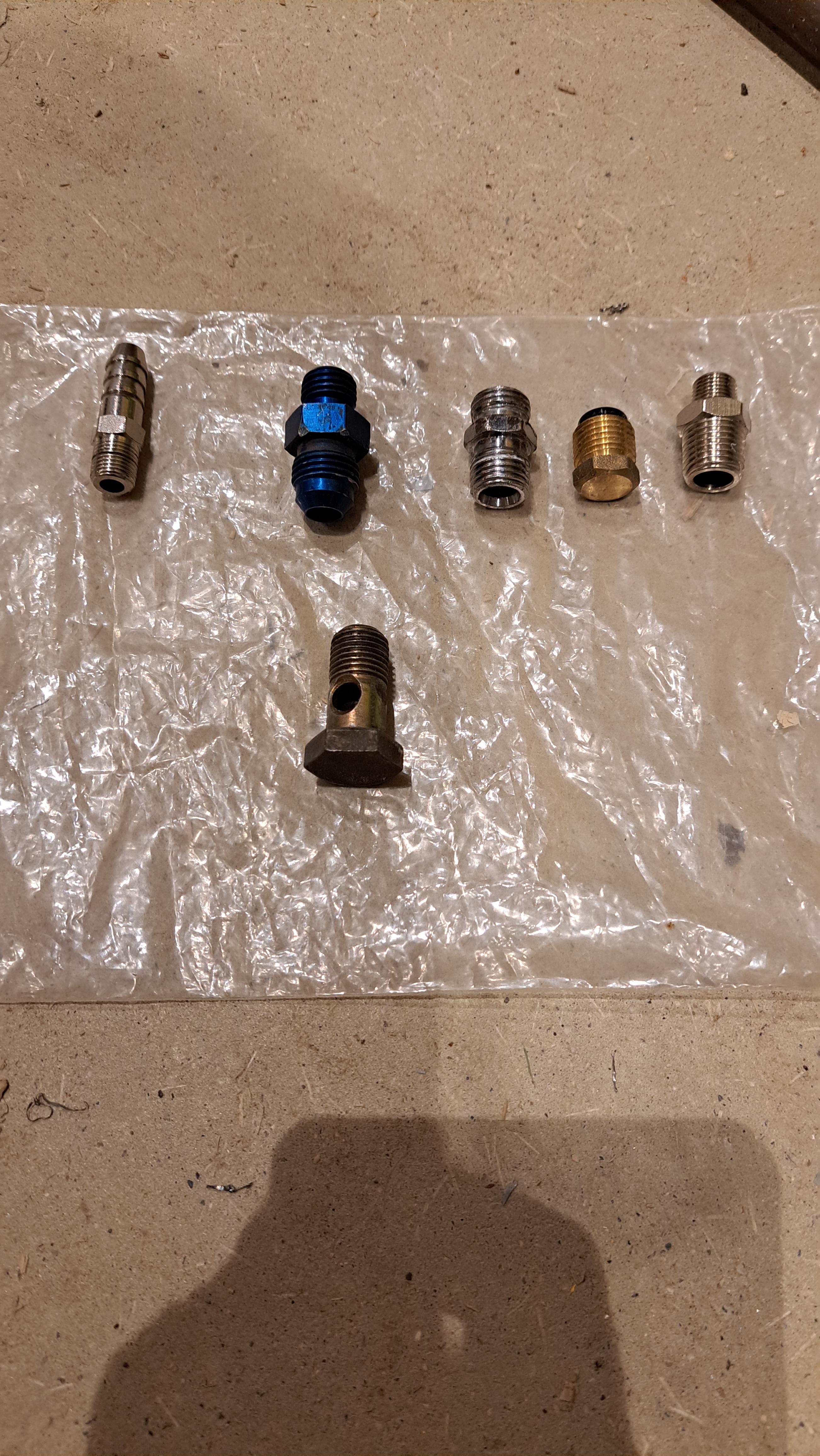
From left to right we have 1/8 bspt, JIC -6AN with M12, 1/4bpst to npt, 1/4bppp and 1/4bspt to 1/8 npt. None fit. On the bottom we have a random banjo bolt from the brakes of one of my cars. I can't recall which. This fits well but doesn't help block the hole up!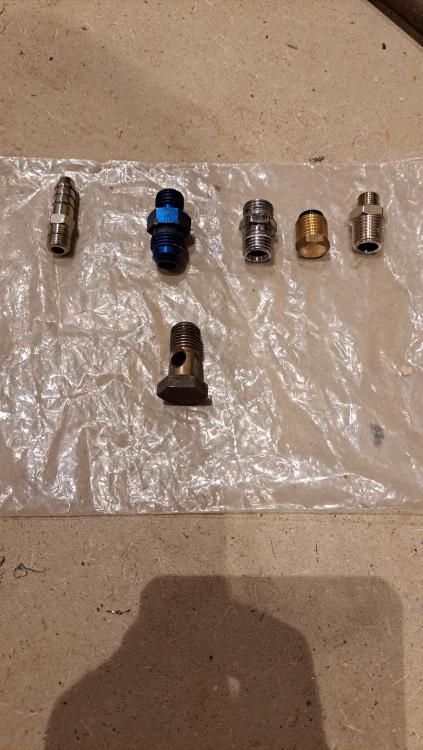
-
Small blanking plug missing from my Willis heater based UFH
dnb replied to dnb's topic in Underfloor Heating
How much? Want to bet that I haven't done this and found they don't fit already? (The gauges in the picture are temperature, and push in to holes in the manifold) I tried the pressure gauge from a couple of spare PRVs and both were too small (one was 3/8" BSP and the other was 1/8" BSP) and neither worked. 3/8" BSP OD is around 16mm so this is hardly surprising. And I've already established that 1/4" BSP isn't right. I have an extremely large box of plumbing spares from my mis-spent youth and from various parent's estate clearances. I am most surprised there is nothing in the magic box that works. -
Small blanking plug missing from my Willis heater based UFH
dnb replied to dnb's topic in Underfloor Heating
Damned keyboard batteries... Lost the post on editing to add some new measurements. My thread is approx 14TPI, so close to 1/2" BSP, but the hole is less than 13.2mm, so this doesn't fit at all! 1/4" BSP thread pitch is 19TPI so even crude measurements tend to rule this out. The hole is approx 10mm to the edge of the thread, so best attempt at measurement gives jsut over 11mm as an outside diameter. It does all point to 7/16th UNC, which as you rightly say is odd. The hole has parallel threads, so a tapered plug might work, but not if the thread pitch is wildly different. Screwloose and B&Q were not helpful. This has been done. I wouldn't ask here if it were too obvious! -
Small blanking plug missing from my Willis heater based UFH
dnb replied to dnb's topic in Underfloor Heating
Definitely not 1/2". Far too small. (I have loads of these in the spares box and they don't fit.) And not M12 either now I have found a bolt to try, although this is much closer. -
Small blanking plug missing from my Willis heater based UFH
dnb posted a topic in Underfloor Heating
Now it's getting cold and I am still a regular member of house not finished anonymous I have installed a Willis heater setup for my underfloor heating using old bits of plumbing from the many boxes of spares I have. All good so far, but I find that I have lost a small blanking plug that goes in the mixer unit's return piece. I assume it is for a temperature probe or similar, but I wasn't going to bother for the moment. (The UFH is intended as a backup heat source for the house - the "real" heating is via ducted air, but I am a while away from commissioning this but it seemed silly to not put pipes in the screed when the opportunity presented itself.) Here is a photo of the offending hole in the UFH assembly. I believe it might be 7/16" UNF but Google suggests this is not a common plumbing part size - mostly returning hits on brake pipe flares and similar automotive things (all my cars have metric brake lines, so no help here). It could also be M12, but this doesn't feel a particularly good match with the thread gauge and as one would expect the entire stock of M12 bolts in the house have all gone on their annual holiday to the back of the extremely full shed. Does anyone know for sure? The local plumbing places don't have much that is non-standard in stock and I would prefer to not have to buy anything big to get this to work. Thanks!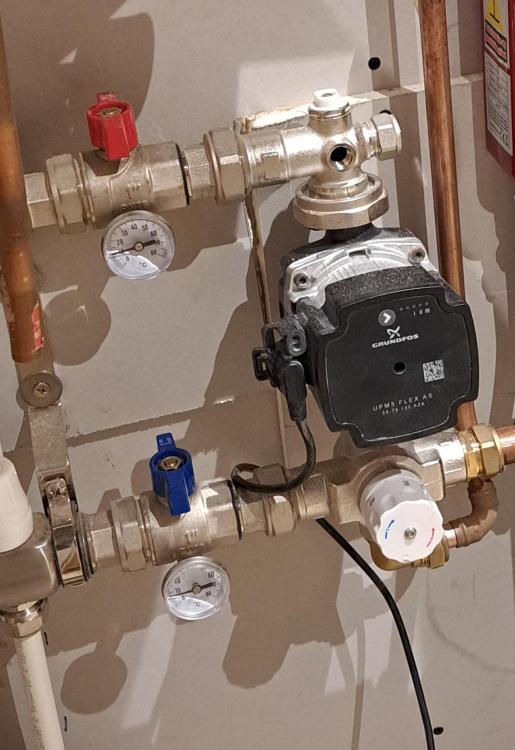
-
I have a 2.7 tonne tracked 360. I looked at a 3CX backhoe but decided I had far too many trees and things in the way so it would always be too big and heavy thus defeating the benefit of having a loader. The 360 machine always seemed more convenient for digging trenches and grading - things I do a lot of. As for costs, yes hiring would be less risk but there often aren't enough to go around where I live and an always available digger affords me a lot of freedom as to when work gets done, and that alone is worth a lot. As for selling at the end... I don't like parting with tools or vehicles, but I have had a couple of local people interested so I don't think it will be too hard if I ever manage to get somewhere near finished. Sorry, we probably aren't the right crowd to talk you out of buying plant.