


Russdl
-
Posts
1783 -
Joined
-
Last visited
-
Days Won
6
Everything posted by Russdl
-
Everything is slowly falling in to place ready for the demolition, apart from the contractor who seems to have had a better offer and now is not interested in the job. The services are almost gone, the demolition notice is in and the asbestos will be out soon. So, DIY demolition? I suspect it is fraught with real and imaginary dangers but is there any reason why I shouldn’t crack on with it (when all the other i’s are dotted and t’s crossed). I have a mass of free labour that is desperate to get started. Any advice on how to go about this? What are the traps beyond the obvious roof/wall crushing the work force?
-
Now that is good news!
-
I wish I could offer some advice but I'm still in 'sponge' mode and just soaking up your output so I can only offer encouragement. From what you say it looks like you've got pretty much everything covered but I suspect wise wo/men will be along soon to highlight any omissions in your planning. Good luck with it all.
-
I think you're right, despite lots of encouragement from 'friends' to "just rip it off and bury it". I'm not minded to take that route. Excellent question. I've no idea at the moment - I'll find out and let you know. @Ferdinand @JSHarris @newhome Some pretty sobering tails there. I'll be getting the pro's in (the ones with the lowest quote!!)
-
It certainly fore warned us of dark clouds approaching. We had a pre-demolition asbestos survey a few weeks ago on our 1950's bungalow and whilst I expected it to reveal some asbestos I was frankly amazed at how much there was, and where, it seems almost nothing was manufactured without asbestos. All the floor tiles in every room. Some wallpaper. Kitchen sink pad. Ceiling panels. Vent pipe. And then the soffits, which are Amosite, which by all accounts is the potentially nasty stuff and inflates the removal quote somewhat... First quote to remove all of it was £7550 + VAT! Second quote which we have just received is £4995 + VAT still pretty bloody hefty but a hell of a lot cheaper than the first. Do they just make it up as they go along?
-
Looking really good Vivien, here's hoping the weather holds for you. Those big first floor windows are going to frame some stunning views for you. (In my Lynx days we would just nip under any power lines ?)
-
Update: SSE is our DNO and British Gas our supplier (who I've just spoken to). They assure me that there will be no problem fitting the meter to the cutout without the TBS CU being in the box. I hope they don't change their minds by Friday.
-
@JSHarris I’m certainly learning that in these early stages!
-
Ah! That changes the price of fish a little. I’ll have to check with the supplier tomorrow as my electrician is not available this week and the DNO/Supplier are due on Friday...
-
At the risk of looking stupid (Google was no help) @ProDave EIC? What’s that? Thanks for the rest of the reassurance.
-
I've changed my plans slightly and the TBS will be 'temporary'. But I'm getting confused about what/where/who/how etc. I can't call anyone until the morning and I won't sleep with these (hopefully minor things) playing on my mind, so I'm hoping you'll be able to check my plans thus far... I'll be trenching (IAW with the DNO guidelines) from their pole, and under a footpath, so that the hockey stick comes up in to our garden about 1m from our low fence which separates our garden from the footpath. I have a wide (700mm) lockable meter box that will be mounted on 2 wooden post. Inside this large meter box I plan to have the meter and Temporary Building Supply. Whats bugging me is: 1. Is there a minimum distance from the fence to the meter box/TBS (it will open in towards the plot) 2. Can I have the Cut Out, Meter and TBS all in one big box? (a bit late to ask that question, but maybe not too late!!) As I understand it, the DNO pull their cable through my duct and put the Cut Out in my large meter box and dissappear. Then the service provider attach a meter to the Cut Out and disappear. 3. Do the service provider leave a meter with nothing hanging out of it and then my electrician connects tails to the meter and on to the TBS or do they leave the meter tails in Henley Blocks. This is probably nigh-naff and trivia but it's vexing me, any light shining would be much appreciated.
-
It's all looking really good, great stuff. The size of those cranes (and the lorry) make me shudder considering how tight our access is. Good news re the power lines - I'm sure they'll see sense...
-
?
-
Sorry Nick, what do you actually mean by that? I'll definitely need help there... How come? It will be required. If I need to go softener first, then accumulator, and this is all at the end of the garden I guess I'd need to run a separate, non softened supply to the house as well for drinking water?
-
That sounds like a nice simple solution. No stone left unturned.
-
@JSHarris ? A plan is starting to take shape. Clearly I'd need to protect the accumulator from long spells of freezing weather but I reckon I could make a shed for it at the end of the garden and then run the larger bore MDPE to the house.
-
@Nickfromwales & @JSHarris thanks for those links. Chunky monkeys aren't they. So if I were to go down this route I'd have the main going to one or two accumulators and then onwards into the house. Is the distance from the accumulator to the house important? I could probably site it (or them) in the garden some 25m from where I'd be expecting the water to enter the house.
-
@Nickfromwales Thanks for that obvious point Nick. Sadly I wasn't bright enough to think of that myself! @JSHarris Thanks for that info Jeremy, how does that work, having 2? Are they plumbed in parallel? Also, what are the rough dimensions of your accumulators? I'm still head scratching about where to put it (them) if I go down that route.
-
@Nickfromwales I'll look into the accumulator option I think Nick. Thanks for the pointers.
-
Splendid chap from Wessex Water popped round on his way past and I've got 4 bar of pressure ? ... but it looks like my 'stopwatch and bucket' measearument was correct - I only have 15 litres per minute flow ? Is that going to be enough for potentially 3 showers running at once? If not, will I need to replace the main or will an accumulator pick up the slack?
-
Well, I have a standpipe. My first dabble with blue MDPE and plasson fittings - a bit like massive Lego, I feel like a builder, and I will now stride around in my Dunlop Safety trousers with a new feeling of self worth. Being generous my standpipe is producing 15 litres of water a minute - but most importantly, it's not leaking! Now for the pressure test, I'll call the water company first...
-
@Nickfromwales I woke up thinking about an accumulator!! I think need to arrange for some more interesting dreams ? I presume the blue connector that I need to use, with the 7mm internal diameter, will have no effect on the static pressure? I also presume it will have an effect on the flow?
-
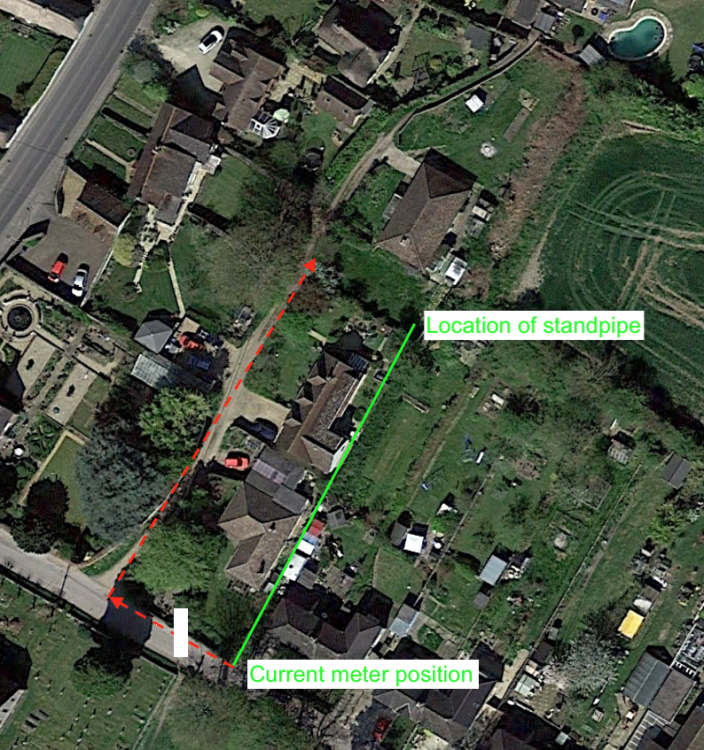
@Nickfromwales I'll be doing that in the morning, so ? @ProDave Probably not. The water is turned off at the meter which is on a road about 50m from the property. I found the main in the corner of our plot and a straight line from that hole to the meter would be under the 2 neighbours back gardens (green line in the image below). I suspect they wouldn't want me digging up their gardens (but I haven't asked the question yet. To replace the main, I suspect the only viable option would be to route it up the gravel track (red dotted line below). I'm hoping Nick will be right and the flow from my piddly little main will be sufficient.
-
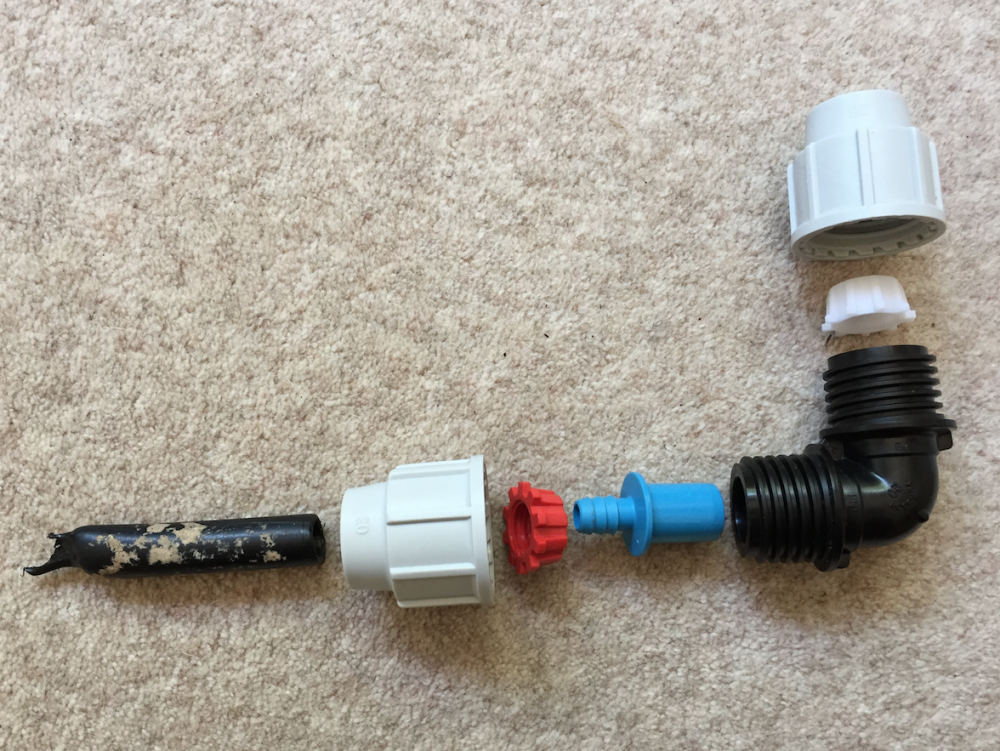
It turns out we have a 3/8" Alkathene water main. Is 3/8" big enough to produce the goods when it comes to connecting to the new house? To set up a temporary standpipe I've got a Plasson 90° elbow (with a blue adapter) the internal diameter of the blue adapter is about 7mm. Does anyone know of alternative connectors that don't restrict the 3/8" Alkathene, I'm guessing that 3/8" is too small and 7mm is way too small?
-
@CC45 that’s been our best guess up to now, pretty heavy duty earth though! @ProDave we have the electric DNO on site in a couple of weeks so I’ll get them to peer down the hole.


