Dan F
-
Posts
1431 -
Joined
-
Last visited
-
Days Won
2
Everything posted by Dan F
-
@joth Did you every to the bottom of the 3ph net metering thing? We're at the stage where we are trying to work out if we should go with single phase or three phase, but there are no clear answers about how UK 3 phase smart metering works, or will work. The Telsa Powerwall Gateway also uses the approach described in the Sunny video you shared, using current meters on all three phases, but unsure if this is supported/enabled in the U.K. Reading the manual you shared: This seems to say that there is no net metering between import/export, but the import/export across phases is netted out. (unless I'm reading it wrong).
-
You are right yes, still needs DALI extension, just no additional KNX bits or the KNX->DALI/Modbus->DALI extension which I'd been looking at and seems very complex. Change is software only it seems. They've also added a daylight responsive function block. See https://youtu.be/JdIc4OcwvlI?t=1086
-
No personal experience, but a TF manufacturer recently recommended the use of ground screws for well-priced tree friendly garden room foundations..
-
Home automation server/system makes?
Dan F replied to gc100's topic in Networks, AV, Security & Automation
Make sure you share you conclusions! One thing I hadn't realised you could do with Loxone, but discovered over the weekend, was that you can actually design and simulate things using the design tool "Config" without even buying anything.. those videos explain how. -
Loxone just added DALI DT8 support, so you can now change color temperature of any DALI fittings that support "tuneable white" without any intermediate hardware in theory.
-
Home automation server/system makes?
Dan F replied to gc100's topic in Networks, AV, Security & Automation
@Thorfun I found this video series the other day which is a fantastic introduction to Loxone. https://www.loxone.com/enen/kb-cat/foundation-series/ https://www.loxone.com/enen/kb-cat/focus-series/ Do you know if C4 can be self-programmed, or installer does everything and then walks away with the password? I'd ruled out C4 assuming this was the case, but I might be wrong... -
My current plan is to use Mixergy, but not depend on the app/cloud, but rather interface with Loxone via modbus. Can then we as smart/dumb as I want with no cloud/app dependency. They've confirmed they have a modbus interface, but I haven't seen the documentation for it yet.
-
Hello from a newbie - one with a Mixergy tank
Dan F replied to BristolBill's topic in Introduce Yourself
Welcome! I'm also interested to understand your experience with Mixergy. We haven't quite started our build yet, but were also initially looking at Sunamp but are almost decided on Mixergy. How are you heating the Mixergy? -
Home automation server/system makes?
Dan F replied to gc100's topic in Networks, AV, Security & Automation
The new version of the Loxone Miniserver no longer has KNX, but instead includes "Loxone Tree" with a proprietary daisy-chain. KNX is now a pricey add-on extension which is consistent with their move towards being more proprietary and more partner-led. Get a quote from a "Smart Homes" outfit and that'll seem cheap! I got a couple of quotes out of interest, but it's crazy crazy money.. so plan to DIY it. Also, even if I don't do everything initially, plan to at least put cables everywhere before plasterboard goes up. Not decided what to do for lighting yet, but not the Loxone light fittings. Potentially centralized 230v dimmers, but also looking at fittings with DALI drivers (which can be used via a Loxone extension). Blinds will be integrated via relays so we can open/close these based on termperature to leverage solar gain but avoid overheating as @jack also does. We'd like to integrate ASHP/MVHR if posisble, but these both use proprietary protocols I think, so it would be additional effort/cost that may not be justified. This is a thread in the Loxone forum where I asked a number of questions regading DIY Loxone for self-build: https://groups.google.com/d/msg/loxone-english/m54bR_8aZvc/XoTIlb0LHQAJ which might be useful. -
MBC foundation question. Do I need that much Type 1?
Dan F replied to rufusmacdoofus's topic in Foundations
Is this due to soil conditions? That's 1150mm below slab from my calculations, which seems a lot! (MBC standard detail depth is 650mm including 150mm hardcode) -
@Jeremy Harris Think you're right given those numbers; electric is simplest and while not efficient use/cost will be very low. Using DHW would mean more expensive brass/copper/stainless towel rails and would also couldn't go directly on DHW circulation anyway, else it would be always on. Any recommendations for good electric towel rail brand that can be integrated with automation e.g. loxone?
-
ASHP + UVC. That's a good point, I was assuming you'd use a thermostatic valve like on a radiator, but exactly how this would work on I don't know. You woulnd't be constantly topping up the water if it's on the DHW recirculation loop, as that water comes back round to the tank. You will potentialy need to heat UVC to account for losses in DHW recirculation and towel rails but this is an existing loop that already exists (where UVC acts as buffer), rather than something new just for towel rails. Also, doesn't make sense to hook up with UFH because when I'm cooling slab in summer I don't want to also cool towels!
-
Hi, Looking at best way to heat first floor bathroom towel rails. Main options are electric and water obvisouly: Electric is easiest but least efficient. Water would typically require dedicated first floor plumbing for this, if you have no first foor heating otherwise (we won't). This additional plumbing means i) extra plumbing/cost ii) additional heat losses which may be underiable in the summer ii) ASHP potentially only coming on to heat towel rails. So, I was wondering if the water recirculation (which we'll likely have come on based on motion) can be used to heat towel rails? I assume you'd need copper or brass, rather than standard steel to avoid corrosion affecting the water you shower in, but is this doable? Has anyone done it? Or am I being too creative? Thanks,
-
@Robert Clark Did you decide against Mixergy in the end then? Mixergy is "B" but you can get it with 100mm if required. Also, if you use the partial charging with Mixergy, while the label still says "B" you'll potentialy be using less energy than with a standard UVC.
-
Amercican style are deeper than standard built-in cupboards. You can get a "built-in" kit for some FF's, but it won't be truely built in and will stick out. If you really want a more american style largish built-in FF then one of the few options avaiable is Fisher & Paykel which are 900mm wide, 610mm deep and have american style double doors + water/ice while still being built-in flush. At their prices though, you might be best to buy two standard FF's next to each other though! 800mm built in: https://www.fisherpaykel.com/uk/kitchen/fridge-freezers/french-door/integrated-french-door-ice-water-refrigerator-800mm.RS80AU1.html 900mm built in: https://www.fisherpaykel.com/uk/kitchen/fridge-freezers/french-door/activesmart-fridge-900mm-french-door-built-in-with-ice-water.RS90AU1.html 900mm (build in kit available, but sticks out 100mm and needs more than 900 width.) https://www.fisherpaykel.com/uk/kitchen/fridge-freezers/french-door/activesmart-fridge-900mm-french-door-with-ice-water-541l.RF540ADUX4.html
-
I didn't let it calculate the heat loads, I put them in manually using 22W/m2. This is the same value @Jeremy Harris mentioned in the other thread as a maximum from his experience, and also happens to be around 150% of what PHPP calculates as the heat load for the whole house. I started out wanting to ensure 200mm was close enough spacing, but then explored the larger spacing just out of interest more than anything else. What I don't understand about UFH (yet) though, is if there are any minimum flow rate constraints. For example: - Our smallest ground-floor room (a study) is approx 5.5m2. - With 200mm spacing, flow temp of 33C and delta T of 7C LoopCAD estimates a the flow rate required is just 0.38l/min. Is this kind of flow rate a Salus actuator could comfortably deal with, or does it have a minumum?
-
Isn't epoxy a plastic and therefore signifcinalty more insulating? I assume there are various non-epoxy self-levelling compounds also though. Anyway i've used RSI of 0.1 for now.. On the spacing LoopCAD gives me the the following: - Using 200mm, the required flow temp is 29.3C (DT of 4C) to achieve floor temperate of 23C and output of 22 W/m2. (seems to match your experience) - Using 150mm, flow temperature required drops to 29C (DT of 4C) for same output. - Using 300mm flow temperature required goes up to 30C (DT of 4C) for same output. - Using 450mm flow temperature required goes up to 32.6C (DT of 7C) for same output. - Using 600mm flow temperature required goes up to 34.2C (DT of 7C) for same output. And peak output with 45C flow temperature: 150mm Peak = 56.2W/m2 (27C floor temp) 200mm Peak = 54.1W/m2 (26C floor temp) 300mm Peak = 51.5W/m2 450mm Peak = 45.7W/m2 600mm Peak = 40.4W/m2 (25C floor temp) I'll almost certainly use the seemingly standard 200mm, but it's interesting that with such low heat load, in theory, even 600mm space with <35C flow temp would suffice. This doesn't take into account response time though of course, also it's clear that if you went away on holiday for a month then the larger the spacing the longer it's going to take to heat the slab to 21C I assume... Given you have a passive standard MBC build, just wondering in what scenarios the response time of the slab is important to you?
-
Hi, We are currently working out UFH zones/spacing etc. and I'm keen to ensure that we get things right to enable us to run at low temps and still cover our heating demand. Given I like to understand/play with the details rather than just take someones word for it, I'm using LoopCAD to model the circuits and their required/actual floor surface temperatures to meet the heat load at different spacings and flow temperatures. LoopCAD takes into account the depth of concrete, height of UFH pipes in concrete, u-value of insulation under concrete and the heatingd demand of each zone and even the type/size of UFH pipe. This is an MBC passive slab so I'm using: Concrete depth:150mm Depth of UFH pipe: 50mm (?) Pipe: 16mm Pex-al-pex Insulation under concrete 0.1 u-value. Heating demand: M&E guy has calculated 20W/m2 on average using standard heat-loss calcs down ground floor rooms only. PHPP gives 15W/(ground floor m2) as heating load for the whole house. What I'm not sure is what to use for r-value of flooring. 75% of the ground floor will almost certainly be targe format porclain tiles , and 25% engineered wooden flooring but our architect has allowed for 10mm self-levelling compound on top of the floated slab. I can't find any data anywhere that tells be the r/rsi/tog value of products like this though, and concern if might be a bad (or worse) than a thick carpet depending on the product. Maybe the 10mm levelling compound isn't justified, but I'm pretty sure we'll use some and might need to use the full 10mm if we want to ensure level-thresholds still work (currently our FFL is 35mm above slab). Any idea? I have a few other questions on UFH, but will save those for a sperate thread once I've got things modelled. Be interesting to see how closely LoopCAD numbers match @Jeremy Harris table here. From initial experimentation it looks spot on! I still like playing with the paremters myself though... Also interested to see if spacing can be increased to 300mm or more and still supply the heat load required with ASHP temp <=35C. (althought not sure what we'd loose by using 200mm instead of 300mm if it's the same cost ...I assume 200mm will mean more circuits to cover floor area and a larger manifold though). .
-
That's pretty neat. Are you monitoring temps yourself somehow, or do these tell you temps? Not questioning your conclusion, just wondering how you know..
-
How do these Salus actuators behave when you run your UFH in cooling model? Given when cooling you want your flow temp to be cooler than return temp..
-
We are going for: - UFH downstairs (heating + cooling) - No UFH/radiators upstairs - Towel rails (probably electric in bathrooms) - Our backup solution for upstairs is a VEAB unit connected to an insulated upstairs MVHR ducting, for minimal heating and cooling. MVHR isn't a great way to heat/cool a standard house as you can't transport that much heat with standard MVHR duct sizes and flow rates, but with PH-standard levels of insulation where all you want is something supplementary we are expecting this to be quite effective. (south-facing bedrooms will also have external venetian blinds, so cold air via MVHR won't be fighting the sun)
-
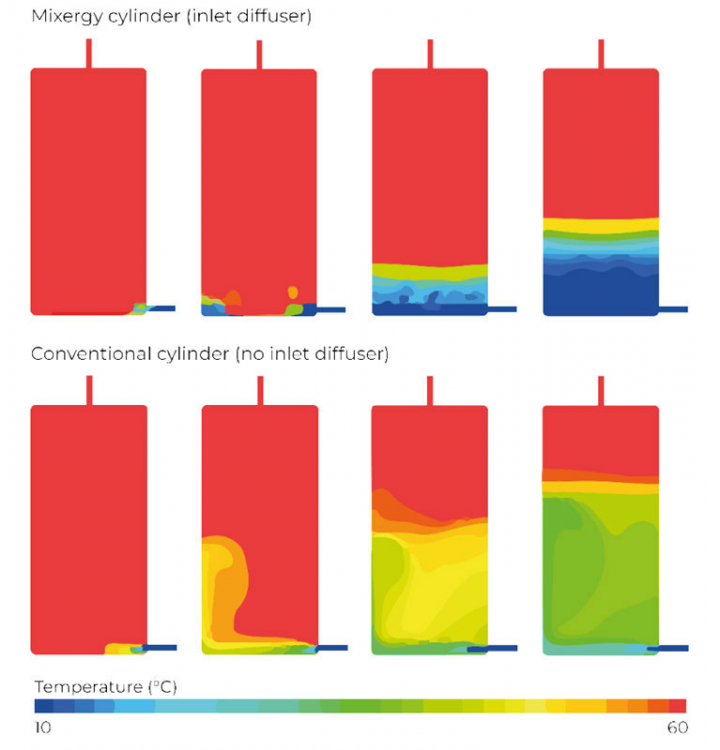
No idea, it could just variance in test. Kind of a shame they tested with 75L and not a larger tank, but I guess the the same model applies. If anything I'd assume large tank might be slightly better as the size of the inlet difussor will be smaller compared to the total volume or the tank and further from the hot water at the top (that's guesswork though..)
-
I found some data which would back up both your assertion and Mixergy's claim. Standard tank doesn't mean all water mixes, just that more mixes, but there is still hot water at top. https://ec.europa.eu/environment/ecoap/sites/ecoap_stayconnected/files/etv/mixergy_verification_report_npl_08122016_-_no_appendices.pdf
-
Mmm, Pherhaps I'll have to quiz mixergy a bit more on exactly how different their tank is/isn't from a discharge/mixing perspective is., Unless @Robert Clark or @joth know?
-
Really? My understanding was that with a a standard UVC the incoming cold water gets mixed and so the water temperature at the top of the tank will be lukewarm by the time you've used a certain % of the tank. This can be improved with a good inlet difuser, which some tanks have, but not all. Do you have any way of knowing what the delivery temperature is over time without supplying heat to your tank? Which brand? Mixergy uses Newark tanks, what I'm not sure is if they use the standard Newark inlet diffuser, or if they use a custom diffuser or are doing anything else on top of this. Regarding ASHP sizing: we have PHPP heating load of 3kW, but have been advised to use 6kW based on other calcs. Issue is that if we go for a 400L tank, recoevery time of 6kW ASHP is going to be high.. which is another reason to be able to load-shift to avoid oversizing ASHP..