Dan F
-
Posts
1431 -
Joined
-
Last visited
-
Days Won
2
Everything posted by Dan F
-
MCS certificate is required to register for SEG payments (with Octopus at least). Also (not sure why) our building inspector is requesting it. You can argue it may take a long time to recover additional "MCS appoved" install costs, and you may be right, but it is a bit more than just a peice of paper. The SEG tariffs are low, but they do add up over time..
-
Can a slab be too thick to have UFH pipes in it?
Dan F replied to Thorfun's topic in Underfloor Heating
You won't use these for a few months if you use the UFH pipe as conudit. If, for any reason, you are concreting them in then make sure you test them first and potentially install a backup incase of failure. -
ASHP installed together with existing heating system
Dan F replied to Bruno's topic in Air Source Heat Pumps (ASHP)
What set up do you have? - With/without hydraulic station. - With/without heat exchanger. - Vaillant buffer, third oart buffer or no buffer? Our, yet to be installed design, has hydraulic station, generic 25l buffer vessel and no heat exchanger. (Passivhaus with ground floor UFH only) -
Are you integrating MVHR and Loxone? If so, ho?
-
I'm flooding with CAT6 currently: - 2 to each potential TV location - 4 to home cinema location, 3 to home office. - 1 to various ceiling speaker locations (potential locations for wireless acess points) - 1 to potential location for door intercom - 3- > 4 to various things in the plant room that can be "connected". - 1 to kitchen island and a couple of other places in kitchen. - Couple to potential locations for cameras. I had considered putting in some pre-terminated fibre in, but haven't (yet) convinced myself that there is going to be any need for it, even in the future. We aren't doing video distirbution, so even if there is an 8k apple tv in a few years, this will all be any tv anyway. I'm, still willing to be convinced though...
-
Can a slab be too thick to have UFH pipes in it?
Dan F replied to Thorfun's topic in Underfloor Heating
I'm using all 3 wires, read that it helps with reliability. Also making sure i connect ground from end-to-end (this is easier if you make sure you buy a cable with drain wire). You can connect behind light switches, but if light switch is 1m high that limits length in slab or makes your branches longer. I personally recommend a dedicated 1-wire bus that is not mixed with tree cabling. It means you can keep it as short as possible just going point-to-point where you have 1-wire sensors, can keep branches as short as possible, and also means that your tree cabling topology can be different and not a strict bus which can come in very handy. Doing this is still a good idea, regardless of it you do/don't use dedicated 1-wire bus. -
Can a slab be too thick to have UFH pipes in it?
Dan F replied to Thorfun's topic in Underfloor Heating
No, given: i) pipes conduct heat very well. (they are for UFH after all) ii) slab temperature changes slowly, so any very minor lag from heating any air between pipe/sensor is absolutely nothing in comparison. -
Can a slab be too thick to have UFH pipes in it?
Dan F replied to Thorfun's topic in Underfloor Heating
You poke up your bit of UFH either in the service cavity of external wall, or within internal studwork or any boxed out areas. Easier with SVP, but not a requirement. It does take some measuring, but you'll need to measure up to work out where to put (and not to put) UFH runs anyway. -
Can a slab be too thick to have UFH pipes in it?
Dan F replied to Thorfun's topic in Underfloor Heating
Look a bit more closely at the photo I shared. The end of the UFH pipe (that the sensor gets pushed down into later) is closed with pliers and taped. Or you can use caps as @Nickfromwales suggested. But the point of the UFH pipe isn't just to position the sensor, but also to avoid concrreting them in. -
Can a slab be too thick to have UFH pipes in it?
Dan F replied to Thorfun's topic in Underfloor Heating
Test all sensors and 1-wire wiring before plasterboarding though. 1-wire can be a bit fussy with grounding, length of branches etc. so you need to ensure not only the sensors work, but also that the wiring works, prior to boarding up and loosing access. -
Can a slab be too thick to have UFH pipes in it?
Dan F replied to Thorfun's topic in Underfloor Heating
You also need to be careful with length of 1-wire branches, so I wouldn't be buying probes with 5 -10m lead, not if you want to get close to 20 sensors on a single run (and single loxone extension). If you have any electric UFH in bathroom, you can also use these probes there and not need to rely on thrid-party control systems. -
Can a slab be too thick to have UFH pipes in it?
Dan F replied to Thorfun's topic in Underfloor Heating
Few things though: - 1-wire is digitial and sends back exact temperature rather than any kind of analog signal. - Loxone polls sensor every x seconds. - Sensor needs power. Two options: i) It gets power via data line and stores it in internal capactitor ii) It has power supplied seperatly (thrid wire). Ton of more detailed information on 1-wire protocol online, but loxone summarize the basics here: https://www.loxone.com/enen/kb/wiring-1-wire-devices/ -
Can a slab be too thick to have UFH pipes in it?
Dan F replied to Thorfun's topic in Underfloor Heating
What is there special about low-temp pump, or is it the blender? What would you reocmmened for low-temp UFH + cooling? -
Can a slab be too thick to have UFH pipes in it?
Dan F replied to Thorfun's topic in Underfloor Heating
Have you worked out how to integrate with the Wunda ones? Are they 1-wire, or proprietary and only work with Wunda thermostat? Would they fit down UFH pipe? Generic ones could work very well, just slight additional risk with quality I guess, also look at length of cable and how easy they will be to work with. I orginally bought all Loxone ones because, like you, I thought I might need to actually put them in the slab itself and so didn't want to take any risks with quality. If you can put them in later, then you work out what to use later, with the obvious caveat that they'll need to fit down UFH pipe. -
Can a slab be too thick to have UFH pipes in it?
Dan F replied to Thorfun's topic in Underfloor Heating
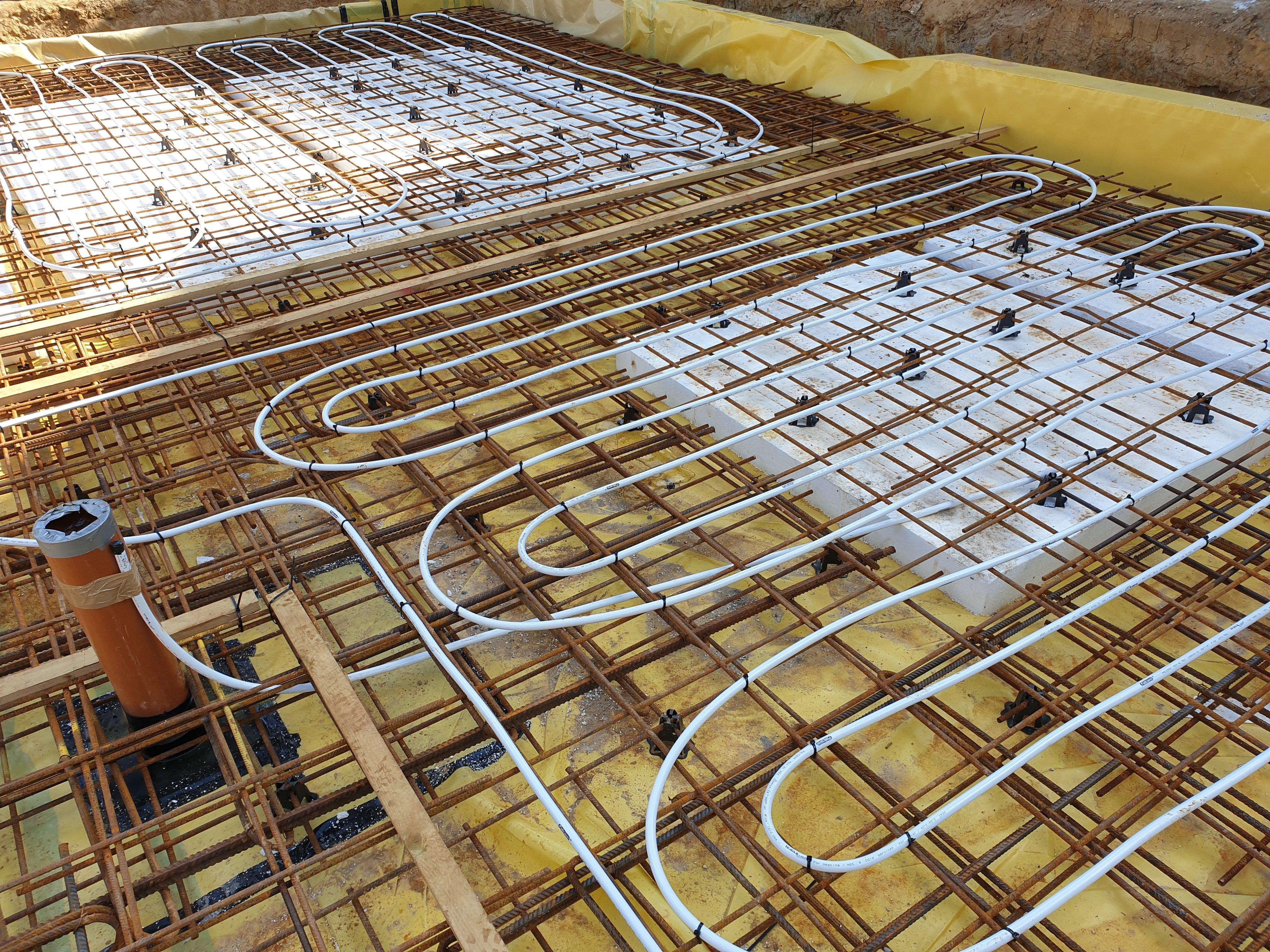
UFH pipe is perfect for the Loxone 1-wire sensors (and probably other similar ones too). Given they are a snug fit it's easy to push sensor lead down into them, even up to 2.5m when you do wiring later. Just cut bits of UFH pipe to length of sensor lead -300mm or so and close one end with some pliers and then weave them between steel mesh and UFH pipe to a decent location. Remember to mark pipe with room name and tape open end just in case.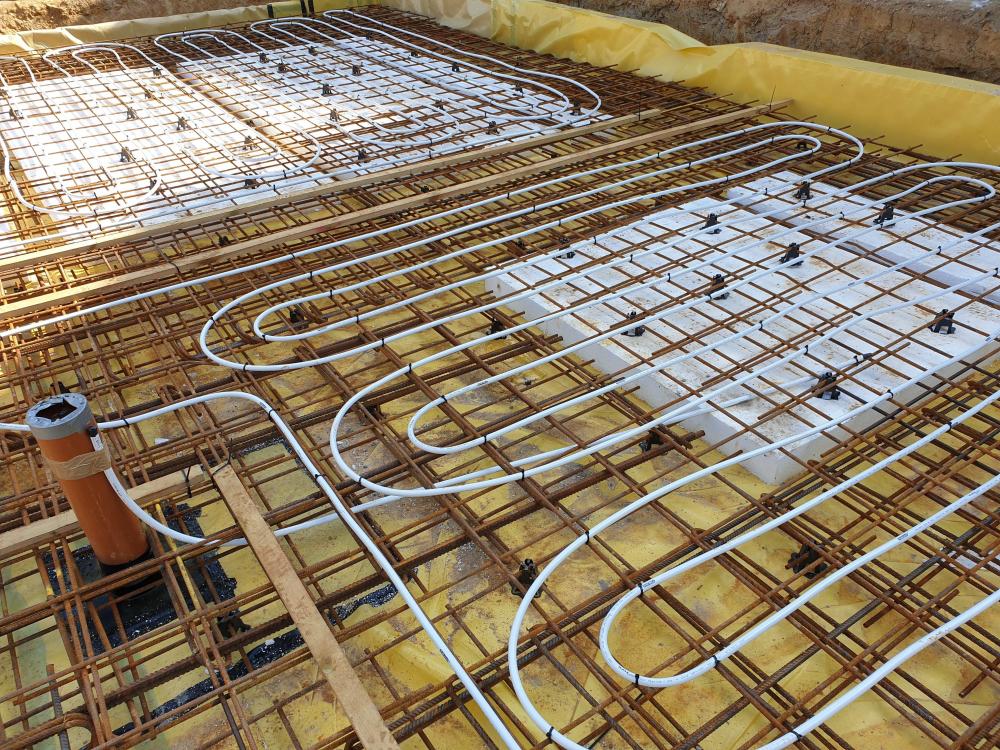
-
Can a slab be too thick to have UFH pipes in it?
Dan F replied to Thorfun's topic in Underfloor Heating
@Thorfun Worked out how to integrate with the wunda "floor probe". Might you be best to use the 1-wire sensors for loxone integration? Also, is one really enough? Even if you don't think you need one per room, still worth using a couple of either end of house and in case one fails for some reason. I won't put them in concrete anyway, but rather use 2m max lengths of spare UFH pipe to create conduits for you to add them later. You don't actually need pump or manifold for concrete poor, we didn't have either. But having manfold will help, and will also make it easier to test everything prior to pour. Make sure you've work out your UFH layout before putting order in, just in case you need another port. BTW. I hope thats £1.30 for a bag of cable ties and not each! -
Can you help me reconfigure my hot water supply layout please?
Dan F replied to Adsibob's topic in Boilers & Hot Water Tanks
If this would works running 1min every 20min, depends on pipe size, amount of insulation, DHW temperature, and what you consider hot as a % of UVC temperature. The length impacts total heat loss of the system and how long pump needs to run for, but not the feasibility per se. The speed of heat loss will be the same, whatever the length, just there is more water to flush through when the pump runs. I thought there was an online calculator somewhere, but I can't find it now.. -
Got samples for SlatWall, Akupanel and Acupanel and, it might be me, but they all seem almost identical.
-
Can a slab be too thick to have UFH pipes in it?
Dan F replied to Thorfun's topic in Underfloor Heating
You don't have to use it to do heat loss calculations. There is a way you can just plug in numbers from PHPP or SAP or something else. Not yet, but they will be. A single 24v output from Loxone will drive all 9 actuators. The balancing aspect of these actuators is self-contained. I've put a probe per room. I haven't decided exactly how to control heating yet, but I'll use a combination of slab temperatues and room temperatures along with other variables potentially including outside temperature, occupancy, tarrif etc. On other thing that temperature probe is useful for is ensuring, when cooling, that you don't cool the slab beyond the dew point (which can be calculated using humidy). -
Can a slab be too thick to have UFH pipes in it?
Dan F replied to Thorfun's topic in Underfloor Heating
If in doubt about spacing, download a LoopCAD free trial which lets you design UFH and simulate it using your floor makeup and heat loss figures. I did this, and 200mm was absolutely fine and only needed very low temperature. This matches other peoples experience. (wasn't I didn't trust poeple, was just my idea of lockdown enterainment ? ) Even if you run it as a single zone, you'll stil need a number of loops so it may still make sense to plan loops around rooms, even if your control system doesn't operate then independantly. The other things to consider is that, even if you want to use it as a single zone (which makes sense), each loop will have a different length potentially and some rooms may have more sun. Given this, my understanding is that you'll need to use one of these two approaches to avoid some rooms getting hotter than others: 1) Have thermostatic control per room/loop 2) Use self-balancing actuactors (we are doing the latter) -
We can't get hold of one, been told July/Auguest by one supplier, September by another and min 6mths by another. Might look at Sonen. I don't see the value in using 3 (one per phase), unless you want a 3-phase inverter to keep running disconnected from the grid. But the an expensive solution when power hardly ever goes out in most areas in the U.K. We were planning to use 2 as a single Powerwall has limit of 5kw charge/discharge, but if we go on the telsa energy plan (not decided yet), then net metering means you don't need to fiddle around optimizing timing of usage or if/when battery is charged, all that matters is the kWh cost (11p) and your total imports/exports over the year.
-
ASHP installed together with existing heating system
Dan F replied to Bruno's topic in Air Source Heat Pumps (ASHP)
So you have the setup on "page 3" of: https://www.vaillant.co.uk/downloads/aproducts/renewables-1/arotherm-plus/all-schematics-wiring-notes-1799366.pdf. For some reason this doesn't show any glycol circuit though. I think I get the "Hydrualic unit" now, it's basically the heat pump interface + 3-port value + pump + optional backup heater in a single box. Kind of makes sense if you want to reduce "bits" but not needed as such. I've stil no idea what the "Heat Exchanger" is though or why you would use one. It does seem, from looking at Vaillant schematics, that they only using glycol when there is a heat exchanger (seperate to any buffer tank) though.. -
ASHP installed together with existing heating system
Dan F replied to Bruno's topic in Air Source Heat Pumps (ASHP)
Vailant buffer? Glycol for ASHP-Buffer loop? Your own 3-port value for CH/DHW control? Is a Vaillant heat pump interface controlling 3-port valve? I'm trying to get my head around it, sorry! Our schematic has a hydraulic unit and I've no idea what it does. I assumed we just needed a buffer and that the buffer serves to decoucple ASHP and heating circuits anyway. Yet there are schematics that use buffer+heat exchanger+hydrualic unit!! -
Can a slab be too thick to have UFH pipes in it?
Dan F replied to Thorfun's topic in Underfloor Heating
A very good wall is typically 0.1 at best, so I'd be more than happy with 0.1 too I think. Few comments questions: - The 49mm "the earth" is interesting? Got any links that expain how this works out? - I wonder if the permiter/area ratio applies in the same way when it's a basement foundation? -
ASHP installed together with existing heating system
Dan F replied to Bruno's topic in Air Source Heat Pumps (ASHP)
Realized you are in Portugal (?). I think it's probably the same one that is marketed as 7kW in the U.K. If you look at the Vaillant schematics [1] there are about 6 different options - Buffer only - HEX. and Buffer - HEX. only - Hydraulic Station and Buffer - Hydraulic Station, HEX and Buffer - Hydraulic Station and HEX - Nothing Which setup do you have? @J1mbo which setup do you have? [1] https://www.vaillant.co.uk/downloads/aproducts/renewables-1/arotherm-plus/all-schematics-wiring-notes-1799366.pdf