Dan F
-
Posts
1431 -
Joined
-
Last visited
-
Days Won
2
Everything posted by Dan F
-
That's quick if you only ordered earlier this year! It's hard to cacluate payback with the pricing being so crazy at the moment One thing to think about is that you'll get most self-consumption (and therefore value) from the first powerwall. The second one will improve things of course, but from a self-consumption perspective, based on some of the modelling I tried to do, the additional increase in self-consumption % isn't that much when you add in the second powerwall. In the winter the calculation is simpler, but it looks like you wouldn't get full value of the second powerwall in the winter either if your average daytime consumption is 16kW? Maybe there is some load-shifting you can implement to reduce the day-time consumption <13.5kWh? It's really hard to model this and noone knows whats going to happen with prices going foward, but in your situation i'd probably be thinking about going ahead with just one. There are other options but if you have powerwall available it's still good from a sleekness and £/kWh perspective even with recent price rises I think. Did you run your calclulatoin with a single PW?
-
I have one, works really well. Caveat is that to get the parital "charging" benefits you need to heat tank using small coil at the top. While this is doable with the Vaillant aroThem isn't not a very efficient way of heating hot water. I'd need to do some modelling to try to understand the advantages of better COP (not using top coil) vs. advantages of not having to heat full tank.
-
Eco Self Build - System Design
Dan F replied to deancatherine09's topic in General Alternative Energy Issues
If you want a powerwall you need to reserve one now, they are in very short supply with most installers now having waiting lists and quoting very long lead times. We've given up and will likely go down the Victron route instead. Likely to be bit more expensive, but more flexible/programmable. Heating/cooling via MVHR is not required on GF if you have UFH in slab. On the first floor Comfopost can add some heat, but you are looking at a couple of kW max (assuming less efficient 55C ASHP flow) That works fine, as long as your ASHP supports cooling. This logic would all be managed by the ASHP controller. Surely, allowing the ASHP contoller to automatically switch to DHW and heat and UVC/SA and then return to cooling is simpler and more efficient that implementing a summer-only approach with your own controls. You can still use a PV diverter if you want to, it's not either/or. But, if you are on Octupus Tesla Plan you are not supposed to use a PV inverter, and there is nothing to gain from using one either. I have everything you have decribed installed, aside from the SA. Our build is also MBC with passive-slab. The "valve / manifold product" is a 3-way diverter valve which is pretty standard and would be an assumed part of any ASHP install. Where you go beyond a basic install is if you want/need different heating/cooling circuits running at different temperatures. If this is your goal, I would strongly recommend against MVHR for supplementaty cooling of bedrooms, it's just not suitable. Even if you have overhangs and automated blinds, the cooling power from MVHR will only give you very minimal supplementay cooling and you definitely won't achieve these temperatures in the summer (unless you ground floor is cooled to 16C and you have blinds). To achieve this you need fancoil units in the bedrooms. -
Eco Self Build - System Design
Dan F replied to deancatherine09's topic in General Alternative Energy Issues
Agree. We came to same decision. Big avantage of SA is the minimal space it takes up, but it has other issues and if you want 300L+ equivalent capacity you need 2 of them which works out a lot more money than a 300L UVC. Issue I saw were: - Hard to tell state of charge. - Requires higher ASHP flow rate than you'd typically use with UVC - Unless you use 70C flow (i think) to charge you don't get the full quoted capacity. - When i looked a couple of years ago they were using ASHP manufuatuer specific controlers! (they do make more sense, IMO, if you plan to charge with electicity rather than ASHP and are short on space) There are some placement limitation, but they aren't very significant and have been relaxed since the original version of their manual. @m0dellergot resistor for £5 from link I shared. -
I've all but given up on Powerwall and am planning to install a Victron system. Be interesting to see what/if anything Tesla might release before signing on the dotted line though. Given we already have our completion certificate the plan is to add some more PV so that the whole install can be zero-rated.
-
Wasn't fantastic, but wasn't terrible either. I think the first test was about 0.55 ACH. That said, I'd still do best to fill all visible gaps as everything adds up and there might be other things later that happen that you don't have such easy access to or even notice.
-
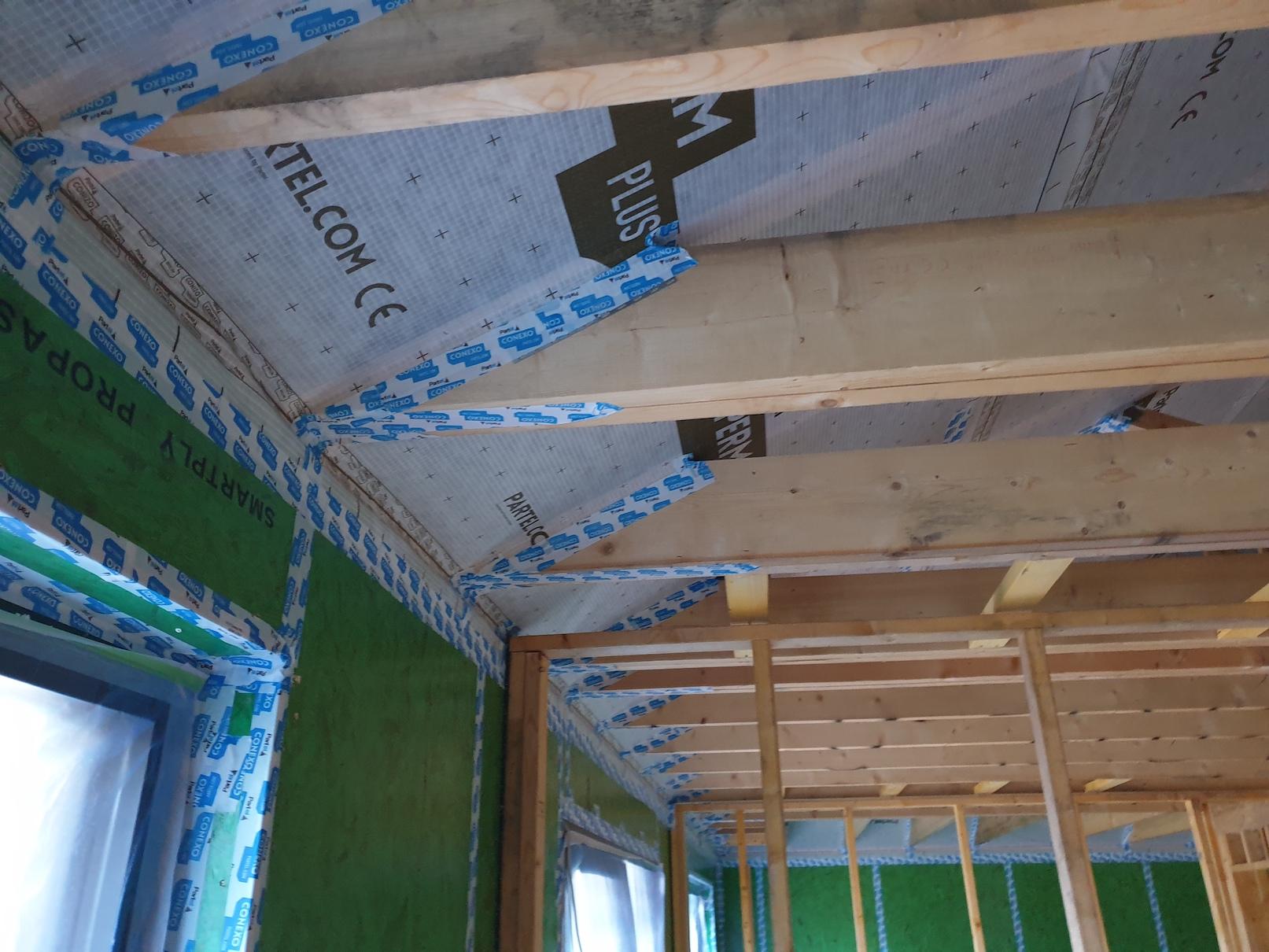
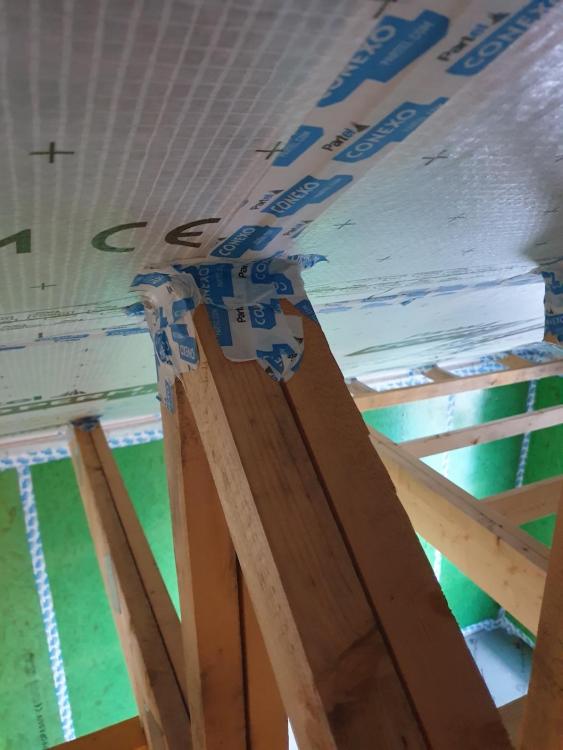
We had some deep ones too, and they seemed to get same approach to work. Just a longer "crack" section on the the g-string. That said, looking at this photo now, I'm not sure how they did it.
-
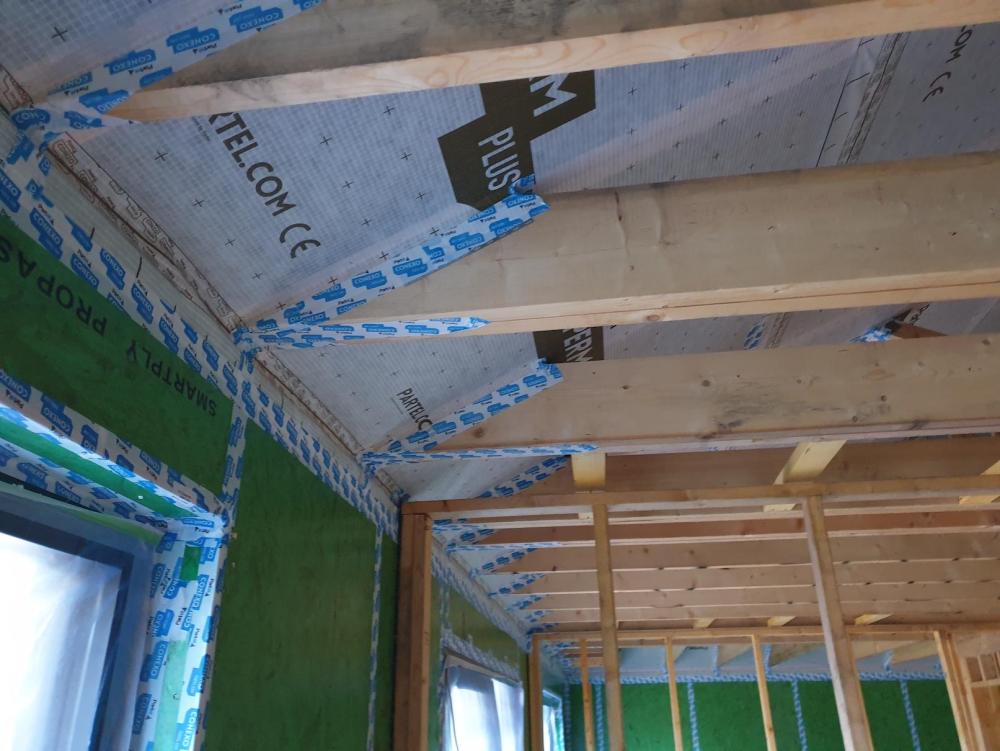
We have load of these and making the roof airtight was a nightmare. This was MBC's problem though and they did a good job of making it airtight.. just took them a long time. Using standard trusses was a bad idea, especially on our project which had a non-trivial roof. The technique that MBC seemed to use on ours was to use tape one side, then feed the tape through the gap (bunching it up a bit) and then continue the tape on the other side. A bit like the way I suppose a g-string works (not that i've ever worn one!).
-
The steel hose supplied with ours is 3/4inch I.D. It's the softener connector and vave that are 1" supposedly. The other end of the supplied hose is 3/4inch. Specific model is Falcon H-3405 Water Softener Flex Connectors.
-
All good so far. Water pressure is good and it accepts tablet salf which is cheaper than the block salt. Wasn't as expensive and some other brands either from what I remember.
-
Ubiquiti home networking - initial impressions
Dan F replied to Adsibob's topic in Networks, AV, Security & Automation
Where are you buying from. UI EU store has most in stock, and those that aren't in stock become available every so often. If you need to compare switches these tables may be helpful: https://evanmccann.net/blog/2020/6/unifi-switches-buyers-guide -
Not really. All thermistors are 1-wire and connections (to a 1-wire bus using cat7 cable) are all hidden in the plastered walls. Even if I did have access to one, I'm not sure it would be easy to break open the thermostat and wire-in a third-party sensor. A lot of ASHP manufacturers have a Modbus interface, Vaillant only has EEBus which is quite limited. Vaillant promised a Modbus gatewat over 2yrs ago [1] but nothing is available (at least in U.K) yet. The only other option is to use eBus [2], but this is somewhat more complex and required a non-vaillant eBus coupler and then you need to discover the registers/operations available and I haven't seen any comprehensive documention for this (Vaillant clearly don't publish it as ebus, for them, is an internal protocol). @m0deller has had some sucess with this already though, so the issue with cooling not being contollable by EEBus is enough motivation to try to follow in his footsteps. [1] https://www.vaillant-group.com/news-centre/web-special-online-press-conference/neue-regelungen-fuer-mehr-komfort-neues-gateway-fuer-ausfuehrliches-monitoring-1-1680893.html [2] https://github.com/john30/ebusd
-
I see that it takes at least 24hrs for our slab to increase 1C in hot weather. ASHP then takes 5-8hrs to remove 1C depending on flow temp (adjusted automatically based on dew point) and ufh pump speed (which is was playing with). So while i am using manual control, and im annoyed i cant automate this easily with Vailant, like Jack it is only minimal on/offs required.
-
You manually turn if on/off though, right? That's what I'm having to do.. but my argument is that given I have temp sensors in the slab and I know all room and exterior temperature too, there shouldn't really need to be anything manual about it.
-
The issue is that the controller uses room temperature and if I put 21C it will cool slab for too long, and the next morning the ground floor rooms will be too cold because (due to the lag in room temperature) it will have cooled the slab too much. The heating function can be enabled/disbaled via a dry-contact or you can use Loxone/EEBus to set the heating mode/setpoint based on slab temperature (or if you want slab temp, room temp, exterior temp and forcast), but there is no such functionality for cooling, you have to use the Vaillant app or controllor both of which use the temperature sensor in the controller. I don't know for certain, but I'm 90% sure it is not using weather compensation from what I've seen. The water temperatue for cooling is: min(configuredMinCoolingTemp, calculatedDewPoint + configuredDewPointOffset) (both min temp and dew point offset can be set per circuit if you have more than one. e.g. UFH + fan coils. Also dew-point monitoring can be disabled for a given circuit). I have the following configured: UFH: - dew-point monitoring: on - dew-point offset: 2K - minTemp: 15C ComfoPost: - dew-point monitoring: off - minTemp: 7C
-
I have, been installed since Jan. Have been using cooling on/off for last few months. Main issue I have is my UFH is in passive-slab and the only way of controlling cooling is via the Vaillant controls which isn't suitable really as room temp lags slab temp.
-
Nice to see it working.. nice find of mind finding same thing (for gas boier) with different product code 😉 Are you cooling UFH in kitchen? Is UFH in a passive slab or just screed?
-
Nice. So it's a case of trying to use this information here and/or sniffing the bus while using the controller to work out how to use it? https://github.com/john30/ebusd-configuration/tree/master/ebusd-2.x.x/en/vaillant There is a home assistant plugin I've seen, but it only maps some things.. and nothing about cooling. https://www.home-assistant.io/integrations/ebusd/
-
Can do most of the basics via EEBus, but can't enable/disable cooling. In theory Vaillant were going to support a Modbus interface, but nothing has appeared yet and the Vaillant team don't seem to know anything. I know about ebusd yes, but I haven't sourced as ebus coupler yet as I was trying to try to avoid needing to use ebus. My main concern with using ebusd is that it doesn't seem anyone has documented available operations and registers, so it could take a lot of experimentation to discover things. Have you had any experience with ebus?
-
Sorry, what I said earlier was incorrect, it'd been a while and didn't remember the details. In our case we have a single membrane for airtighenss and vapour control on the internal-side of the roof insulation and an external breather membrane. What it was that came up with building control in our case was ventilation, not the membranes we used. (sorry for confusion!) Our roofer and building control wanted to vent the void under the (natural) tiles, but our architect had proposed mortar-bed ridge/hip tiles with no ventliation. In the end, we want down the mortar-bed path route because, according to the BS this is fine when: i) you have an internal VCL, ii) the roof covering (natural slates in this case) is air permeable and iii) the external membrane has low vapour resistance. In all other cases you did need to vent. You may be able to use foil-backed PIR as a VCL but I you'd need to tape and seal all joints, so it would probably be easier and more effective to use a membrane underneath the PIR I think.
-
What tiles are you using? I can try to dig up the info if its useful.
-
Yes, but when RH does increase it will accommodate and adjust a few degrees. In going to have to dable with Vaillant ebus protocol to control cooling as no dry contract or interface for this 😞
-
The Vaillant controlls have dew-point monitoring, not sure about the Daikin Altherma (google doesn't throw anything up). If you ASHP doesn't have this then yes, you do need to be careful with condensation by limiting the temperature your floor surface gets too. The UFH flow temperature can be slightly lower, but should insulate exposed pipework in this case (could be an issue if it goes withing any walls). Have a play around with dew point calculator to get an idea. 18C floor with 24C room temperare and 60% RH is a non-issue, but if RH or temp is much higher than this then condensation can be an issue. https://www.calculator.net/dew-point-calculator.html
-
We didn't use a VCL for our warm roof. But this was only because i) we have high levels of airtighness ii) we were using natural slates (which provide more natural ventilation). I read through the BS at the time to ensure this was OK but can't remember all the details now. But but as far as I remember if we didn't have either of those two criteria a VCL was required.
-
I think there is a very high chance it will. If it doesn't, it should just be a case of getting a different resistor and using the same plug.