joth
-
Posts
2861 -
Joined
-
Last visited
-
Days Won
5
Everything posted by joth
-
Ours was about £2500 to disconnect, and took them over a year to do complete all the work. (Being on a main road by a school limited when they could do road closure, and the original date got canceled on day-of by the council due to being second week of the pandemic lockdowns -- ironically, as the school closed and roads were deserted so would have been ideal time -- so they did a temporary disconnect under our garden and then took a year to get off their hands and do the bit in the street, eventually done as emergency works as the entire main had leaks for over half a mile) Also ironic they'll subsidise new connections, but not disconnection. +1 to putting in the yellow ducting in just in case, if you're worried about future proofing. (We weren't so just left it out)
-
You're doing a full demolition and digging out new foundations? Leaving the old pipe in situ and "capped off" in the property won't be an option. It won't be safe to work, it at very least needs a temporary disconnection at the property boundary and subsequent re-connection. Each is a separate chargeable work by the DNO. When you look at the cost of the unneeded reconnect, I expect you'll decide not to proceed with it. Depending on the DNO and how you play it with them, they may mandate a disconnection off your plot (so they never have to request permission in future to come onto your premises for subsequent maintenance) or be happy to just leave that temporary disconnect there unused. Disconnecting on the street can cost more and take longer, e.g. if they have to apply for permission to close a road. Either way, it's the same sales pitch to a future buyer: "not on mains gas". My experience (based on estate agent valuation) is for resale you can make back more than the loss in not having gas by installing higher than building reqs on other energy saving measures (insulation, airtightness, mvhr, PV) and upselling those in any future sale. Slinging "net zero carbon" on a brochure is (in some areas anyway) now seen as a boon, not a drawback.
-
I don't understand what you're saying. Install now (or ideally March) to get max summer electricity generation. Deferring to October is about the worst option as you get the wear and tear (and expiry of warranty) of having it installed over winter with virtually no generation to show for it
-
If you're getting the MCS cert as a guarantee of installation value for money, quality of install not damaging property, amount of annual yield meeting what is promised, assurance to new purchaser of the house, it's obviously bit of a fraud. But if the only reason you're doing it is to appease your electrical supplier so they will pay for SEG export, it seems fair game to me. The installation needs to be safe to hook up to the CU and DNO, MCS cert or not, so requiring an MCS just to get payment is bureaucracy for the sake of it. Would be interested if you do go this way how you get on. Spring / right now (before summer!) is obv ideal time to install.
-

Hybrid inverter for small in roof 2kw array - help please!
joth replied to Timmyk's topic in Photovoltaics (PV)
If you use SE optimizes they automatically disconnect their output (in fact, reduce it to 1V) when the inverter is shutdown. Still, I'd want the DC isolator anyway. The other option is only do maintenance at night or very cloudy days. And MC10 are fairly safe from accidental contact. Still, I'd want the DC isolator anyway. -
It's pretty ridiculous really isn't it. VAT is normally associated with "luxury" goods rather than basic essentials. So buying a device to efficiently heat your own house is considered a luxury, but if you also pay someone else to do the installation of said device for you, it's no longer a luxury. Section 2.7.4 is also insane. Basically you need to break up large jobs into discreet bits to be able to zero rate parts of the work on a large project. Even though that adds risk for the customer and supplier, and the joining up of the pieces maybe worse for it. (I'm thinking about big ticket items like EWI that needs designing into the wider scheme of a retrofit, not something trivial like TRVs that they cite as an example) 2.7.4 Mixed supplies Where you’re undertaking more than one job at the same premises, the VAT liability will depend upon the circumstances. For example, if you’re contracted to build an extension and, as part of the same contract required to fit thermostatic valves to all the radiators in the house, this is a single standard-rated supply of construction services. However, if you have a contract to build an extension and sometime after the work has commenced, the homeowner separately asks you to install thermostatic valves, this is a separate supply.
-
Of course, Powervault ran an Octopus Agile trial https://octopus.energy/blog/agile-powervault-trial/ Kinda ridiculous that a year (or more?) after that finished you still can't use it reliably with the much simpler Go tariff
-
Note it's no 7.5p / kWh According to https://www.powervault.co.uk/wp-content/uploads/2018/07/Powervault-3-specifications.pdf they have an API and a Smart tariff controller via portal. Any use? I do dislike this trend for needing a subscription to access non-dumb controls. Interesting about them being noisy. Presumably puts out heat, and I understand batteries prefer a non-freezing environment, hence my thought putting them in the house makes some sense. (Bit unlike inverts in this way)
-
I found it pretty frustrating tbh. It doesn't include any library of fixture definitions so you have to do a lot of leg work to find them on the internet. This means in essence choosing manufacturers and models before making the design which felt backwards to me, and also it's only the architectural grade manufacturers that publish those files which are 10x more expensive so rather defeats the likely aim of doing DIY design, and even then many will only share them with registered professionals. At the other end GU10 generally have lower quality optics so not sure if you'll find exact definition files for them. To the previous question about honeycomb louvres the one place we needed them is on 8 very tight angle spot lights over the dining table, which block any glare from the eyes of the person sitting across from each light. We used cute little fittings from Lucent for this, recessed into the roof light reveal. https://www.lucent-lighting.com/products/tubeled-micro-monopoint/
-
MVHR with a lot! of steels + other dilemmas
joth replied to BartW's topic in Mechanical Ventilation with Heat Recovery (MVHR)
Definitely try and plan this before construction. Even if changes are needed onsite it's much better to have a scheme in mind before everything goes up. Do you know where the MVHR itself will go? Try and think about the problem in 3D. Steels block horizontal runs, but you can get a long way by running ducts horizontally on floor 2 and then dropping down a floor where needed (maybe running horizontally on floor 1 before dropping down again.) A loft installed MVHR has several downsides, but can make this sort of vertical access into very large open plan areas much more convenient. If you have ComfoCool it requires the higher boost mode of the Q600 so that maybe why some installers upsized it -
This data cable only needs to go from the incoming supply to the battery, and you can put the battery anywhere you want, e.g. in the house next to the incoming supply? I don't understand where the requirement for a whole new solar array is coming from, just to avoid running one data cable.
-
Going from DMX -> 250V mains -> 350mA constant current is inefficient, expensive, and gives very poor dimming control especially at low light intensity. You're also at the mercy of the "mains dimmable" LED driver the fitting is matched too, some are OK (we have some from Phos that work well) others are barely better than on/off. Really, ideally, I'd use mains dimmers only for GU10 and decorative fittings that only have mains driven option, and DMX constant current drivers for everything else.
-
Selecting light fittings for special effects like this is quite involved, as you want to ensure a good beam angle and possibly including honeycomb louvers to control the glare as you walk past. Once the optics are decided, you then have to figure out what driver options are available for the items in the short list. Our lighting designer provided invaluable help for this. As others said doing them all as a DC series constant current set may work well, especially if you intend to dim them (rather than just on/off) as this ensures they all dim equally in unison In a few locations I was able to run 1.5mm2 mains cable looped from one fitting to the next, and then with a bit of cleaver waggoing repurpose the wiring to be in series rather than in parallel when we actually chose the fittings, putting the constant current dimmer back in the loxone cab. 1.5m2 T&E is overkill for this, but "fine". (Just mark it up clearly at each end!) Agree with that. I see Whitewing have Constant current drivers now too, which maybe useful. One option to look at is the various 1W markers from All LED: http://www.allledgroup.com/index.php?route=product/category&path=6_24 probably worth ordering one of each and testing in situ, if you can. We used these for various door/window/staircase/shower niche lighting details. Good value, waterproof and nice dimmable light (when used with a DMX->Constant current driver, not via mains)
-
The Smart Meter SMETSv2 polyphase spec mandates this "net metering"behaviour. I have I've linked it many times over the years, but here it is again: https://www.gov.uk/government/consultations/smart-metering-equipment-technical-specifications-second-version Page 87 "Consumption shall be the sum of the cumulative Active Energy Imported on the importing measuring element(s) of its Electricity Meter less the sum of the cumulative Active Energy Exported on the exporting measuring element(s) of its Electricity Meter;" i.e. you just add up all the import in the given time period and subtract all the export in that time period to calculate total consumption. @Dan F also got some supplier(s) to confirm this. (And has empirical evidence?)
-
It seems easily forgotten! I've explained it 3 times on this on page alone, and umpteen times elsewhere on this forum. But this myth keeps popping back up
-
How Smooth should new plaster on plasterboard be
joth replied to NewToAllOfThis's topic in Plastering & Rendering
If you have downlighters near those walls it will pick up any imperfections. Our lighting designer flagged places she was putting a shear wash of light down a wall and we asked the plasterers to make an extra effort on those areas. Tapped joints half way up the wall we're definitely the worst issue, decorators had to sand and fill those several times -
Boiler Upgrade Scheme Grant - Actions to Take Now
joth replied to Green Power's topic in Air Source Heat Pumps (ASHP)
This is slightly misleading. Better to say ..."any 15kW heat source, matched with appropriately sized emitters, will heat it." You can't replace a 15kW boiler with a 15kW ASHP and expect to get the same output without also checking the rads can still deliver the heat demand from the potentially much lower flow temp. -
Not easy, but also not necessary. Install a smart meter and it records net-usage across all three phases. So you could put generation on one phase, all your house hold usage on a different phase, and it would still only charge you for the difference between import and export at any given moment. (It's still good to try and balance phases as best you reasonably can, as it will reduce local voltage drift, which can avoid overvoltage cut out in the inverter, but this is a secondary consideration)
-
It maybe eye-wateringly more (10s of thousands) or maybe just £1k more. It depends how far you are from the nearest 3 phase supply. Ours is under the main road right outside. They could move the single phase feed to a new location for £1500, all work done on our plot, but it was £3000 more to upgrade as they'd have to close the main road and dig a big hole in it. Only way to know is put in an application and ask. With our DNO (UKPN) you can only request one quote at a time, but when the surveyor visited he was happy to sketch up and verbally give me price indications for all the options I was interested in, and then just take one away for the formal quote on.
-
Could you explain? I'm on Octopus Go for import and Octopus SEG for export, and I _appear_ to be being paid. That said, the payments are not automatic, it seems I have to raise a support ticket every time I want them to credit me, which they dutifully do and claim it's now fixed so I'll receive future payments automatically but I never do so I raise another ticket. Is this what you mean by they won't pay if you're on Go? Now I think about it, the automatic payments may have stopped around the time I moved from Agile to Go, but they never said this is the reason.
-
https://www.theverge.com/2022/3/17/22982166/matter-smart-home-standard-postponed-fall-2022 Now expected Autumn 2022. As I've mentioned before, this is just for publication of the 1.0 standard. I expect it will take 5 years to gain basic, reliable cross manufacturer interoperability and 10+ years to be proven for security, usability and feature set to make it a generally useful for designing into the fabric of a building. [I was going to tag this to an existing thread but can't find it now. IIRC it was ostensibly about garden irrigation so makes sense to fork a fresh topic on this anyway]
-
- 3
-

-
Hadn't realised Agile Outgoing was so high. Do they have historic data for the export prices at all? My assumption was that times of high PV export would equate to times of very low wholesale prices, as the grid would be awash with excess PV. But in the current situation maybe it makes sense Standard outgoing is now 7.5p, still not much but the same as the Go cheap rate import
-
Sure but until the roof structure is up theres still chance to change that. Whereas insulation under floor and in the walls will effect the groundworks so needs deciding far sooner, that's the point.
-
If you've not yet started the build, put your thoughts into adding more insulation and airtightness. Solar PV can be retrofitted quite easily later in the project. Insulation can't.
-
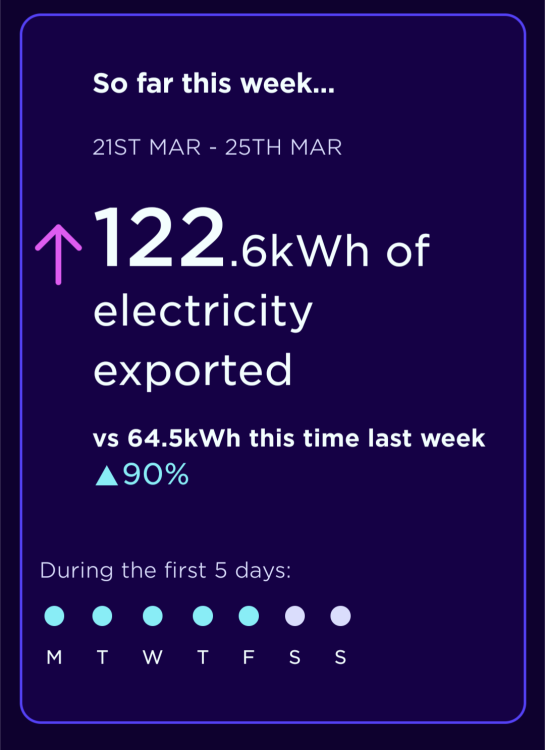
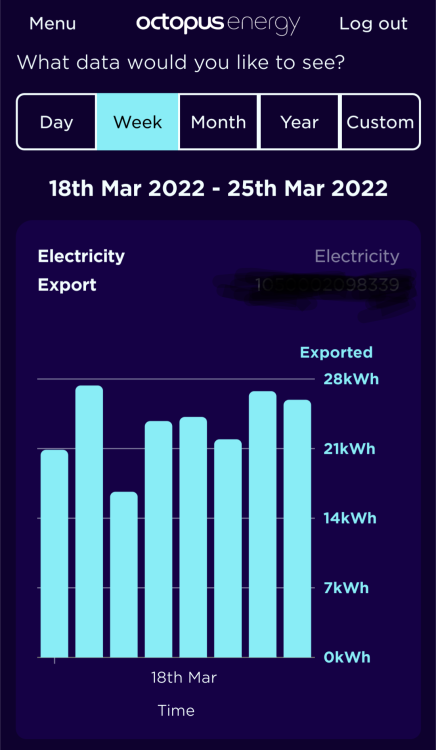
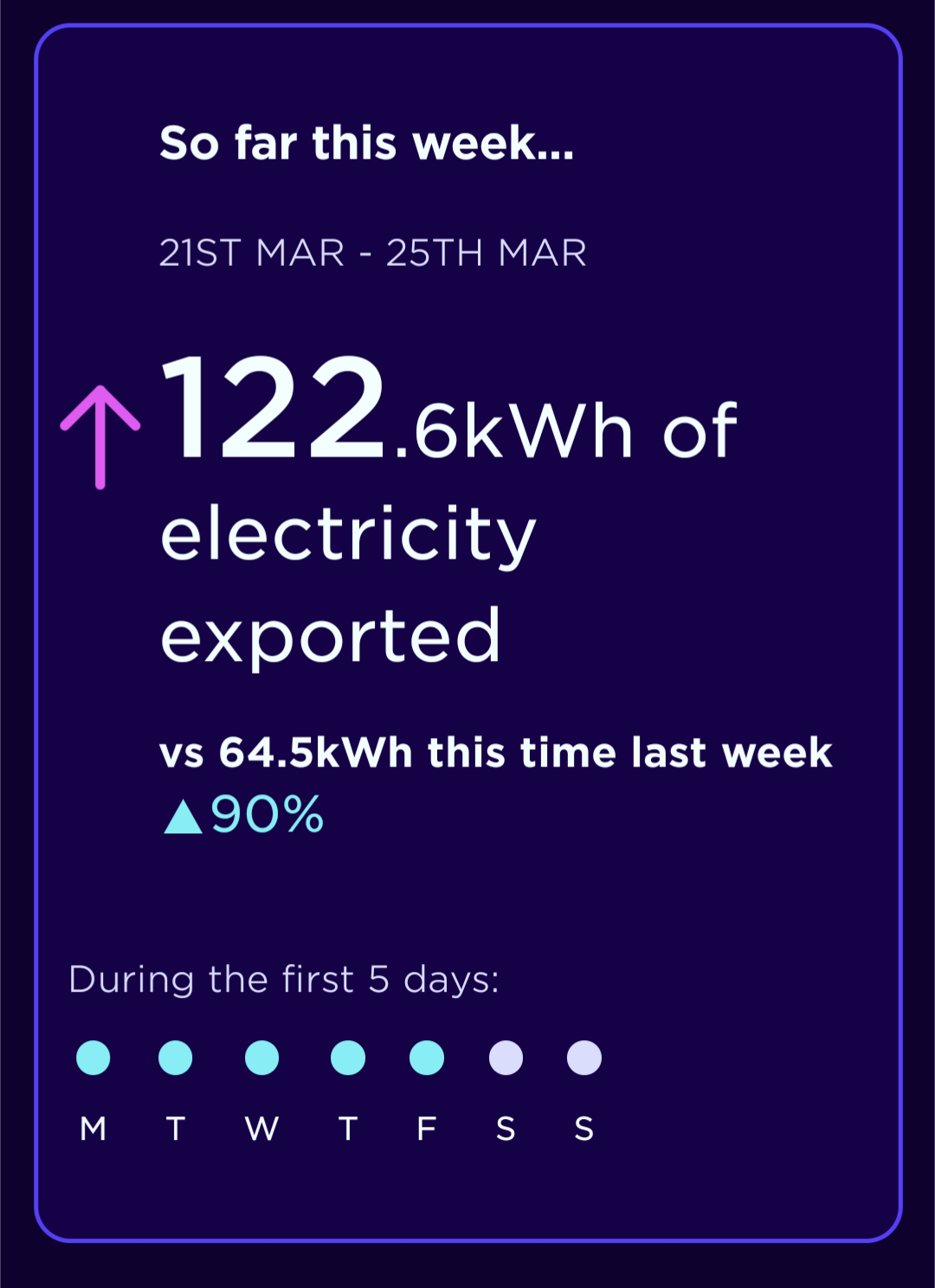
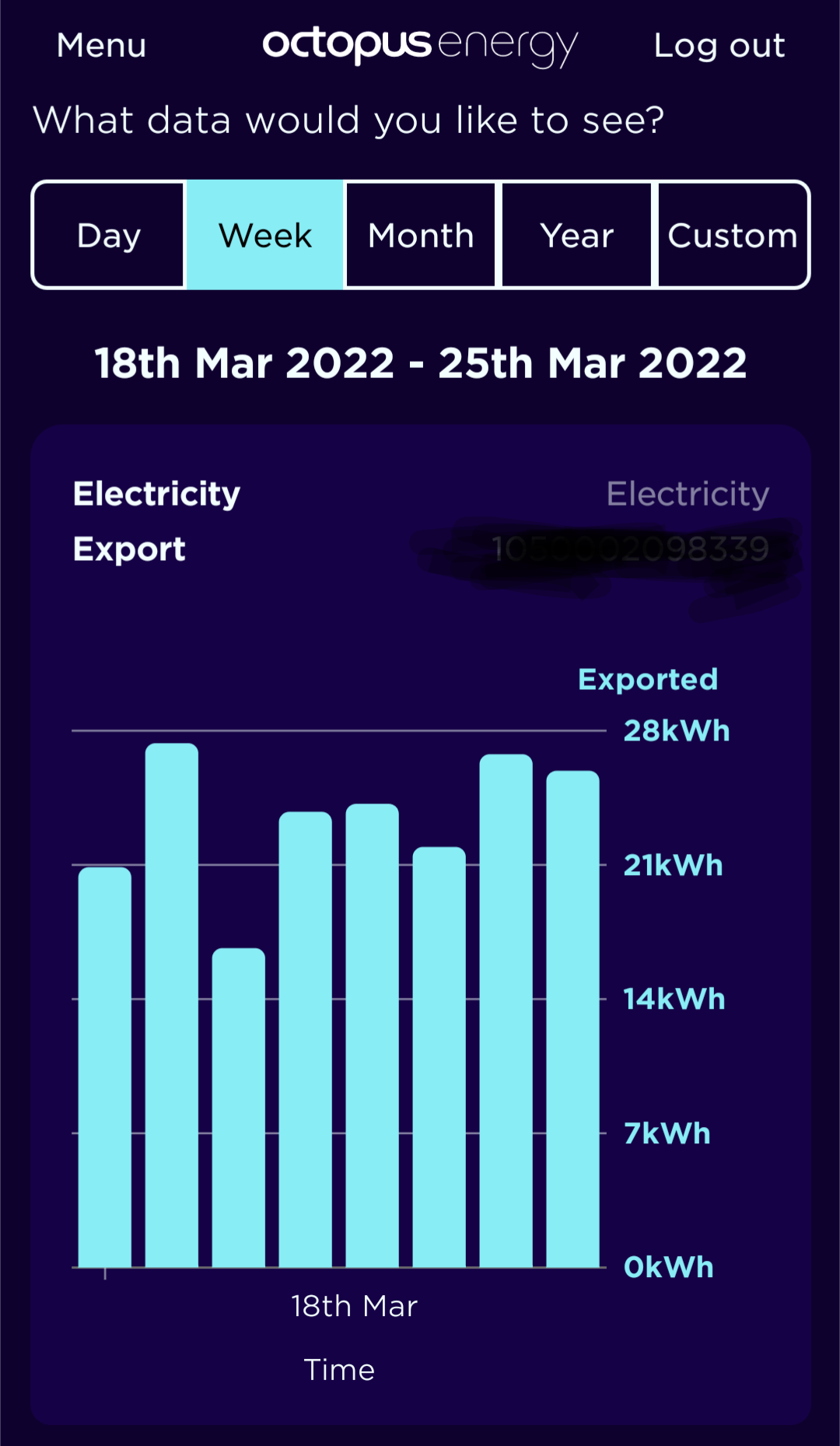
Loxone has some degree of support for this, but my experience was it's too course grained to be of much use. It samples spare export once a minute then turns on appliances in priority order for a fixed time (e.g. for the duration of the wash cycle) They are building in integration for Siemens/Neff and Miele appliances maybe that will eventually lead to finer control, bit overall I agree the demand side load shifting is a very long way off if we ever get it. funnily enough we've been away this week so our 8kWp has mostly all gone to export. No amount of self use or storage can really cover this scenario. Still made us a whopping £13 on the SEG in a week