
joth
-
Posts
2861 -
Joined
-
Last visited
-
Days Won
5
Everything posted by joth
-
 Think carefully if you want either chimney. They're drafty holes in the house that let dirt in and heat out, and there's much more efficient and cleaner ways to heat a house in the 21st century
 -
Similar to you we did not want a bulkhead hood over the island so we went with Bora down draft. But as that's not an option for you, I'd but some serious consideration in no hood/ extractor then. The MVHR is sufficient for BC. Out of interest what induction hob did you previously have, and what was the issue with it? Modern / higher end ones are markedly better control and responsiveness than the cheap stuff from Currys, but if the issue was with digital vs analogue control (for example) there's little ways to avoid that.
-
To insulate the suspended floor, best practice is to use a airtight membrane to build a cradle for insulation between the joists. E.g. https://www.eco-home-essentials.co.uk/underfloor-insulation.html https://www.ecologicalbuildingsystems.com/post/best-practice-approach-insulating-suspended-timber-floors
-
Telford: no wall mount option Newark: wall mount possible as an option, but only up to 50L Looks like I'll go with my sleeper stool, and cheapest 120L I can find. Thanks all.
-
Do you have Gas hob, oven, boiler, or all-electric? ASHP? Generally the DNO will inform you the earthing arrangement when they install the head, normally via some stickers on the cutout.
-
What's a 22V EV charger? If you plan to feed it direct from the kiosk, you'll need some sort of distribution board and breaker for it in there. At very least make sure you have a 4 pole isolator switch on the tails after the meter so you can adapt the consumer side without having to open the meter up. 3 phase chargers are uncommon as most EVs don't support 3ph charging, AIUI. If you run 3ph to the house but only plan to use one phase you'll have to oversize the SWA considerably to accommodate it all on any phase. You're probably looking at 10mm2 minimum and in 5 core that's hard work. Another option is to put 3 core in now and duct so you can add more later. We ended up pulling a separate earth core, to keep the SWA more manageable. How much PV will you have space for? If it's more than 3.68kW then putting it into multiple phases will save on paperwork so worth pulling 3phase to wherever you think the inverter might go. (Tip: they're best sited somewhere that will remain cool even on a hot day)
-
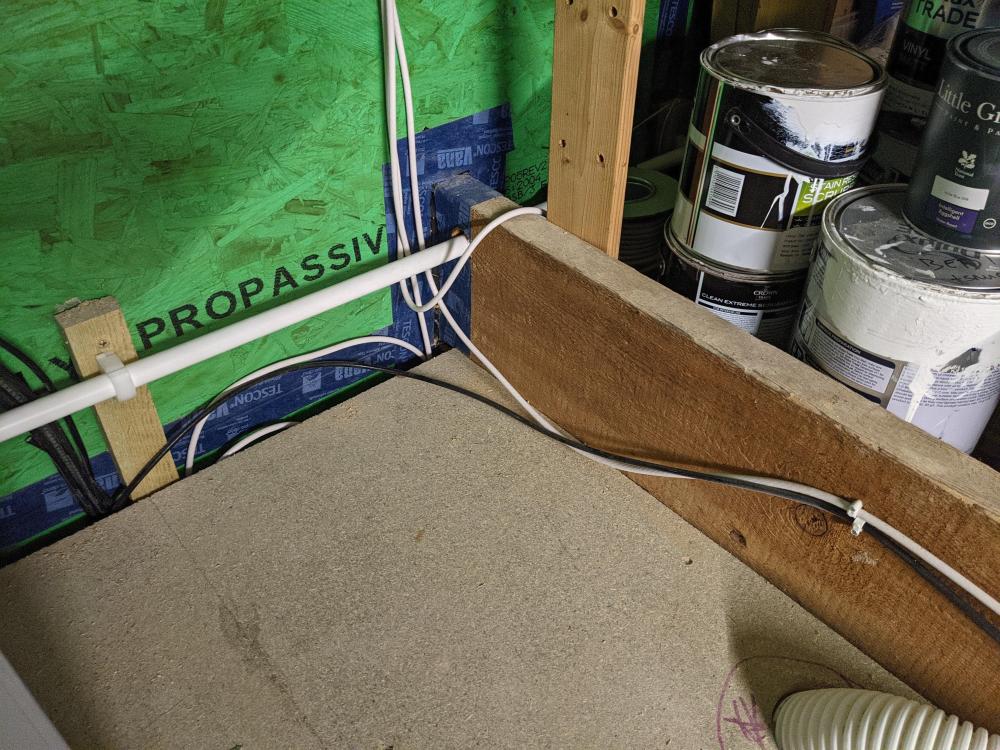
I've sent Newark and Telford and enquiry about wall-mounted buffers. However i think I can probably make a stool for it. There's an original joist running the down the center of the loft under the roof ridge, perpendicular to the ceiling joists below it. Rather than view this as an obstacle I think it's an opportunity. I can use some garden sleeper offcuts beside it and a plywood top, and this will transfer some of the tank weight directly into the gable end.
-
Interestingly their eBay listings have all been pulled down. I wonder if other MCS installers saw it mentioned here and got pissy about it. They still sell kits on https://www.solar-energy-store.co.uk/solar-panel-kits but I don't see mention of DIY certifications.
-
AIUI it depends on the FiT. Most had "deemed export" of 50% of generation, and didn't have an export meter installed. On these so long as the battery is outside of the generation meter there's no way for FiT to be impacted. But those with metered export could easily be impacted. I'd imagine the catch all advice is ask the FiT provider to confirm.
- 15 replies
-
- 1
-

-
- mcs
- energy storage
- (and 6 more)
-
Yes exactly. ( although if it has a coil I could possibly put the primary in that and the secondary zone through the DHW connections to decouple them and reduce the glycol requirement)
-
I heard a rumour they'll add 8kW inverter support for their "Energy Bank" in the next month or so. So the next questions are: - can it be charged from the mains? I assume so, but that's not a normal inverter function so curious how it actually happens - what sort of API or advanced control interface it has? E.g. to put it charge mode during overnight cheap rate, or avoid over filling from mains if the forecast is for a really sunny day I'll be interested to hear from anyone that has installed one already
-
What's the difference between a buffer tank and an unvented cylinder? Can I just use a UVC? https://www.ebay.co.uk/itm/283876880215 That's good value and allows wall mounting. Only downside is both pipe connections are on the underside which maybe suboptimal when used for cooling. (Cold water will just stratify at the bottom
-
Cheers! Annoyingly (and to my architect's surprise) the joists run parallel to the gable end so the stool would need to protrude out into the loft quite a way to get several of them, and it's loading them right in the middle of their span which doesn't seem ideal either. 2x50 does sound feasible but certainly more expensive. (But then this whole project is an exercise in good money after bad, as I'm going to need another 100L of glycol mix...🤣)
-
Thanks I had spotted that one in a prior search but (embarrassed to say) the number of ports on it scared me 🤣. Would it work for plumbing in series with the zone? In another thread @JohnMo suggests it needs to be a vertical buffer with a top port for in series to work, which makes sense on instinct
-
Mitsubishi Ecodan split buffer location
joth replied to Strand's topic in Air Source Heat Pumps (ASHP)
It adds volume to the system, so will reduce short cycling. The benefit of inline is it requires one less pump. The downside is you can't charge up the buffer during off-peak/high PV generation without also circulating water through the emitters. (The ecodan controller has a "smart grid" mode specifically designed for precharging the buffer like this) (I guess you could have manifold actuators shut off the UFH loops and an automatic bypass valve to allow for this. This is what I'm vaguely considering myself, but it's a bit off piste) -
Interesting. I'm drawing a blank searching for this. Is the goal to spread load over more joists, or cantilever off the wall? Thought so. Yeah Easy to find 50L wall hung, but not so many 100
-
I'm looking to add a buffer tank to my FCU zone. I already have a LLH between the ecodan primary loop and the two zones (FCU and UFH). For space reasons it will be far easier to put the buffer in the loft, inline with the FCU zone loop, than try and replace the LLH with one. My estimate is I need 100-120L buffer, for 8kW ASHP. At that size, I think it will be much better to mount it onto the gable end wall than load onto the (60 yr old and a but haphazard) loft joists. This one seems to fit the bill, except it doesn't mention that it supports wall mounting. https://www.plumbnation.co.uk/site/gledhill-stainless-lite-plus-direct-buffer-store-cylinder-120-litre/ Can wall-hanging be retrofitted to a buffer tank, or does it need designing in by the manufacturer? Otherwise this one would work - a lot more expensive and smaller, but as well as supporting wall mount it has a better insulation energy rating. https://www.plumbnation.co.uk/site/vaillant-compact-100l-buffer-cylinder/ Also love to have any other suggestions? I only need 2 port tank (for use in series with the FCU). An immersion heater pocket is a nice to have, but really not necessary (the FCU circuit is only used for cooling).
-
Nit: inform the supplier (unless in NI?). The DNO don't have anything to do with the meter and won't give a fig which direction it is turning. Technically after informing supplier you'd have to leave the PV disconnected until they fix the meter, as at that point you've admitted to then you're knowingly breaking the law by causing it to run backwards.
-
Well it does if the meter goes backwards, as you'd be breaking the law, but ultimately you're only going to confirm that by installing the solar and finding out.
-
FIT was disconnected in 2017 and replaced with SEG which does require a smart meter to be paid for export. (It's literally what the S in SEG stands for). But this is irrelevant to the OP as they're not getting an MCS install so won't get paid anyway
-
Can anyone recommend a small monobloc ASHP and UVC?
joth replied to Dave7338's topic in Air Source Heat Pumps (ASHP)
For a small flat you might want to consider air to air heatpump as well, it can work out simpler. (And provides more effective cooling, if that's of interest). That wouldn't do DHW thought - what do you currently use for that? What emitters will you use? New radiators, sized for heat pump? 2kW is a very low a heat demand, but the ecodan 5kW plus pre-plumbed tank would be one to look at. You'll very likely need a reasonable sized buffer tank, unless you're putting in lots of rads or UFH. https://les.mitsubishielectric.co.uk/products/residential-heating/domestic/outdoor/ecodan-r32-ultra-quiet-puz-monobloc-air-source-heat-pump-2 -
Generally the answer now is install a smart meter and this indeed only has a single L+N outlet. (assuming single phase!) A separate question is do you intend to turn on and off loads based on time of day/ economy times? If so you need separate timer (or more advanced control logic) for that but you can put that near the load it it's more convenient.
-
Outside temperature also will. And of course if there's solar gains to help it along
-
SEG pays 7.5p per unit, so the £345 quoted above for an MCS cert could pay back in 1-2 years if you failed to self use much of the output (e.g. during the build??). And the 20 years after that is pure profit. That's without going on Octopus Agile outgoing which is currently paying 30p/unit, I hear?? So could pay back within this summer. Over 20 years, who knows what will happen to export prices, but if they continue to rise above inflation, you'll kicking yourself in a decade.
-
Oh! For some reason I thought gas couldn't terminate to a meter in kiosk. At least not permanently. /shrug. Assuming you're having to remove electrics for the demo too, this is a good choice if you have the space and can have them both bundled into one cabinet.