joth
-
Posts
2861 -
Joined
-
Last visited
-
Days Won
5
Everything posted by joth
-
yeah the small LCD control panel is called the "remote control" or something. Yeah, you'll need one of those too 🙂 (I assume it's bundled with the FTC, no idea) Really I'd say best contact the ebay seller and ask them all this. Also confirm it is Inc VAT. (It's against ebay terms for it not to be)
-
I feel stupid. loxone's search is crap https://www.loxone.com/enen/?s=SolarEdge&submit=Search But apparently this thing called Google works quite well https://www.google.com/search?q=loxone+SolarEdge Thanks! LOL. I've somewhat stupidly put in a speculative order for the SE EnergyBank, so prepping myself with as much knowledge as possible about interfacing directly to the inverter. Couple observations from a skim: - Looks like loxone are linking an old version of the Tech note, there's an updated version here: https://www.solaredge.com/sites/default/files/sunspec-implementation-technical-note.pdf - Looks like SE is just exposing read-only interface over modbus, so I'll need to look elsewhere if I'm to gain any control over the battery charging priority.
-

Fluctuating mains voltage tripping Shelly 1PM relay (I think)
joth replied to Russdl's topic in Electrics - Other
I don't understand what I'd be changing there as the Shelly 1 and 1PM are identical apart from the 'Power Monitoring' aren't they? Yes, I think the Shelly 1 is a lot cheaper though so my comment was more if you had another use for the 1PM you can swap it out and replace with the cheaper unit. I guess it is, but it's been working fine for months, no 'overtemp' shutdowns, just the 'overpower' on a couple of occasions, but I've no idea how hot it gets. The extended time working makes this sound more likely. A relay has a mechanical switch that degrades over time (especially if turning on and off under high load) and as it wears it creates more resistance which will result in higher operating temperature. Also it will become more liable to electrical arcing which might trip the overpower component. Another idea is open up the Shelly and see if the relay is replaceable, maybe with a higher rated one, but personally I'd always be a bit nervous running it exactly at its limit. -
https://www.cityplumbing.co.uk/Mitsubishi-Ecodan-R32-Ultra-Quiet-PUZ-Monobloc-Air-Source-Heat-Pump-11-2kw/p/232575 Has them at £3850 + VAT new (Vs £1,695.00 in the eBay listing, presumably that is Inc VAT) Mitsubishi Electric Ecodan Air to Water Heat Pump PUZ-WM112VAA
-
Fluctuating mains voltage tripping Shelly 1PM relay (I think)
joth replied to Russdl's topic in Electrics - Other
Are you wanting the energy monitoring function from the shelly too? You could add a Shelly EM clamped on the contactor output side, and replace the 1PM with a basic Shelly 1 if you like. -
Fluctuating mains voltage tripping Shelly 1PM relay (I think)
joth replied to Russdl's topic in Electrics - Other
16A is a large load to thump through a poor little Shelly for sustained periods. I expect it heats up a bit, and that might alter it's over-power detection circuit too. And Shelly has over temperature as well as over voltage protection so even if you stay inside bounds on one the other might flip. Most immersion controllers use a higher rated contactor. You can drive the input to that from the Shelly. https://www.screwfix.com/p/british-general-fortress-20a-dp-contactor-no/6654p -
Yah and the flow switch is bit of a bugger for commissioning - any air trapped in it will shut the system down. Ours is technically installed out of MI guides to (has to be a certain way up and not near any other hydronic perturbations). Yes - that's exactly what the FTC6 controller is. A PCB in a metal box. The FTC6 installation manual is probably the most comprehensive guide to all the parts needed. You'll also need a bunch of thermistors depending on the design - zone flow/return sensors, UVC sensor, etc. I presume some of those come with the FTC6 but certainly not all. I need a replacement UVC stat and an additional buffer tank stat, so if you figure out how to order these parts let me know!
-
@Dan F I was finally in the right place and with SetApp Admin mode and enough time to survive the FW updates, so managed to get "Modbus TCP" enabled on my inverter at last. Next question: is there a dummies guide to using this interface to extract generation stats? Ideally directly into Loxone, perhaps a template device exists?, but I can go via some other SW if needed. I found the DE article below on using modbus TCP in general, but it leaves a bit of guess work (both in the incomplete EN translation, and mapping SolarEdge onto it). https://www.loxone.com/dede/kb/kommunikation-mit-modbus-tcp/ Thanks!
-
It's a monobloc so you need: - FTC6. - isolator switch - primary circulation pump. - flow sensor - filter - expansion vessel - prv. - fill/drain port. - anti freeze value (or glycol) And stuff depending on the system design, e.g. electronic mixing valve, manifold, low loss header, 2 position diverter valve, uvc, etc etc..
-
The easiest way to think of it is: 1. Building a very airtight and well insulated house is what creates lots of cost savings. 2. An MVHR is necessary in an airtight house to stop the occupants from suffocating. (the alternative is to pump cold fresh air in directly from outdoors, which completely defeats the purpose of all that hard work making an airtight house.) As Nick says, providing heat source and moving it around is not the job of MVHR. It's primary role is about providing fresh, breathable air.
-
3 available / 5 sold. Ex demo/display. Curious why anyone had 8 identical demo models sat around. It's not like you get chain stores with these things on display.
-
Getting advice on airtightness
joth replied to Helen2's topic in Mechanical Ventilation with Heat Recovery (MVHR)
It may sound silly, but remember to get triple glazed windows WITHOUT trickle vents. Some still charge more to remove(!) them from UK spec, one of the many reasons we went for Windows from a European manufacturer. Agree but I'd word this much stronger: make the airtightness goal a requirement in your contract with your main contractor, choose a contractor that has worked to a better than building regs airtightness goal before. Ensure they train and monitor all contractors work. Simple things like offering no-blame if airtightness is damaged so long as they report it immediately you have chance to fix it before it's too late. We did OSB airtightness layer then a service void then plasterboard, this had 2 benefits: no need to seal around every socket/switch/light fitting etc, and also the OSB was bright green and really easy to teach the trades to never cut/drill into it without consulting the foreman. Good luck! -
You won't be able to get the correct fiber that a future installer wants so you'll just need to leave that as an empty duct. For telecoms now I'd get the provider (virgin or openreach) in now to do the installation. I actually signed up to a rolling one month virgin contract, they turned up a few days later and left a giant coil of cable in duct at our boundary, so I immediately cancelled the contract and then pulled that cable through the garden and house to the AV cupboard, then contacted them 6 months later to terminate and commission it. Internal wiring I'd suggest 2x CAT6/CAT6A to each data point and up to 4 to the TV (especially and main TV location, for future proofing) I did cat6a everywhere but cat6 is more than likely fine. Also consider pulling data cable to other useful places like the PV inverter, heating system, outdoor equipment, doorbell, CCTV camera points, etc.
-
Rainwater Harvesting...
joth replied to Mulberry View's topic in General Self Build & DIY Discussion
It's definitely worth asking the question. For us (Hertfordshire) the mains water is pumped out of the aquifer which destroys local chalk streams. They dump filtered sewage back into those steams to make up for the abstraction, which further destroys the chalk stream ecosystem. Reducing demand on mains water by capturing rain will clearly and directly reduce the damage to those streams. Also RWH can reduce the runoff to the city drains which also reduces the load on that infrastructure. Affinity and Thames water make great noises about how much they do to save the streams, but at the same time the owners are siphoning off billions of pounds of tax payer subsidised profits via hidden companies in the Bahamas so I have no faith at all that my money handed over to privately owned public infrastructure being good for the local community The economics of RWH never stacked up, but we *very* nearly did it on principal alone. Feargal Sharkey did a talk about it in our local pub and was very persuasive. In the end aside from cost, the final straws that stopped us were realising it will be empty at the exact times our demand was highest and also when the environmental benefit of it would be highest, and admitting to ourselves we'd not keep on top of the maintenance and we'd end up with mouldy toilets. (Our plumber was very adamant about that being an inevitability) Still sad we had to cut it from the build. If a whole street or the local school installed it, maybe it could work more efficiently and effectively. -
Awesome. Tips: If you can get U/FTP CAT6 it maybe worth it as the shielding between pairs _may_ help if you run multiple protocols to the switches down one cable (e.g. knx and 1-wire on different pairs) but again it's 99% overkill. Also if you use green jacket for this cable it looks like knx or Tree cable which I thought I cute wheeze, and clearly sets it apart from any other ethernet cables.
-
All those standards (and Loxone Tree) run fine over CAT6 so you'll be fine if you put that in to each switch. I used CAT6A purely for larger cores meaning lower voltage drop on 24V power delivery (and also it's a bit more robust for the contractors pulling it through) but I'm sure that was overkill. I was originally going to do T&E to each switch point too, but in the end dropped it as I was going all in with home automation. If anyone wanted to convert to dumb lighting in future they'd just have to rack up a couple dozen SSRs in the cabinet.
-
My electrician thought I was crazy pulling cat 6a to every bathroom. All our electric toothbrushes charged from PoE. Who's laughing now!
-
where are you in the UK? I have our old site board (3 RCBO, 2 double sockets and a working light) sat cluttering up the garage (Herts) We did pretty much exactly what @ProDave suggests, except we had an intermediate step of running the old house fuse board off the new site board for a while, just to give the old wiring RCD protection, until the demo started in earnest. Having earth leak protection for everything during the works is a must have.
-
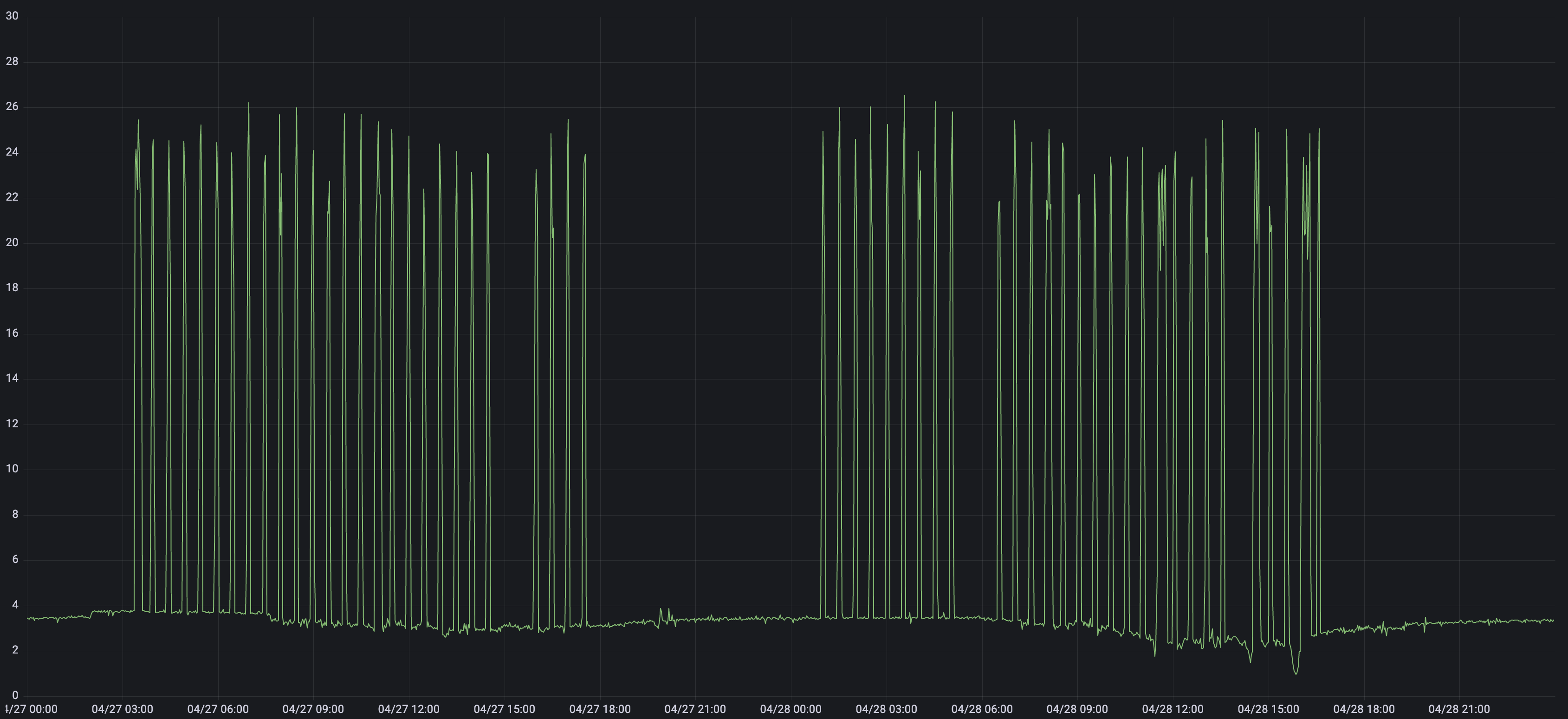
Personally I'd be unhappy with 25W continuous. But my hunch is @Kevm has only sampled periods when the compressor heater is "on" , and hasn't averaged it out over the 'off' periods. As you see below, it draws about 25W peak For me, over 2 days on standby (in April), it's only on for less that 25% of the time, hence my measured 5.5W average standby load. 5.5W I can live with. It's not ideal, I'd much rather have a (scroll) compressor that avoids the need for this by design. Ecodan has certainly dropped off the list I'd recommend to someone because of this. For an occasional use property (holiday let, etc) this becomes even more stark.
-
No, not at all. You're conflating the discussions of commercial and centralized system. With 50 shellys (or tuya relays) adding one Home Assistant server (or similar) still has total independence from a commercial system lock in, but will VASTLY reduce the number of times you're reprogramming/configuring the individual devices. Better to say: enduring the pain of programming a distributed system is the price you pay to avoid a central point of failure. Interesting to note that even with the very distributed architecture of KNX to do anything interesting you'll need a Gira HomeServer, LogicMachine5 Power, or similar, which brings you right back to single point of failure
-
Google is great for these unit conversions: https://www.google.com/search?q=0.4+Wh+per+minute+in+watts = 24W (indoor + outdoor) If you average it over a longer period (hours/days) it will give a more representative number. FWIW my own measurement: https://www.google.com/search?q=266+Wh+per+48+hours+in+watts = 5.5W (outdoor unit only)
-
Yeah, Loxone is very much about the house doing everything automatically, we never use the house day to day. It has a more centralised architecture mostly to simplify programming, although it's hybrid architecture really as you can slave miniservers together so could do one per floor / area. To achieve any useful automation with shelly you'll probably need a central server (Home Assistant or similar) which is logically the same thing. For example during nighttime you want all rooms to know to use a low level mood to act as night lights for bathroom trips. Programming 50 Shelly's to know about global state like "it's night time now" and then reprogram when you want to alter logic sounds soul destroying (e.g. I now have an additional cut out to stop the cats triggering lights all night, or to interlock it with burglar alarm state, or whatever. It's a life of continuous tweaking) Totally agree on the concern of single vendor lock in. I did the central wiring plan to mitigate the impact of that a bit, and also used DMX for all lighting (Dali also valid choice).
-
Have a look at Loxone too. It's not perfect, but it's a little more accessible for DIY than either knx or C4, and it generally has the option to be installed professionally without obligation for ongoing support fee (although of course the installer will want to sell one. And this is a benefit over shelly etc, that if you were unable to maintain it future your family could easily get professional support in for Loxone, assuming they don't go bust of course). I went for your option 2, and self installed Loxone in the wiring cupboard, with the thought eventual house sale will highlight the option of professional Loxone support or the relative simplicity to rewire it to another system
-
Need a security camera recommendation..
joth replied to Bitpipe's topic in Networks, AV, Security & Automation
If you can get a USB one then yes, but they've been unavailable for a year now I think. I managed to get an M.2 dual tpu and installed it on PCIe via a double stacked adapter board in an old server. Duct tape special but it's working! -
Need a security camera recommendation..
joth replied to Bitpipe's topic in Networks, AV, Security & Automation
How much power (Watts) do you find the PC sucks running BlueIris? I only had a low powered NUC but it was still spinning 150W and couldn't do anything to budge it downwards. I now use https://frigate.video/ and a coral EdgeTPU , much lower demand