


TerryE
-
Posts
3826 -
Joined
-
Last visited
-
Days Won
30
Everything posted by TerryE
-
Update on Timeshifting to Minimise Heating Costs.
TerryE commented on TerryE's blog entry in The House at the Bottom of the Garden
What is the domestic gas boiler penetration? I would guess of the order of 60%. ASHPs about 1%. If the government is serious about its energy targets then this ratio needs to collapse. -
Update on Timeshifting to Minimise Heating Costs.
TerryE commented on TerryE's blog entry in The House at the Bottom of the Garden
I agree with your basic analysis and that we need to be fairly clear about RoI decisions which should inform such decisions. In some cases equipping a new build was easier because man choices had to be evaluated and executed in line with the overall build program plan. The options where realistically yes or no; there wasn't a sensible defer option. Examples here for us include the decision to a warm loft to create a 2½ storey layout; the adoption of MVHR, the use of SunAmps for DHW. In the case of ASHP, I deferred to decision to install the ASHP itself, but instead I put in the Willis heater as an interim solution and also buried insulated piping and power circuit that any future ASHP installation would need. However we have completed our build and moved in at the end of 2017. So now we have an established status quo with known characteristics and run-rate costs. Any future material change should be based on an informed cost / benefit trade-off. However, one issue that really complicates all this is that the whole environment is still very dynamic, and any trade-offs need to take an honest reflection of this: just extrapolating out the status quo can be a real mistake. For example: Components such as batteries and ASHPs are still on the steep part of Engineering Experience Curve and so will be experiencing real capability improvement and price/performance drops year-on-year, so it can often make more sense to defer decisions year-on-year if you are going to get a better / cheaper system as an end result. Take the case of an ASHP, ASHP units cost roughly 5 times the gas-boiler equivalent, with a comparable gearing on installation costs. This is because we are still on the 'low volume, high price' end of the price curve. Even at current high energy prices, I can't make the case to install and ASHP and demote the Willis to fallback. This might not be the case in a year's time. Battery technologies and chemistries are still rapidly evolving, so I double that current Li-based systems will remain in pole position for house-based systems for long (other than perhaps for V2G solutions). I also think that UK Energy Providers will be forced to offer new time-of-day pricing models to create demand-side leveling as the percentage of renewable increases. This will all help, but for us the installed price of powerwall-style batteries would need to fall by a factor of 4 or so, for numbers to add up, as I can for do load shifting on roughly 80% of my high winter-based load by scheduling without any local storage. -
I use a Sonoff USB Dongle attached and old Laptop that I use as a VM host and which runs Home Assistant to drive my ZigBee devices. HA has preconfigured support for all sorts of devices including LED controllers, though I don't know if it directly supports this one. However, my suggestion is that you work out what home automation system you want to choose, then pick a controller that is properly supported by it.
-
You could also just feed a HW tap direct into a drain and then you'd get through the HW a lot or you could ask what your objective are here and modify behaviours accordingly to minimise costs whilst maintaining those objectives. In terms of our DW and WM, these are both cold-fill and have timer functions in-built so 90+% of the these go on overnight to use cheap rate electricity. My aim in having a shower is to get clean, quickly and efficiently. All of this COVID focus on the "right way" to hand-wash reminded me that the three most effective components in removing microbes, dead skin, sweat and dirt are (i) soap solution on skin, (ii) contact time, and (iii) mechanical friction. A high-flow volume doesn't really help here, as this buggers up (i) and (ii). So my strategy is to do a quick wet down (say ~10s), then a full body lather and rub down for at least 60s, then a quick rinse and blade off to remove 99% of the soap and then a final rinse off. Our showers have a 8 L/min click-stop and I probably have under a min flow under this stop limit. We have ~2bar head at normal flow rates so unstopped we get maybe 15-20 L/min but I find I need maybe 30 sec final rinse-off to come out spotless and soap-free, so perhaps 15-20L in total for the shower. Maybe this might seem a bizarre behaviour to most members, but all I can suggest is that I come out of the shower cleaner than if I'd just stood under it for 3-5min @ 20L/min, so I view this latter as pouring money down the drain for no benefit. Or just call me boring old Mr Pompous. 🤣
-
Not really. The point of an ASHP to pump heat as cheaply as possible. Two things drive this cost per kWh heat pumped: the effective CoP and the unit rate of electricity. If you have an energy-efficient house which has a long thermal time constant (e.g if I was to lose heating now my house temp drops around 1-1½ °C per day) so it doesn't really when you pump the heat during the day, just that you pump enough day-to-day to balance out overall heat losses. The "when" bit becomes: when I can buy it cheapest.
-
Electrics 2nd fit, Gas, UVC must be done by a certified professional. Some trades require a lot of skill / learning curve so it just isn't worth trying to do then yourself unless you are "in the trade": plastering, slating, bricklaying, precision concrete work, etc. In our case we use a local builder to do our groundworks: we had to drop the entire site by ~ 0.6m to get the headrooms we wanted and maintain ridgelines; that was a lot of 40 tonners of subsoil to dump. (Luckily a farmer in the village was culverting a stream that ran alongside his yard and happily took it all.) He also did the drainage, stone skin and other outside work. We use MBC for the TF, warmSlab, insulation and air tightness. We used some of our builder's preferred tradesman subbies: electrician, tiler, slater, plastering. MBC's structural engineer did all of the structural calcs and worksheets. Internorm did our fenestration. We pretty much did the rest ourselves: Overall architectural concept, but an architect technician (AT) did all of the initial AutoCAD drawing for Planning Applications; these were passed to MBC's TA for the basis of the build drawing sets. Overall project managed, planning submissions, procurement. I was recently retired and had done some (IT) PM professionally, so we were comfortable taking these on. Thermal specification and design; heating implementation (less 240V electrics), home automation. All joinery / woodworking including fitting a custom staircase spanning 3 stories. Used to be an occasional hobby, and I was a lot more comfortable with my standard quality of work than that of my builder's preferred chippie. Fitting kitchen and all sanitaryware. All plumbing, and MVHR, both design and implementation. Also external rainwater and weather proofing. Decorating (though used / paid a nephew who does this professionally for a lot of this). Jan used to run a custom-made curtains business, so she did all of our window hangings. (i) This saved a shed load of money -- maybe 40% of what the build would have cost us if we had subbed out these. (ii) We had far better over design and implementation cohesion and quality because we could consider the issues end-to-end and were motivated to achieve a standard that we wanted to live in. However you need to be realistic: What are your own skills / aptitude experience? For example Project Managers and Architects charge a lot because the work is skilled and time consuming. Doing these functions yourself can save maybe 20% of the total build costs, but you have to be totally honest about your own skill levels here because you doing them badly could end up costing you a lot more. BRegs impose certain requirement v.v. certification and those are primarily triggered by safety / risk issues. e.g you cannot do electrical installation because the Regs mandate that it is inspected and certified by a registered qualified electrician. So even though I have rewired my previous house to the then Regs, it was a lot easier to subcontract this all out to a known and competent sparky. However some here have done the first fit themselves and used an electrician for second-fit and certification. We used an approved private BInsp rather than the LEA inspector, slightly more expensive but better overall because the Inspector was more customer focused, whilst still enforcing the regulations, but we found we could discuss issues with him and he occasionally made excellent suggestion of an implementation approach that would still comply with the regs. For example, I still had to submit and self certify all the required design and test documentation for things my MVHR, foul and potable water (including why my system was exempt from relevant the Part G HW safety thresholds.) I did the SAP-as-designed calcs myself. This was a mistake in retrospect, because the as-build calcs must be registered by a certified practitioner. All of our local SAP firms would only quote for a job lot and weren't interested because I'd done the as-designed myself. Luckily I found a company that was more flexible and were willing to do the as-built submission, but TBH, it probably cost just as much in the end. Time is money for other trades, so you holding the work up is going to lose goodwill and prove costly. We always made sure to have any prep work that we were responsible for completed before it was required. We were helped because our TF + fenestration was erected and weather proof in under a couple of weeks. After that we were largely responsible for all internals at our pace and the builder could get on with the externals. This made the interfaces straightforward and stress-free.
-
As @Iceverge and @Nickfromwales, have commented: I have UFH in-slab with 3 UFH loops heated by a single Willis heater @ 3kW. The main advantage of in-slab UFH (this sort of approach) is that you have a huge thermal mass within the house's warm envelope. In our case this means that we can do all of our heating using cheap-rate electricity: if you can accept a ~1°C ripple on your house temperature, then it doesn't really matter what time-of-day you dump the heat into the house; just do it when the electricity is cheapest priced. No ASHP at the moment, but I will put one in when a can get a decent price. Iceverge found out about this approach too late and hence has to do a lot of his heating at peak rate prices. As to H/W this can depend on your use. We take short showers and the odd shared bath, so the electrically heated SunAmp approach works for us. @ToughButterCup in one shower probably gets through as much as Jan and I do in a couple of days. 🤣
-
We took our incoming power through from the meter box (in armored cable), up the service cavity and floor void to the distro box, so the up-and-over route is an option here. It's a lot easier to pull stuff through 110mm than 50mm, especially if you turn up through the slab using a slow bend. Also ASHP double insulated pipe runs to your potential ASHP location. Even if you don't fit an ASHP on day one; it's a lot easier to future proof before pouring the slab than digging up after you are in.
-
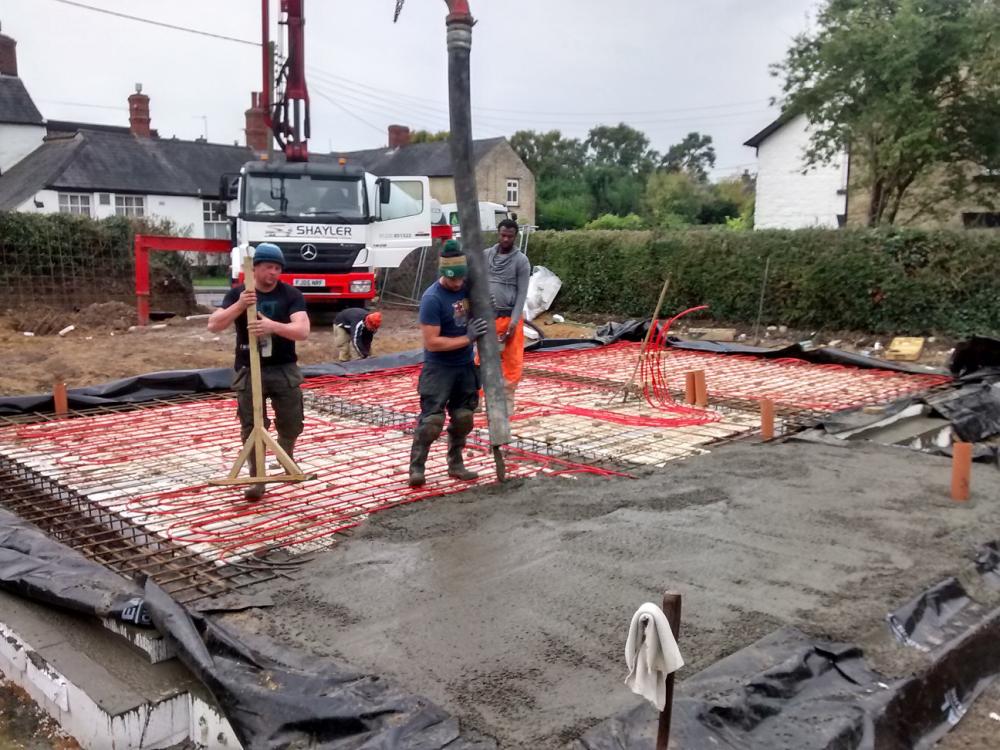
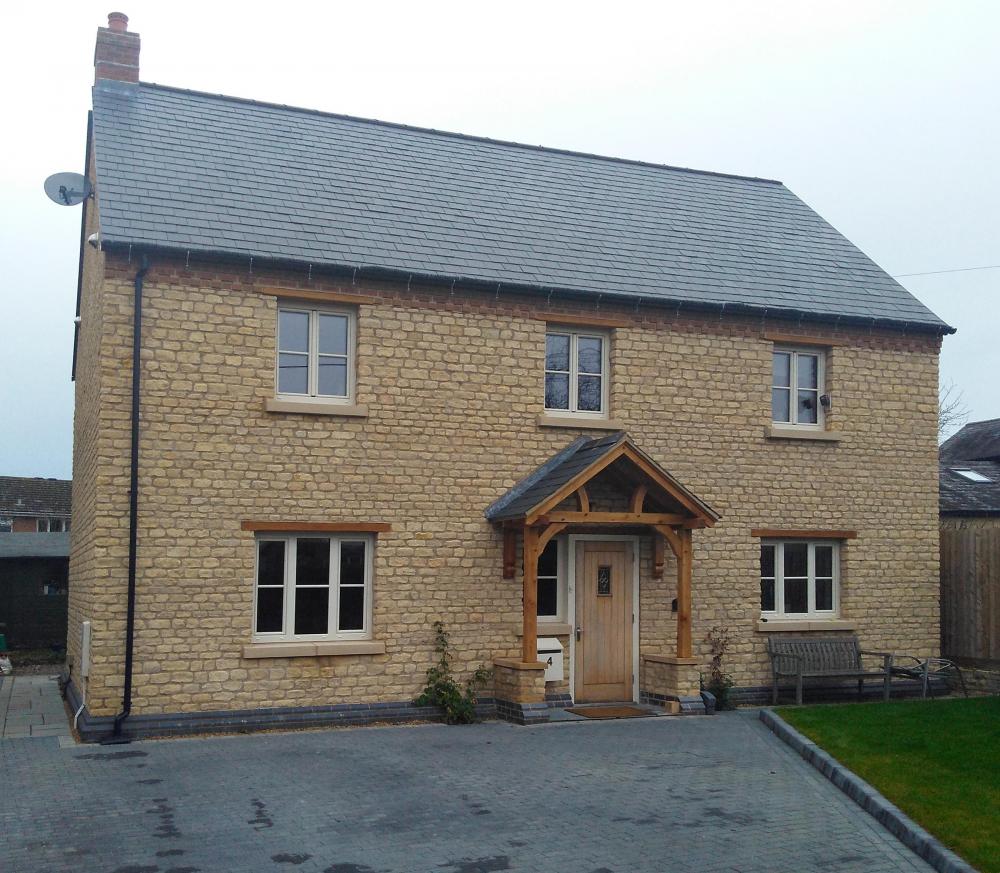
@Shaun McD, As @jack says at 20,000 ft, our warm slabs used a broadly similar approach albeit with some difference because specs and BRed variations, e.g. MBC wacks down the subbase in 5cm layers to guarantee compaction; EPS thickness is typically 30cm; the upstand section are factory pre-cut; the rebar is typically a lot heavier for 2 and 3-storey houses; and most UK BCOs would be unhappy about burying 25mm MDPE in the slab, even if rebated into the EPC. Here is our slab being poured, but we have a 2½ storey Larsen-strut TF proving the structure (hence the heavy load-bearing ring foundation) with a stone cladding for weather-proofing and looks. and as finished: One of the other posters was questioning about pipe pressures, etc., so a couple of useful references from one of blog posts on plumbing design: ... such reference works as this excellent intro into pipework calculations: John Heartfield, Water Flowing in Pipes I – The Theory and useful sites like the Pipe Pressure Drop Online Calculator. The first is worth a scan if you want to get a handle on some of the sizing issues.
-
WiFi repeater over ethernet
TerryE replied to Carrerahill's topic in Networks, AV, Security & Automation
My £7.50 pcm sim-only deal offers unlimited talktime and texts, but data is capped at 15Gb PCM. -
WiFi repeater over ethernet
TerryE replied to Carrerahill's topic in Networks, AV, Security & Automation
BTW, it is well worth avoiding these 0 and 1 subnets if you ever want to implement VPN back into your LAN as most coffee shops, etc. use them, and the routing algos can get confused when the guest LAN that you've connected to and the home LAN have the same subnet. Just pick any other yyy in the 192.168.yyy.0/24 subnet such as xxx=44 or 111 or whatever. -
@Shaun McD, Using the 1st floor void for distribution, then drop or rising the services vertically through the service void is a very common approach adopted by many here. We did all of our own plumbing, largely under the inspiration and remote guidance of @Nickfromwales, a.k.a my hero 🤩. This saved us a load of money, and honestly we ended up with a far superior installation than if we've used our builder's preferred plumber. It was all relatively easy stuff. There are loads of threads and blog entries from members on their individual implementations, so it is well worth getting a glass of vino, and doing a few hours browsing of these for hints and examples. This will get you started and save you loads of grief. I did the central plumbing in copper. I had done some copper / end-feed work before (about 25 years previously), but you just need to watch a few YouTube videos and have a few practice attempts. I did very little soldering in-place but instead used the valves, etc. plus the odd compression connector too break up copper-work into sections that I could bench solder/assemble, and since these sub-units ended in compression tails, I could add a few temporary end stops to allow me to pressure test the sub-units before assembly. The basic topology was hub and spoke using brass manifolds and Hep2O 1-1 to the whitegoods, etc. Jan and I split the Hep2O 50:50, and she'd never done any plumbing before, but soon became proficient. Have a browse of content here. Brilliant solution. 🙂
-
I am one of them. I endorse pretty much everything that @jack and @Nickfromwales have said. IMO, having this type of warm slab was up there amongst the best design choices that I made. The only embedded service in-slab is the PexAlPex UFH loops that are designed to be embedded in concrete. Everything else is run through the service and floor voids. We did add four piping / cabling ducts under slab and rising in our equipment area. We used 110mm drainage pipe for this because we needed so much anyway. One hint though if you do use this trick: use a slow bend or 2×45° to turn through the slab as this makes pulling through a lot easier. Another advantage of a single raft pour is that the FFL is flat across the entire ground floor to within a few mm. You don't the between room bumps that can occur if the UFH teams pour a self leveling screed per room.
-
None of this looks right to me? Build Quality Issues
TerryE replied to Saul's topic in General Construction Issues
Your last picture looks like a weep vent. These are quite normal and can be needed wherever you have horizonal DPCs (e.g. over lintels) as internal dampness can collect on the DPC and this needs to allowed to run off though to the exterior. The masonry bees also love them. 🤣 -
WiFi repeater over ethernet
TerryE replied to Carrerahill's topic in Networks, AV, Security & Automation
I use an Asus router and a BT infiniband modem (bought 2nd on eBay). We used to get crap WiFi on the upper floors because our ecoJoists seem to degrade the signal through floors, ditto outside. I have since bought 3 more Asus routers cheap on eBay to cover these areas: Asus routers will mesh (that is the main router acts as a master and the others slave off it, and all use the same SSID, etc.) so our mobile devices automatically pick the strongest signal. BT and other providers now offer similar. -
I have a passive-class house and I use resistive heating, that is I have a wet UFH system in-slab. OK our ground-floor footprint is a lot less than yours at less than 80m2 living space footprint per floor, but we do have 3 floors. Our slab and frame supplier charge us less than £2½K to add the heating loops into the slab pour. I did the rest for maybe £500 or so, so our CH worked out at around £3K total. One of the reasons that it was that cheap is that I use a resistive heater (a "Willis") to heat my UFH circulating water. We only heat our ground-floor with UFH, but I do use an oil-filler on the 1st and 2nd floor to top up overnight in the coldest months (up to ~10 kWh) at a total price less than £200 including the smart switches controlled by my home automation system. However, I also did the groundwork to add an ASHP at a later stage (pre laid insulated pipework to ASHP location, plur power spur) if and when the number made sense to do so. I figured that we'd go resistive until we had enough data to make an informed decision., and we've never reached a threshold where we have enough of a payback to make the investment case viable. During Dec/Jan about 70% of our electricity use is off-peak and for space on DHW heating this is 100% efficiency — that is 30 kWh of electricity generates 30 kWh heat. With an ASHP at the ~30°C circulation temperatures with long cycle times we would be looking at CoP of nearer 4 so we would need 7½ kWh electricity to achieve the same. That's a 22½ kWh energy saving. Based on our current year-round actuals, it makes sense for us to defer this decision, but we still have the option to add an ASHP should it make sense to do so. It seems to me that this IR panel route locks you into a CoP of 1.0 at a high installation cost. If you build to passive class (or near, e.g. wall, slab and roof U-value 0.15 W/m²K, decent triple glazing, MVHR, airtightness 0.6 ACH, or better), then the whole dynamic and sweet spot for heating changes. For example you really only need ground-floor heating Our in-slab heating cost us maybe £30/m² based on the ground floor, but that was for the total CH system costs, and we got 3 floors heated for this price.
-
I realise that this is a bit of polemical digression, but maybe no more than Nick's about RPi power use. 30 years ago, I was the technical manager for a ~100 strong SW project. We used an Oracle code generator which took around 50K "lines" of logical design, business rules, screen definitions , and generated around 1M lines of actual code -- except that the developers then needed to tweak maybe 5-10% to do the actual functionality that was require. This proved to be a one-way trap: you were left with ~1M+ lines of code to maintain. Yes, the Oracle framework could allow devs to update the logical design, etc and regenerate the code, but this would lose these customisations that then need to be reapplied manually -- or you just worked with the 1M line code base from then on. Since this experience, I have had a total aversion of any form of generator system which isn't properly orthogonal and in some sense minimal, as these rapidly become unmaintainable. You as the author will have enough trouble remembering what and why you did something a year or two ago, let alone if you need someone else to pick up this gauntlet. With Home Assistant, if you want to add a service like MQTT for example, then you click one button to install it and configure one file though a configuration tab to change maybe a dozen or so configuration lines and that's it: you have a working service that is version updatable and properly backed-up against failure. If you do your own application stack with Docker you might end up with <100 lines of setup and config per service, and all within a single file hierarchy that you can maintain in git. Yes you could natively do this on a dedicated server, but where is what you have installed and what files were changed tracked and documented? With ProxMox, there is a nice website which bundled up a whole load of installation scripts to create VMs and LXCs for dozens of services and application: cut and paste the install command, and answer a few Qs; you then have a running MariaDB LXC, whatever. However, from the perspective of maintenance and configuration management, this is no better than running a dedicated server per application. Hence I use one VM for HA, and a Docker LXC for all of my other applications and services. This might sound inefficient: running a bunch of containers inside a ProxMox container, but in reality all these containers run as LXCs over the Linux kernel (which supports nested namespaces, etc). There is a slight overhead for the docker-proxy daemons handling the mapped sockets. So long as the lower FS is something such as ext4 that works well overlayFS, the CPU hit is minimal.
-
@Nick Thomas @jack, TBH apart from my 1st home PC 30 years ago, I haven't bought a pre-configured PC. I've always built and configured my own by buying the MB, CPU, case and peripherals in the past so if I was doing this now, I would probably do very much as you suggest. My 1st private laptop was a freebie from the Innotek guys at Sun in 2008 IIRC, a thank-you for setting up their VirtualBox forum and being a moderator on it. I am not really interested in some beast that is needed to run Win11 adequately, as I haven't used WinX for non-work use for over well over 15 years (except that I did need dual-boot for some VirtualBox development). Since switching to Ubuntu, I have used ex-business laptops which you can pick up for a quarter of the buy-new price -- if you are willing to accept a scuff or two, then maybe adding extra RAM and upgrading the HDD (or later swapped in SSD) At these prices, I personally don't think it's worth buying a new NUC style device. I have also been buying the odd RPi and lots of ESP SoCs for IoT and hobby work over the last 7 years or so. The current laptop that I am using for ProxMox had been sitting powered off on a shelf in my office for over a year. My one extravagance these days is that I use a (bought-new and now) almost 2 year-old Acer Spin 715 Chromebook for all of my interactive work and internet browsing an viewing. This is twice as powerful as my last Ubuntu laptop, and less than half the weight; the build quality and weight are on a par with a Macbook. I also SSH or HTTPS into all of my servers from this as well, and I use the native Debian LXC that runs within ChromeOS a lot. As to Docker, this is stack that runs this forum. Brilliant, IMO.
-
Already done that. Around 15VA when run at the few % max utilisation that it currently runs at, or roughly 10p/day at current prices. Given that this acts as 15W heater in the winter which is needed anyway, the net cost is 0.025 × 17 × tariff increment or 4p/day. However my 2 × RPi4s ran at ~ 10W. They are powered down now, so the net delta is a third of this, or just over 1p. In the noise.
-
Going back to my OP and "shall I move HA etc. off RPis", I have now got my laptop-based ProxMox set up working stably. The laptop is used as a NUC with inbuilt battery backup. It's got a 6 year old core I5 CPU that has about 3-4× the power of an RPi4, 8Gb RAM and 1Tb SSD. Absolutely poodles for anything I need. Proxmox supports both VMs and LXC containers. I have: The standard HA VM install in 1 VM courtesy of Proxmox Helper Scripts (PHS) A VPN gateway also from PHS so I can remote in to my LAN securely A Docker LXC also from PHS. Most of my other services run within this last Docker environment and these were migrated from an RPi4 that hosted the Docker environment that I used for my application services : [nginx, php8-fpm, mariadb and redis] for my blog; [ftp] for outside cameras; [pihole, and unbound] for ad-blocking and private DNS. So this laptop does everything that I need and with lots of headroom in terms of processing power, RAM and storage. Note that I prefer using a Docker Compose project for my application stack (as opposed to native ProxMox LXCs) because this way the entire stack setup is defined in some 750 lines of configuration, split across less than 20 files, and all of this under GitHub configuration management. OK, using Docker means that you can't just hack issues into your runtime setup; you need to resolve them point-by-point, and then update the YAML and other config files to reflect this, so the debug journey is more convolved, but the end result is very clearly and crisply defined. Also given that LXCs and namespace mapping are all supported with the Linux kernel, the overhead introduced by Docker is small: the main runtime impact is the slight overhead of the docker-proxy processes. So I now have 2 × RPi4 and 1 × RPi2B free to use on my IoT projects. 🙂
-
Shot is an understatement! It looks like it is about to pop! It needs junking / replacing. If you do recycle, then stick in an airtight plastic bag so that if it does pop then the lithium won't get exposed to air and spontaneously combust.
-
By way of an example we typically need around 30-40 kWh heat per day during the peak winter months, so that's around 1.5 kW on average. Our heated slab is around 75 m2 so that's 20 W/m2. Black body radiation is around 7 W/m2K so the UFH heating has to keep the floor around 3°C warmer than room temperature to provide this heat input. Nice to walk barefoot on this. 🙂
-
We've ~76 m2 interior on our ground floor warm slab. We used slate through, and then topped this off with some nice strategically placed rugs. we alo used the same slate for our exterior door cills. We've got a passive-class house so it is quite comfortable wandering around barefoot all year round.
-
Is this sub-standard. Sanity check needed!
TerryE replied to devondumpling's topic in Heat Insulation
No it's not fine. You are right. These sorts of gaps are enough to allow air circulation within the panels and this will drop the effective U value. It would only have added a few mins per panel to use filler foam to seal the gaps. Sloppy workmanship, plain and simple. -
Don't I hold the record 😊 -- a cupboard, 0.7m × 1.4m, with floor-to-ceiling bifold doors off the GFL toilet. The MVHR is in a warm loft room that is used for storage, drying, and my son's clothes hanging. It was a trade-off as the house was footprint limited because of plot and planning restrictions, so the extra 14m2 was better used for a couple of bedroom ensuites.



