NailBiter
-
Posts
139 -
Joined
-
Last visited
-
Days Won
1
Everything posted by NailBiter
-
Download speed is perfectly decent, upload speed is a little ropey but that ping is quite high, there are probably things you can do to reduce it.
-
Starlink kicks arse and it is improving all the time. The latency is still quite high but they are targeting sub 20ms which would be great if they achieve it.
-
Sonos Era 100 fails to work well with Ubiquiti
NailBiter replied to Adsibob's topic in Networks, AV, Security & Automation
I've bashed my head against Sonos and Ubiquiti equipment on a number of occasions, feel for you mate. Are any of your Sonos devices connected via Ethernet? You may be bumping into some issues described here: Read the linked Unifi document but also read the top comments on Reddit thread above, some good explanations there. Like you rightly say the Soundbars are rock solid (as are the subwoofers) so we use those. We've also switched to using OG Homepods in stereo pairs instead of any Sonos speakers for music. A shame we can't take advantage of the subwoofer though. -
Yeah that sounds like a much better idea thinking about it thanks guys. Also decouples the smart bit (more likely to fail or need upgrade but also cheap if only being used to switch a contactor) from the more expensive and longer lasting contactor.
-
The Sonoff device is likely already using a contactor as it's rated up to 20A. I can't find any explicit documentation though. Teardown (20A version): https://youtu.be/O1HvycrP4s4?t=457 You can also get big monsters like this (switches up to 5500W): https://tech.scargill.net/sonoff-powr3-powerful-controller/
-
You need a Wi-Fi (or Bluetooth / Thread / Zigbee / Zwave) relay / contactor capable of handling the load you are putting through it. Something like: https://shellystore.co.uk/product/shelly-plus-1/ (but only rated up to 16A so be careful) or https://itead.cc/product/sonoff-pow-elite-smart-power-meter-switch/ (one of them is rated up to 20A) Personally I'd flash ESPHome on whichever device I chose (super easy to do) so I knew they were secure. You can also program the timer at the device level so even if Home Assistant / ESPhome is down the timer will still run fine locally on the device. There are various ways to make this nicer to use e.g. using the screen to display auto / manual mode, next timer run and current time
-
The above worked out fine and has been accepted by our building control company. If anyone needs help with it in future tag me.
-
Ok so I filled out the "Appendix B: Model form connectivity plan" from https://assets.publishing.service.gov.uk/government/uploads/system/uploads/attachment_data/file/1119957/ADR1.pdf On it we put: 1. Location of proposed ducts to carry future fibre and entry point into dwelling. 2. Likely location of street pot on property boundary for future fibre provider. 3. Evidence that BT do not currently supply FTTP. 4. Communication with two fibre providers that cover the area but not our property stating they can't serve us. 5. Screenshot from BT Wholesale checker showing our neighbours BT line and the downstream handback threshold being less than 40mbps. 6. Screenshot from Starlink stating capabilities of the system exceed capabilities of the BT FTTC offering. 7. Screenshot of the active Starlink account. 8. Screenshots from other major suppliers (Virgin Media, City Fibre) postcode checker pages. 9. Noted that the property is also served by 5G. I think that covers everything off so will wait to see what they say.
-
Yup I've got Starlink setup at the address already and that is very much our experience too. Latency is much improved recently.
-
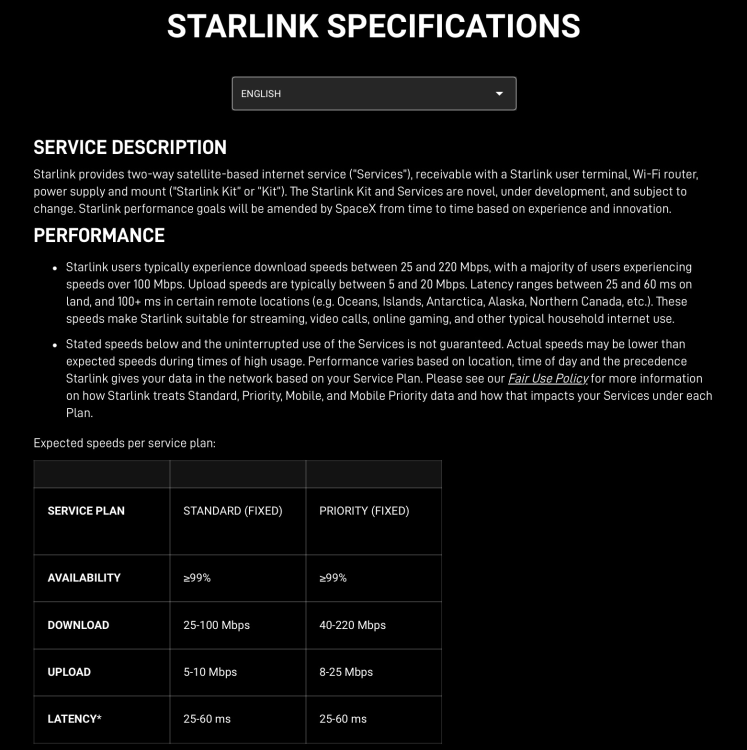
Thanks much appreciated. I guess my question is whether Starlink is considered the next speed down from fibre or whether copper FTTC would be. Our downstream handback rate would be 40mbps on BT and would require 100 metres of trenching however Starlink is: To be fair of course we will have to trench for fibre anyway so that's not really a cost unique to FTTC.
-
Hello all, My understanding is that if a BT FTTC connection (which is the only fixed connection available) is slower than Starlink then it would be acceptable to install Starlink instead. We also intend on running ducts and pull cords to BT's specifications anyway for eventual fibre rollout. Does that seem correct or have I missed something major? I've forwarded this opinion to our Building Control team so I will update this. Cheers
-
This article makes me think prices of panels have further to fall: https://www.reuters.com/business/energy/losing-hope-rescue-some-european-solar-firms-head-us-2024-04-15/ This part jumps out: So there are significant built up stocks of solar panels and production seems to be increasing faster than consumption. I'm no economist but unless something changes would that not point to serious reductions in prices?
-
What is the go to software package for doing this? I've been playing with the tools built into ArchiCad trying to learn how they work but it seems that there are a lot of capabilities missing (or I'm not able to find them due to lack of skill / training).
-
Is there any logic in just dropping cat6 if it is a reasonably sized window where you can get away with a 24v blind? It gives you maximum flexibility (except if you need a bigger motor and therefore AC power). It also gives you control wires. You can terminate cat6 yourself and it is easy to deal with (e.g. replacing the blinds could just be as simple as unplugging a network cable and crimping a new RJ45 on the new blind to the correct length). No need for any electricians. Edit: Some more info here: https://umbrashading.co.uk/24v-vs-230v-roller-blinds-which-motor-is-right-for-you/ Powering via POE might solve some of the downsides they are saying about, it also means the control device only has to be turned on when the blinds are moving (the POE switch could turn the port on, send the command, wait for confirmation its completed and then turn the port off). Edit 2: More info here: https://www.reddit.com/r/homeautomation/comments/ubp7su/poe_roller_blinds/ Seems that powershades are one of the few providers of POE blinds at the moment: https://powershades.com/truepoe
-
D cells? What year is it?! Doesn't everything battery powered run on either coin cells, 18650s, CR123As, AAs or AAAs these days? IMO you either want to charge the batteries whilst they are still in the device, e.g. a torch / lantern with USB C on it or you want to be able to cram a fair few batteries in a large battery charger. For example we have a fast 4 port charger that can do 18650s and CR123As and one of those Ikea AA / AAA charger boxes. These are mounted to a tiled wall in a tiled room (in case they decide they want to set fire). This means we don't have cable mess like the above and we can keep a supply of charged batteries in a FIFO queue.
-
I never suggested a provider would maliciously access my inverter specifically. I suggested they might decide (as Apple and many others have) to put some code that benefits them and doesn't benefit me in a software release. They would not be the first (and sadly won't be the last) if they do go down this route. Everyone has their own opinion on this stuff, I respect yours but you seem to determined to change mine. I will not change my mind and I suspect you won't change yours. Are we adding information or noise at this point? I think we have both said what we have to say.
-
I like to have control of my own tech, even as nothing more than a personal preference. Any further reasons are superfluous regardless of their relevancy. From what I can see the inverter information is not in the Modbus registers as it is not part of the SunSpec protocol the inverter seems to follow. That based on a lot of guess work, someone more informed might be able to find them.
-
No, were there any indications Apple were going to push code worldwide to degrade their batteries before they did it? Did I know SolarEdge had some sort of kill switch embedded in my system that needed cloud to fix? Nope. The best thing is they just don't have access. Then when their programmer is thinking "its fine if this sensitive kill switch triggers as we can just remotely toggle it back" vs thinking "hmm perhaps this threshold is too low, we don't want lots of RMAs". Forced updates (before allowing any setapp access) and required cloud (it is required for SolarEdge or you can't get at the optimiser data which is a core product feature and shouldn't require a cloud) are a big no in my book.
-
Yeah that's fair, I think my point regarding the bean counters is a lot more pertinent.
-
WiFi is a bit juicy. You would be much better off with Thread, Zigbee or BLE. I've got a few POE controlled relays that work well too.
-
This isn't something that I have heard of currently happening but there is no reason why it couldn't. Ransomware authors are money grabbing bastards (literally). If they think there is money to be made hacking inverters and threatening to burn your house down while you are at work if you don't pay them they will do so. Bonus points if they use their access to work out your working schedule from your usage patterns. Push Notification: We have root on your inverter, your house will burn down / we will permanently damage your expensive solar system / we will get you a fine from your DNO if you don't pay x Bitcoin to this address in the next 15 minutes. Push Notification: 14 minutes.... send x Bitcoin to address repeated. Push Notification: Your monthly usage data is here (to show we have access) Push Notification: We have turned your power off to prove we can. Push Notification from various IoT Cloud Products: device 1 is offline, device 2 is offline etc etc. Push Notification: 13 minutes... send x Bitcoin to address repeated. What do you do at this point? Assume they can make good on their threat and pay them? Try and get home in 15 minutes? Send a neighbour round? Call their bluff and hope they are bluffing? What I'd do in that instance is put my phone on silent, because I know god damn well they don't have the access they are claiming as there are several layers of defence in depth between my inverter and them. You are probably thinking what can NailBiter do security wise that SolarEdge can't. Well firstly I don't allow people to login to my network with a username and password. Secondly if I absolutely had to for some reason I'd at least bother to implement 2FA. Their security posture is so weak because they think exactly like you do, that this isn't possible. Which it isn't until it is. It seems most companies prefer remediating security breaches rather than preventing them in the first place. What does exposing something to the public internet give me that my overlay network does not?
-
Someone could definitely break something and piss off your DNO if they had root on your inverter. They could likely cause permanent damage to your home battery if you have one fitted (it isn't hard, drain it to zero and turn off alerts) which would be expensive. That said my concern isn't with hackers my concern is bean counters at the company deciding they want to increase profits at the expense of customers. Exactly like the ring thing. None of my neighbours understood why I insisted on non cloud connected cameras and then the same people were seeking my advice when they were switching away from Ring. Putting an overly sensitive lockout in a device and only allowing unlock via the internet is the same as requiring internet in my book. I also object to being forced to install updates when using SetApp to login to my device. I'm normally very careful about update cycles and reading release notes. No I don't want you force pushing 1 day old code on my inverter which is a critical piece of my infrastructure before you let me access it. You may be comfortable slipping on a pair of digital handcuffs and that's fine. Sometimes I wear a pair for myself in return for convenience (e.g. with Apple products). In this particular instance and with this particular piece of hardware I'm not comfortable wearing them.
-
That's a fair point. My primary experience is with SolarEdge and they make you register the Serial Number of the inverter with their cloud before they will even let you start setting up the device. My concern is nobody seems to be focusing on local control planes it is all cloud. Which is optional until it isn't. I'm not saying we've reached that point but that it could conceivably be round the corner if consumers don't start pushing back.
-
Just started a self-build in Dorset. Exciting times!
NailBiter replied to NailBiter's topic in Introduce Yourself
@Carly Lawson I have no desire to talk you into (or out of) any particular building material but please seek as much advice as you can before making your decision. Also if you do go the ecobrix route make sure to put some sort of financial protection in place. Both Durisol (now Ecobrix) and Isotex (another mineralised block ICF provider) went bust on separate occasions. I know in the latter case at least some people here were left out of pocket. -
It took about an hour from contacting them to having the issue resolved which in all fairness is truly excellent service. Exactly, or once the inverter is a bit older they might be incentivised to not fix issues or worse to create issues (like Apple getting caught degrading their battery performance allegedly to push more upgrades) We are fast approaching that point it seems.