NailBiter
-
Posts
139 -
Joined
-
Last visited
-
Days Won
1
Everything posted by NailBiter
-
Just started a self-build in Dorset. Exciting times!
NailBiter replied to NailBiter's topic in Introduce Yourself
You should however be aware of the limitations of an LLM (large language model) such as ChatGPT before making too many decisions based upon what it says. For example here is a case of a lawyer getting in trouble because he relied on ChatGPT which fabricated court cases that never happened: https://www.theverge.com/2023/5/27/23739913/chatgpt-ai-lawsuit-avianca-airlines-chatbot-research -
Sunsynk likely consists of more than one person with varying levels of expertise. I'd suggest a social media manager without much training in engineering wrote that. I'd also suggest that a solar company with a profit of £4,673,687 in 2023 and £19,942,282 in the bank has at least one individual who is a trained engineer. Besides which RidgeBlade are an entirely different entity than SynSynk. I'd be a lot more interested in a critique of the system than any attempt at shooting a messenger.
-
@BramcoMaybe but it definitely works here. Try from your mobile device (or laptop if you are already using it)
-
Try a different browser, I just ran through the registration flow with a disposable email and it worked fine, nothing odd to report.
-
Solcast is reasonably accurate (if you pay for access to the lower interval data), I'm guessing you are using the free high interval data but it is hard to tell from that graph. That is only 1 of the forecasts EMHASS needs to work however. You also need to be accurately forecasting use and that forecast also needs to be accurate. Your forecasts may be off as your array may be a slightly different azimuth / pitch or your panels may be producing a different amount of power than you told the solar forecasting tool. You might also have shading issues. At first it is likely EMHASS will be wildly wrong but over time it will learn. Yes that has to be from the past as we can't learn from the future. If your claim is that accurately forecasting the above is impossible I'd contend that hard is not the same as impossible. Using data and machine learning algorithms to calculate something is the exact opposite of finger in the air. Relying on an individual to monitor by manually and respond manually is a much more time consuming and error-prone approach but to each their own. I think you may have missed that it isn't just using past data to make predictions it uses current data to update those predictions. You don't have to use it if you don't want to, nobody does, equally it is a tool there waiting to be used if you want to.
-
Of course it depends on the quality of your forecast data (and how accurately you modelled your array and shading). It also depends on the optimisation strategy you use, day-ahead would have less ability to respond to forecast error than MPC.
-
Using a diamond core drill. any advice?
NailBiter replied to saveasteading's topic in Tools & Equipment
Some of the most recent SDS(+, max) drills have an electronic clutch system that will detect when this happens and reduce torque. There are also some mechanical clutches around. https://support.dewalt.com/hc/en-us/articles/360012664938-What-is-the-DEWALT-E-Clutch-System https://support.dewalt.com/hc/en-us/articles/360012593237-What-is-the-difference-between-Brake-and-Kickback-Brake-on-the-60V-MAX-DCG414 -
Many lithium home batteries are IP65 and can be installed outside. I know the SolarEdge EnergyBank is one of these. Use load shifting (see above) to keep the battery size as small as you can for your house. A runaway Lithium fire outside will do damage but depending on what the exterior of your building is made out of will not spread further. Also don't forget batteries can be installed quite far away from inverters. Ours is all in the shed at the bottom of the garden.
-
That would very much depend on personal circumstances including location, insolation, azimuth, pitch, size of the array, size of deferrable loads and your familiarity with software / machine learning.
-
Consider an energy management such as EMHASS (https://emhass.readthedocs.io/en/latest/intro.html#what-is-energy-management-for-home-assistant-emhass) to perform load shifting of your deferrable loads.
-
I think Victron might be the closest. They don't deal direct with customers at all and their product offering is hard to understand for someone without specific training. There are two risks of company bankruptcy, one of which only applies to cloud connected kit: 1. The device breaks and spares cannot be obtained / fitted (either directly, via a non-OEM replacement or from scrap) 2. The device becomes locked out (apparently something as small as a device tripping an over sensitive fuse twice in a row can do this) and can only be reset via their now non-functional cloud system. Not only does 2 have a greater chance of happening but it is unnecessary and hard to mitigate (rarely such a thing as a non-OEM cloud).
-
The battery DC isolator was set to disconnect and EnergyNet (Zigbee based) card removed from SetApp and disconnected. In all fairness I didn't try doing a total factory reset but it very much seemed some sort of flag had been set. I neither need nor want remote assistance, I'd much rather be empowered to fix my own issues without having to rely on a 3rd party. Having root on your own tech (or a company that won't ever go bust e.g. Apple) is incredibly important IMO
-
I don't have a screenshot of the chat unfortunately but they were very cagey about what they were doing and wouldn't give any info. I wish I'd dumped all the Modbus registers before and after, if it happens again I will. It definitely does suck that a peripheral prevented generation. Also what happens if SolarEdge go bust?
-
There are potentially some loopholes, for example: If you were to have a small driveway with a bicycle lock up, say a strip of 1200mm or 1500mm and then the fence it is plausible that this would work. I have no formal training and I am probably wrong though. Do not take this as advice in any way. It all comes down to case law as a lot of the important terms aren't fully defined (e.g. what does significant mean)
-
As always it comes down to case law, interpretation and an element of luck (which you can influence with forethought and research). It isn't as clear cut as it seems, for example look at this failed Planning Appeal: https://planningjungle.com/wp-content/uploads/3150593-Appeal-Decision-Notice.pdf
-
Planning departments make stuff up as they go along so this might not be useful to you. There have however been cases where it was held that "adjacent to the highway" means you have to be able to touch the fence when standing on the road. In this case because of the pavement you could argue that your fence is not adjacent to the highway. Unfortunately we had no pavement so we couldn't rely on that. (Edit: sorry after looking it up that would only apply to a grass verge / hedge, the footpath is considered to be part of the highway) You might need to be persuasive / appeal. I lived in a corner plot, did something similar and rubbed a council enforcement officer up the wrong way in the process. Took me the best part of a year to finally get him to leave us alone. He even tried pursuing us when we reduced the fence to 1m high claiming a change of use had occurred (he was unable to evidence this so eventually gave up after haunting us for a few more months) You will also want to check your deed for covenants, your house looks the perfect age to have a whole laundry list of them. Some are likely to refer to the fence and garden / what you can do with it. Don't panic though as you may be able to argue they no longer apply.
-
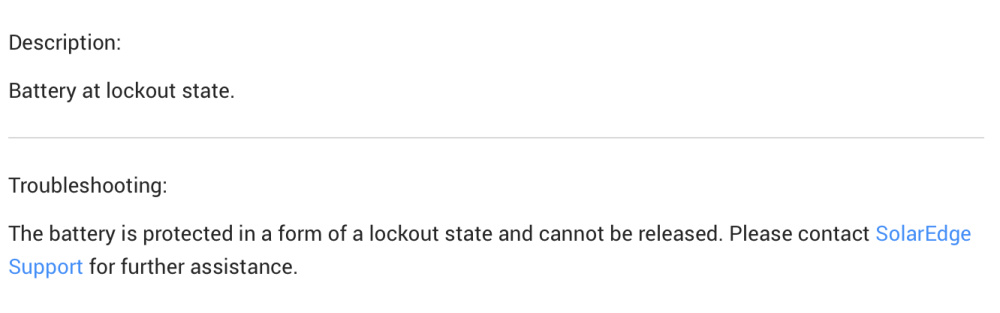
No software update for at least 6 months before generation stopped but when I went to troubleshoot you have to install the latest update. SetApp forces you to do so when you try to connect to the inverter. The issue was related to our battery, my guess is they have some sort of quite sensitive lockout mode as their Energy Bank is a newish device and they'd rather inconvenience customers than potentially get in trouble with grid operators. It came up as a priority 9 (highest) alert and the alert made it very clear the only way to clear it was to contact support. Interestingly it didn't just lock out the battery it also stopped all generation. I'd much rather have access to troubleshoot myself than have to beg someone else to make the changes to their backend I need made. Solar is about self sufficiency not dependance. @elite No specific fault code, just a generic message like below:
-
Just started a self-build in Dorset. Exciting times!
NailBiter replied to NailBiter's topic in Introduce Yourself
The Nudura at least flat packs (folds down) and is reasonably light. It probably isn't as ecofriendly as a mineralised wood product like Durisol or Ecobrix but a large part of the "issue" with ICF houses is going to be the concrete itself. We got a quote from MBC for the ground floor and 1st floor (lower ground is below grade so would have been ICF in either case) and it was high. I've not had the full comparative quote for ICF through yet as we have had to do additional ground surveys (now complete!) and redesign the lower ground floor. I will post a comparison once I have the data. -
I have full SetApp access (I installed it with a friend). I also have an RS485 USB adapter plugged in so I have full access to all the Modbus registers. There was nothing I could do about the lock out, it told me to contact support and they had to connect remotely to the inverter. I did try and push the tech to tell me what they had done but even as an installer they wouldn't tell me. There is obviously some kind of lock that can be applied without internet connection and only fixed by them. I'm not comfortable with that being possible.
-
You don't need to go down the Home Assistant route to run an overlay network. It is no more complicated than NordVPN Mesh (which also looks like a good solution, e2e encrypted so you should be ok but I'd rather trust my own code). I linked to OpenHome instead of Home Assistant directly because their ideas of how an Open Home should work are technology agnostic, simple things like having local and complete access over devices that may be running for decades vs being reliant on a cloud. Thanks for taking the time to respond, I really appreciate all info about which providers are doing what. I'll try and compile a list.
-
Sorry I seem to have had some trouble replying. The main issue for us was the fact we had to put the inverter back on the public internet to allow SolarEdge to apply their fix. There must have been some code in the inverter that could trigger it into lock down mode even if it wasn't connected. With something as important as solar, especially as it pertains to self sufficiency I don't want a killswitch I can't reset.
-
No worries I run an overlay network for all of our devices (worth setting up, can help if you need). Similar to TailScale but not it. Huge difference between me having remote access and anyone the company wants having remote access. I try and follow best practices from here where I can: https://building.open-home.io
-
@Bramco I appreciate the reply cheers. Do you happen to know if it required syncing over the internet / with any cloud during activation? I'd rather stop the cloudy tentacles from the get go vs having to try and extricate them.
-
There might be quieter VAWTs available soon(TM)
-
I've previously been using quite a lot of SolarEdge stuff but I'd rather not be forced to use their cloud. We recently had a device (unrelated to solar) trip the power a few times and our battery refused to keep working. It ended up needing to be reset by SolarEdge from their end as it was in some sort of lockout mode. Fortunately it wasn't a tricky process but I dislike not having root on my own equipment / poking holes in my firewall. Are there any inverter manufacturers where you can selfhost the control plane locally?