Spinny
-
Posts
793 -
Joined
-
Last visited
-
Days Won
1
Everything posted by Spinny
-
Comparing Thermals of Laminate Flooring Underlays
Spinny replied to MortarThePoint's topic in Wood & Laminate Flooring
That has always been my worry, but I cannot for the life of me find any way to find a good tradesperson. Internet reviews are meaningless and often fixed and fictitious. Recommendations are dodgy because often the customer just doesn't know the difference between good and bad - or else they are doing a favour recommending their cousins boyfriend. I have tried highly rated on checkatrade and they say they will come but never do. I have had 7 plumbers, 3 have done incompetent things, 2 never quoted, and 1 buggered off for 3 months immediately after starting work, and 1 blocked my mobile because I called him twice in 3 weeks enquiring after my quote. -
Comparing Thermals of Laminate Flooring Underlays
Spinny replied to MortarThePoint's topic in Wood & Laminate Flooring
A painter with a wall sander ? How does that work ? Is he sanding imperfections in the plaster ? How do you find a painter and decorator that diligent ? -
I have already drilled a 20mm hole in position for an outside tap. I need to drill it out to 35mm to take the Frosti tap I have bought. I cannot seem to find a 35mm Masonry drill bit that does not have an SDS fitting (it needs to be over 300mm long). I don't own an SDS drill. Can I buy a converter somewhere so I can fit an SDS ended drill bit to my standard hammer/non-hammer (non-SDS drill). I see hundreds of adapters to fit a standard non-SDS ended drill bit into an SDS drill, but am yet to find one the other way around. (PS I only need to drill one hole. I have already drilled through the two concrete block leafs at 20mm with no problem using my non-SDS drill at 20mm. So answers that say 'buy an SDS drill' are not helpful to me.)
-
Builder put 'rockwool' below DPC, I am in flood zone. Fixes or thoughts?
Spinny replied to boxrick's topic in Heat Insulation
I think you need to talk to the architect. This an unauthorised deviation. Consideration needs to be given to the possible options to remedy the situation. Replacing it would be one, but there may be other options, the obvious one being to up specify the external waterproofing so that water cannot get into the cavity. (presumably the flood waters don't reach the DPC height) I only have experience of one extension build so am biased by that, but I'd say you cannot trust builders or tradespeople, you have to start by assuming that everything has to be checked until they show that to be unnecessary by their own conscientious actions. Builders don't necessarily even read the architects spec. The problem with building is that once a mistake is missed when it occurs it becomes very costly to put right later. -
Include windows in an invitation to tender?
Spinny replied to DaveKF's topic in New House & Self Build Design
If you are plastering then a possible dividing point is the 'mist coat'. i.e. have the builder plaster and apply a mist coat to the plaster. A builder will assume anything not specified is basic and cheapest available. So specify e.g. skirting, architrave, coving, internal doors, hinges, handles etc. - MDF, timber, pine, oak ? Builders may just produce a quote with 'Estimate Only' for some sections or items. For example plumbing, or electrical work. You may need to insist they provide a broken down quote from their plumber or electrician against your defined specification. We had builders give an estimate only figure which was half the actual cost when it was quoted - good trick to make a quote look cheaper - but not what a customer wants. Our architect put provisional sums into the SoW where the spec was undefined. Also Provisional items are things to be quoted but you may decide to drop from the contract (e.g. to save cost). Don't forget once you sign with a builder and he is part way into the job, it will be too late to argue with him if you want an extra and he quotes you an exorbitant price for that extra. (PS We were only doing an extension not new build.) -
Include windows in an invitation to tender?
Spinny replied to DaveKF's topic in New House & Self Build Design
We chose our own window, door, and rooflight suppliers. (I honestly expected much more input from the architect which was disappointing because you have to do all your own research and legwork and visits to see them in the flesh). We included them with their quoted prices in the building tender. However a builder will add 10% (plus VAT if applicable) on the price straight off, and will also charge for delivery, fitting etc. At the very last moment our builder suddenly took them out of his price. I have been told this occurs quite commonly because ordering custom size/spec doors and windows most often requires a very large deposit or even full payment with order - and delivery/install can be many months later. This then represents a large negative cash flow for the builder. He left the rooflights in, but we had to take them out too when he was completely failing to prepare an order in time for them to be on site at the right time. I had to work out the sizing including heights w.r.t. the roof slope/furring myself, and order the rooflights and matching upstands directly myself. We had the doors, bifolds and windows fitted by the suppliers. Seems the best way to me albeit you need the openings prepared before they can come to site to measure. Then they produce drawings for your agreement, then make to the drawings, then come and fit them. Means you are not dependent on a possibly dodgy builder not fitting them very well, it isn't your fault if they don't fit, you get a guarantee from the supplier/fitter, and if the builder has screwed up the opening they will call it out when they come to site - arguably you can charge the builder for a failed fitting. Our builder screwed up the bifold opening. There can be a LOT more to ordering the doors, bifolds, windows, and rooflights than you might think or expect. Lots of options these days - RAL colour, Matt/Satin/Gloss, handle colour, handle style, type of lock, opening direction, opening side, hinge colour, height vs FFL, trickle vents, style of frame, sightline on bifolds, type of glazing unit, cill ?, cill type, cill size, internal blinds ?, blind colour, corded ? And then you have to think about where you want the plaster line to be on the frame and how that might match with other adjacent windows. Is your builder (who won't live with the end result) going to carefully consider all that stuff ? A lot may depend on your budget, but often fenestration is a big part of design/look these days. -
Nice little tip someone gave me for running hidden wiring for a video doorbell - run the cable up the post by taking the stop bead off and hiding the cable within the stop bead.
-
Flat Roof with Parapet detail - correct fall
Spinny replied to Ay8452's topic in Roofing, Tiling & Slating
You could use a large cricket between the roof outlets to push flow outwards towards them. (You can google flat roof cricket) We have 3 rooflights and one is a long one against the wall so the wall below continues seamlessly up into it. The architect omitted to design any detail behind the roof light so we do get some ponding behind it when it is very wet. I realised their mistake only after the firing strips had been done and too late to organise any insulation crickets made from PIR to go under the membrane. Tis another of the gotchas you only learn from experience. Like putting your lighting plan up against the structural engineers beam and joist plan before you find you cannot put lights where you wanted them. -
Looking at 240V motors, really don't fancy rechargeable and have put in the cables now. One blind company has said each blind should have it's own fused spur ? This seems a bit OTT to me especially for 3 blinds above a bifold needing 3 fused spurs. Each one only seems to draw 100W or so. Told blind motors need to be powered up individually for set-up, but surely that could be achieved by just disconnecting the other motors ? (Or adding an inline switch in the blind box.) Can anyone comment ? @Mattg4321 @garrymartin @Andehh @CalvinHobbes @nod Anyone
-
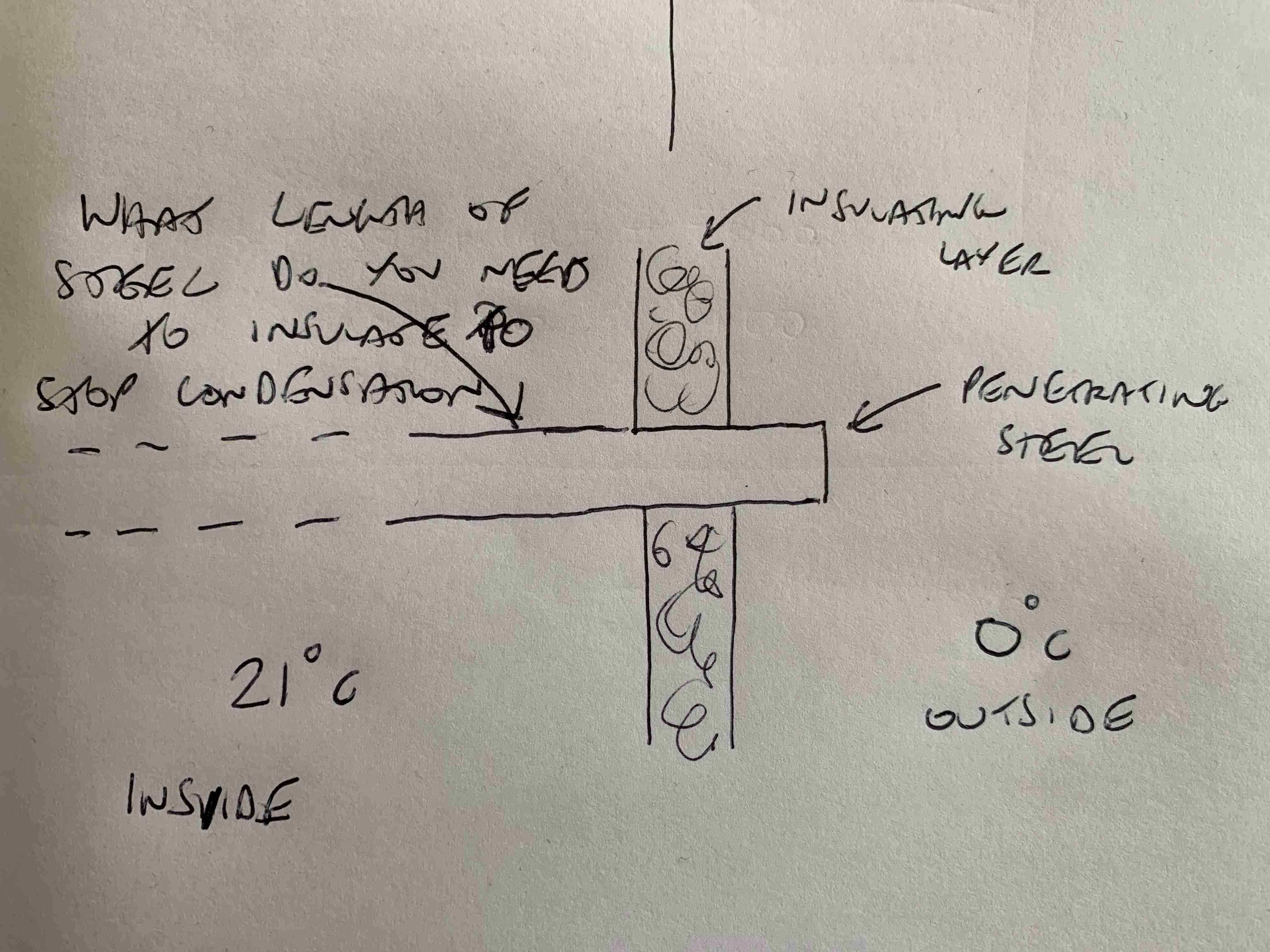
I am aware of aerogel as had it specified by the architect in the form of aerogel wallboard. Ironically for the same type of issue in the vary same room. Alongside the steels over the wall opening I also have a 1m piece of wall. This is a continuation of the outside wall of the house where the warm roof on the side extension abuts this wall. So again above the roof the wall is external, but below the roof it is internal. The architect said this wall must therefore be insulated and as I wanted the thinnest possible option came up with aerogel wallboard which has been installed. I have come across this one https://steelconstruction.info/images/5/53/SCI_P380.pdf which includes section 1.7 on condensation. This type of detail - steels to create an opening in an outer wall, must be so so common. So I am a bit dismayed there isn't a clear practical solution in common use. At this rate I am going to have to pay the architect exorbitant amounts to give me an answer. What the hell does everyone do ? (I am sure they are not commonly buying aerogel to install in every knock through extension).
-
OK. So If I have a 10M beam, and 9.5m of that beam are within a heated building at 21C and 0.5m of that beam is outside at 0C, what is the temperature of the steel beam ? Won't the internal innermost end of the beam be at 21C and immune to condensation. Meanwhile the outside end of the steel is at some temperature below 21C and above 0C and is radiating heat into the outside air. Bad for heat loss, but... How much of the internal steel must be insulated to protect it from condensation ? 10mm, 100mm, 1000mm 10000mm ? (The more length of the beam you insulate internally the colder the beam will get.)
-
OK. However in this case it is impossible to get continuity of insulation. Because the steels are bolted together and support outer leaf and inner leaf they will always be a thermal bridge (save removing them and inserting insulation above them - which isnt happening). Insulating the steels moves the bridging point but cannot eliminate it. Taking the case of say a steel which penetrates the insulation layer - what do you do ? You cannot separate the steel internally from the rest of the structure across its entire perimeter and length. You can insulate the steel close to the penetration, but at what point can you stop ? What is the temperature gradient in a steel beam ? If I put a bag of frozen peas on top of a steel in a warm room how much of the steel gets significantly colder than the room ? (I agree the thermal bridge is wicking heat out of the building. However given that can't be completely stopped, the other question is how can condensation be avoided ? If the room is 21C what temperature surface will it condense onto, and will the steel reach that temperature ?)
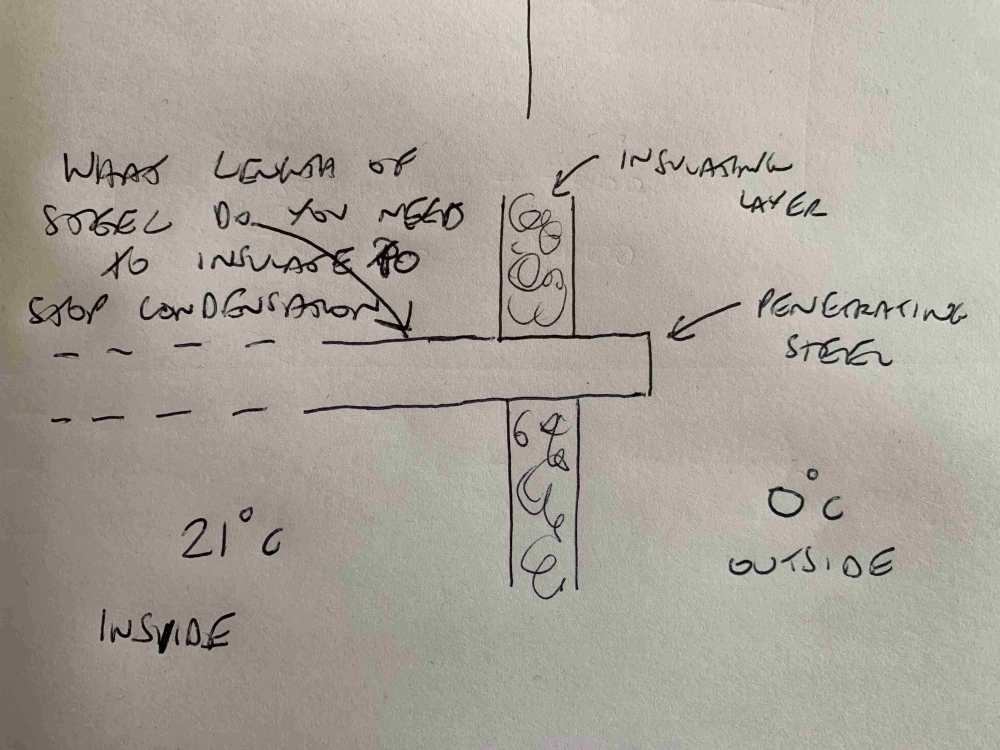
-
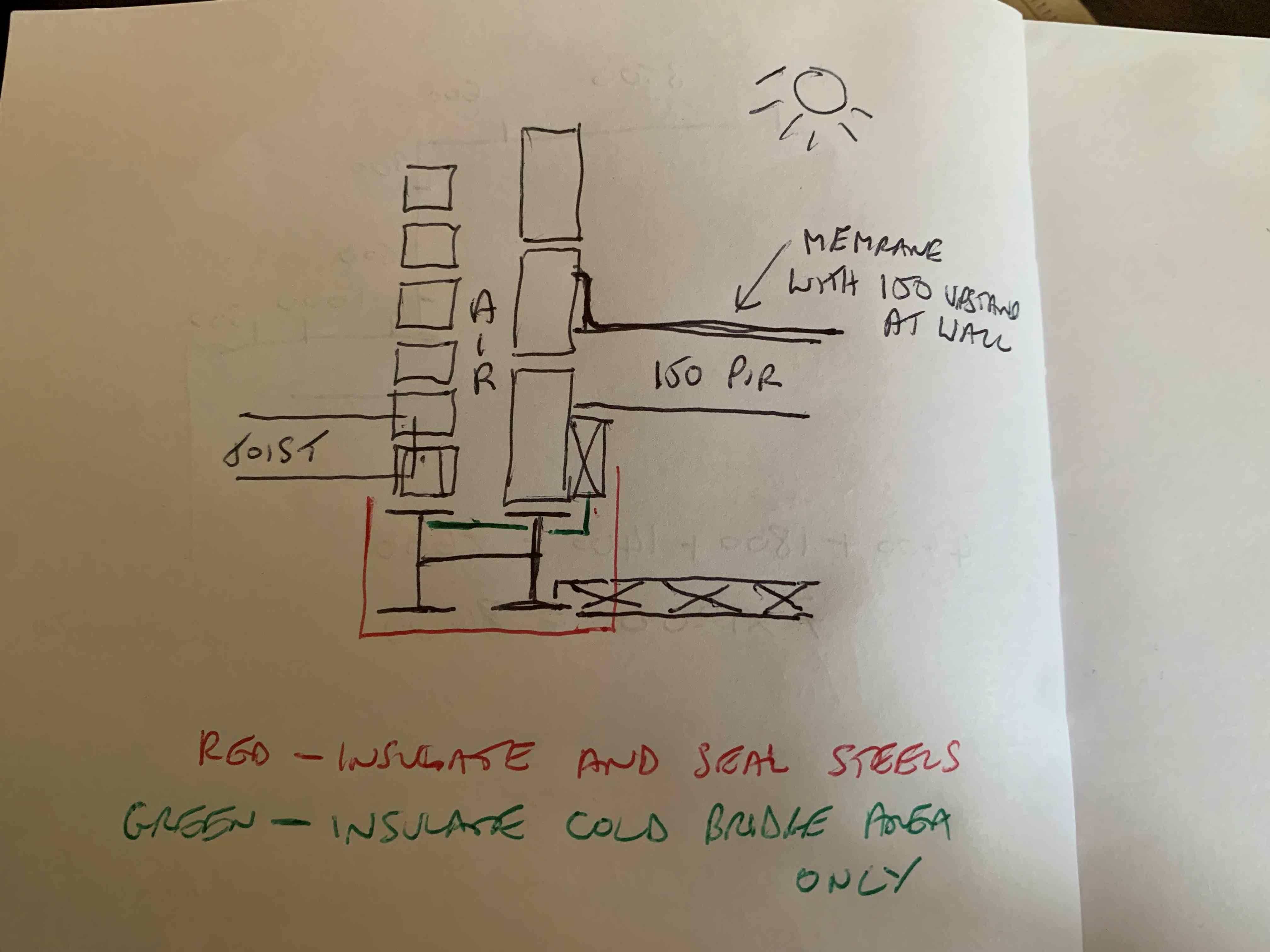
Thanks @JohnMo I really don't want to put 25mm PIR under the steels because (a) it will further reduce the already lowered ceiling height and (b) ceiling has already been battened into the steel level with the bottom of the steel ready to board up. I could put some insulating plasterboard under the steel and across the whole ceiling but it will have downlight holes and has to be fireboard under the steels. I guess the question is should the steels be treated as in the warm zone or the cold zone ? They are really in the internal warm zone of the ceiling void but just happen to have something of a cold bridge acting on one face. Whatever I do the steels are a cold bridge because they are bolted together. I either put them mostly in the warm zone, or insulate all around them putting them mostly in the cold zone. In this video the steel is on the inner leaf but has a cold bridge plate to the outside, but the answer is just to insulate the steel close to the cold bridge... https://youtu.be/1-qJc2BaXo0?feature=shared Is there some way to estimate the temperature the steel would reach ? (PS Does warm moist air percolate through rockwool and would it still condense on the steel - unless adding a vapour barrier too?)
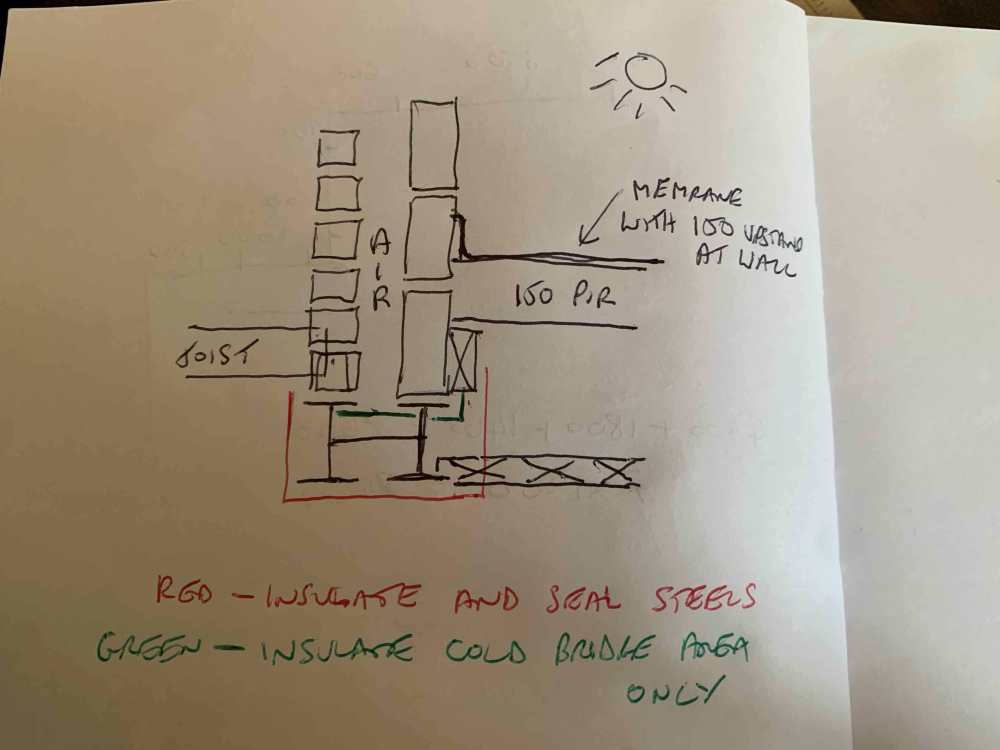
-
Running Cables down a corner
Spinny replied to Spinny's topic in Networks, AV, Security & Automation
@crispy_wafer Yes thinking along those lines. The walls are going to be wet plastered and NOT dot & dab. Wondering if I could put some shallow trunking down the narrow recess wall and then get the plasterer to thicken up the plaster on that recess wall. (Annoyingly there is a steel beam above (and a steel column inside the wall) - will have to run the cables around the steel. -
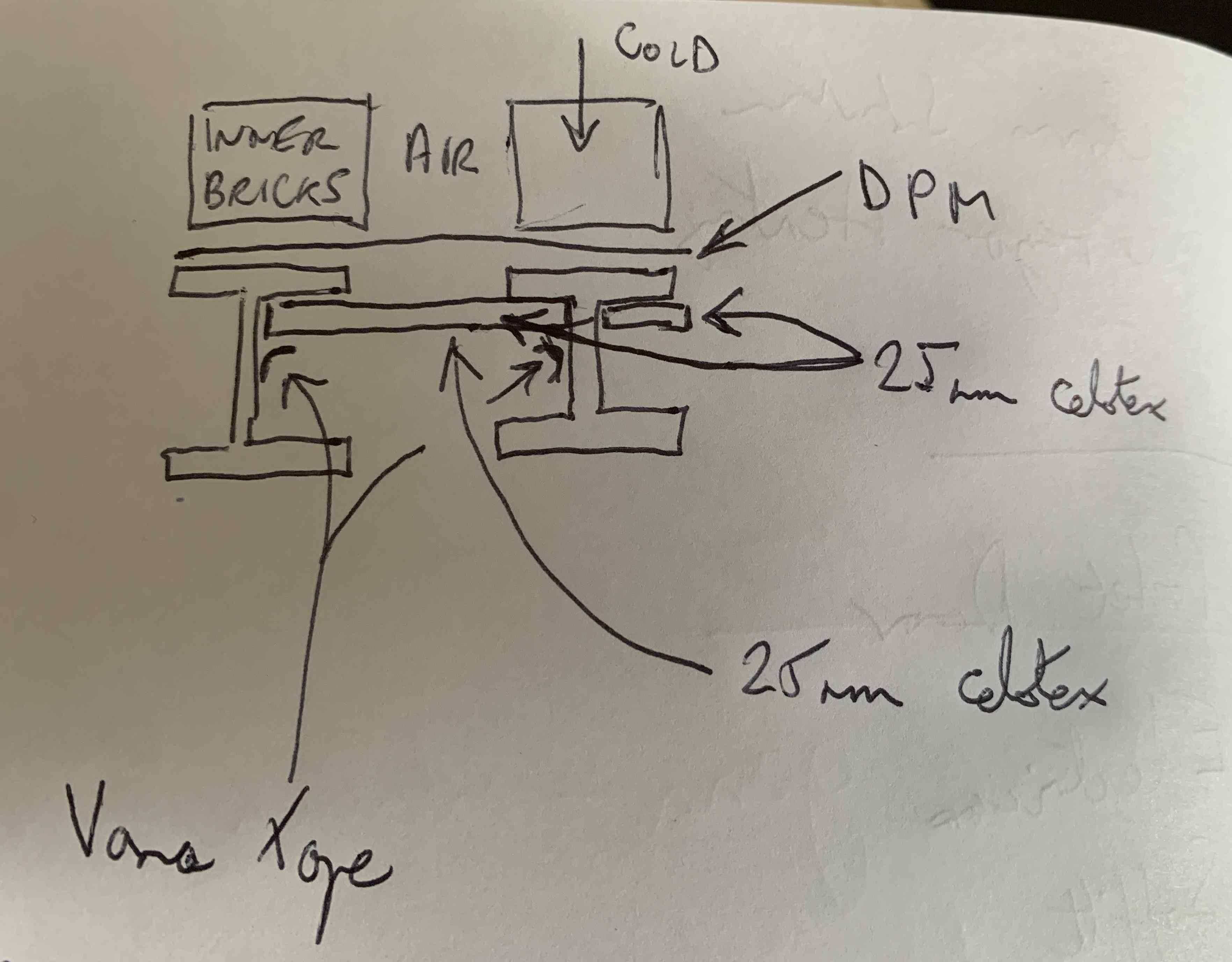
Starting down this route in the sketch - 25mm PIR taped to the top flange of the steel. The idea being to stop the potentially cold DPM between the steels acting as a possible condensation point. Insulate the cold top flange of the outermost steel to stop it being a condensation point. Stop air in the cavity above the steels mixing with warm air in the ceiling void. Is this any good or am I going wrong ?
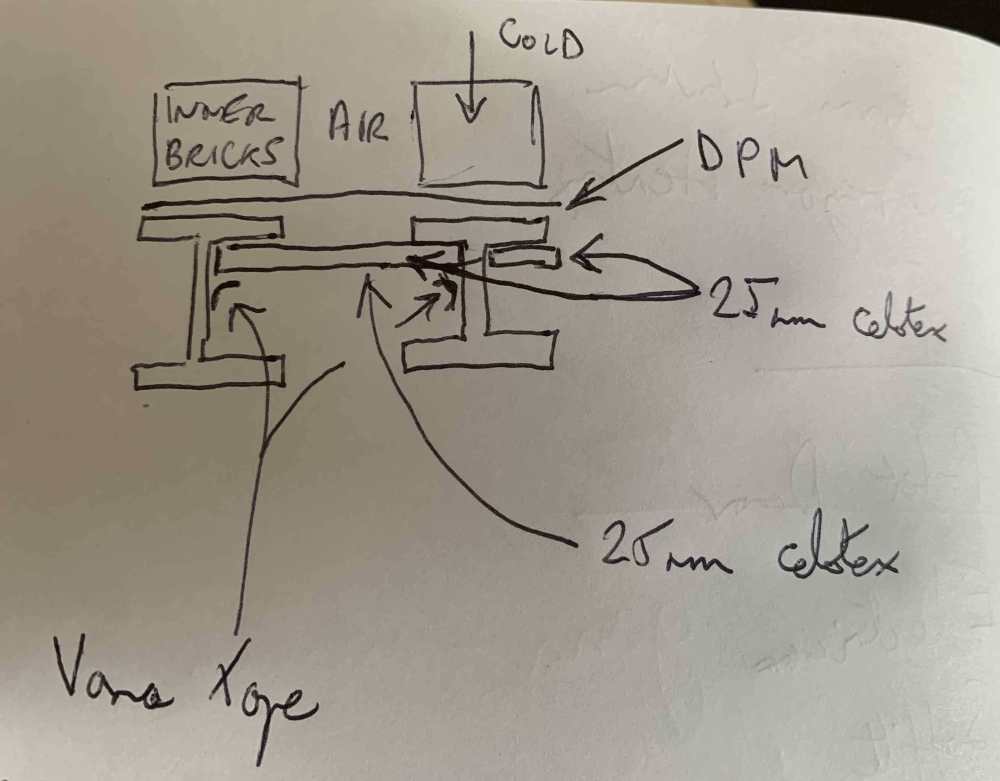
-
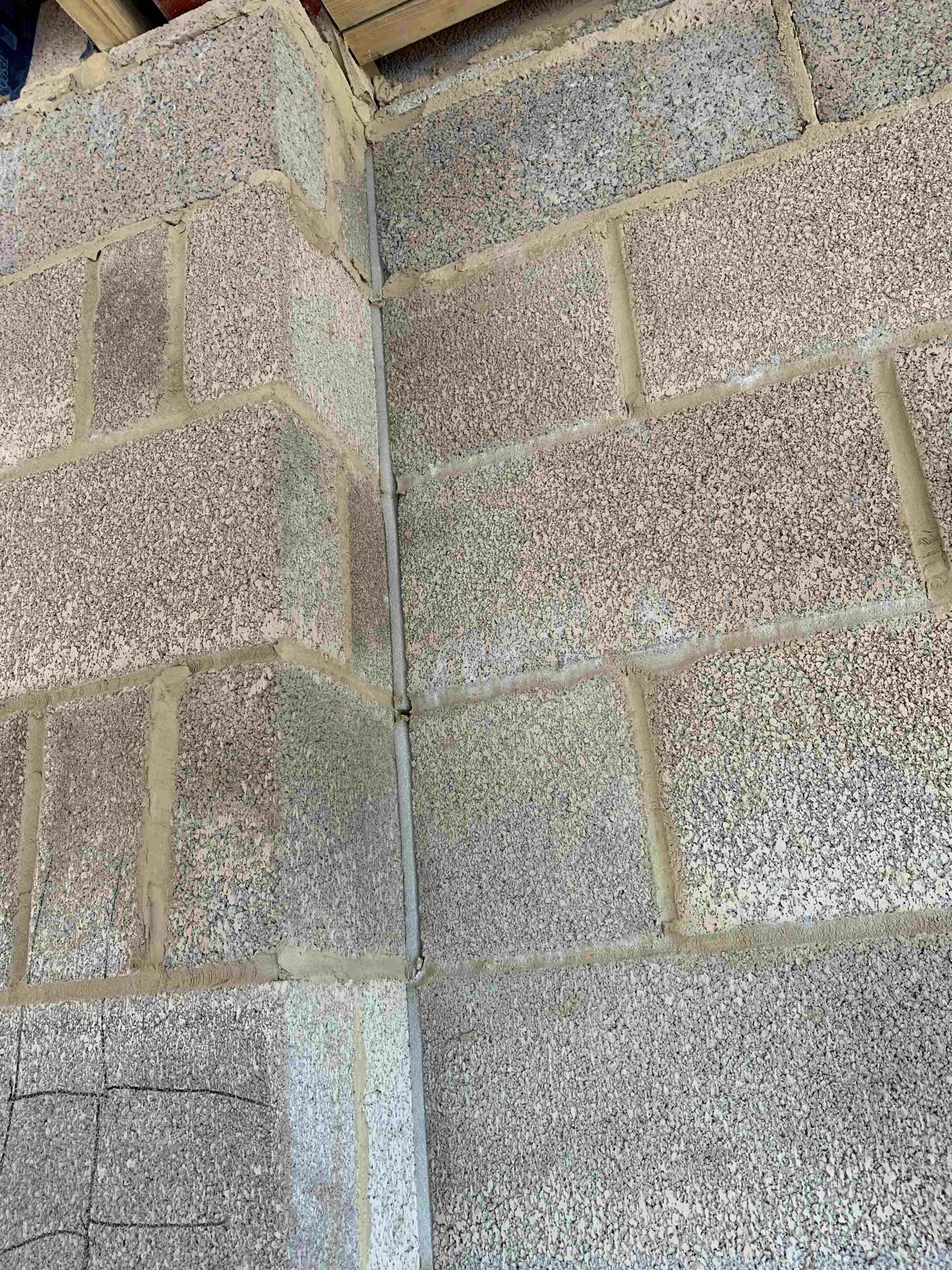
Concerned about the size of my TV conduit, so contemplating running some cables down from the ceiling in this corner - maybe speaker cables or a network cable. There is a movement joint in the wall there - I guess I am not supposed to run any cables in the edge of the joint ? (It hasn't moved in the 2.5 years it has been up) Might fit a wall cupboard or a shelf into the corner - not sure what the best position would be really for cables - tight to the corner ? - or middle of the short recess wall ? Think I need to run the following 15m to the TV... 1 off directional HDMI optical cable 2 off Cat 6 network cable (one as a spare) 3 off speaker cables (right, left and centre channel) Coax aerial cable Digital optical audio cable Samsung OneConnect optical cable ? (looks like the ends don't come off, so would have to go through the conduit on its own first.) ??
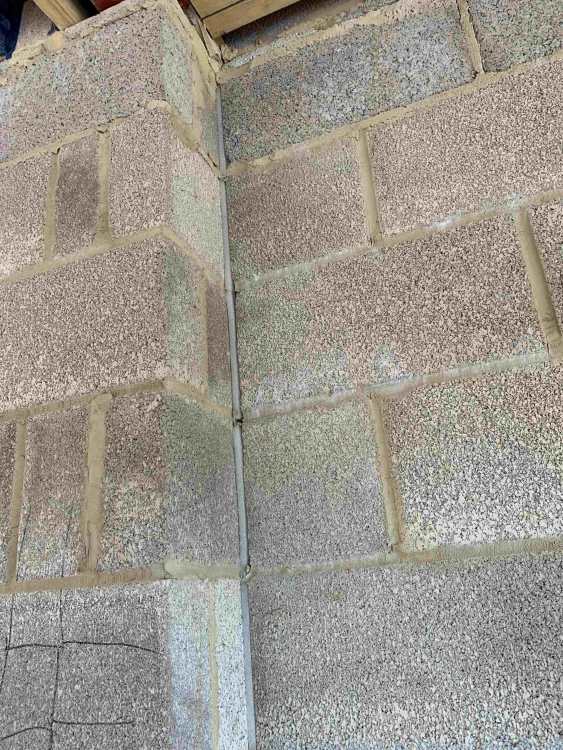
-
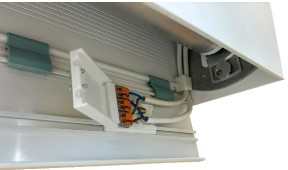
I have this question/problem too. Sparky has run one cable from the consumer unit to feed 3 blinds. Now been told that configuring somfy 240V smart roller blind motors has to be done one at a time, and that I should have fused spurs from a cupboard somewhere. Well i don't have a nearby cupboard within 6m. My blinds are going into a blind box. Is there not some simple and compact 240V push fit in line connector that could be used for each blind to allow disconnection ? Seem to be plenty of inline fused connectors for low voltage car wiring etc - are there any for 240V ?
-
It is for a 1930's staircase. Just replacing an existing joist that has twisted and warped out of shape. (Now I know why the builder's carpenter force fitted it back in) Something has happened to timber sizes since the 1930's. e.g. 1 inch PAR was 21.5mm then, now it is 20.5mm etc etc Funny how everything gets smaller and how it gets harder and harder to find anything ''non-standard''. There are millions of 30's houses with 32 inch doors but often doors can be not available in that size - not off the shelf - ditto door lining kits. Chances of me getting a straight cut with a hand saw and labouring away trying to cut down the grain - no thanks. Can have a go with the jig saw if I must. Things that used to be so simple - time to bury me deep I suppose.
-
A local Jewson had a big sign on their fence saying 'We Cut Wood', when I went in they told me no the saw mill had been shutdown and was being removed. The nearest one that could cut anything was 25 miles away, they only had a band saw, and only one guy was trained to use it, and he was part time and reluctant. They told me cutting wood was too dangerous ! Can't think of any independent merchants left in my area. The odd couple just supply stuff, don't have any cutting facility. There are places that can cut sheet material to size but will not cut down timber. Everything has gone internet. I take your point about cheap tools but unless you are a well equipped carpenter with the space to set up indoors and accurately set measurements to the mm ? And with the exorbitant cost of labour ? You would think it would make more sense to have a central sawmill with highly accurate, high speed/volume, fixed cutting machines and plenty of on-site wood supplies. Who has got the capability to ferry around 3m and longer stock timbers to get them cut- some tradies - not the great unwashed public/DIYer.
-
Finding this frustrating. Must be over 20 years ago when I last wanted timber cut to size. All I had to do was go down to a local merchant (now a Travis Perkins) with measurements or even just a sample of architrave. A man would happily cut your timber to size or run off any length of architrave or skirting of any size you might want. Often practically while you waited. Never seemed to cost all that much and always seemed to be spot on. All the timber was stored horizontally. Now I can't find anywhere that will cut small quantities of timber to size. At the moment all I want is one metre of joist cut to size to fix a step in my staircase. Finished size means I need a 47mm by 195mm cut down to 177mm. Found one place a 30minute drive away but only has a band saw and they cannot be certain of an accurate cut. There are some internet providers but they seem to provide ''on view'' timber cut to size but not treated joist timber. Plus the delivery charge makes a small amount very expensive. What has gone wrong with the world, where am I supposed to get small domestic timber requirements cut to size ?
-
I agree they look nice and are de rigueur in Bathroom shops. Think you can also get ones with display screens in them. Never actually had one or used one so can't help. In stores I have often felt the led light surround didn't light up your face as brightly as wall lights above or to the side. (Possibly a blessing at my age). Can't comment on your ebay source.
-
Anymore on insulating this - see sketch above ?
-
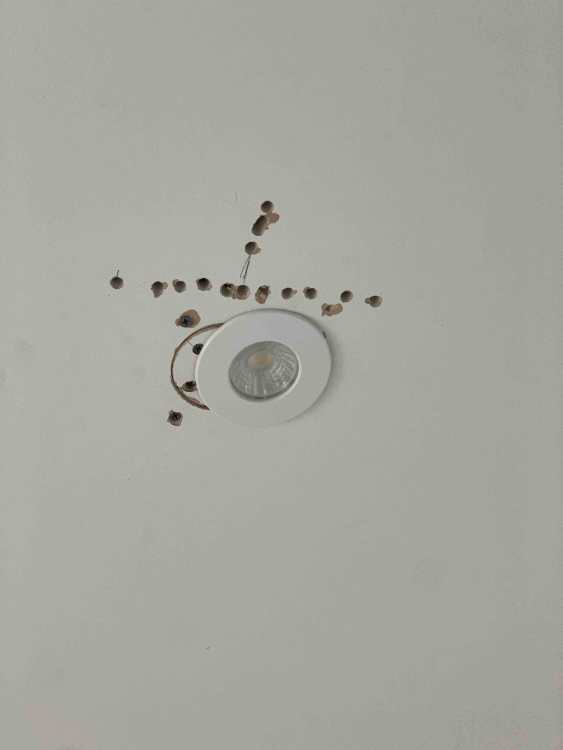
I ain't no pro. I am an innocent lost in a building maze trying to find the way out. Lintels over doors and windows usually project about 150mm beyond the opening itself, so going say 200mm away is likely to be ok. But if you did hit a lintel you would notice and stop. Gently drilling a small hole with a drill could be used to see if a given point is clear of the lintel. Just worth checking joists - take a floor board up upstairs ? or use a screw detector to look for plasterboard screws into the joist, or tap the ceiling to see where it is and isn't hollow, or do like my sparky in the photo and drill baby drill. If the joists run the other way you should be OK anyway.
-
Structurally you would want to check which way the joists run in the ceiling above and where they are positioned. If there is a joist running across the room with the end bedded into and supported by the wall that has the window in it, and the joist is above the hole you plan to make, you might end up cutting out masonry supporting the end of the joist. Also look for any electrical sockets or switches etc which might be vertically below your planned hole, as sometimes electrical cabling can be run vertically down the wall behind the plaster to feed the electrical point or switch.
-
Insulated tile backer boards and thermalite wall
Spinny replied to tommyleestaples's topic in Wall Tiles & Tiling
Can these boards be used outside ? I have mentioned elsewhere I need to put 25mm XPS insulation against the outside blockwork under my bifolds to about 500-600mm underground to compensate for a problem with the internal upstand insulation. I noticed Fastwarm do a 30mm XPS sheet https://www.fastwarm.com/fastwarm-30mm-xps-insulation-boards-11115-p.asp But when I spoke to them about it they suggested using tile backer board... https://www.fastwarm.com/fastwarm-30mm-tile-backer-insulation-board-11095-p.asp