
D Walter
-
Posts
116 -
Joined
-
Last visited
Everything posted by D Walter
-
Thermal Store with PVs and underfloor heating
D Walter replied to D Walter's topic in Boilers & Hot Water Tanks
Thanks ProDave. Using an unvented cylinder would presumably mean not utilising the PV for UFH (i.e. running UFH directly off the gas boiler), which would probably happen anyway as UFH would only be required in winter when PV is at low output. One of my local PV installers is trying to persuade us to go electric only with a supplier like Green Energy or Octupus who do c. 5p per unit off peak, with a Thermal Store and a Tesla PowerWall on the basis that we can easily install an 8kW PV system. It all loooks very expensive, complicated and possibly "bleeding edge" technology so we will probably go for the tried and tested UVC as you suggest. I would feel more comfortable exploring the more complicated options if I could find a consultant (not a salesman) who understands the technology and practicalities of installation and management who could also do a cost benefit anlysis. -
Advice would be most welcome on use of PVs to provide hot water and underfloor heating. We are installing a 6.5kW PV system in addition to a gas boiler and are beginning to look at the systems available. We have 4 bedrooms, 3 showers (one of which is a bath) and wet underfloor heating in concrete flooring. Our assumption is that the primary benefit we will get from the PVs is water heating, until such time as battery technology is affordable, but our hot water usage will be modest except when we have guests. Ideally, we would want to have the option to run both hot running water and underfloor heating from the PVs. We are looking at 300 litre Thermal Stores with 6/9kW immersion heaters which should be able to do what we want but would really like any thoughts on: whether we are on the right track; Thermal Stores (thus far I have looked at Advance Appliances Energymanager Sealed System and McDonald Water Storage Thermflow 300); control systems for managing the overall system. Thanks in advance.
-
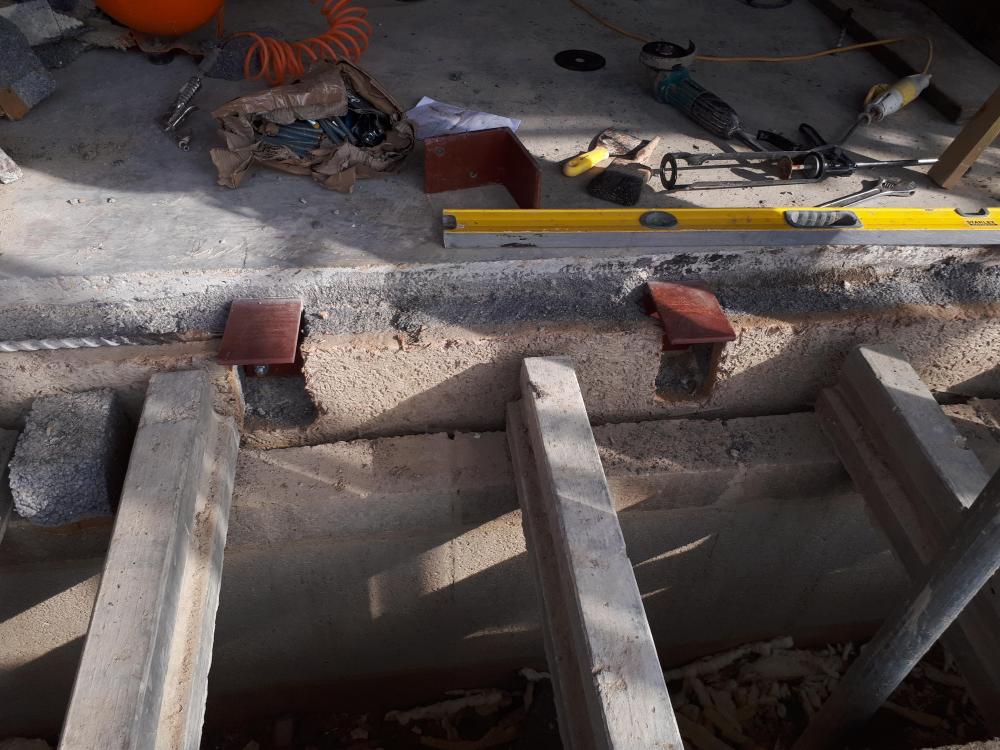
Hi, one of the issues which has arisen with our Velox build is how to support the weight of the large triple glazed windows. I assume that this is an issue with most ICF builds. The window frame is approximately 100mm deep. At first floor level the window frame sits approximately 15mm in from the exterior 35mm Velox panel. This means that it is resting entirely above the 180mm of exterior EPS insulation. The attached picture shows the "angle" we are using at ground floor level (where there is only 80mm of EPS to ground FFL) to support the window frames, bolted through into the concrete floor. I would be interested to hear what solutions other people have used in ICF builds.
-
I would echo Humpty Dumptys comments on using Velox. It is a bit agricultural, hard on tools and heavy to lift/shit. Chasing for services is much harder work than with EPS formwork. Lots of care needed to keep everything plumb and we screwed small plywood squares over every intersection of three Velox boards prior to pouring to keep all joints aligned. The end result is incredibly solid with good fixability internally and externally, good for plastering and good sound insulation. We had minimal issues with Velox boards bowing and expanding but we had pretty much perfect weather for building.
-
For inside we looked at 1) traditional plastering; 2) parex spray plastering; and 3) "glueing and screwing" plasterboard with skim coat, on our interior Velox walls. We are going with the "glueing and screwing" but to avoid any air gap behind the plasterboard I am going to cut off every wire tie on the inside walls as they are approx 5mm in depth.
-
Contrary to what I said above, although still on the Velox website, the Velox multi-layer partition product is NOT available, at least not in the UK.
-
When I talked to Russwood about a year ago I said that my assumption was that the treatment did not extend the life of the wood and I was told that SiOO:X also acted as a preservative. One point people should bear in mind with Accoya, Larch, Cedar and other timbers with an acid PH is that, particularly in damp conditions, the secretions from the timber can attack certain metals, particularly if there is a galvanic coating. This can impact not just fixings but also metal cladding and metalwork structures like galvanised balconies.
-
Hi Russell, I have no technical knowledge on this but we are using closed cell spray foam as our topmost insulation layer in a ventilated build up under a metal (Tata) roof. One of the reasons we decided to use foam is to assist in getting an airtight seal around the roof plate as we will have an MVHR system. Airtightness seems to be one of the main reasons closed cell spray foam is so popular in new builds. We did use a breather membrane above the rafters (under the battens) partly because you need something to spray against from underneath and OSB is not acceptable from a condensation calcs perspective. BASF can provide some evidence by way of test results that the heat from the spray foam will not damage the breather membrane (I think the test results are for open cell foam but they say the heat impact is equivalent). I wanted to spray against PIR fixed above the rafters (not foil backed) but, illogically to my mind, this threw out the conensation calcs. I believe there is an argument that you would not need a VCL under closed cell spray foam insulation but BASF does say the foam will allow vapour transfer, albeit at a very slow rate. One point to note is that it is easier to spray thinner layers of insulation (we are using 154mm) rather than the thicker layer we would need to achieve our target U values. Spray foam is also more expensive than most alternatives. Accordingly, we are going to have semi rigid batts under the spray foam and PIR under the rafters, with a VCL under that.
-
I also understood that SiOO:X acted as a preservative.
-
I don't know Vulcan or Teckwood. Bear in mind that Vivix Lap is only "lap" or "weatherboard" at this stage and not "flush", though they say they are bringing out a flush product in the middle of the year but they may have issues with patents etc..
-
One correction, the Vivix Lap Formica product is significantly cheaper than I thought at £50+ per sq metre.
-
Hi Canalsiderenovation. The TrespaPura and Vivixlap products which are basically printed formica give a very realistic wood look from a distance in various colours including greys, browns and red-browns as you have what is basically a printed photo of wood. They are expensive at £100+ per sq metre. The surface is formica smooth which will be good for cleaning but will mean it looks less like real wood the closer you get to it. These products carry a 10 year guarantee and will resist but not prevent bleaching. The extruded/pultruded upvc and other composites are much cheaper, carry similar warranties and again come in greys, browns and red/browns and are around £30-40 per sq metre depending on quantity and supplier. Some have a shiny surface and some a roughned matt surface. If you look at any campsite with chalets you will see numerous examples of these materials. I have not seen any of the shiny surfaced variety or indeed any of the brown or red/brown examples which look anything other than plastic, either close to or from a distance. I much prefer the look of the grey samples, particularly the roughened matt ones which do not appear to be imitating wood. If like me, you are looking for a synthetic alternative to wood which will contrast with the grey theme of the rest of the house it is not good news. As for quality, I could not see much to choose between the Dura Composites, the Specialised Timber and the Envirobuild products, all of which look good to me.
-
Thanks to everyone for your responses. With softened and raw supplies to the kitchen I can keep my options open and change later if I am unhappy with my original choice. It was really helpful a) to hear that servicing the Quooker is so simple; and b) that the alternative limescale filters basically do the same job as the whole house water softener. I will probably start with softened water to the Quooker and a separate raw cold water drinking tap.
-
Hi, I would like to pick your collective brains on water softeners and use with instant boiling water taps. We are on the Isle of Wight with "hard" water (107 Ca mg/l) and are looking to install either a Harveys or Kinetico softener. We are also looking at the Quooker Flex Pro3 instant boiling water tap which provides a mixer function from the hot water cylinder and cold mains and an instant boiling water function from a 3 litre vaccum tank, again fed from the cold mains. We are plumbing the kitchen with (i) unsoftened cold mains water, (ii) softened cold mains water; and (iii) softened hot water from the HW cylinder. We therefore have the option of feeding the Quooker cold supply from: a) softened or b) unsoftened ("raw") cold water mains. If we use softened mains our cooking and tea/coffee would be from fully softened water which may not be ideal from a taste/mineral content perspective. If we use raw water we run the risk of the Quooker scaling which will neccessitate an annual service. Quooker does sell a water softener kit (£245) with a bi-annually replaceable filter (£50 each) but that is prohibitive and goes against the grain if we are softening the mains water anyway. Quooker states: "The Scale Control has been developed to lengthen the lifespan of your Quooker by reducing the water hardness. It is the most reliable descaling solution for the Quooker and improves the taste of the Quooker water. The Scale Control works with an high-capacity ion exchange cartridge (2750 litres at 10°dH) that can easily be replaced at the end of its lifespan." From this it looks like the hardnes is reduced to the point that scaling does not occur but presumably does not have the same impact as the mains water softener. Incidentially, they also sell a water filter kit at similar price. We do have the option of having a separate cold water tap, possibly with its own filter, for drinking water and we could use that with a kettle for tea and coffee but that largely negates the point of the Quooker. Another possibility is to install an alternative water filter between the raw water feed and the Quooker which reduces limescale and deals with other contaminants. An example of this is the Osmio EzfitPro 300 https://www.osmiowater.co.uk/watts-ezfitpro-ii-ultracarb-and-fluoride-water-filter-system.html. This system costs £119 and contains a limescale and chlorine filter and a separate Active Ceramic filter with an combined annual filter cost of approximately £90. I would welcome any advice/experience and any thoughts on alternative instant hot water solutions. Thanks David
-
Hi Mr Punter and thanks for the vote of confidence. I will put together a blog but have been mostly responding to questions on Velox/ICF so far. I do have a main contractor (a friend who is a carpenter by trade and his brother who is the brickie) and all trades and materials are run through their company. I do most of the research into the non-standard components such as ICF, metal roofing, metal and timber/composite cladding, MVHR, balustrading, windows, composite mesh decking etc..etc... and only get my hands dirty when emergency labour is required. I also do most of the liaison with architect (very little), structural engineers (lots but thankfully now finished) and steel fabricators (lots at the moment). My builders have been brilliant with real attention to detail and regularly come up with suggestions to improve the build quality and less frequently to save cost.
-
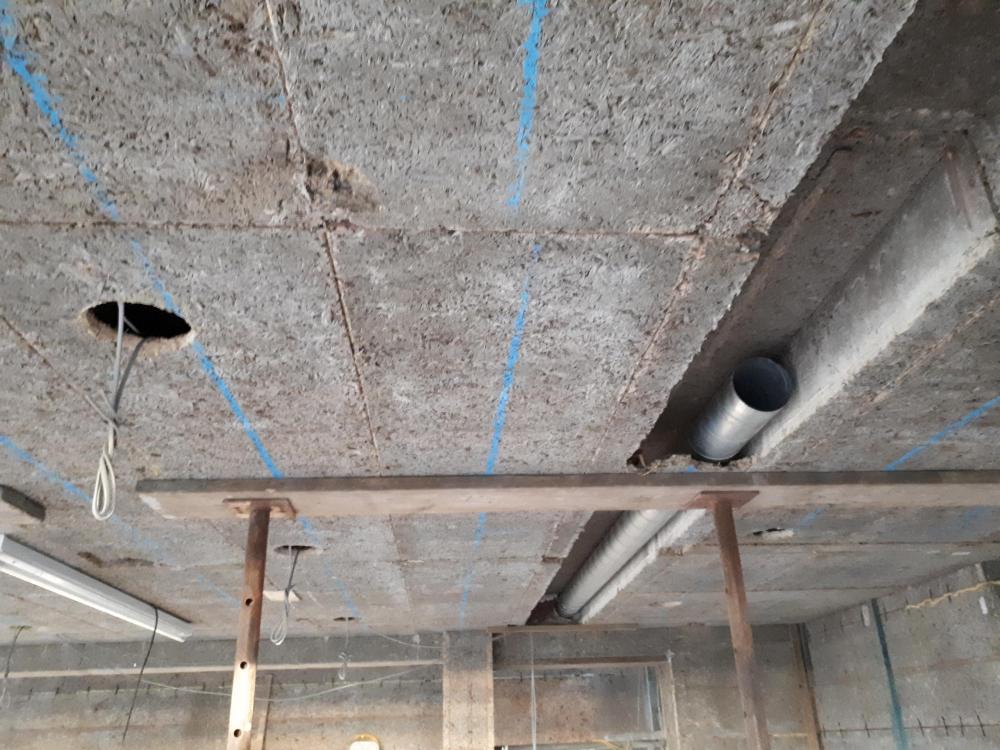
First fix underway with the voids in the Velox ceiling modules being utilised for MVHR ducting and cabling.
-
We have used Velox internal walls with our Velox build. We have both structural (220mm overall with 150mm concrete core) and non-structural (100mm). The non-structural panels are basically foam-glued in place. The non-structural panels are heavy, as mentioned by Sue B above, but do result in solid walls with excellent fixability across its surface and good sound insulation (39 DB). There is a new Velox multi-layer partition product which is lighter at 55kg and gives better sound insulation (49DB) but this was not available when we ordered. It is standard practice to chase out service voids in the Velox panels but clearly laying services will be simpler with a studwork wall. For us it was a trade off of solidity against flexibilty.
-
I now have more cladding samples than I can shake a stick at, ranging from TrespaPura/Formica, through various composites (Dura and Enviro have almost identical products which look good and some of the composite decking products look ok for cladding), to the wood products (Larch, Accoya, Cedar), most treated and some untreated. The cost difference is significant, ranging from around £25 per sqM for untreated cheaper timber to £35-£40 ish for some of the composites to around £100+ per sqM for Accoya and some of the more engineered products. I am concerned that some of the timber treatments, though prolonging lift expectancy, may result in early/differential blackening and I have been given some horror stories regarding treatments. Accoya seems to get a good rating generally if given a Teknos coating though it is at the expensive end of the spectrum and will be very pale unless stained. It does have a broad spectrum of colours and wood shades available. It also has the best warranty and a good reputation as regards resisting blackening mould. I would be wary of some of the other technical woods (heat treatments etc..) which do not have the acetylation treatment of Accoya. To my mind the composites look best in greys where they are not trying too hard to mimic timber colours. They are also at the cheaper end, only beaten by the cheaper timbers like untreated Larch. TrespaPura and Formica are printed so the range of effects and colours is limitless and the smooth surfaced products should be easy to clean. I have not been given any information on how quickly and to what extent the more synthetic products are likely to be effected by UV bleaching, though the darker composite benches I have seen seem to have survived well. Natural timber seems to suffer more from differntial weathering/bleaching and will require regular treatment if you want to delay the bleaching (2-5 years depending on the orientation and conditions) and as I mentioned earlier, the treatments themselves can cause problems. The timber can be pre-weathered to avoid differential weathering with e.g. Sioox, at a cost of something like £15 per sqM. The Sioox should also extend the life of the timber. Lots to choose from and I have no experience in this area but the above is what I have gleaned from talking and reading up.... Any comments/thoughts would be appreciated.
-
and so it begins........ design 11 so far
D Walter replied to Sue B's topic in New House & Self Build Design
... and there is the answer. -
and so it begins........ design 11 so far
D Walter replied to Sue B's topic in New House & Self Build Design
The joins can also be chased out. Going at 90 degrees is an issue but our 90 degree angles downstairs are in shower and utility where we do not mind having a lowered ceiling service void. The main rooms have straight runs. Upstairs we have vaulted ceilings with service void so no issues. We went with concrete first floor for soundproofing, thermal mass and UFH. PosiJoists would probably have been quicker and cheaper and gives much more flexibility. Decision making is, after all, the art of the compromise. -
and so it begins........ design 11 so far
D Walter replied to Sue B's topic in New House & Self Build Design
Hi @dzhou11. Velox would normally specify 50mm concrete with the underfloor heating pipes tied to the rebar and embedded in the 50mm and no screed. We had to go with 80mm for structural reasons due to large spans. My builder wanted to embed the underfloor heating pipes in a self levelling screed but 1) Velox recommended not doing this (not sure why); and 2) I think we were running out of depth for the floor so we just went with the 80mm concrete and power floated it. It worked out well but it is very difficult to get completely level, not least because the diferential curing of the concrete at the edges relative to the centre. We will be doing a little bit of grinding and levelling for the flooring. -
Sewage treatment plants
D Walter replied to Kerron Allen's topic in General Self Build & DIY Discussion
Thanks Stones. -
Sewage treatment plants
D Walter replied to Kerron Allen's topic in General Self Build & DIY Discussion
Thanks Peter. I just had another recommendation for the WPL DMS2 so good to get your thoughts too. -
Sewage treatment plants
D Walter replied to Kerron Allen's topic in General Self Build & DIY Discussion
Hi, I am trying to choose which sewage treatment plant for up to 6 persons with discharge into a stream. The Vortex and the Biopure seem to be mentioned most. Any recommendations? Also, I will be having a water softener (probably a Kinetico Premier) fitted. The water softener needs an drain outlet (I believe this is for the waste salt solution). Can anyone advise me if this outlet can feed into the treatment plant or does it have to be to to the groundwater drainage. Thanks. -
Hi, SE plans attached, as requested. 9423-01C Foundation Plan.pdf 9423-02B Ground Floor Plan.pdf 9423-04A Second Floor Plan.pdf 9423-05D Sections & Details 1 of 3.pdf 9423-11A Columns & Beams RC 1.pdf 9423-03A First Floor Plan.pdf 9423-07B Sections & Details 3 of 3.pdf