
D Walter
-
Posts
116 -
Joined
-
Last visited
Everything posted by D Walter
-
Hello and an interesting question to start
D Walter replied to Peterparky's topic in Introduce Yourself
Yes, but was the offer of £1k in writing? And, even if it was, how to prove the contract for the balance....? -
Hello and an interesting question to start
D Walter replied to Peterparky's topic in Introduce Yourself
The general rule relating to contracts in respect of real estate (land and buildings) is that it has to be in writing otherwise it will be unenforceable. Your contract may well be different as it does not relate to rights in land itself but rather a "finders fee". However, assuming the contract does not have to be in writing, in the absence of someone else being able to confirm the verbal contract, the difficulty in proving your verbal contract strongly suggests that you should take what is being offered and effectively cut your losses. Sorry! -
One point to note when getting quotes for windows, particularly if you have very large sliders, is that some of the suppliers will quote against your specification but will re-size the windows according to what they can supply without pointing this out. It is all in the small print and you will have to interrogate their quote in detail in order to spot the discrepancies. I had this from a handful of suppliers when I was geting prices where banks of three windows with one being a slider were divided into banks of 4 windows.
-
Hi Mr Punter, At-Eco do both supply and supply and fit. My builder was going to do the fitting but given the volume of glass and the size of the triple glazed panes we decided it was better to put the risk on At-Eco rather than a small builder. The installers laser-levelled all the windows during installation and were happy to work around my builders.
-
Hi Coops85. We used At-Eco. We originally contacted At-Eco over 2.5 years ago when we were investigating products for the build. They were very helpful (and patient) throughout. As I said, my builder was very impressed by the installation team and it takes a lot to impress him.
-
QS Costings versus The Real World Query?
D Walter replied to Powerjen's topic in Surveyors & Architects
It is worth talking to local people (estate agents, tradesmen, local authority building inspectors) about builders. I know my builder a bit through sport and got a massive thumbs up when talking to friendly estate agents, surveyors, structural engineers and others. My building inspector uses him for his own building work. I waited about 18 months for my builder to finish his current project and it was the right decision. -
It is also worth noting that some manufacturers give their suppliers seasonal discounts around the Christmas period. We were notified of the discount window by our supplier about three months in advance and got our order in on the last day of the discount. In a sense we were fortunate that our build had been delayed by some months or we would have had to place our order on the basis of the pre-discount quote to keep the build schedule on track and would have missed out on the 10% saving which we obtained.
-
QS Costings versus The Real World Query?
D Walter replied to Powerjen's topic in Surveyors & Architects
If you can find a really good builder who you trust they can critique your plans for expensive "bells and whistles", areas which will be difficult and therefore costly to build and other areas which could go wrong. Having said that, it is really difficult to get a good builder to spend any time getting to grips with plans until they are on the job and not still concentrating 100% on finishing the previous job. It is also hard to get round the mindset of good tradesmen who have learnt by experience not to make aesthetic, design or structural suggestions to clients as it will often come back to bite them. Thankfully, I have learnt to read the slightly pained expression which comes over my builder's face when he thinks (knows) we are making the wrong decision.- 54 replies
-
- 1
-

-
- qs
- quantity surveyor
- (and 1 more)
-
We have a lot of glass in our house and I got quotes from about 15 different suppliers and manufacturers. In the end I went for Internorm UPVC triple glazed windows, clad with aluminium on the outside. The inside has a 3M tape covering which makes the inside look and feel like aluminium. Not a mm of UPVC in sight. The "whole window" U values are between 0.7 and 0.8 depending on frame to glass ratio, which is basically equivalent to triple glazed timber windows. The windows were significantly cheaper than the Internorm timber windows and priced almost identically to the best price I managed to get for aluminium windows from other suppliers/manufacturers but with massively better U values (the best U values I got for aluminium windows was around the 1.5 level). The quality of the windows is superb and I have nothing but praise for the distributor I bought them through and their installation team (we used the supplier's installation team as some of the larger windows were over 6 square metres and I preferred the supplier rather than my builder to bear the risk of any accidents). More importantly, my builder, who is the ultimate perfectionist, was really impressed.
-
QS Costings versus The Real World Query?
D Walter replied to Powerjen's topic in Surveyors & Architects
I paid a QS more money than I am comfortable disclosing to do a full cost plan for me to use as the basis for a tender process. The cost plan came in at approximately 50% over the tender I went for eventually. I did not end up using the cost plan as the basis of the tender as, when dealing with small builders, they have an understandable reluctance to use any cost breakdown structure other than the one they are accustomed to and comfortable working with. To add insult to injury I later found out that the cost plan had been given to one of the builders who was bidding for the work but I could not use the information to recoup my payment to the QS as it was given to me in confidence. Anyway, like most of my costly mistakes, it seemed like a good idea at the time.....- 54 replies
-
- 1
-

-
- qs
- quantity surveyor
- (and 1 more)
-
Hi Tim, apologies I was looking back through posts and don't think I answered one of your questions. Yes, we have looked at just about everything we could find on the market. Initially we were going to use larch or cedar but have seen so many badly weathered (or over treated) examples locally and on the mainland that we were put off. I would have happily used charred timber but with the anthracite Tata cladding the whole house would have been dark grey/black and we did not want that aesthetic. I did a number of tests charring larch and cedar at home with good success. I also looked at numerous composite products and the one we liked best, taking look, durability, fixing and corner/reveal profiles and ability to maintain into account was Trespa Pura. Formica also do a good product but not yet in a flush profile.
-
Continued to shop around and think we have Trespa at under £65 per m2, excluding the metal corner profiles and fixings. We are firming up on the quote but it looks by far the best quote we have had and is from a reputable supplier.
-
Hi Tim, There are a few reasons why we did it this way and I will try and work through them. a) there is an optimum point in the thremal profile of the wall for the windows to be placed in order to minimise the risk of condensation. Unfortunately we did not have a thermal image profile for the walls but Internorm estimated that it was a certain distance in from the outside and this was directly above insulation and not above the concrete core; b) if the windows (which have a u value of c. 0.75) are above the concrete core of the walls (which have a u value of c. 0.15) and not the insulation they will themselves act as a thermal bridge; c) visually the window reveals look better at less than the 215mm plus cladding depth which would have been needed in order to have the windows resting on the concrete core and there is less opportunity for seagulls etc to use the reveals as a platform. On the Continent they tend to have much deeper reveals but they also often have to accommodate external roller blinds. The steel angle supports for the windows will act as a thermal bridge however we insulated the supports as best we could and their direct physical contact is only with the window frames themselves. Everything is, after all, a compromise and we hope we got the compromise about right.....
-
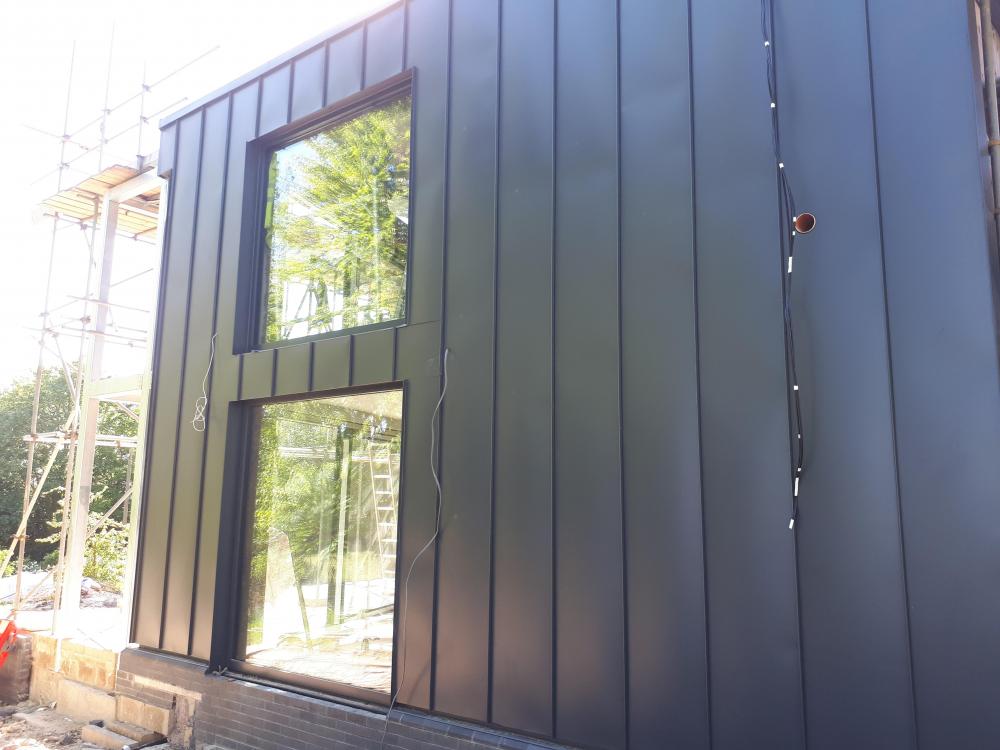
Hi Tim, sorry about the delay - I am just back from a cycling trip in France. The lay-up is: 1- breather membrane (Tyvek) stapled to Velox 2- battens 3- 18mm OSB 4- breather membrane (Tyvek) stapled to OSB 5 - Tata
-
Sorry the picture is not great but this is the only bit of Tata without scaffolding at the moment. When more of the scaffolding is down I will post some more pics including fascias and soffits and roof.
-
The cheapest price I have had on Trespa is c. £85 per m2. Some quotes were significantly higher (by about 25%). There is also the cost of the corner profiles to consider.
-
The composite products like Hyperion do have their drawbacks. They are most used in static caravan parcs. They are designed to have all the butt joins between boards in line with a vertical cover strip which is generally not what is looked for in a modern house. I know people who have used staggered joints but it is tricky and the 10mm gaps between butt joints can be unattractive. Additionally, the corner details for window reveals and corners of walls are wide mouldings. Again, I know people who have cut the mouldings to a thinner profile but at some risk and a lot of work.
-
Hi Tim, do you mean Tata or Trespa Pura? I can load pics of the Tat at this stage but will wait a bit till the scaffolding is down. The Trespa will take a bit longer....
-
Hi Tim, We have clad about 1/2 of the external walls with vertical standing seem Tata Colorcoat Urban and did not cut off the external ties. We are going to use Trespa Pura on the remaining 1/2 and don't think we will bother to cut off the ties. We took the view that, particularly with the internal ties cut off, the external ties will make no appreciable impact on thermal bridging and will not interfere with our battens.
-
Hi, we cut off all the internal metal ties on our Velox build using an angle grinder. We then used a face grinder to smooth the corner joints between Velox panels and glued and screwed plasterboard and skimmed. The result is no void between the face of the Velox and the plasterboard and a beautifully smooth plaster surface. Insofar as the metal ties act as a thermal bridge any impact of that has also been minimised.
-
Thermal Store with PVs and underfloor heating
D Walter replied to D Walter's topic in Boilers & Hot Water Tanks
Thanks again for the good advice! -
Thermal Store with PVs and underfloor heating
D Walter replied to D Walter's topic in Boilers & Hot Water Tanks
To further impose on your patience I have a couple of questions. Following the advice given above we are going to go for an unvented indirect cylinder with two immersions powered by either 6.5 or 8.4 kW PV system and a gas boiler. We will not need greater than a 300 litre cylinder but the 300 litre cylinders tend to be min 2000mm high. The cylinder will stand in front of the UFH manifold which is at approximately 1950mm making access difficult. The 400 litre cylinders tend to be shorter at c. 1600mm high which will work better with the UFH manifold, though we would need to restrict the width (and therefore the insulation) to c. 750mm due to the size of the cabinet. The 400 litre cylinders which will fit the cabinet tend to have c. 2.5 kW per day standing loss as compared to 1.7 kW for a better insulated 300 litre cylinder. My assumption is that, apart from the greater standing loss suffered which will be a pence a day, the bigger tank should not have a greater running cost as the same volume of hot water will be used so very little more water will be heated on an ongoing basis. Does this, if you will excuse the pun, hold water? My second question is whether I should go for a tank with the standard placement of immersions at 799mm and 1117mm or would I be better going for a cylinder with lower located immersions at e.g. 432mm and 910? My guess is that the lower immersion would be beneficial in the summer months as there will be more kWs from the PVs to heat the greater height of water above and detrimental in the winter where the immersions may never get the head of water to a satisfactory temperature. -
Thermal Store with PVs and underfloor heating
D Walter replied to D Walter's topic in Boilers & Hot Water Tanks
On airtightness we are not sure what we will actually achieve but are aiming at better than 2 m3/hr per m2 We have solid concrete walls and floors, well sealed triple glazed windows and doors, sprayfoam insulation at roof plate plus taped foil backed PIR and continuous vapour control layer so we are hoping we will achieve very good airtightness for the MVHR system. -
Thermal Store with PVs and underfloor heating
D Walter replied to D Walter's topic in Boilers & Hot Water Tanks
We are at a U value of 0.15 on walls, between 0.09 and 0.11 on roof and windows between 0.7-0.8 with predominantly glazed SW aspect so we should have low UFH requirement. -
Thermal Store with PVs and underfloor heating
D Walter replied to D Walter's topic in Boilers & Hot Water Tanks
Totally agree! We are at first fix and doing roofing as we speak so are installing the SWA internal cabling from utility to roof for PV installation and will research the best PV/cost. The PV technology has moved on in the last 9 months since we got our first PV quotes and there has got to be a step change in battery technology in the near future so not looking at any form of battery for the time being. The immediate decision we need to make is primary heat source and HW cylinder and as we are on mains gas it looks like the sensile option for now is go with gas boiler and probably a 300l UVC with 3kW immersion. Thanks to all for your very practical input!