

.jpg.c21f3ac78c9b7efd90cbdcb312744dc5.jpg)
jack
-
Posts
7460 -
Joined
-
Last visited
-
Days Won
41
Everything posted by jack
-
.jpg.c21f3ac78c9b7efd90cbdcb312744dc5.thumb.jpg.7adcad4c0e384f5ecd7d56b0618df6e5.jpg)
Prepping for ASHP and sizing - Heat loss calcs confusion
jack replied to mistake_not's topic in Air Source Heat Pumps (ASHP)
I spent many years working air-conditioned offices in Australia. The dry air and cold drafts aren't something I found very pleasant. By contrast, underfloor cooling feels very natural. -
Prepping for ASHP and sizing - Heat loss calcs confusion
jack replied to mistake_not's topic in Air Source Heat Pumps (ASHP)
I only started running Grafana earlier this year, so the only data I currently have are Loxone native (and hence probably not much help). For context, I presently run the cooling open loop. I can enable cheap rate cooling and/or daytime cooling (scheduled between 10:00 and 16:00, from memory). I can also push a button and get 2, 4, 6, or 8 hours of cooling. Periods where the cooling doesn't come on for a period are usually cooler and/or cloudy (and hence less solar gain) periods. This shows the downstairs slab temp (note: not air temp) and the UFH flow temp for June and July last year: Note the runup to the peak slab temperature in late June. With the cooling off, the temperature rose consistently from 19.4 on Monday 23 June to 21.6 on Saturday 28 June, when I enabled cooling This is what the weather was doing during June 2025: The house has a long time constant when it comes to reacting to external temperatures. Even though the temperature in June was highest on about 21 June and fell off sharply after that, the internal house temperature continued rising for a couple of days before I turned the cooling back on. Unsurprisingly, the cooling downstairs has virtually no impact on upstairs temperatures. Here's 10 days starting on 23 June, showing the relentless increase in upstairs temperature even after the cooling is turned on downstairs on the Saturday: That was actually the hottest it got upstairs in all of 2025. Not sure if any of that helps. I originally planned to add things like flow sensors along with power monitoring for the ASHP so I could get a better sense of what was going on an perhaps tweak things for better performance and lower costs, but in the end I decided it was too expensive and complex. That said, earlier this year I expanded the inputs available for Loxone, such as excess solar power and temperature forecasts. I'm hoping to do something with those to better automate cooling this year.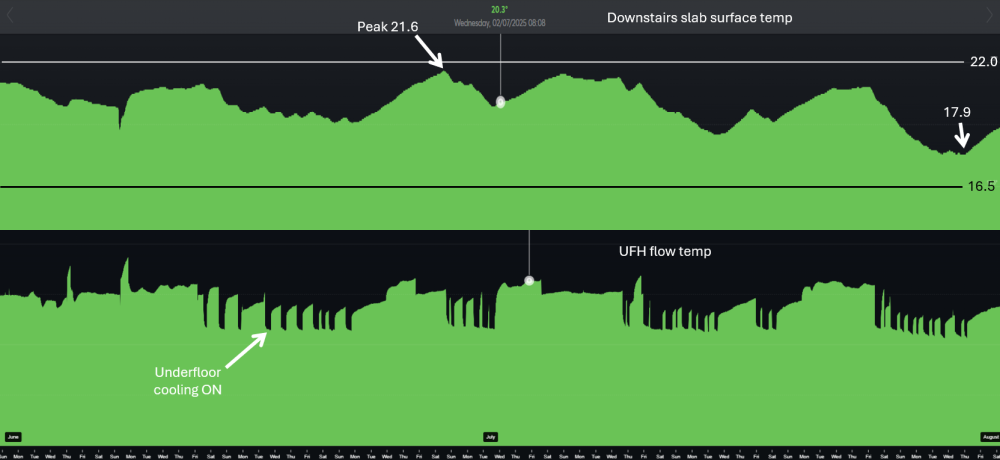


-
Prepping for ASHP and sizing - Heat loss calcs confusion
jack replied to mistake_not's topic in Air Source Heat Pumps (ASHP)
I can only talk about my personal experience, but we cool our downstairs slab with an ASHP during hot periods and it's remarkably effective. Coming in from outside on a hot day is like walking into a cool cave. We run a flow temp of about 16 °C and that's enough to keep the slab under about 20 °C, even in a multi-day heat wave. We do have concrete floors, which I'm sure helps a lot. I don't imagine the effect would be as powerful with, e.g., wooden floors. I'd be careful about overstating the effects of convection in a well-insulated house using low flow temperatures. Sure downstairs gets warm, but as you walk up the stairs there's a clear temperature gradient as you move towards the downstairs ceiling. In the middle of winter, it's typically 2-3 °C cooler in the hallway upstairs (no heating upstairs) than it is downstairs, even in the central landing with open stairs and a large double height area. I suspect that hotter floors in a more poorly insulated house would increase convection. -
This is a useful thread:
-
You have a sense of humour, I'll give you that.
-
Really? Have you lived in the UK for the last few decades? As an example, how about the ricidulous energy pricing paradigm discussed elsewhere in this thread, which has left us with insanely high energy prices? Straw man - this is not my argument. False equivalence & appeal to emotion - you've listed inherently "bad" things as examples of things governments should be able to ban, but not explained why the question of whether drilling is commercially viable is equivalent to those things. I say they aren't equivalent. Straw man. Not my argument. Straw man. At best incidental to my core argument: This is my core argument, which is narrow and specific: And as for this: Straw man - not my argument. The reference to renewables is a false dichomy (investors don't have to invest in only renewables or drilling). The "cracking return" is a sly appeal to emotion (people interested in financial returns are somehow bad). I won't be continuing the discussion. Hopefully it's clear why.
-
Irrelevant. Even if there were zero reduction in CO2 emissions, my position is unchanged. Even if arguments that drilling won't be practical or profitable are correct, then either: Oil companies won't drill even if granted licences, in which case the argument is moot. Or they'll drill, lose money, and presumably stop drilling when it becomes clear they made a mistake. In both cases, the end result is drilling doesn't continue. I don't actually have strong beliefs either way, but I do believe that non-experts (including governments) shouldn't be involved in decisions about whether something is practical or profitable for a company. There are, or course, plenty of other factors that governments should weigh in on, such as safety regs, environment, tax, etc.
-
For existing fields with well-understood geology, I believe new wells can be planned and drilled in a matter of several months. I don't know whether there are additional delays associated with manufacturing the rigs themselves.
-
If that's true, then no-one will drill if you give them a licence, in which case you're wasting your energy arguing. Your other arguments may be true, but they're irrelevant. Local drilling will generate less CO2 overall, and may at least bring some tax into the coffers. The rest of it is a commercial decision that ought to be made by commercial entities. If it makes such little difference, why are you arguing against private companies siphoning out what remains? Let them get on with it in parallel with doing what we can on renewables and (more importantly) grid capacity and storage.
-
Firmly disagree. Gas is going to be burned for decades. North Sea gas displaces gas from elsewhere, so is (relatively) carbon neutral. I'm fact, it could potentially produce slightly less CO2 overall due to the fact it isn't being transported halfway around the world.
-
Respectfully, this is a pointless argument. Either there's still oil/gas to be economically extracted, or there isn't. The government doesn't need to get involved in figuring that out. Grant the licenses (with restrictions as mentioned by @LnPand others above), and get out of the way. If there's no long term gas, private companies will figure that out soon enough. We can deal with renewables in parallel.
-
This is equivalent to posting a picture of an unseasonably low temperature forecast for a particular summer's day and saying "bUt cLImatE ChaNgE is waRmInG thE pLaNet!!...".
-
Grand designs: off site construction
jack replied to Post and beam's topic in Property TV Programmes
I feel seen. -
@craig, is this something you could help with? Many thanks.
-
Anyone had a Danwood build without an MVHR?
jack replied to worldwidewebs's topic in General Self Build & DIY Discussion
Have you asked why they're making these decisions? I'm sure they aren't doing it just to be difficult. It could be about routing needs, including competition from power, electricity, and water routing, interference from building elements such as joists, and/or limitations of their build system. In our case, we'd initially planned to put the MVHR in the pantry, but ended up moving it to the plant room right next door. Admittedly, a large part of the need for that location was my fault, because I didn't give nearly enough thought to the plant room layout before everything (drainage, power, water) was permanently positioned when the slab was poured. In the end (and possibly more relevant to your situation), we also decided to move the manifolds into the utility room, largely because it was clear we'd really struggle routing the per-room ducts around all the other power, water and drainage passing through the ceiling in the plant room. Similar issues could apply even to a couple of large ducts, depending on the routes they might need to take. I suppose my point is that there's generally a reason for every decision. They should be able to articulate that reason. If you end up with the MVHR in the utility room, you could box it in. We did that with ours in the pantry. It just looks like another set of cupboard doors. We did similar with a dropped ceiling below the manifolds in our utility room, with flush access panels for maintenance if needed. It worked well for use. The access panels have have never been opened in the decade since we moved in. -
It might be just a case of spreading the load across as many timbers as possible, but you'd need an SE to confirm the mass needed, and whether your roof has the necessary load capacity. We have a low-angle ballasted system on a flat roof that uses concrete council-type slabs as ballast, but with a frame system specifically designed for PV. I can't easily check, but it's something like a couple of slabs per panel, I think. I'd have preferred a through-membrane system bolted down to the roof deck, but unfortunately didn't plan ahead and so it wasn't a reasonable option at the time. Hasn't moved in 10+ years. I appreciate it's desirable to avoid roof penetrations, but if done properly it needn't be a significant leak risk. You'd still need SE calculations for load, lift, and fastener pullout, but I still think that's preferable to using ballast. Even it's within your roof's load capacity, you'll be putting considerably more pressure on the membrane and underlying structure.
-
We used Express Glass Warehouse about 6 years ago for the laminated glass on our external balconies. No idea whether it's still the case, but back then they were the cheapest decent quality laminated glass I could find. I assume you know exactly what specs you're after. We went for 17.5mm clear laminated & toughened panels. Incidentally, if you want suction lifters, for the cost of postage you're welcome to the ones I used. What channel or other mounting system have you gone for?
-
Had boys growing up in our house and can confirm! There's definitely a move towards compatibility with a smaller number of standards, like Matter and Home Assistant. Admittedly it was ten years ago, and I'd certainly do a few things differently now, but I personally went for a centralised home automation system that meant I could use relatively dumb lights, with DMX control. You can also get DMX relays for very little money. That puts all the "smart" stuff (dimming, automated on/off times, different scenes depending on different times of day/year) in the central system. The big risk, of course, is that if the central system breaks, everything breaks, but a spare raspberry pi and SD card don't cost much in the scheme of things. Getting back to your point about branded systems, blinds are one of the worst areas for this. Typically you have to use their proprietary wireless system controller or a dumb relay. Of course, you could use a wireless relay (e.g., Shelly and the like) controlled via a home automation system, but it's a shame they're so insistent on using their own standards.
-
I have Scolmore Click (Definity, from memory) retractive switches throughout my house. Admittedly things might have moved on in the 11+ years since I installed mine, but they are loud and very heavily sprung. It's difficult to double-click them, especially if you're (say) turning off a light late at night and don't want to wake anyone up. I'd definitely be buying a sample of whatever I was thinking of using. Obviously it's a matter of personal taste, but I wouldn't buy screwless metal faceplates again. On white/light walls, they draw a lot of attention. They also mark fairly easily and I think metal cover plates can look/feel cheaper than good quality plastic. If I were doing it again it'd be white plastic all the way, focusing on how the switches feel in use.
-
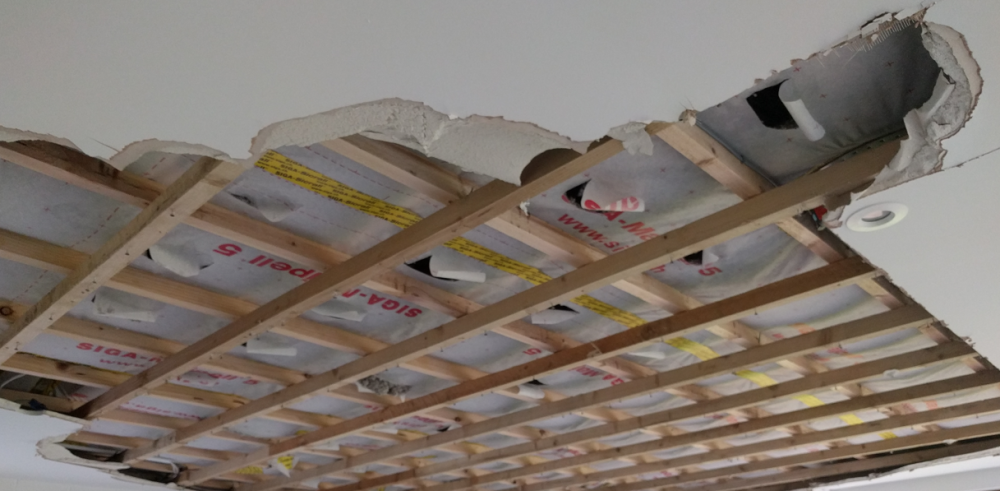
The stuff you saw was definitely the dry-installed type. Wet cellulose is applied in a completely different way. You start with the wall cavity open then spray in damp cellulose and scrape/compress it flat with the studs before plasterboarding. I've never heard of anyone offering the wet-spray stuff in the UK. My recollection is that Jeremy discussed it in response to expression of concern about post-installation slump of the dry stuff. Personally, I do have some concerns about how perfectly dry-installed cellulose fills cavities, especially for flat roofs, under windows and the like, and tall walls where there's a lot of weight compressing the cellulose at the bottom. I'm sure there's an element of installer skill, too. Water can travel a long way through cellulose. I guess the thing you have in your favour is that you only had a fixed amount of ingress based on the one-off snow event, so hopefully it won't have gone too far. In our case, we think the leak was there for months, which allowed it to saturate a lot of cellulose. We had two leaks - this was the worst of them: With an area as (hopefully) small as this, @lizzie might get away with making a smallish opening, pulling out the wet stuff, then manually pushing fresh stuff back in manually. To be honest, with such a small amount I'd be tempted to pull it out, dry it properly, and re-use it. Except for the re-use, that's what I did when we had another leak (scaffolders punctured an aluminium trim on the flat roof above the garage and didn't tell us about it, so first we realised was when we spotted the leak). Not the most pleasant job in the world, and you will make a mess, but it worked out okay. The cellulose sort-of stays put when you compress it, so you just keep stuffing it up until the space is full. For a small patch, allowing it to dry out is a possibility. You could consider piping dry air from a dehumidifier into the service void for a couple of weeks. Personally, I'd be happier if I knew it was all properly dried out, including any wooden elements in contact with it, so I'm not sure I'd risk it.
-
Random attempts to access shared resources is common across a wide range of communications protocols. It's used across all the major mobile standards in the form of a RACH channel.
-
Landscaping - Bank Edging Replacement
jack replied to BOSullivan's topic in Landscaping, Decking & Patios
Some mini-diggers have retractable tracks that let them get through doorways as narrow as ~700 mm. One of our neighbours had new fences put in about 5 years ago and two of them have already failed at the base. This is in a very damp area that gets no sun. I see similar all the time around me. I wish I'd known when getting the fences done how long ordinary treated posts tend to last. Our fences are 10 years old and no obvious issues yet (we're much higher up than the neighbour and on sandy ground), but looking at all the failing (and not that old) fences in my area, I know it's only a matter of time. As for longevity, perhaps not ideal for OP if they plan to sink a load of vertical posts, but for fenceposts in general, postsaver sleeves have a good reputation. -
Welcome to BuildHub.
-
Full details in this BuildHub thread. Thanks Jack
-
And by quite a lot in some cases. https://www.reddit.com/r/OctopusEnergy/comments/1rwgpp5/wtf_octopus_just_slashed_iog/ Just in time for the sunny weather when my solar produces more than I can use!
.jpg.c21f3ac78c9b7efd90cbdcb312744dc5.thumb.jpg.7adcad4c0e384f5ecd7d56b0618df6e5.jpg)



