

.jpg.c21f3ac78c9b7efd90cbdcb312744dc5.jpg)
jack
-
Posts
7460 -
Joined
-
Last visited
-
Days Won
41
Everything posted by jack
-
What. The. Actual? You couldn't make this nonsense up.
-
-
.jpg.c21f3ac78c9b7efd90cbdcb312744dc5.thumb.jpg.7adcad4c0e384f5ecd7d56b0618df6e5.jpg)
Creating a fall on a flat roof: and attaching the wall plate for it
jack replied to ToughButterCup's topic in Flat Roofs
This is what was designed for ours: The onsite detail was slightly different, in the the channel walls aren't tapered in plan, as shown on this. I'd absolutely include these channels, ensuring falls the full length of each channel and out through each parapet. You don't want any pooling water to sit there, and potentially go through freeze/thaw cycles (something I'm sure was a factor in the leaks we had). One thing we don't have, but will get around to one day, is an emergency overflow pipe set above the outlet level, draining outwards to a highly visible place. If somehow all the gutters get blocked, and water builds up, I'd like visible evidence rather than waiting for problems.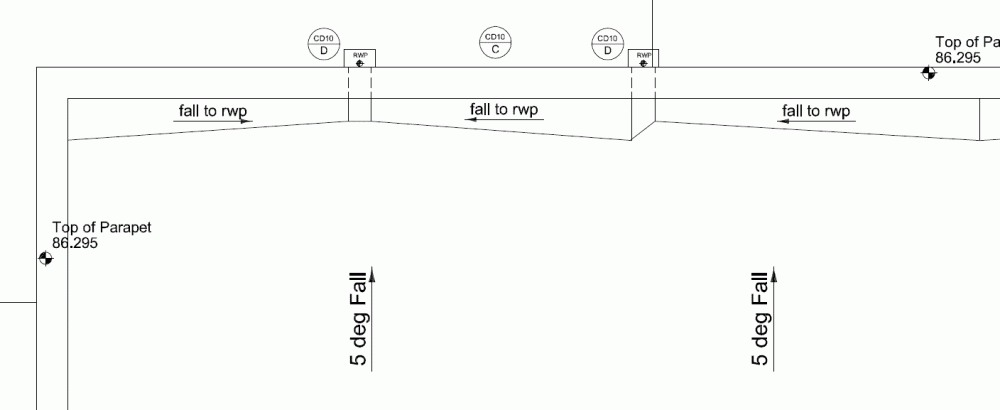
-
We used (and were happy with) http://www.dovecsl.co.uk/ They're based in Camberley so pretty sure they'd cover Woking. I don't know whether they'd do this sort of demolition, but you could ask.
-
I suspect it was 50mm drain pipe, something like this: https://www.drainagecentral.co.uk/50mm-Push-Fit-Waste-Pipe-x-3m-W9800 Just to be clear, I'd still use this if I were doing it again. I just wouldn't bother with the strips of insulation and plastic tubing.
-
Washing in cold water is the norm in Australia. Australians find the idea of washing in hot water a little odd. I think it's partly because the climate is so warm, and the UV (on average) so high, that when clothes are dried outside - which is the case for a lot of the year - they're effectively sterilised.
-
I guess it's possible, it just seems odd that this is the only example of this sort of behaviour anyone's brought to the forum. Maybe this is the vanguard - I hope not, unless they also intend to behave like this with commercial clients. Interesting theory. It would certainly fit the "model home" approach that they use when they pick a subset of a large development for inspection. Our electrician (Justin, who you met I believe) also chose our house for his audit, but I think that was because he works by himself, so doesn't have a lot of large jobs to show for an audit, and the timing was right.
-
But what's the commercial driver for him behaving like this? His company can't be happy with what he's doing - it takes far more time than doing it the way most other BCs do things. It's upsetting an existing client who may well pass on bad feedback to others that might consider using them. How can this make commercial sense?
-
Ha. Nice one! Did Kingspan confirm the 200mm spacing? Sounds like utter bullshit to me.
-
We did something similar and the numbers just didn't stack up (I believe our water costs are lower than yours, too). Once you get pumps and filters involved, you incur maintenance time and costs as well.
-
What's the cost of this system and its ongoing maintenance, and how many litres of water do you expect to use per annum? 4000L costs about £5 where I am.
-
We have an ASHP with flow and return pipes flowing through the EPS underneath it. There are 3 x 100mm layers of EPS under the slab. We cut two channels in the middle layer , deep enough to take polypropylene push fit pipes. Can't remember the size - 60mm? I went with polypropylene because it was cheap and handles high temps pretty well. The highest temp it will see is 55 deg C from an ASHP, which is well within limits. I bent one end up into the plant room on a long radius. We foamed those place, then covered with the top EPS layer. We used (from memory) 28mm Hep2O barrier pipe, to which I stuck strips of thin nitrile insulation - 3mm or something like that, I think it was. Then I threaded that through a length of cheap plastic film tubing. A touch of washing detergent on the outside of that and it pulled through pretty easily. Seems to work well for us, for both UFH and DHW. If you're just using it for UFH, the extra stuff I did is probably overkill. In fact, if I were doing it again I'd consider just pulling the Hep2O pipe straight through without all the extra insulation and tubing. Not sure I follow this. Could you explain a bit more what you're doing?
-
Every 200mm? That's insane. Do you think he's bluffing? Could you call Kingspan and ask whether they know anything about this? If not, I think it's perfectly reasonable to demand that the BCO/engineer provide a written basis for this requirement.
-
Yes, yet another mistake on my part. No need to rub it in!
-
Expected cost of thin coat exterior render system
jack replied to Pete's topic in Plastering & Rendering
Sharp job! -
+ several million for this. The less you move the faster you deteriorate when you get older. I've been doing a lot of reading about exercise and older people (partly for my parents in law, partly because I'm no longer that young myself). I found this to be an excellent book, but the short version is that it's never too late to start exercising. Most importantly, as you get older, you should focus on activities that build muscle (ie, strength training) rather than doing cardio.
-
Okay, thanks. I'll look into it when we next speak to him about bits and pieces for completion.
-
Thanks Nick. I don't think I have a schematic, no, although my wife might have stored one somewhere. Will check. I do know that all that's visible/accessible on the hot side is a bloody great pipe heading up through the ceiling of the plant room, so I suspect a manifold approach wasn't used. Plumbing (as in the actual conduit design and routing) is the one thing in the house I had literally no input into. From memory, the plumbing happened largely while I was neck deep in something massive at work, so I just had to trust it would all be done properly. Like I said, next house!
-
Yes, same plumber. He suggested a hot loop and we said no for energy consumption and potential overheating reasons. (Another) silly mistake not at least running the pipework so we could add it in the future, but I genuinely didn't think it would be possible to be waiting 45 seconds for warm water at the affected basins. Live and learn - next house will be different!
-
Some people are jealous, some people are arseholes. Your neighbours are likely both. I have no idea what to say in reply to your situation, but keep fighting the good fight. I hope your husband beats the odds - as I'm sure you know, it does sometimes happen.
-
Man, I hate people who finish things they start. It's a sickness. That's an amazing level of finish for the price. No way I'll be sharing what we've paid to date...
-
Hi Sue No, there wasn't any credit card deposit. The £100 credit card thing was discussed near the start of the thread.
-
Where was this advice three years ago! Who else would you get to design pipe runs? We made sure when we designed the house that everything was as compact as possible. The bathroom and two ensuites are all in compact row directly above the utility room and plant room (which are adjacent each other). The kitchen is literally the only tap that's any distance at all from the plant room where the UVC is. I don't understand what sort of route the basin tap must take if it takes over 8 times as long for hot water to get to it as to the shower literally two metres (in plan) away. Even the kitchen tap gets water faster than the basin, and it's miles away!
-
The basin in the adjacent ensuite takes a while to heat up as well, but I don't think it takes as long as the basin in the main bathroom. From memory, if you've had one of them warm, the other one runs warm almost immediately, so you might be onto something. Even so, I can't see why there's ~40 seconds difference between the shower and basin in the same room. They're both almost directly on top of the plant room where the UVC is. Even if the pipe did loop next door first, it's a couple of extra metres at worst. One thing on my list is to get hold of a schematic from the plumber so I have a reference in case it's need in future.
-
Our static pressure is very high - just short of 6 bar, from memory. Our plumbing design assumes a 3 bar PRedV. Given that one or two elements of the design have left us a little unhappy (eg, 45 seconds - admittedly at 1.5 bar - for warm water to reach the bathroom tap, while the shower in the same room takes 5 seconds to get up to full temperature), I suspect that the ability to tweak it a little higher or lower than that might be useful.
.jpg.c21f3ac78c9b7efd90cbdcb312744dc5.thumb.jpg.7adcad4c0e384f5ecd7d56b0618df6e5.jpg)



