


PNAmble
-
Posts
240 -
Joined
-
Last visited
Everything posted by PNAmble
-
Radiator Placement and Eskimo Radiators
PNAmble replied to PNAmble's topic in Central Heating (Radiators)
I have emailed Eskimo Technical Services who are assuring me that there is no error, I've followed up asking for any independent validation, they work closely with Birmingham Uni, so hopefully they'll have some independent data. -
Radiator Placement and Eskimo Radiators
PNAmble replied to PNAmble's topic in Central Heating (Radiators)
https://www.eskimodesign.co.uk/s/Correction-factors-based-on-Delta-T-50.xls Our heating consultant who did the thermal modelling identified 5 (plus an optional 6th) radiators across the house (assuming house at 21 degrees steady state) to provide the output Using Eskimo we can reduce the size (they will all be 1800 high) and the delta t. Hence why we are considering them from an aesthetics and HP CoP efficiency rating. -
Radiator Placement and Eskimo Radiators
PNAmble replied to PNAmble's topic in Central Heating (Radiators)
So agree there are cheaper solutions but actually your example isn’t like for like delta t 20 the Eskimo is 712w and your example Is 634w. Due to the different correction values used by Eskimo (if it’s believable) which as you scale to bigger radiators especially tall as opposed to wide, the correction ratio and lightness of the radiators becomes a big factor is choosing radiators - looks are important as well. Thanks for the point 2 I’ll check to see if our design works as we hadn’t considered that. -
Radiator Placement and Eskimo Radiators
PNAmble replied to PNAmble's topic in Central Heating (Radiators)
1) aluminium rads have been about for years so I assume that’s not a problem 2) so this is a potential concern , not quite certain I understand the implications of min volumes. How do they get worked out. And is the implication that I may need a buffer tank? 3) yes expensive but per corrected output wattage they are cheaper than many steel radiators (that would be used) and significantly smaller. -
Radiator Placement and Eskimo Radiators
PNAmble replied to PNAmble's topic in Central Heating (Radiators)
We have due to the upside down nature of the house. We don’t have a thermal store in the foundations so the ‘load’ over night isn’t an option for us. Size of heat pump is the same as we are designing the radiators to run at 35 flow rate. interesting re the towel rails. How do you set towels ? Or so they dry naturally due to the MVHR? -
Radiator Placement and Eskimo Radiators
PNAmble replied to PNAmble's topic in Central Heating (Radiators)
Physics does support the idea. And where a heat pump is running 24x7 at low temp then the ‘retention’ of heat becomes a bit irrelevant ? A little bit of knowledge is dangerous. I have asked Eskimo and they are standing behind the correction factors. -
Hi, Whilst progressing groundworks, we are working on the heating design. We are building based upon Passive House u-values and air-tightness (0.6)/cold bridging standards/MVHR; the Thermal Model we initially commissioned has defined a Fabric Loss of 2.2Kw and infiltration/mvhr loss of 0.4Kw; The Changeplan heat loss calculator (online) has matched the fabric loss but has calculated a very large 2Kw of Infiltration heat loss. (both at minus 5) The house will be an upside down house (living space has large south facing sliding doors with external blinds, master bed/ensuite on first floor all other bedrooms downstairs with north facing windows), for a variety of reasons the semi raft foundations will be Insulated / screed above. For the former reason we have decided to heat via radiators/ASHP and not install UFH. Using the Passivhaus advice that via radiators it should be planned to use approx 200% of the calculated heat loss, we've come up with a requirement for approximately 4.5Kw of space heating. (we have additional electric towel radiators in 3 bathrooms which aren't included in this calculation). We want to run the ASHP at as low temperature we can (40/35 or even 35/40) using Weather Compensation (the heating engineer has identified a 5Kw Ecodan Monobloc ASHP), so radiator sizing is based upon the appropriate delta T correction factors. So the questions / advice I'm after is: 1) the theory in an airtight house is that all rooms will be the same temperature, following this does it really matter where the radiators are placed as long as the total output required is installed; using the per room thermal model we've split the radiator output across ground floor and first floor as per the heat loss. 2) the correction factor applied to steel radiators means that we need to go for significant sized radiators; however, Eskimo Design has Aluminium Radiators (Column) (https://www.eskimodesign.co.uk/products/p/column) and they use a very different correction factor due to the design and use of aluminium which effectively makes them almost twice as efficient at low temperatures meaning we can use less radiators for the required output - meaning we save on wall space. Has anyone used these radiators and do they operate as defined at low temperature. We do understand that they will heat up quicker, and loose heat quicker than steel radiators but we don't think that's a problem in that we'll be running the ASHP continuously (as we don't have a concrete slab to heat up over night). 3) Does anyone have a modulation curve of the ecodan ASHP, and will it modulate low enough during the "shoulder months" without cycling .. or to avoid this would we potentially "switch off" one of the radiators to lower the overall space heating installed output during these months. 4) I assume that we don't need TRV's as the ASHP will modulate correctly, (we may have an overall thermostat to take advantage of the advanced load capability of the Ecodan ASHP). but is the assumption re TRV's correct. We've had advice from our MEP consultants, but due to continuing errors in their work, and lack of responsiveness and general dislike of paying fees during the build we've disengaged their services, and we weren't convinced they really understood the impact of building an airtight house. Looking for advice and thoughts so that when we create our install plans for the MEP services they are correct. Thanks in advance.
-
We are in the process of building an upside down house - including the master suite upstairs. 3 other bedrooms downstairs. PH u values and airtightness etc. no heating in bedrooms except TRs in en-suites. ASHP and low temp radiators (assuming 40/35 degree flow rate) In living areas upstairs and in hallway downstairs. 🤞we got our calcs and thermal modelling / heat loss correct.
-
Ours was only supposed to be type 1 mot, but due to the discovery of a spring / water , they decided to add a layer of concrete (2m base) to ours, which hopefully is going down today.
-
There is a lot of excavation required as mentioned. Ours will be used to level of the upper area. Once we have this sorted, we'll be into simpler times with a raft and timber frame. We are reasonably close to a quarry so stone will be delivered direct.
-
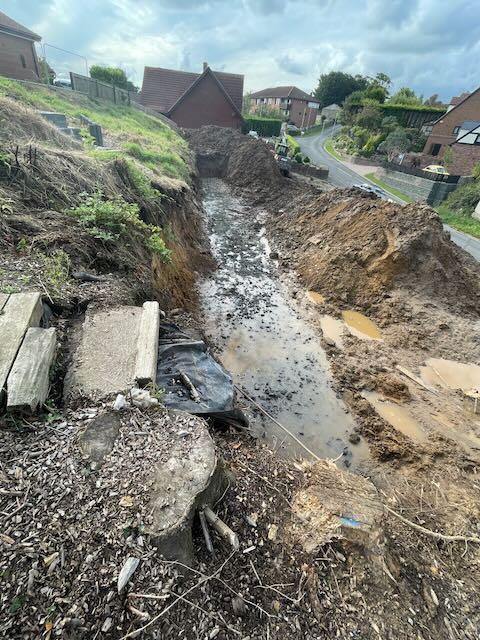
Our groundwork is just underway and after moving earth they are building a 2.5m retaining wall, (24 meters long). We are on sandy earth, we are using Gabions which our groundworker found to be the cheapest solution agreed with the SE. They will sit on a bed of stone and concrete due to the ground conditions. Base layer of gabions will be 1.5 (deep) x 1.0 x 1.0 second layer will be 1.0 x 1.0 x 2.0 and third layer 0.5 x 0.5 x 2.0.
-
Integrated/ flush solar panels on a metal standing seam roof
PNAmble replied to WisteriaMews's topic in Photovoltaics (PV)
We saw these guys at a show last year https://www.bradclad.com/solar/ we were considering them but changed our roof design. -
Had the same conversation with OR last week, dropping off ducting in two weeks, also gave me a big roll of Detectable Buried Service Warning Tape to lay in the trench above the actual duct.
-
Ignored in Northumberland.
-
We are about to start on a turnkey around 2800 per m2 (210 m2). Passivhaus standard finish and a sloping site with retaining walls so is on the higher side. The valuer for the mortgage company was talking about 3000-3500 m2.
-
I recently went through this, I think I then submitted the quote, and a bit later an application form was sent out to me, which I then completed. they then did a site visit, but also contacted me to discuss, they then produced a plan which is where they will bring in the service. This also gave me a contact name to discuss anything with. I was concerned that submitting on the portal would make me pay, but it didn't it just started the process of engagement.
-
What are the dimensions Of the opening s. We looked at a three piece 6meter (each panel 2 meters) triple rail with our build which is passiv standards. In the end the cost and Part O meant we tweaked our plans. But there were a few suppliers who got down to 1.0 and then Cero III doors which got lower but cost was too high for us to consider.
-
Interesting, as we are at the point of think if we should add some sort of leak detection. Obviously there are the simple discs which create an Alarm, but has anyone had experience of something like these which are a bit more comprehensive https://www.grohe.co.uk/en_gb/smarthome/grohe-sense-guard/
-
Passive house plumbing first fix - any tips
PNAmble replied to markharro's topic in General Plumbing
We are a few months from this stage but had all the M&E plans done. We are going for a few radiators not UFH you need to insulate cold otherwise you’ll get condensation on the pipes and you need to insulate hot plus heating otherwise you’ll get unwanted heating eg you don’t want extra heating in summer just because you are having a shower. -
I find the UniFi protect integrates seamlessly. I have the cloud key gen2 which acts as the controller and NVR. All integrated running in a small rack. PoE and wireless cameras as needed.
-
You can get recessed housing for the nanos. https://www.broadbandbuyer.com/products/32739-ubiquiti-nanohd-rcm-3/?gclid=Cj0KCQjw5f2lBhCkARIsAHeTvliA9Fm-a2DavLXxC-v-04qeMD0nLAYnGkFZdPFwTROPCU5b3sXlw_4aAgWyEALw_wcB If you are going Ubiquiti AP I’d go for Ubiquiti pie switch, I’ve also got the cloud key for management and the security gateway enabling me to avoid using the junk routers that providers supply, if you do use theses don’t forget to switch off the Wi-Fi. Also don’t confuse Poe driven Access Points with Mesh or Boosters very different levels of performance. If in doubt of coverage just throw some addition cables and leave them in the service void.
-
Performance and upgradability. But depends upon what you do with your network and what performance is important to you.
-
Ubiquiti normally are pretty clear which are outdoor. I’ve got one of these indoors. With the one I referenced on the other post outdoors. I’m also a fan of POE especially cameras. I have a full Ubiquiti system including cameras, avoids cloud storage and ongoing fees providing a rock solid connection. you could always add a poe splitter outside and put multiple access point if you are having difficulty. Wi-Fi doesn’t normally travel around corners. Personally I’d deploy cat6a cables.
-
How waterproof is the Ubiquiti U6 Pro
PNAmble replied to Adsibob's topic in Networks, AV, Security & Automation
I have an outdoor one. It’s not your model it’s this one https://www.4gon.co.uk/ubiquiti-unifi-uap-ac-mesh-access-point-p-6923.html. it’s been outside no shelter on an exposed corner of my house powered by POE for three years with no problems at all. -
Would annoy me. But I’m also the guy who can’t cope if the door and top of windows don’t align exactly. 🤷🏻♂️. I’d send it back

