


Beelbeebub
-
Posts
1522 -
Joined
-
Last visited
-
Days Won
11
Everything posted by Beelbeebub
-
That is interesting! Quite an innovative idea.
-
Usually the manifolds have Isolators on them. Have yountried isolating the 1st floor manifold and checking if thr downstairs one works in that situation? My gut feeling is the mixing valve or pump on the ground manifold are the issues. First check the pump is actually spinning. It should get warm and vibrate a bit. You can check it is turning directly and free it up if it's a bit seized following this video If the pump is turning then you should get flow (as shown on the flow indicators). If not check the actuators are opening and that your balancing valves are open. The flow meters are also the balancing valves. If there is flow but it's not getting warm then it's your mixing valve. Try winging it back and forth abut to free it, otherwise get it replaced
-
Question about DNO approvals and inverters
Beelbeebub replied to Beelbeebub's topic in Photovoltaics (PV)
15p/kwh is attractive. I think I'll enquire about a g99 route. I noticed some inverters have a current loop to check if any is being exported. Presumably it could be set to limit the export even though the inverter was more powerful. If I was limited to (say) 6kw, a 6kw inverter might be too small for my needs. So would I have to chose between a bigger inverter or exporting? Seems mad there is no way of simply limiting the amount that can be exported even with a bigger inverter. -
Pitched roof mounted ASHPs next?
Beelbeebub replied to Marvin's topic in Air Source Heat Pumps (ASHP)
What if you had a slightly beefier version of those tank top mounted units that had some bigger ducts (say 250mm). If that sat in the airing cupboard, which is often on the upstairs landing and the two big 250mm ducts went up into the loft so one sucked from the loft space and the other vented via a "chimney" (a steel pipe sticking uo thorigh the roof similar to a wood fire chimney). First off any heat that did escape into the loft would end up recycled back. Int the house. Effectively infinite loft insulation. It would also vent the loft very effectively to dry roof timbers etc. Secondly, installation would be similar to fitting an unvented cylinder in terms of logistics. Just a big tank to lug upstairs (diameter around 500, 550mm). Servicing would be internal. Fan noise would be external on the roof facing upwards, so noise shouldn't be an issue even terraced street. The airing cupboard could have some more sound dreading applied to help and the mass of the water would act as a damper. During the summer you are getting a boost from the hot loft and could vent the cool air into the house or could take from internal to act as air con. The current units like the vaillant Astor are about 3kw output at a cop. Of 3 (ie input of 1kw) using 2x 170mm ducts. A pair of 250mm ducts would allow about 2.5x the flow so could provide about 7kw output at a cop of 3. If you had some fancier ductwork you might be able to squeeze a pair of 350mm equivilent ducts (a 500mm duct divided into a pair of semicircles that sewage to round ducts). Those would have 4x the area so could produce up to 12kw alright you might trade power for lower noise and maybe have 9kw which would dovetail nicely with a 3kw input. -
Question about DNO approvals and inverters
Beelbeebub replied to Beelbeebub's topic in Photovoltaics (PV)
Thanks for the responses! So is it possible to have a large inverter (say 10kw)somehow set, maybe with some hardware, so it can never export. More than 3.6kw and thus be a g98 job. If at some point in the future I can export more I coukd ask, get permission and the outgoing limit be reset to a higher number? Basically I have room for a lot of panels, potentially 14kwpeak or more but pretty west facing. I honestly can't be arsed with the faff of applications etc especially if the price I get for the exported energy isn't great. Say I manage 8kw export for an average of 5h a day, over the summer that's 40kwh. At 5pkw that's only £2 a day for 180 days. £360. OK not nothing but is it worth the faff? Could I just get a10kw inverter that has no export facility at all and not bother with g98/99/100 -
I see that you can fit up to a 3.6kw inverter without approval, just notify. I have space for a considerably larger array. Which would be useful as my house seems to be high demand (15-20kwh a day) so a big battery and an array to fill it would be useful. Is it possible to have a larger inverter fitted but have it limited to 3.6kw outgoing?
-
Dunno, I've had quotes of 5k all in for a multi split (4.rooms.iirc). If you just stick a direct invented (less than 1k) on that's 6, maybe 7k with no faffing. Installing a wet system is a lot of paperwork, plus you need to pipe rads to each room. Which might (depends on layout and routing) be very disruptive and costly. It's not unusual to hear people paying north of 10k after the grant for an install.
-
What would be really interesting is if a PHX can provide sufficient thermosypon effect at the temperatures and power levels typical to avoid the need for a circulator pump.
-
Maybe. Or even just use a plate heat exchanger. PHX for refrigerant to water exist. They are in every single air to water heatpump So all you need is one of those, possibly a circulator pump and some control electronics to get the HP to think it's just a standard fancoil.
-
I don't see why someone doesn't make a drop in replacement for an immersion - just a coil of copper pipe - that connects to a standard a2a heatpump. Only difficult bit might be the electronics to fool the HP.
-
Stand alone heat pump cylinders (an unvented cylinder with a small self contained heatpump sat on top) will always cost less to run than an immersion. However they are more to buy. A. Typical immersion heater cylinder is under £1k. A heatpump cylinder is at least double if not triple that.
-
They mentioned air to air which limits the hot water options. I believe Daikin have an unvented cylinder that connects to a multisplit outdoor unit in the same way the heating units do. There are some Chinese cylinders on eBay that do the same but I have no idea as to quality.
-
Hybrid system layout to ponder
Beelbeebub replied to Beelbeebub's topic in Air Source Heat Pumps (ASHP)
Some thing like this would be preferable. That way any of the components can be swapped out simply. -
We managed about 16kwh/day average for heating and DHW over a year. 130m2 "dorma bungalow", 8" glass wool cavity fill between alight blocks. 12" same in roof with 2" of wood fiber over the top. 8" of XPS foam under floor slab with beam and block. High performance DG windows (not triple). Very air tight with MHRV. Solar thermal panels for summer DHW and a (rarely used) wood stove that coukd feed the heating and DHW in winter. Our winter peak use was obviously higher than 16kwh/day as some summer days we used 0kwh gas.
-
Hybrid system layout to ponder
Beelbeebub replied to Beelbeebub's topic in Air Source Heat Pumps (ASHP)
I have to say, I would want the core heating control in the house to be independent of Internet, wireless etc. I'd also want the interfaces between the major parts to be a simple as possible. In 10/20 years time I dint want to be tracking down an obsolete part just to avoid ripping out the entire system. To be honest the simplest interface is a volt free contact at one end and 240ac or 24/12v dc circuit. Ideally a simple switch/relay to indicate DHW demand for each source. The flow temp being an inbuilt setpoint function of the source and a separate switch/relay to indicate heating demand the setpoint ideally being an inbuilt WC function from the source. For user controls the DHW just needs time to be active (a simple timer) and a setpoint temp. Possibly a disinfectant cycle on a timer as well. For heating, if using WC a simple "hotter/colder" dial for the user thar adjusts the WC curve would be easiest. No touch screens, no menus, no Internet or server's. -
Hybrid system layout to ponder
Beelbeebub replied to Beelbeebub's topic in Air Source Heat Pumps (ASHP)
Hope you all had a nice Christmas! 🎁 Anyway, thanks for the comments. Hydraulic separation: It's unlikely (as in it could be locked out in the control strategy) that two sources (HP & Boiler) would ever be connected to the same zone so the pumps would not be interacting anywhere except the return line. As long as there is a close coupled tee/LLH or even buffer in the return at the split to each source I don't think there would be any issues? Return temps : This might be an issue if the boiler is running high temps and flow to the DHW and the coil isn't big enough to dump the energy so the return temp is higher than the HP wants and it never starts (as you said). However, in this case wouldn't the warmer water just flow through and heat the heating zone anyway. This would be a slight ineffiicency as you would effectively be using the gas boiler to heat the house when you could have been using the heat pump. On the other hand, you'd probably get a bit more efficency from the boiler as the rerun temp would be lower? If this situation was a major concern it could be avoided by not running the HP when the boiler is running or at least when the return temp is too high. This would also be used to prevent too hot water ever reaching the HP and any concerns about refrigerant over heating/pressure. Current set up. He has a Y plan I believe, but it's not a major issue as the current plant room will have to be moved and reconfigured during the upgrade (they're extending their kitchen into the current utility room) and he'll be repiping to the upstairs and of course the new UFH. The series layout is intriguing but the idea is the system would initially be just the boiler but piped out so adding a HP later would be trivial. I can see there would be a slight efficiency advantage when there is overlap but, as you say, the DHW might be problematic. Control This is the heart of the issue. He'd need to find a control system to do all of this. I'm not sure if the vaillant controllers can and if they can't, can they play nice with a 3rd party system that can? -
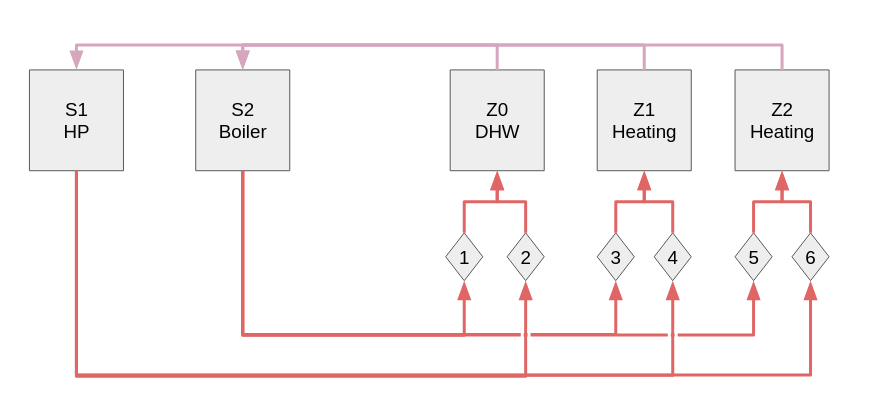
Was chatting with heating engineer brother in law at a family get together. He's shortly going to be upgrading his home system. He currently has a Vaillant combi boiler rigged up as a system boiler (ie. the DHW part isn't connected) His heating is via rads and DHW is via an unvented cylinder with a fairly large coil. It also has a secondary coil for a solar system that provides almost all their DHW in the summer. The upgrade involves putting UFH throughout the ground floor. The upstairs will remain on rads. They are all fairly oversized k2 units, with one exception which can be upgraded. The plan or the heating would be to have 2 zones, upstairs and downstairs both running at the same low temps ie, less than 40C He was pondering sticking a heatpump in parallel with the existing boiler so it could be run when it was most cost effective (i.e. when the cop is greater than 3.5ish making the p/kwh lower than gas) to that end the HP wouldn't have to be large one, possibly a 5kw Vaillant. It probably wouldn't be called on to do DHW as that is almost always cheaper by gas given the temperatures involved, though if he gets solar PV that may change. So we came up with this very simple layout Sources 1 & 2 are the Heat pump and Boiler respectively and both have their own pumps There are 3 zones. Z0 is the DHW and will require a flow of around 65 Z1 & Z2 are the UFH and Rads. They are lower temp, weather compensated. there are 6 x 2 port zone valves All the zones link back to a common return line which feeds both heat sources This should allow him to chose which heat source heats which zone. It can allow for simultaneous heating and hot water from both sources. He can heat the rads with gas and the UFH with HP. Or the entire heating system with gas. Eventually, when the gas boiler keels over, he might replace it with a second heatpump. This would give him really high modulation using just one HP in low demand periods and both together when he needs the power. Anyway, it was all a bit of idle speculation over mince pies - he is not experienced with HPs, though he has lots of experience with gas/oil/lpg systems I though i would throw it open to comment, see if anyone can spot any obvious flaws or suggest improvements etc. Merry Christmas all.
-
Can the flow temperature be too low?
Beelbeebub replied to JohnnyB's topic in Air Source Heat Pumps (ASHP)
All the kit is there. Assuming it's a 4 pipe system all that's needed to make it a volumiser is to bypass the two top connections. Which could be done when removing one of the pumps. Probably less work to make. It a volumiser than to remove it entirely. -
We actually make a surprising amount of stuff in the UK. About 10 years ago we used to be around the 5th largest golds exporter in the world. Obviously we would be behind the big 3: China, USA and Germany. Then it would be Japan, S Korea, France and UK all at more or less the same level swapping places from year to year and rank method to rank method. We"ve slipped a bit since then because of some extra trade barriers but we are still in that mix below the big 3. Just a little more mod pack, around the 6-12 place mark. The big diffence is it's no longer the mass market stuff like clothes, bikes, furniture, iron mongery etc. And it's no longer a big employer with huge factories employing thousands of workers in giant halls. UK manufacturing is more biased to high value, high skill items. Machine components, aero engines, scientific equipment etc. These are made in boring industrial units with a few hundred or even few tens of employees so we don't see them.
-
At least some vaillant arotherms are made in the UK (Belper, Derbyshire)
-
Can the flow temperature be too low?
Beelbeebub replied to JohnnyB's topic in Air Source Heat Pumps (ASHP)
If the flow round the HP is much higher than the flow around the UFH loop you will get the warm water "short circuiting" through LLH/Buffer. The fact your two identical pumps are set to the same may be a clue. The pressure drop around the HP to LLH loop will be low so the flow, higher for a given pump speed. The pressure drop around the UFH loops will be higher, just because there is alot more distance. So the same pump.setting will result in a lower flow. If the flow around the UFH is lower than the HP, you'll get the HP short cycling. Ideally you want the two flow rates to be identical but that's near impossible. I would err on the side of the UFH loop being a bit higher flow. This will reduce the temp around the loop below the level the HP produces, but shouldn't be a major problem with the low temps a UFH system uses and should minimise short cycling. -
Vaillant ASHP low pressure isues - fix?
Beelbeebub replied to markharro's topic in Air Source Heat Pumps (ASHP)
good point - i should have said "open slowly". Blind spot I guess a I do this so often it's second nature. -
Vaillant ASHP low pressure isues - fix?
Beelbeebub replied to markharro's topic in Air Source Heat Pumps (ASHP)
Agree, I didn't notice it was a new system. Initial venting could be the cause but this is the 2nd pressure drop and it should be stabilising by now. -
Vaillant ASHP low pressure isues - fix?
Beelbeebub replied to markharro's topic in Air Source Heat Pumps (ASHP)
You open both and there should be a whoosh sound as water enters the system. You may need to turn the slotted screw on the right hand side (by the lever) so it is inline with the pipe. Wait until the pressure gets to the right level (usually about 1 bar) then shut bothaand return the screw to perpendicular to the pipe (as in the picture) . To be correct you should also undo the hose and store it away, but nobody ever does that A bigger question is why are you losing pressure. There are 2 possibilities. 1) the expansion vessel (the bug white cylinder) has failed. Every time the system warms up it over pressures and water leaks out of the pressure relief valve. 2) you have a leak somewhere in the system. Both will need looking at. Don't just keep topping up every few weeks. At best you'll rust out any radiators connected to the system. At worst you're dumping water somewhere in your house. -
The point to note about output modulation is that it can be misleading to just think of a fixed % of the. Maximum. This is because the point at which you are likely to need the lowest output is usually when the outside temp is at it's highest Your HP mauly be able to modulate down to 25% of max output but that max output grows as the outside temp increaces So 25% of 5kw at - 5C is 1.25kw But if your output is 8kw at 15C it's 2kw. And your demand at 15C is lower than your demand at -5C. So for the true picture of modulation you need to look at your highest power output at the lowest OAT and your lowest power output at the highest OAT.
