


Beelbeebub
-
Posts
1522 -
Joined
-
Last visited
-
Days Won
11
Everything posted by Beelbeebub
-
The RCD bit might be the killer. The current draw is not necessarily that high. I think alot is in how the inverter is set up. The new Grant r290 units draw considerably less.
-
Yeah. The core bit is what Scop van be achived. If it is better than about 2.5 then you have emitted less carbon per Kwh delivered burning gas in a power plant, transmitting it to your house and using a heatpump than if you burnt the gas in your boiler. At that point it's a climate win.* Very true, you'proably be restricted to a 4kw nominal unit - but that should be enough for flats, new builds and terraced houses with decent insulation. Crucially if you could just stick the HP on the side of a building with no restrictions there's nothing to stop you fitting 2 or even 3 to your house. A ring main can typically handle 32A (7kw), it's just the pin plug that limits to 13A. 2 units (one upstairs and one down) would give you fantastic modulation plus redundancy. The main thrust was to make installing a HP really easy. Minimum rewiring, paperwork etc. Yeah, hydrids are a good sokution, sadly excluded by the subsidy regime. The one that is 4kw and just sits outside and taps into the return pipework is neat. The other option if, we want to go with hybrid is straight up installing air to air multi splits. Completely sepwrate from your wet heating system. The fear with air to air systems is they could be used as cooling in summer and actually drive up consumption. But if we had "approved" models that were firmware limited to a minimum setpoiy of (say) 30C, they would onky be useful coolers in the worst heatwaves, where it might actually be a useful thing to have cooling from a national perspective. But an A2A. system is easy to install and cheaper. It overlays your existing system so you don't need to worry "what if it costs too much to run" or "what if it can't keep me warm in a blizzard". Your old system will still be there. It's just you'll have another way of heating your place 99% of the time. And then one day the boiler will break and the home owner will think - why bother replacing it, I can't remember when we last used it. Yes, at that point you need to sort out DHW, but there is time to do that. Maybe the UVC with a refiderqnt coil yhatborenends to be a normal head unit. Or the stand alone HP cylinders. Or even just an immersion cylinder. Not as cheap to run but simple. * in reality, the 2.5 figure is a worst case as our electricity isn't exclusively gas anyway.
-
Yeah, the key would be if the mark was basically a sidestep around a bunch of paperwork. The idea is that a plumber should be able to go to a plumbers merchants, grab a certified quiet) HP off the shelf and stick it outside a house with zero paperwork. If the HPs came with clip on cosmetic panels in different colours/materials so the things didn't look you'd left a chest freezer outside your house it would help. Just making them black, green and brown would be a big improvement. Wheelie bins are black, green and brown and we have accepted those outside houses now.
-
At the moment the green taxes on electricity are much higher than gas. The current SCOP need for a HP to "break even" with a gas boiler is about 3.5 This is perfectly possible but requires quite a bit of installer knowhow to achive. There are many tales of people who installed HPs and ended up with higher bills. If the green taxes were moved from gas to electricity, that break even SCOP drops to around 2.5 which is very easily achievable in all but the most ham fisted installs. Secondly, the installation of HPs needs to be made vastly easier. The planning and noise requirements need to be drastically streamlined. Noise in particular. New HPs are getting below 40db. If we had a system where a HP could be given a "hush mark" or something which would allow it to be sited anywhere as long as it it 1m from a neighbour's window. It would make a diffence. If the HP required less than 13A draw, being able to have it wired in to a spur off a ring main or even just plugged into an outside socket would make life easier. Basically we need to remove as many barriers as possible. A HP is potentially easier to install than a gas boiler. Not (as some here have proved) beyond a competent DIYer and certainly not beyond a decent plumber. Make them cheaper to run than a gas boiler and easy to install with minimal paperwork and the country will switch pretty rapidly.
-
It might be a Chofu unit, but Chofu haven't got it on their website yet (which I would expect). It's interesting it seems to be bigger (power for power) than the chofu r32 units - which were nice and compact. They do seem significantly quieter though so maybe the extra size is sound insulation.
-
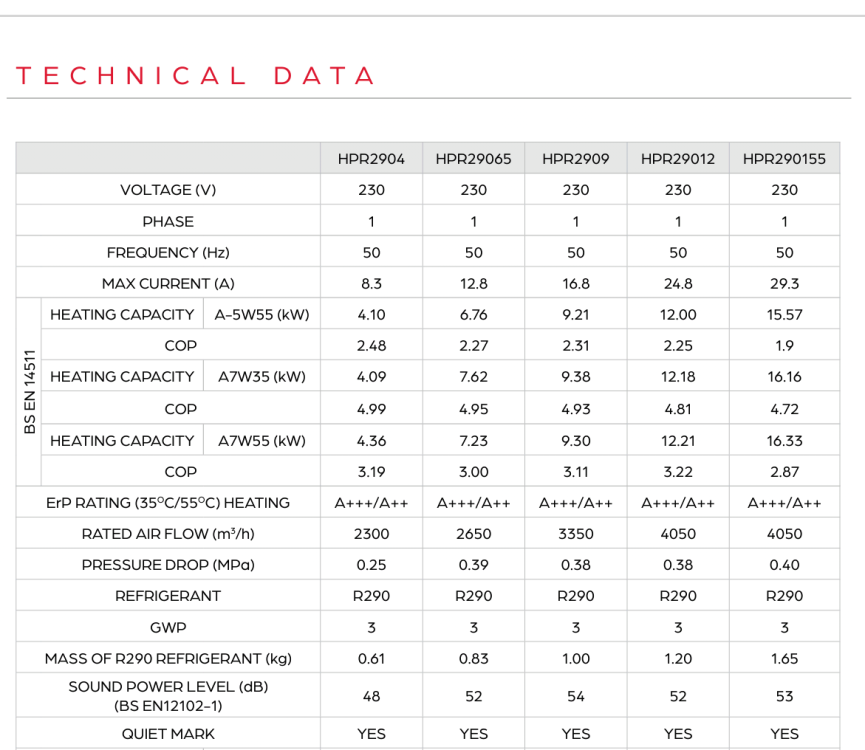
Grant have released details of their r290 heatpumps https://www.grantuk.com/professional/products/air-source-heat-pumps/r290/ As before I think it's a rebranded unit from another manufacturer but I don't think itvs Chofu, who make the current r32 units. At first glance the performance seems to be about the same (unsurprisingly as r32 and r290 units have very similar performance characteristics) The biggest difference apart from the units being black (yay!) seems to be the size. The r290 units are significantly wider. Still. Nice to see another entrant in to the fray.
-
DHW heating up when Heating is on
Beelbeebub replied to Helene's topic in Air Source Heat Pumps (ASHP)
The old approach to central heating and DHW control was very mechatronic. All the logic was done via cams closing switches and driving motors etc. The 3 port mid position valve was a very clever solution to the problems that posed but IMHO it can all be done these days with 2port valves directly wired to the (microprocessor) controller. The only need for the micro switches is then simply as confirmation the valve has opened/closed. A very simple system can be done with a 3 port valve just driven full A or B but if you ever need a 2nd heating zone (eg upstairs radiators) you might as well go with all 2 port valves (S plus I think it used to be called). -
DHW heating up when Heating is on
Beelbeebub replied to Helene's topic in Air Source Heat Pumps (ASHP)
It looks like you have an S plan layout. Each of those valves are basically on/off valves that either let the water flow through or don't. For the old gas systems there were 3 modes Heating only - heating valve on, DHW off DHW only - heating valve off, DHW valve on Split - both valves on. This worked because the flow temperature was set by the DHW demand ie. About 65C For heat pump systems you only have heating or DHW on at any one time as the flow temp is differnt for heating and DHW (usually). So it's possible that a) your DHW valve is stuck open, or at at least is leaking some flow past. B) your system is acting as if it was a gas boiler and trying to do both. The thing to check is if the DHW valve is activating when in heating mode. You can do this by listening for the motor wjen it switches or by fiddling with the lever. If the lever flops about the valvle has a to activated. If it is stiff then it hasn't. . -
DHW heating up when Heating is on
Beelbeebub replied to Helene's topic in Air Source Heat Pumps (ASHP)
Bit difficult to say without a look but the problem could be that the.diverter valve isn't diverting the flow to the heating circuit so some water is flowing through the DHW circuit. Some tests to do What happens when the DHW cycle is on. Does any hot water go to the heating? Does the valve move at all between modes? If the vlave isn't moving it could be the vlave has a fault, either physically stuck or maybe the seal isn't working properly so some water is sneaking past. Or it could be the actuator - maybe that has a fault. If that is all working OK, it could be an issue with the signal going to the valve. You mentioned a new. Controller has been fitted. Has this been wired up correctly? Are the connections tight? Has it been configured correctly? Sorry it's not more helpful. -
DHW heating up when Heating is on
Beelbeebub replied to Helene's topic in Air Source Heat Pumps (ASHP)
It sounds like your diverted valve isn't working properly. Also check if your heating is getting warm when the DHW is on. -
From an UFH perspective I originally had several zones each with a time controlled thermostat. It wasn't very satisfactory. Different rooms at different temperatures doesn't seem to work. The heat always leaks in between rooms faster than your floor can put it in. We were ending up with the system trying to heat the entire house from just one floor zone, which ended up very warm. I eventually ditched all of them for a single zone and no timer. Just a simple thermostat. Balancing by room was done by tweaking the flow rates and the flow temp was adjusted as low as possible - abkut 28C from memory.
-
When the UFH flow Temp is <35C, dhw?
Beelbeebub replied to Post and beam's topic in Air Source Heat Pumps (ASHP)
Thats daft and uneccesary as you have to put in a valve for switching between DHW and heating anyway, so why would you design the heating temp to be higher than it needs to be? That sort of thinking sharks back to (old) gas boiler days when you only had one flow temp so set it based on DHW (usually over 65C) and then designed the heating system around that temp. If your installer is using that logic you need a different installer. -
Dont understand this term in a heat loss calc
Beelbeebub replied to Post and beam's topic in Air Source Heat Pumps (ASHP)
One thing to note about modulation is, a HPs output range is dependent on outside air temp. The spec migbt say output 3-10kw (so 30% modulation) but it might modulate from 3 to 7kw at -2C but 5-10kw at 12C As you're more likely to bump into cycling when it is warmer outside, the minimum output at 12C and max at -2C (ie 5 and 7kw or 70% modulation) are the more relevant measures. -
I would argue the costs would be lower than the current 7.5k BUS grant which seems to be, for reasons discussed, just seen as a bonus for the closed shop installers. This incentivises doing jobs at max cost with little thought of the best performance. (as an aside it would be interesting to see if the average before grant cost of installs has risen by 2.5k since the grant went from 5 to 7.5k) Yes the heat meter would cost a bit (that would be provided free to consumer as part of the subsidy) but if they are standardised and knocked out they aren't that expensive. No special elec meter is needed, the monitoring of power in is purely for cop calculation which isn't needed for the subsidy only heat delivered. The whole thing would be administered by the energy providers. This would allow the installer base to be widened out to beyond just MCS peeps (reducing costs and increasing choice). As you say the cost of a HP unit isn't much more than a good boiler and it seems that much if the "upgrades" needed like buffers, second pumps, fancy controls, replumbing in 28mm throughout, completely new cylinders etc is actually suourflous at best and harmful at worse. The best results seem to come from single zone, open loop WC systems with a single diverter and a cylinder with a high recovery coil. Better yet would be to only upgrade bits (like the cylinder) if required. So install the HP, leaving everything as is (cheapest option). After year, if scop isn't to satisfaction the customer isn't out of pocket but can upgrade the necessary but (maybe a rad and small section of pipe or the cylinder)
-
If we assume good case of a 3.5 scop install delivering 10,000kwh a year with gas/elec being 10p/35p that works out at £400 a year paid back and a saving for the customer (vs gas) of £400 a year. Over 10 years that would be 4k paid back and at the end the customer is still paying exactly what they were on gas 10 years of near guarentee you will pay the same as if you were on gas gives plenty of time to sort out any botched installs.
-
In order to qualify you have to have the supplied heat and consumption meter fitted (tamper proof box). Say your system delivers 10,000 kwh heat over a given period. At (for easy calculation) 10p a kwh for gas that would cost £1,000. The scheme assumes your HP is 2.5 scop so your elec consumption would be 4,000 kwh. And at (again for ease) 35p kwh of elec you would have paid £1,400 for elec. So the scheme pays you back £400 and your heating has cost no more than gas. If your Scop was actually 3.0 you would only have paid £1,165 and you're actually "made" £235. So the way to scam the system (aside from tampering) is to make your system more than 2.5 efficient. Oh no! (clutches pearls). The 2.5 assumption increases each year until it hits cost parity with electricity (3.5 in my example). There would be a cap on total oaynents/subsidy of £7.5k so it would never cost more than current system. Aside from people outright tampering with the meter box I can't see how you can defraud the system except by making a really efficient system. As the actual performance would be availble (via the box) it could be published on a big website along with the installer details. Installers could then go to customer and say "look I regularly get 4.0, with your type of house so use me!". Gokd installer would be able to charge a premium and also be incentivised to minimise install costs.
-
Waves flag for government spending the money on a guarentee scheme so that HP will cost no more than gas for 5 years. If the assumption is a scop of 2.5 then anyone getting a better scop actually saves more over the period making the payback loads better and gives time to rectify any under performing systems.
-
Quote for ashp - didnt expect that much!
Beelbeebub replied to TheMitchells's topic in Air Source Heat Pumps (ASHP)
Look at fancoils, that have higher outputs for a given water temperature. -
My understanding is that VRF system have branch boxes that contain some valving - which is fine but extra expense My "proposal" was for the pipework to be dead simple. Effectively the same layout as a 2 pipe wet central heating system. The major difference would be the indoor units would have a valve roughly analogous to a TRV but electrically controlled that woukd either allow gas to flow through the finned coil (and turn fan on) or not. If you want to add a second indoor unit to a room all you need too is tap into the existing flow return and wire up the electrics. More or less the same as adding a radiator to a room or even extending the system on to a new room. Rather than having to run a new flow/return set from the outdoor unit (assuming you have enough spare ports) Was really just an idle thought on how we could make installing A2A systems easier and quicker (thus cheaper).
-
Quote for ashp - didnt expect that much!
Beelbeebub replied to TheMitchells's topic in Air Source Heat Pumps (ASHP)
Which takes me back to my argument that rather than subsidise the installation and create a closed shop of subsidy harvesters we should subsidise the consumer directly. If the unit is monitored (power in vs heat delivered) basically using a prepackaged meter system provided as part of the subsidy, you can monitor how much heat was delivered. The scheme then looks at the difference between how much that heat woukd have cost if you had used a gas boiler vs how much you elec did cost. It then subsidies that difference - so the consumer never pays more than they would on gas. But also if they are more than 3.5 efficient they actually make money. The subsidy tapers off after (say) 5 years. Any money left unspent from the £7.5k pot would be split 50/50 between the installer and the consumer. This woiod give consumers certainty, 5 years to troubleshoot any problems and an incentive for both the installer to get it right. Would also allow a picture of installers efficency to be built up. The key but woukd be the monitoring package which would be a box with 4 ports (flow and return in and out) plus power in and power to heatpump and a radio/modem unit for sending results. Basically an open monitor but in a tamper proof box Would be adminstered by energy suppliers so all done via your bill. This way the installers have zero incentive to inflate costs as they just won't get the job. It will go to another company who didn't pad the job.. But also an incentive to do a halfway decent job so they might get some windfall split in the future (the scheme might do it annually to improve incentive). As the payments are based on actual performance not estimated we coukd ditch the approved installer approach. The only qualifier beyond basic industry training eg electrician, would be thr installer using the monitor box (supplied by government) Would also build an amazing database of performance -
I'm aware of VRF systems and thry are overkill for domestic situations. Which is why I was wondering if there was a simplified version for domestic systems. The need for simultaneous heat and cool is small in domestic situations (the possible exception being DHW production in summer) What would be useful in domestic situations (heating particularly) would be the lower pipework requirement of a "series" system vs the current "radial" systems (aka multi split) For example a typical upstairs would have 4 or maybe 5 rooms to heat. That is towards the maximum of most domestic multi splits and would require 4 or 5 pairs of pipe to be run from the outside unit to the top floor. If a single pair of pipe could be run to the first unit. Then on to the second and so on it woukd reduce installation cost and disruption. I would envisage the indoor units would come with 4 ports as standard, an in pair and an out pair. The out pair would be blanked off with plugs by default and the pipework (basically a post of tee connections) would already be in the unit, avoiding the need for onsite brazing. This would reduce the skills and material for install. It woukd also make adding an extra unit very simple. As adding extra units would be simple there would be less need for a high power density in the units. They could be simple 1kw units with basically a finned tube radiator, simple fan and a valve making them cheaper. If your room needs more heat input, just add another. The lower power density would also mean lower air flow requirements thus quieter. Is there a practical reason why this system doesn't exist? I don't think the system would need variable refrigerant volume or any fancy valves beyond the normal reversing valve in the outdoor unit and a open/close valve on each individual unit to shut off any hot gas flow into the coil if that room doesn't require heat.
-
The traditional A2A split unit has a AI vke outdoor unit (with compressor) and a singke inside unit with a flow and return line between them and also (usually) a condensate and power/data cable. Each inside u it has a corresponding external unit. In effect each one is stand alone. There are multi splits. These have several indoor units and one outdoor. Crucially they all appear to have one flow and return (plus date etc) lineset to each indoor unit. The number of indoor units is fixed by the number of "branches" on your outdoor unit and you have to pipe a radial system with lots of pipes going to and from your main unit. Is there a resin why there are no systems where the I door units can all be connected to a common flow and return, much like a wet central heating system? Although the flow would be live to each indoor unit, a valve could prevent any gas flow into any "off" units so the heat output would be minimal. It would seem this method would make the piping of such whole house systems with potentially 8 or more indoor units, much easier. Just pipe to unit 1, then on to unit 2 and so on. Obviously the units would need to be designed for this. Is there a reason why this isn't a thing? What am I missing?
-
Mini Store - Heat Geek / Newark Cylinders for ASHP
Beelbeebub replied to Nick Laslett's topic in Air Source Heat Pumps (ASHP)
To be fair,.we.had some tenant who moved from a coal fire in each room and immersion to a combi and they struggled with how little they had to do. At one point they were having issues and it turned out they were leaving it off and turning it on each time they wanted hot water! They complained it was too inconvenient to walk from the bathroom to kitchen to turn the boiler on to wash their hands! 😁 It took a while to impress upon them that they just needed to leave it on and not touch it at all. -
Mini Store - Heat Geek / Newark Cylinders for ASHP
Beelbeebub replied to Nick Laslett's topic in Air Source Heat Pumps (ASHP)
For better or worse, the combi is the yardstick. I don't think people really need actually infinite hot water. They just want to not have to think about it. They also want the space a big cylinder takes up for other things. Right now the relatively big cylinder specified by manufacturers and installers is a bit of a barrier. Both in cost and size. The HG system is a good attempt at making the installation a bit lower friction. As long as the hot water delivery is good enough - ie the times where the customer has a tepid shower or has to wait 20mins for the cylinder to recharge are very few, then it's a great idea. A 9kw instantaneous water heater (variable power controlled to just top up the temp if too low) afterwards would extend the hot water delivery time and not fall foul of g3 regs. -
Mini Store - Heat Geek / Newark Cylinders for ASHP
Beelbeebub replied to Nick Laslett's topic in Air Source Heat Pumps (ASHP)
But it's DHW cycle is limited. For true combi performance we need to produce hot water for an infinite time. If you don't defrost you HP the capacity and efficency drop (which is why we do defrost them). That will eventually mean the amount of hot water you can instantaneously heat will fall and your bath or shower will become tepid.. You already get this if you have to many hot water draws on a combi. If someone is showering and someone else fills the bath, the flow rate and temp fall. What people really want for a "just like a combi" heat pump is an installation that takes up similar internal room to a gas boiler. As HG identified the issue is more the storage of hot water. Current approach is a large UV cylinder. This is OK if replacing a large UV cylinder but when you are swapping a vented cylinder you get the g3 issues and when you are swapping a combi you get the G3 and space issues. A combi or at most,. Kitchen unit or kitchen cupboard hot water storage and delivery system that could operate efficiently on a HP (ie no high temp bricks or phase change) woiod be very useful.

