


Beelbeebub
-
Posts
1522 -
Joined
-
Last visited
-
Days Won
11
Everything posted by Beelbeebub
-
I assume you have an unvented hot water cylinder. The grant system (assuming they have installed as per instructions) uses a totally seperate anti legionella system basically a timer and immersion you set to go off once a week. So you can set the hot water temp to as low as provides enough water at a hot enough temp for you. The next thing is to check if weather comp is active. It might not be if your installer was not on the ball. The easiest way to check is to feel the rads. Are they warm to the touch, and does that vary? Ie on a cold night are they warmer than a mild day? Do you have a single thermostat or one of each room?
-
Need to work out what setting you have now before any changes. Did they swap radiators, put in new pipework? How warm do they get? Have you got Underfloor? How warm do those radiators get? Is it always the same? Is your HP running continuously or starting and stopping all the time? One thing to note is you will not be able to generate enough electricity to power your HP through the winter. You will be paying for some electricity. If things go well, the extra you pay for electricity will be less than you would have paid for LPG.
-
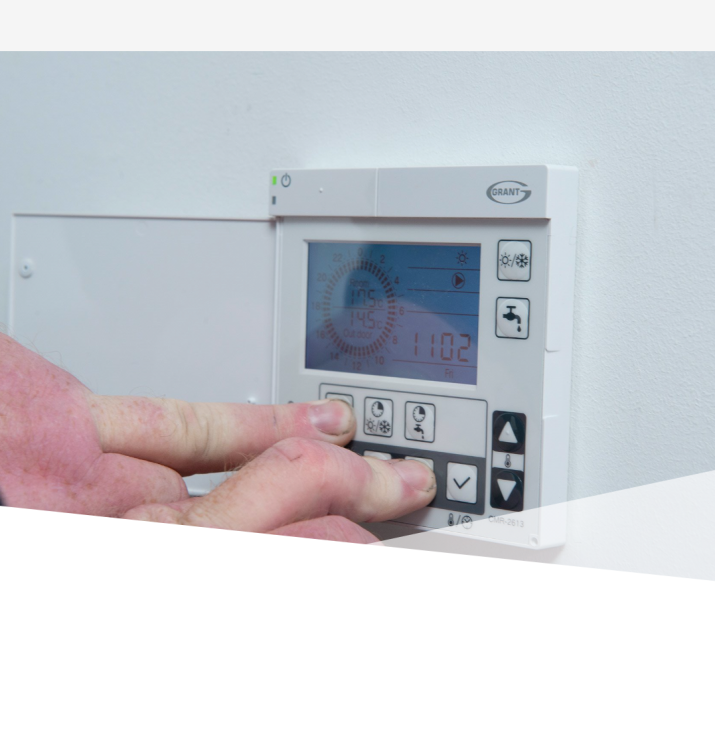
Welcome. As the others have said, what is your setup? The Grant units are pretty good but they are setup from the factory to act like oil/gas boilers so they are more familiar for installers. In particular they tend not to use weather compensation but just set a fixed flow temperature for your UFH/rads and control the temp by turning on and off via a standard thermostat. This can really hit the efficency. There are ways of setting the system to be more efficient. Do you have the white control unit?
-
I recall there was a fair bit of resistance to the switch to condensing boilers. Clouds of steam, condensate drains, more cost and complexity, less reliable (the heat exchanger rotted out fast in early ones). People found endless reasons why they were a bad idea and a dead end that we would regret installing. Now they are standard, nobody blinks an eye. The diesel "gov said we should have diesel now they changed their minds - idiots!" (normally followed up by a rant about wokeness or something) is a but more nuanced. The switch was for carbon emissions amd they are lower carbon per km than petrol though that advantage has been erroded by the introduction of evermore powerful diesel and evermore frugal petrol units. But the turn against them now is because of air quality problems, specifically. nitrogen oxides and particulates. Back in the 90's these issues were known (my first job was in diesel particulate abatement) but the view was they weren't an issue. Of course one diesel engine in 10 spewing Nox and PM2.5s isn't a major issue. When you have half of the vehicles doing it, and they have got bigger because everyone needs a 250bhp turbo diesel to haul their 2 ton SUV around town. It becomes a bigger issue.
-
You are right, to an extent it is a money issue, but then so is installing a heatpump! You can't handwave the costs of installing to the aesthetic requirement as but then also point to the costs of installing a heatpump! Right now we could heat almost any building in the UK with a heatpump and achive a better than break even scop. The exceptions are off grid houses or those with an insufficient electricity supply for their demand (big stately home on a poor single phase supply) But a 40kw HP is bigger and more expensive to install than a 40kw boiler and UFH or fan coils or k3 rads are more expensive to install than some k22 ones you can grab down screwfix for £150 each. Dont get me wrong, we should be insulating houses, and looking hard at things like AONB and listing when they get in the way of efficency, but HPs are the absolute best way to cut our heating carbon emissions (which are significant) We will always need gas for some uses - high temp industrial,maybe some cooking, portable power even vehicles. But keeping you living room at 20C isn't one of those uses.
-
I agree we need to upinsulate alot of houses and external is the preference but that bumps into a raft of issues itself. Fire safety is obviously top of a lot of minds but also damp prevention especially when the roof overhangs are less than the cladding thickness. Then there is the biggie - appearance. External insulation will change the appearance of buildings. In places. Like the cotswolds this is going to be unacceptable. Nationally we need to reach a consensus about priorities, climate change or olde worlde cottages. But there are many houses that are already suitible for HPs. If your max hear demand is less than about 12 kw, which is about half the properties already, then they are good to go now. Realistically there isn't much point of getting the max demand below 4 kw as your sizing starts to be dominated by hot water demand. But efficency isn't affected by the size of the unit. If you have a large leaky house you can still achive a high SCOP. You just need a bigger (and more expensive) unit. The scop is (largely) determined by the flow temp. The reason people think big leaky houses can't be efficiently heated is because they also tend to have undersized radiators. The tendency was, my In-laws farm house as a case in point, to run the rads hot (scalding hot) to compensate as it didn't really affect the consumption but replacing dozens of radiators with k3's would be expensive.
-
The cheapest thing to do in most cases is a like for like swap, but for co2 reduction it is always Heatpumps. So we need to decide (as a nation) which way to go. 3.4 is doable in most properties as long as you can get the flow temps down below 45C. The capital cost is the issue, both for upgrading the emitters to achive the lower flow (and any water cylinders if required) and also the unit itself. A large leaky farmhouse could be heated efficiently but the cost of the 30kw heatpump would be prohibitive. There is no reason HPs can't achive cost parity with gas boilers - it's just production volumes and supply chain. Any all electric houses (about 2m) should be converted ASAP. In fact it would be a good way to "prime the pump" for the supply chain. Offer really generous subsidies for swapping storage heaters and direct heater houses to HPs - air to air if necessary (cheapest way). Thwt will give you 2 m households to build up the industry with.
-
Do we have any figures for how many kwh or bio gas you can get per hectare of land? Ideally net figures as I imagine there is considerable use of tractors and other fuel hungry machinery to harvest, prepare and transport that biomass. And do we have the figures for how much land we would use to replace all fossil gas with bio gas? I have a gut feeling we would end up needing an unrealistic amount. Beyond that is there a figure for the efficiency of harvesting biomass, digesting it, piping the methane to houses and burning it for heat vs harvesting the biomass, burning it, transmitting the electricity and using a heat pump. I get that people like gas boilers, they are super convenient. A small and relatively cheap box that fits in a cupboard that can do all you heating and hot water via some small and cheap radiators you already have fitted. That is very attractice
-
It"s a fair point - we still get the slightly disingenuous "3 or more time more efficient" line, which is true but for people on gas that still isn't enough to make it cheaper. There are a growing number of "typical" homes out there achieving cost parity or better with gas boilers. The insulation and air tightness aren't actually the issues, all they affect are the size (and hence cost) of the HP and emitters. But the difference between gas and (typical) electric unit costs is the issue. Currently it's 3.5-4.0 meaning your SCOP needs to be 3.5+ to break even. Possible but not a given. If the differential dropped to 2.5 ie 10p a gas unit and 25p electric, then the break even performance would be 2.5 and people would be rushing to fit HPs. I seem to remember doing a fag packet calculation that if we moved the Green taxes from electricity onto gas it would push the ratio below 3.
-
Stop pushing heat pumps or face major backlash, green energy magnate tells Labour Party donor Dale Vince warns that urging homeowners to switch to clean-power technology risks political storm bigger than Ulez Dale Vince, a major Labour donor and renewable energy advocate, called on Keir Starmer to rethink national programmes, championed by Boris Johnson, pushing the technology. “It’s a Johnson-era policy, and like most Johnson ideas, it wasn’t thought through,” Vince said. “It wasn’t meant for the real world, if you look at the amount of money committed. Electricity energy bills overall in our households will go up unless you assume heroic levels of performance.... " And now we come to the kicker..... " Vince claimed that he was speaking in the “national interest” in criticising heat pumps. He proposes an alternative – green gas, or biomethane, made from organic material, which his company Ecotricity develops." Isn't it convenient that the thing that is in the national interest just happens to be the thing his company is pushing..... Astonishing coincidence. https://www.theguardian.com/environment/2024/oct/12/stop-pushing-heat-pumps-backlash-green-energy-magnate-labour-ulez
-
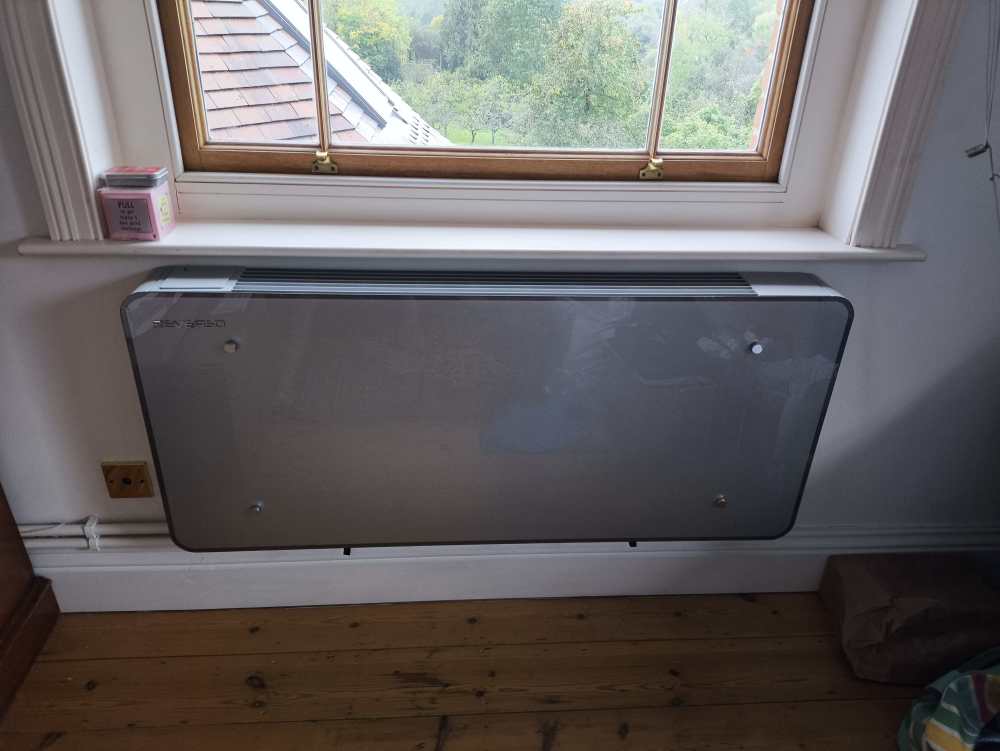
Fan comfortably kept the room at 20C (low point of 19.7C) whilst it got down to 1C outside. Fan was on maybe 2/3 the time in fairly short bursts (my thermostat is a bit twitchy) flow temp was 40C ish, probably a bit below.
-
ASHP sizing, heat loss calcs, buffers
Beelbeebub replied to Dunc's topic in Air Source Heat Pumps (ASHP)
A decent UFH setup in a well insulated house needs flow temps in the low 30's or even high 20's. A flow of 45C is way too high. Make sure they put the pipes in at a decent spacing and don't thry to cheap put by having 300mm or more spacing to allow for the low outputs needed. -
ASHP sizing, heat loss calcs, buffers
Beelbeebub replied to Dunc's topic in Air Source Heat Pumps (ASHP)
Fair enough. Your specs seem good and your design point very conservative. Unless you are far north -5 isn't very common and 21C indoors is nice and warm. Your calculated heat loss is well below the output of the lowest sized HPs. So I would suggest go with a small unit (assuming you don't have an unusually high hot water demand) use a single zone system, weather compensation, no buffer etc. If you are really paranoid then make sure you have a little extra space on amd around your installation site. If the absolute worst happens and your 4kw HP isn't quite enough you could always swap it for the next size up a 6 or 7kw unit easily. They are typically only slightly larger. So site your unit as if it were a 7kw eg don't get right up against the limits of the space around it requirements but pop a 4kw unit in. -
No, it was some video about the factory in NI. Usual stuff about bringing employment and being in control of the process. But one shot had a guy putting the sticker on. https://youtu.be/u-kAyg6LOaw You're right about that video, awful placement - I'm a fan of Heatpumps (ha) but I'm not going to argue they are beautiful things. The best we can hope for is unobtrusive - and that isn't.
-
ASHP sizing, heat loss calcs, buffers
Beelbeebub replied to Dunc's topic in Air Source Heat Pumps (ASHP)
If your heating demand is under 2kw you'll struggle to get an (air to water) HP rated for much less than 3.5kw. Has the house been built yet? Such a low demand might suit an air to air HP (aka air conditioner) instead (depending on layout, preference etc) -
Did wonder how big a surface area you would need for passive airflow to be enough. I think, given your radiators have a dT of around 20C to the room, and you probably don't want a dT of 20C between the evaporator and outside temp, you would need about 4x the area of your internal radiators on the outside of your building. That wouod imply a dT of 5ac between your evaporator and the outside air.
-
The refrigerant to air heat exchanger seems smaller than comparable units, partly because of the design of the case. Most "box" units have an L shaped coil to get extra area. Then all the gubbins off to one side. The Octopus one is just a square heat exchanger with the gubbins infront/below. I'm thinking there is probably a really good reason that almost every aircon/heatpump outside unit uses this offset box configuration.
-
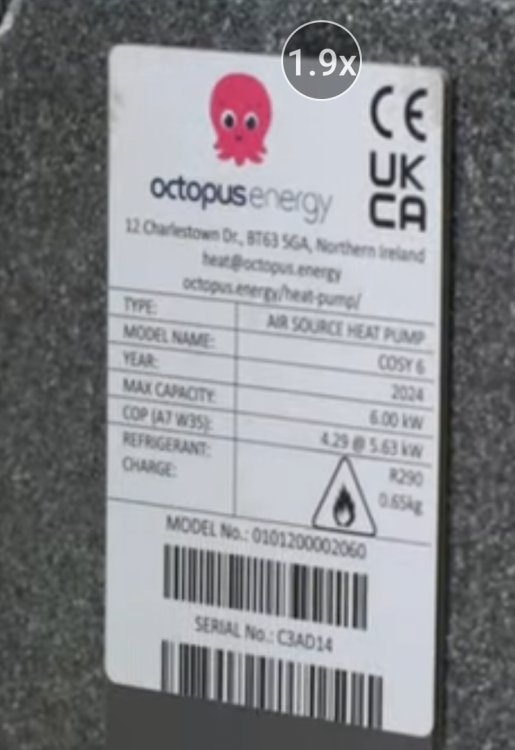
Screenshot from a video The A7W35 performance of 5.6kw with a CoP of 4.29 doesn't seem very impressive. For example the Grant r290 unit is rated at 4.99 at 4KW for the smallest and 4.95 at 7.6kw. If the Octopus unit was very small and compact it migbt be forgivable but it seems pretty, err, "portly" to be honest. Maybe it is very quiet. It is notable the Octopus unit uses 600g of refrigerant which is the same as thr grant 4kw unit. So maybe the Octopus unit is working harder so sacrificing CoP if it was derated to 4kw maybe it would perform like the Grant unit. I wonder what the noise levels are like.
-
Oil to ASHP decision - RHI and changes next year
Beelbeebub replied to RichardL's topic in Air Source Heat Pumps (ASHP)
Yeah, you have the slightest internal leak and the house stinks forever. If it gets into flooring or anything it's scrap. Never been to a house with an internal oil boiler that didn't smell of diesel fuel near the boiler. -
Radical different heat loss and radiator output quotes
Beelbeebub replied to Matty D's topic in Air Source Heat Pumps (ASHP)
I think the 1.3 holds good for standard designs, but if you had some sort of designer rad, or on maybe a cast alu rad with lots of fins, it might change a bit. -
The floor standing unit. There is a caveat with the nose levels. It has various fan speeds from about 200rpm to about 3000 that are selectable via dip switches. The factory low setting is something like 800 or 1000. And is audible, though not loud. 200 is dead silent, 400 you need to put your head next to it, 600 is just audible a few feet away. I set mine at 400, which derates the output from the tables in the data sheet. My advice is go for the biggest that will fit/you can afford and run at a low fan speed. The other thing to be aware of with the reverso. They are Italian I think and the dimesnions of cutouts for pipe access etc are subtly different to the UK norms so the pipework has to kink slightly - not big problem but annoying. I'm going to try the Myson high wall units in another room for comparison of noise etc.
-
Long story. It was a weird system from the late 90's. Basically these little rubber tubes. The material was "santoprene" I believe. Very flexible and the company had a 50y guarentee. They went on about how it was used by NASA and in medical etc. The problem was the material became brittle when exposed to warm water with dissolved copper or iron in it (can't remember which). Space rockets and medical devices don't encounter this often! But central heating systems...... Anyway the first pipe went after a few years, which is when my parents found all this out. They also found the company had folded due to all the warranty claims. Anyway, the system has limped on for anther 20 years by being run at a low pressure and temperature (sub 1bar and sub 40c) but has finally given up the ghost when my father, who has dementia, decided the central heating needed topping up and forgot to turn off the filling loop. System went up to 2 bar before the pressure valve went, but not before it split multiple pipes. I took up one room and the pipes were like old plastic. You could split them.with your fingernail in places. I replaced that room with a DIY speedit pipe system. But it was a faff, so I tried another route in another room - fancoils. TLDR: don't use experimental UFH systems, stick with PEX pipe
-
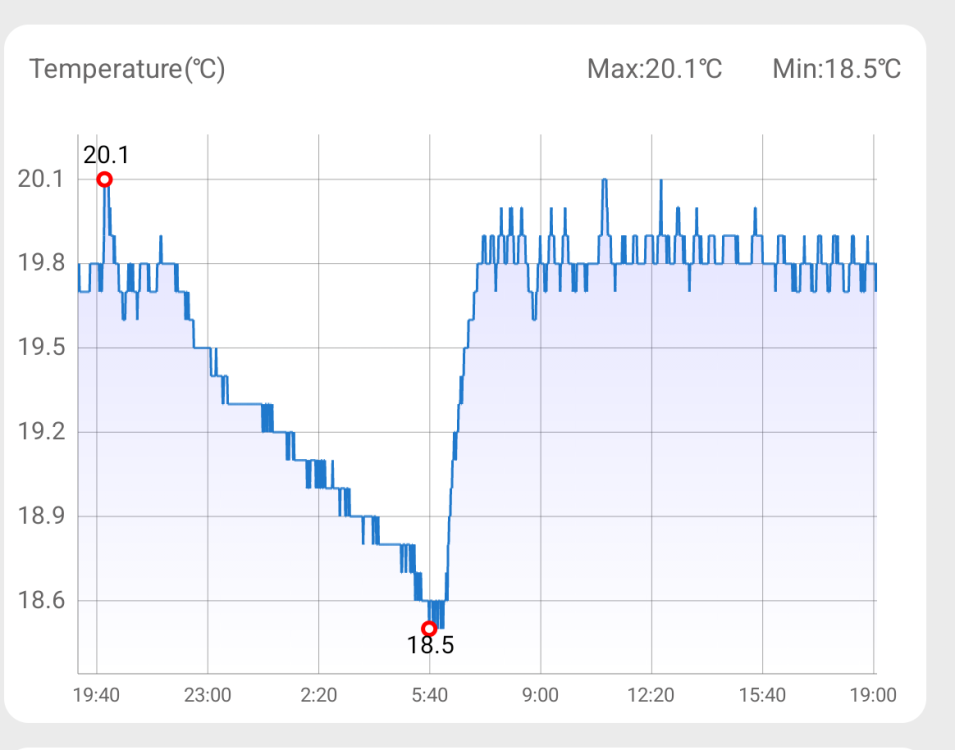
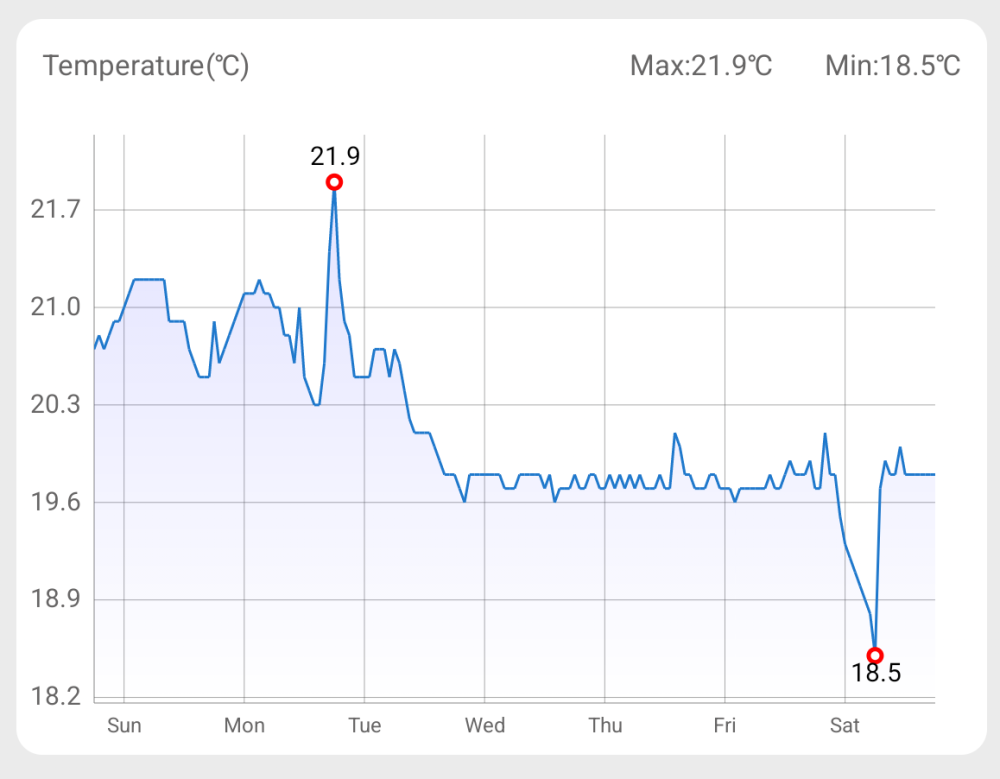
Little zoom in on the 18C setback.
-
So I fitted a reverso fan coil back last spring. Obviously it didn't get much use until recently. It's fed by a 40C underfloor circuit. The whole house is on underfloor so there is a single blending valve for the heating circuit. The fan coil was plumbed in tk replace the dud UFH circuit. The room was controlled by a thermostat (ancient danfoss unit) opening a 2 port valve. The warm water then flows and the unit's fan is switched by a slightly bodged setup triggered when the flow into the coil rises above 37C. Anyway, I have a few days of data to see how the system is handling temperatures. Prior to Wednesday the hearing didn't kick in as the room never dropped below the 20C setpoint The 18C drop on Friday night was due to me setting the setpoint to setback to 18C from 10pm to 6am. This also gives an idea of the unheated performance of the room. Overall I'm pretty pleased. The unit is not running continuously, which means i could have lower flow temps. It is near silent. The biggest clue to it kicking in is the ping from the thermostat relay.
-
So a 4kw unit would just about be doable, possibly a 6.5kw depending on what the continuous vs surge currents are. Prob enough for a flat or a reasonably insulated terrace. Two units would do a lot of houses and 3 would do most. But it would be a big shift in mindset.







