sharpener
-
Posts
1492 -
Joined
-
Last visited
-
Days Won
1
Everything posted by sharpener
-
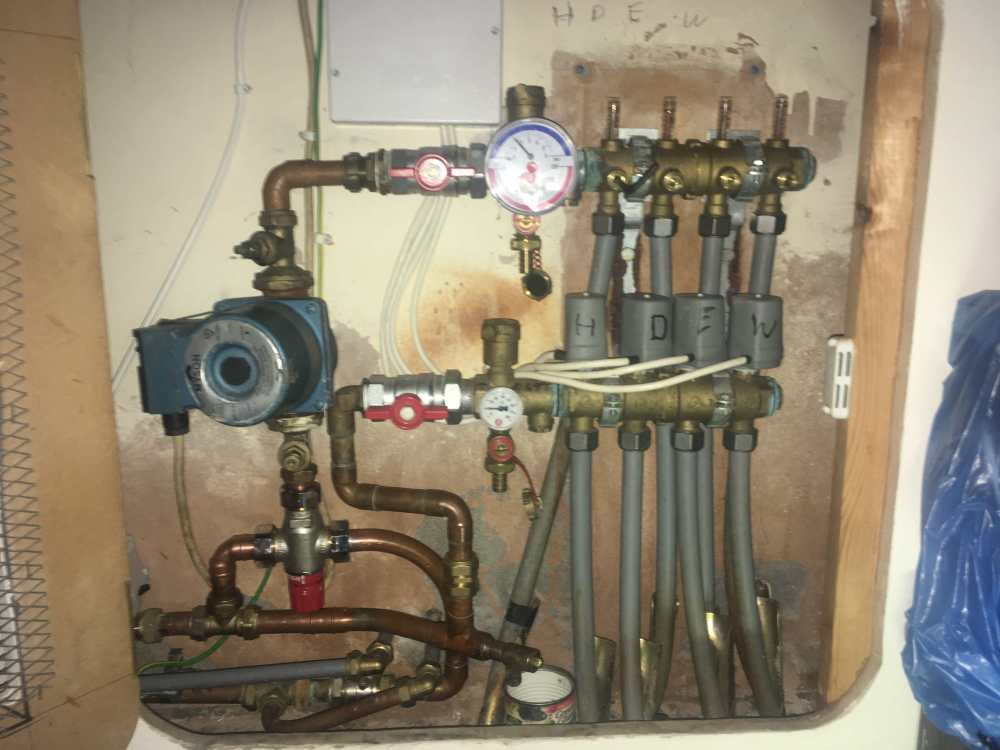
Needed one capillary coupling bc there is no room for a compression one under the TMV, and took the opportuity to move the drain cock round a bit so I can now get a hose on it out through the cupboard door. Otherwise it is all easily dismantlable for access. A lucky bonus was that where the new T is there was a (redundant) isolating valve, and its end cap thread was the same so I didn't have to get the nut and olive off the pipe. Bizarrely the top joint on the T (which was all new) was the only one I had trouble getting to seal, all the re-used old olives sealed first time with a smear of Hawk White. As you say, happy days when it goes well but I am glad I did something else for a living.
-
Job hasn't turned out quite as I expected. Ordered a Reliance online, was sent old water-damaged stock with a date of manufacture 2010 so I asked for and got a full refund. Had noted the locking ring requires you to take the entire knob off so losing any relationship with the calibration markings (current model may of course be different). Also the bumf says all ends are compression but this is not true, the outlet is a union fitting that needs soldering to the pipe. Then ordered a 22mm Inta. More compact and seems better designed, though instructions are pretty sketchy. Regulates to 35C quite closely. Quite heavy and bulky bc (I think) the casting is the same as for the 28mm model, ports are just drilled smaller. Seems more flow resistance than the unknown old one, loop flow rates are about 1/2 what they were. Well 11 compression joints and 5 capillary ones later it is all in place with a few mm to spare and does not leak. But weather now too warm to evaluate properly. (Original pic is here, the scorch marks are not mine!) This softened the black magnetite(?) deposits sufficiently that I could carefully scrape the inside of the sight glasses clean using the threads of a 2 in woodscrew.
-
MCS position in the market is no less entrenched. They seem to have fixed many of the bugbears but the assessment position being in the middle of free space could still be problematic. Has there been discussion of this elsewhere on the forum which I missed? Can't easily find an authoritative link to an actual "in force" date, has one been announced?
-
ASHP - how noisy are they in reality
sharpener replied to Walshie's topic in Air Source Heat Pumps (ASHP)
Vaillant twin fan (12kW) facing next door, neighbour cannot hear it and it is near silent at up to 85% output, above that there is a slight buzz but you wouldn't want to be outside for long when it is that cold. -
That's reassuring, it's a new build so presumably can be made to meet modern standards. But losses through walls and roof must be very low with a total net 348 sq m only needing 5kW, which is under 15W/sq m* so the accuracy of the air change prediction is probably quite important. So I would seek assurances from whoever specified the MVHR and its mfrs rather than rely on a guesstimate from the HP installers. *that's 4x better than our barn conversion at 60W/ sq m

-
To me the big unknown is the 50% discount in the heat loss calcs from the assumption that the MVHR will recover 50% of the heat that would otherwise be lost through ventilation, I don't know how realistic this is. OTOH they have assumed all rooms will be at 21C. For most ppl this is too hot for a bedroom and 18C ensures a better night's sleep. Ditto Utility Room and some others perhaps.

-
OVO which tariff first before heat pump add on
sharpener replied to connick159's topic in Air Source Heat Pumps (ASHP)
Well if you were on Octopus before you will know that none of these things are necessary with Cosy. It took them many weeks to install a smart meter and switch my exports from Good Energy but is has been seamless ever since. -
Yes, it does not look brilliant but all is operational so a lot more work to replace it esp if I have to move/extend the loop tails. Have currently got the sight glasses soaking in de-scaler, do you know of a better way of cleaning them? Sorry to disappoint but I won't be employing a plumber for this! In addition to the new mixing valve it will as you say need a couple of elbows as the cold inlet will be where the control knob is and v-v. But a small DIY job compared with fitting 3 extra rads which is what I did before the HP was contemplated. Has no-one got any views on the relative merits of these various valves or do they all come from the same Chinese factory anyway?
-
Thanks @Nickfromwales. The TMV isn't mounted on the manifold (there isn't room) but beneath the pump (as in the pic in this thread) so to shoehorn it into the same space I want to replace it with one with 22mm compression fittings like this own-brand. Or this RWC or this Inta, is it worth paying the extra money? Thanks for all your help on this forum!
-
Yes, obviously the Rolls-Royce of mixing valves. But is designed to plug straight into an Ivar manifold and not mine (make unknown). Have now taken the original valve off and all three ports communicate whatever the knob setting! Taking it apart, it clearly has a thermostatic capsule but the internals are all seized solid. Simplest(!) is to re-do some of the pipework to suit a modern valve, they all seem to have the inlets at the two sides and outlet opposite the knob. Choice seems to be between the Inta or RWC or the cheaper plumbing/UFH outlets' own brands at about half the price. Maybe @Nickfromwales has some advice? Current thinking is that with the valve to set to say 37C then with the flow at correct temp for the rads it will close down to admit the right (small) proportion of hot and mainly recirculate. OTOH without any call for heat for the rads the HP will provide flow ~35C, so the valve will open right up and present no restriction to its full output going into the UFH. So the switch between modes should be automatic. But the catch is at startup, I think I will need to ensure the rads circuit gets up to temp for say 30mins before the UFH is switched on to ensure there is a store of water at ~45C to make sure the valve closes correctly. If not it will remain fully open, the return flow will be diluted by cold return from the UFH and the HP will never get hot enough for the rads. As long as the UFH remains energised this will be a stable latch-up situation.
-
Well assuming that the Wiser controls will maintain their setpoints in the individual rooms and will also call for heat if at least one room is below the setpoint it sounds as though you need to add a relay so that the call for heat from the Wiser setup will also enable the boiler (but not otherwise). Then turn down the Wiser settings to 21 or whatever your target room temp is. When on heatpump alone it will still use a flow temp set by the WC so you still get the benefit of it. I don't think in the UK you will get winter conditions where the boiler will be more cost-effective than the heat pump, so unless the HP is just not big enough I can't see under what circumstances you would want to use the boiler.
-
I think you need to tell us what make and size of HP you have, what "3rd party boiler" is installed and how, whether you have got rads or UFH or both, and what controls you already have e.g. the manufacturer's own controls and also any additional smart TRVs, room stats etc which are often part of the UFH installation.
-
I need a replacement 22mm mixing valve, they seem to vary in price from about £50 to over £100. Is there anything to choose between brands? Like compactness, ease of fitting, reliability... Inta and Reliance seem to be widely available. Some of the cheaper own-brands e.g. this one specify mixed temp down to 35C and an incoming hot range of 60 - 85C which if true is not low enough for use with a heat pump. OTOH this one from RWC has a setpoint for the mixed output which will go as low as 25C which might be useful. Ideally I would like to find one with the cold opposite the outlet with the incoming hot at right angles (as per this thread) but that seems to be a forlorn hope!
-
Fire regs sh!t show and now I need a new priority demand valve
sharpener replied to Adsibob's topic in General Plumbing
The suggested replacement looks very similar in design to the 1/2 in pilot-operated solenoid valves in our rainwater supply system. They are energised 24/7 and have worked for years. One turns on the rainwater provided the tank is not empty and the other shuts off the mains water against the incoming mains pressure. So I think the concept is sound. I have on one occasion in 17 years had to dismantle one valve and clean the pilot orifice which was a bit tricky. -
There is an alternative to a pressure tank I think, one of these pressure controllers. Normally the pipework is pressurised. When a tap is turned on and the pressure drops its starts the pump, then a flow switch keeps it on until the flow reduces to less than 0.5 l/min, a short overrun then re-pressurises the pipework and the built-in NRV keeps it so. We bought one of these Clarke controllers (the cheaper one without pressure display) as a direct replacement for the one originally supplied with the Stuart Turner jet pump which is installed in the garage. The user experience is just like having mains water. I see no reason why it would not work with a downhole pump. If anything it might be better bc there is a longer pipe run to store the water at pressure. As others have said depending on the water analysis you will need filters and maybe a UV steriliser.
-
Flexi-Orb update. from the Renewable Heating Hub
sharpener replied to TheMitchells's topic in Air Source Heat Pumps (ASHP)
duplicate deleted -
Flexi-Orb update. from the Renewable Heating Hub
sharpener replied to TheMitchells's topic in Air Source Heat Pumps (ASHP)
When I worked in technical consultancy and contract R&D my worst recollection was a client company who made torque wrench calibration machines. The 3 or 4 ppl who came to the first meeting had as their only technical qualification one Chemistry O level between them. I think the original owner/inventor had retired and so they had no real idea how their product actually worked, and consequently could not comprehend the ideas we had for improving it. Difficult to help. I had one for an MD. His idea of keeping tabs on my R&D department was to see if the expenditure was tracking the budget. It seldom deviated bc nearly all the costs were the salaries of an agreed number of ppl. My idea was seeing if we were achieving the technical milestones like new product features, reduced service callouts, bug fixes. He was not interested in the slightest. -
Flexi-Orb update. from the Renewable Heating Hub
sharpener replied to TheMitchells's topic in Air Source Heat Pumps (ASHP)
Yes but not exactly their fault. Contract was to connect to existing UFH 'as is', no-one would guarantee performance as neither I nor anyone has records of 1995 floor construction, insulation (assumed 100mm IIRC) or pipe spacing (though IR camera would prob. have told us that). A different firm included for replacing manifold actuators valve and pump with all new, their quote before BUS was £22k. Also all new 28/22mm under landing floor, didn't think disruption was necessary and proved right on this. Problem largely went away after a long stay got slab charged up (is a second home). Was debating even before you wrote whether to live with it or try and replace the mixing valve with a new thermostatic one but it will be very awkward to do, is in a confined space in a jumble of pipework* and the end connections are different orientation from modern valves so will need several elbows. Now weather is warmer I will not need the UFH to get/keep the living room up to temp so plan at least to get valve off to see exactly how it works and if it is in fact (a) thermostatic at all and (b) whether it actually does anything. Knob is missing but I now have a workaround with a circular offcut of plywood. * it appears from the old holes in the wall that the manifold was moved by about 4 ins at some point and pipework adapted to suit. No obvious reason, perhaps bc wiring centre and relay box were relocated as well. Also I put an extra rad on other side of wall teed off from UFH feed, fortunately just enough room for them to put the new UFH zone valve in the return after the tee, and actuate it from existing switched live to pump. All a big shoehorning exercise. At least I made sure there are isolation valves in the right places, so I can work on it at leisure. Will take before and after pix for you! -
Flexi-Orb update. from the Renewable Heating Hub
sharpener replied to TheMitchells's topic in Air Source Heat Pumps (ASHP)
Problem is how to encourage takeup. Government incentive schemes are difficult to design so they reach the intended parts of the economy, this is no exception. how to ensure good quality (which is necessary to fulfil aims of 1. and ensure vfm). Answer is perhaps better (re-)training of workforce. That is a legitimate and effective area for government intervention in this and many other areas. (Including Building Control, self-certification is not going to work in a new technology, where you get the blind leading the blind.) Interaction with planning regime. MCS is a technical standard that should never have been used as the basis for deemed (or any) planning permission. This toothpaste prob. not going to go back into the tube however. Wottamess. I have though got a 12kW installation done to a good standard or £7.5k of my own money. Doubt I would have done it without BUS as that sum would not have covered the hardware. -
Don't hold your breath getting a replacement switch from ST. They told me my jet pump was not field repairable so did not stock any spares for it. Eventually found a shaft gland for it on ebay.
-
You can get a rubber bung type connector with a bore to suit 20mm plastic or 22mm copper and a ribbed exterior to fit a 40 or 50mm waste. Best to fit on a downward pipe run. Or a universal rubber sleeve reducer with jubilee clips either end.
-
We have a written checklist for going away but it becomes second nature. This stemmed from owning a quarter share in a boat, we got fed up with the other partners leaving things on/not replenishing stores/not reporting defects etc etc, drove us mad! Twice we have had leaks through the ceiling, on one occasion had gone next door to the pub and a new fitting sprang off. Other time son left a basin tap on with the plug in and forgot about it. Neither covered by checklist but not much damage either.
-
You have been lucky! I read the title as the whole tank dropping through the ceiling. Yes if you can convert to mains pressure and ditch the 30 y/o tanks you will feel all the better for it. Make sure first you know where the vent pipe comes from and how you will deal with it.
-
Plant Room Distance from ASHP - 25m too far?
sharpener replied to SBMS's topic in Air Source Heat Pumps (ASHP)
Vaillant are even simpler. When on Auto and supplying heat either to DHW or CH the internal pump runs at max flow rate, for a 12kW that is 34 l/min, smaller sizes pro rata. You can change it to a specific residual head if you want but mostly they run fine on Auto. Modulation is achieved by varying dT not flow rate. The pump runs at a lower speed only when the Energy Integral s/w is not calling for heat so the HP is idling. -
Plant Room Distance from ASHP - 25m too far?
sharpener replied to SBMS's topic in Air Source Heat Pumps (ASHP)
How difficult can this be? Here you go https://heatpumps.co.uk/pressure+flow/simulator.html. So for a 12kW Vaillant the flow rate is 34 l/min, which over a 50m total pipe run has a pressure drop of 90 mbar with 35mm Cu pipe, and 250 mbar with 28mm which is 3.6 psi. Available head as upthread is 8 psi which allows as much again for indoor pipework and fittings so unless these are very restrictive I think you would be OK with 28mm. Volume in pipe 27 litres which is no big deal. If necessary you can just add a secondary pump in series with the flow, controlled from the MA terminal on the Vaillant interface unit, and adjust the 2o settings so the two pumps share the head loss. But most installers would probably play safe and fit a low loss header, close coupled tees or a buffer tank. These are all a bad idea as there will then be what Heat Geek call "distortion" i.e. mixing resulting in an increase of entropy, which will unavoidably reduce the CoP.