


sharpener
-
Posts
1492 -
Joined
-
Last visited
-
Days Won
1
Everything posted by sharpener
-
At the present rates of exchange I think this is still the best strategy. It takes too much explaining to have OH run the washing m/c and dryer overnight if sun is expected the following day but ?not otherwise which (I think) has a very slight advantage in theory. I also have a zappi EVCS. With the Eco + setting and a boost timetable configured for the Cosy cheap periods it will then also charge at other times if there is a surplus being exported. At a marginal rate of 15p this is disadvantageous, so it is maddening that it involves remembering to set it to OFF before the battery is full in the morning.
-
BUS grant: what evidence to qualify ?
sharpener replied to Post and beam's topic in Air Source Heat Pumps (ASHP)
We had two bc the first installers changed the spec on me and put the price up. There is a guidance document for installers on the OFGEM web site. From my copy of the May 2023 edition it seems applications may be made in retrospect, in which case yr installers should simply be able to do that and get the money.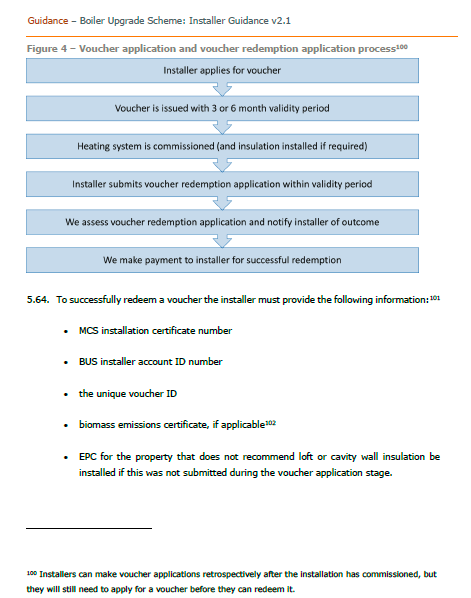
-
BUS grant: what evidence to qualify ?
sharpener replied to Post and beam's topic in Air Source Heat Pumps (ASHP)
Stand your ground! Unless the failure to give further information was due in any way to your not responding they will not have a leg to stand on if they take you to court. In my case OFGEM wanted to evidence that the wood burning stove was not part of the central heating system but were easily satisfied. My impression was that they struck a reasonable balance between the consumer and protecting the public purse. Did they tell you what information they were trying to get from the installers? Perhaps you can show it was already in their possession so they had no need to revert to you before replying to OFGEM? Also maybe ask OFGEM if they will entertain a new application as the old one has lapsed through no fault of yours. My boss once told me most disputes are won by the party with the better filing system. -
Gravity driven plate heat exchanger for DHW
sharpener replied to Dillsue's topic in Air Source Heat Pumps (ASHP)
I don't think you will get a useful amount of gravity flow through a HX. But 7kW HP will probably be OK with existing coil (based on my experience with a 12kW in Noise Reduction mode). You will get some improvement - if needed - by circulating the (potable) water with a bronze pump, so buy that first and try it before shelling out on the HX. You will need to fit a NR valve as well otherwise there is a backflow path through the pump when it is off. -
If you install i.a.w. Vaillant's spec as above I don't think you will have a problem. Work by a third party will not invalidate the warranty if they are Vaillant approved installers - in practice most of their MCS installers are. I would go for wall bracket mounting though and I am not sure this is advisable for the 10 and 12 kW twin fan units as although very thin front-to-back they are quite tall and rock a bit on the isolating mounts. But they are extremely quiet.
-
Do I need a HP specific cylinder?
sharpener replied to Beelbeebub's topic in Air Source Heat Pumps (ASHP)
Link upthread already. This takes you to the conclusions Nothing "goes wrong". The flow temp will get very high, but the HP does not object - though the CoP will suffer. As @JamesPa says, you can take quite a hit before that justifies the capital cost of fitting a different cylinder. -
Do I need a HP specific cylinder?
sharpener replied to Beelbeebub's topic in Air Source Heat Pumps (ASHP)
Key was reducing the heat flux to the cylinder to minimse the delta T, which is done (i) by sharing the HP output between cyl and the thermal store, charging them both at the same time (ii) putting a secondary bronze pump to recirculate the DHW to improve heat transfer on the outside of the coil (iii) not using the asinine Vaillant algorithm for DHW which has very high (essentially unlimited) flow temps. All this was agreed with Vaillant technical who produced bespoke schematics. Eventually I found a (sixth) installer who was prepared to go along with them. Even then it did not go entirely to plan, see the writeup from Sept 2024. I don't think there is any aspect of this that BUS are directly concerned about. They were more worried about the wood burning stove not being connected, as this was listed as supplementary heating on the EPC. With a 10kW mitsi you will have less of a problem and may be able to turn it down natively to the point the delta T is reasonable. @JohnMo may be able to comment on this. -
Could this be the cause of our noisy heating system?
sharpener replied to Beau's topic in Air Source Heat Pumps (ASHP)
Poor advice! There is a lot of useful diagnostic information available in its Live Monitor function which is not available on the app. E.g. actual flow rate, current flow temp vs target, % compressor modulation depth. Also a Reset button which has been known to get you out of trouble. Result. Let's hope so. -
Sizing ASHP according to heat loss calcs
sharpener replied to flanagaj's topic in Air Source Heat Pumps (ASHP)
Yes. E.g. the Vaillant 5kW will go down to about 1/3 output or about 1.7kW Their 3.5 kW unit is simply the same with a s/w limit to 85rps compressor speed, so does not modulate any lower than the 5kW does. Below that they will cycle but if there is a reasonable system volume that is not a problem, the (adjustable) Energy Integral algorithm limits it to about 2 cycles/hr, anything less than 3 is generally thought to be OK. I believe you have already discovered this supply sizing tool but it may be useful to others https://www.ssen.co.uk/our-services/tools-and-maps/demand-calculator/. I still think you are worrying unnecessarily, you won't need to be cooking with both ovens and charging the car while using the machinery in your workshop. 100A will be plenty, no need for 2 or 3 phases which may cost £1000s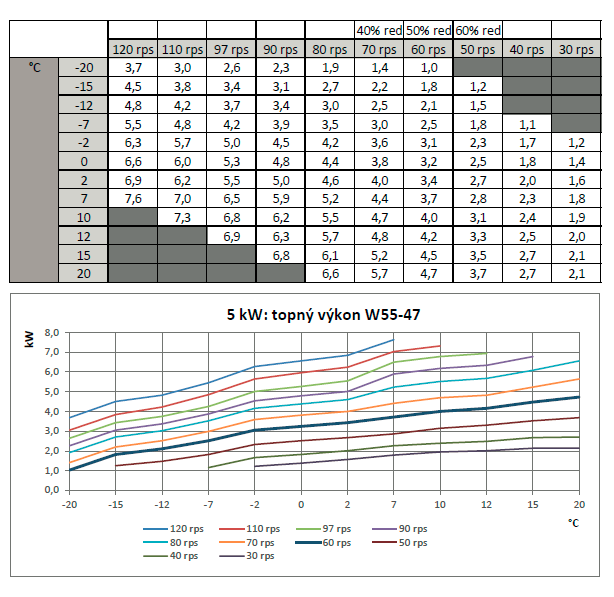
-
Sizing ASHP according to heat loss calcs
sharpener replied to flanagaj's topic in Air Source Heat Pumps (ASHP)
I would use a CoP of 3 in your estimate but the load from the HP is the least of your worries. If you can perhaps avoid charging the car while you are using your workshop then I don't think you will have a problem. Choosing the right ToU tariff is key to this. We have a 12kW HP, a 7kW zappi charger, and a Victron inverter which draws over 4kW while charging the batteries at 70A. When it is all going at off-peak rates that makes about 15kW. My DNO has approved all this under a G99 application to run off an 80A/18.4kW supply. -
Could this be the cause of our noisy heating system?
sharpener replied to Beau's topic in Air Source Heat Pumps (ASHP)
By default the pump speed is set to "Auto" but you can adjust it on the white Interface Unit, worth experimenting. But very likely there is flow noise caused by turbulence at the kinks. and this is then radiated into the room by the nearest radiators to them. -
Yes, AFAIK that sends data to Octopus and so is probably what their cloud app shows you. Whereas the proper backhaul link to DCC is what is used for statutory metering purposes. Hence the discrepancies between the two. Wottamess.
-
Yes, after I put in the G99 application they completely removed the 3.7 kW battery inverter power limit and the 3.68kW export limit, and did not replace them with anything higher. (I am though limited to 80A export by their company fuse.) In passing I am surprised @jimseng the OP is only getting an 80A/18kW supply. But I think I read somewhere that DNOs are now reverting to that from 100A which was the previous standard for new installations. I had to (self-) declare a limit of 80A as I did not want to upgrade the meter tails, which go through a thick stone wall. With batteries, an HP and an EV this required some fairly heroic assumptions about time diversity. I haven't. The FIT provider is only interested in the TIC connected to their 230V a.c. Total Generation Meter which is the basis of their payments. The second array is connected to a DC-DC charge controller which converts the output to 48V d.c. which goes straight into the battery. Any subsequent transformation of this into AC for export is subject to any limits set by the DNO (i.e. none) but nothing to do with the FIT provider. Exports are measured by Octopus using their smart meter, as I have now opted out of the "deemed export" regime at 50% of what is measured by the TGM.
-
From what I can see they are mainly hybrids. The F series are described as "battery ready", not sure what that implies but it means they are a bit more expensive than the Solax.
-
Thanks, that puts my mind at rest to some extent. If the last reading of the month is erroneously low the billed amount (credit) will also be wrong, but (presuming the error does not get corrected subsequently) then in the following month you will be paid more to compensate, and lose only the notional value of the interest due. Ultimately it is only the last ever reading that needs to be completely accurate!
-
If you have the roof space IMO definitely worth putting up more panels than the old default 3.68 kW limit. At 15p/unit from Octopus it is a sound economic proposition. Need all I can get (for the new heat pump) so I had a further 3.24 kW installed under MCS, connected them to my battery system via a DC-DC converter, completed the G99 and G100 paperwork as a self-install and after a certain amount of fuss got approval from NG (formerly WPD) for unlimited exports. Because they are not connected at AC the new panels can't export directly, so no need to involve Good Energy who are my FIT provider, or Octopus either. Also this means that I can use all 6.9 kW of PV for the house/EV/HP or export it all, using the one 4.4 kW hybrid inverter. As @Dillsue says, best to reserve the capacity while you can. There are going to be limits imposed I am sure, as the Spanish are discovering with their lack of grid stability.
-
I have seen the same occasionally but assumed it would be corrected in due course. @MikeSharp01 did you get it sorted, and if so how? Is it going to be a permanent fix or something you have to watch out for for the rest of your days (sigh)?
-
One of my 2kW PV inverters dating from 2011 has now given up the ghost. It is a Stecagrid 2000 slave unit, am awaiting a price from Steca in Germany but I think it will be expensive to repair/replace. Meanwhile as the master inverter is now out of warranty (having been replaced 4 times) I am thinking the best approach would be to change the lot for a Chinese-made one with a new 10-yr warranty. This Solax would seem to do what I want. Has anyone got any experience of it they would be willing to share, or other advice? TIA
-
Not if you are also on Octopus Outgoing at 15p/unit. Then the marginal cost of anything and everything is 12.65 (if in a Cosy cheap period at night) or 15p otherwise as any consumption means you are foregoing the same amount of export.
- 70 replies
-
- 1
-

-
- utilities
- electric bill
- (and 3 more)
-
So someone knew what they were doing...
-
Buffer Tank Hot when Heating Mode Turned Off
sharpener replied to James1234's topic in Air Source Heat Pumps (ASHP)
The use of the word "ideally" rather gives the game away doesn't it? In contractual documents it recognises that the advice following it is not going to be observed by many/most recipients. You could anyway argue that the presence of lockshield valves is "some form of temperature control". -
I have a similarly complex charging regime but have been considering just charging battery to 100% every cheap period. The thinking is that every unit bought off the grid at 12.65p liberates a unit of PV which can be exported for 15p. Is there a flaw in this?
-
@JamesPa has a spreadsheet which I used to good effect when I was doing my system design. But it was a bit optimistic, never managed to quite work out why.
-
You can improve the heat transfer on the outer surface of the coil by using a bronze pump to circulate the water in the tank while it is being heated. I did some experiments which showed a 2x improvement but in practice I don't get as much as that. You also need an NRV or you will have a parasitic path through the pump when it is off. Vaillant tech accepted this as part of the scheme to re-use the existing tank with a 12kW HP. Incidentally their smallest is 3.5kW - but that is just the 5kW with restrictive software. I don't see how you get a better CoP with a PHE, there has to be a temperature drop across it (typical design figure is 5C) so the HP runs hotter for a given DHW temp therefore the CoP will be worse.
-
IMO 200 l would be plenty for this situation, assuming the wet room does not imply any great medical/disability requirements.
