


sharpener
-
Posts
1492 -
Joined
-
Last visited
-
Days Won
1
Everything posted by sharpener
-
Radiators not reaching flow temperature
sharpener replied to Helene's topic in Air Source Heat Pumps (ASHP)
Looks like it, there are two expansion vessels, one is connected directly to the top tapping on the cylinder -
Radiators not reaching flow temperature
sharpener replied to Helene's topic in Air Source Heat Pumps (ASHP)
Most HPs have a powerful circulating pump in the outdoor unit. You only need an additional pump if you have got a buffer tank or low loss header so there is hydraulic separation if you have a mixing valve on the UFH if you have a large radiator system - in which case balancing the work rate of the two pumps is not easy if you have a secondary circulation loop on the DHW -
Radiators not reaching flow temperature
sharpener replied to Helene's topic in Air Source Heat Pumps (ASHP)
The brass thing to the right of the pressure gauge is an automatic air vent, unscrew the small screw on top a couple of turns so the trapped air can be released. -
IIRC from the FB link upthread it would appear to need flow = 70C. Sunamp have several variants tuned to different HPs inc the LT Daikins.
-
https://www.manualslib.com/manual/1583441/Vaillant-Multimatic-700-2.html?page=94#manual Also I see Neil Gascoigne reports his Sunamp has an internal temp sensor which takes the place of the Vaillant VR10 DHW sensor and is wired to the corresponding terminals in place of it. I think these are SP1 on the Heat Pump Interface unit (not the VR71 itself).
-
Overspecify the voltage rating if you can and if there is room (don't change the capacitance value). Buy the highest spec which for mains is Y1. Buy from a big components supplier like Farnell who by and large don't sell components which give them returns. Worth buying a German brand e.g. Wima or Wuerth.
-
Not quite sure why that is. There are stringent standards for direct-on-line mains caps (X1, X2 etc) to address the massive inrush currents which can occur, but longevity is still it would appear problematic. There is a regular business re-capping Topfield PVRs which I have had to pay to get done, in addition to the things mentioned above. Yet I have also got audio gear from when I was a student still functioning on original caps both electrolytics and high-voltage film type (Quad FM II tuner has valves!).
-
Congratulations @eugen for getting it going again. Do you think this was a manufacturing error or did they just try to save money by fitting an undersized capacitor, you mention the "normal" one but don't say what "normal" is or how you know? These series dropper capacitors seem to be quite troublesome, I have had to replace them in a smoke alarm, a central heating programmer and the heat exchanger motor in a MVHR system. Usually I fit a replacement with a higher rated voltage and/or a better brand e.g. Wima in the hope of not having to do it again.
-
As @ReedRichards says the two control modes will be fighting each other. I had not clocked you have the Honeywell thermostat, you should wind this up to 25C so it is always calling for heat and then sort out what the Daikin controls are doing. Ideally it would run 24/7 on Weather Comp with a night setback of 2 deg or so. There must be some way to disable the auxiliary electric heater which is almost certainly what is costing you a fortune. I have also read somewhere that (some) Daikin compressors will not start if their temp is below ?5C so that might be the problem, to overcome this they have a compressor sump heater which may also be wasting a lot of power in the cold weather, or might be faulty so not allowing the compressor to run at all. This is all a bit hearsay I am afraid. I tried to use the Daikin find-an-installer process but it fell down and then they were not interested so I gave up.
-
Provided the HP is the ultimate source of all the heat for the DHW I would think it complies with the MCS rules. Your installer will have to send OFGEM a copy of your quotation to apply for the BUS voucher, beyond that I don't think they would be concerned if it is stored in a Sunamp (and I don't know of a mechanism for getting their approval). Also ask him where it requires details of the Sunamp on the MCS paperwork he has to file after completion. You might find a current thread on this forum interesting as there is a Neil Gascoigne there looking for advice on setting up his newly installed Sunamp DHW installation.
-
Bit of an extreme scenario and haven't really thought about it in a lot of detail. But one priority would be hot water, the HP will be ~3x more efficient than the immersion heater so a full tank would use up about 1/3 of the battery. Would have to use the microwave for cooking as the AGA takes overnight to reach operating temp. Once going it keeps the kitchen/dining room warm and also the bedroom above it, not something MCS calcs take into account. One installer said he would insist on fitting rads in the kitchen "in case a future purchaser takes the AGA out". In which case, I said, he can put the rads in, I am not going to pay for them. Fortunately the people I am talking to currently are more pragmatic.
-
Not quite. The scenario might be we return from a winter break in the Canaries and find the house in darkness from a lengthy power cut. It has been a sunny day so there is enough charge in the battery system to run the HP for >2 hrs though. Frost protection would mean we can heat the house, burst protection not. Fortunately we have a WBS, an oil-fired AGA and even oil lamps.
-
OP wrote but I would be very surprised if a house built in 2000 has no insulation under the concrete floor. We haven't any record of what was used in a 1995 barn conversion, but the HP installers agreed that min 50mm insulation was likely and have used that in their calcs. Somewhere there is a table showing what the Building Regs required at various dates in the past.
-
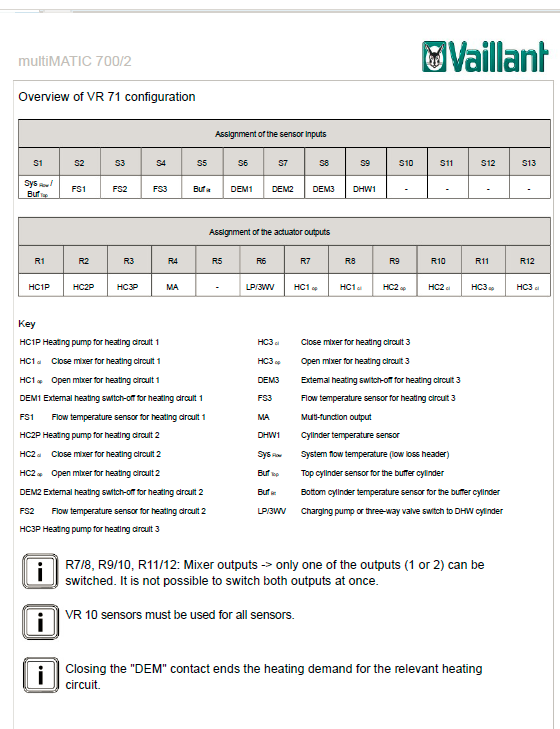
Here is the connection diagram for the Vaillant VR71 interface box. You can see that terminals S6, S7 and S8 are used for the heat demands for up to 3 different zones. Note 3 says they are contacts closed to stop heating, this is the reverse of the usual convention but it can anyway be changed to "closed for heat" in the installer menu. In my case the zones will be rads, UFH and a thermal store. Vaillant have signed off the schematics with the Honeywell external controls connected to S6, the existing UFH manifold controls to S7 and a timeswitch to S8 so I am 100% confident they are happy with external third party controls, and a simple contact closure from your Sunamp (of either sense) should work fine. I do not know whether the Sunamp should be treated as a separate zone or as a substitute for the usual HW cylinder. Your installers should agree a set of schematic diagrams with Vaillant for your Sunamp application, they will not support it unless the design is signed off like that. If you can get them to give you a copy and post it here we can tell you more.
-
+1 Useful table thanks. There are in fact two temps involved for a given concentration (a) the lowest temp for free circulation of the working fluid (in table above AIUI) and (b) a lower burst temp where the fluid is a mush which won't pump easily but the system is still protected against frost damage. Another table here comparing the two, for both ethylene and propylene glycols. For any given temp you can save about 1/3 glycol if you don't need the system to actually work(!)
-
Agree wholeheartedly about hydraulic separation, it is a sticking plaster for poor system design. I don't like glycol either but IMO it is the least worst option for protecting a big capital asset against catastrophic damage without requiring (a) mains power or (b) a seldom-used cheap mechanical device to work first time when you need it. (Yes I am also thinking of service valves under the sink, and pump isolating valves, usually the spindle seals fail when you operate them in anger, giving you two problems where you had just one to begin with. Had this happen on me over Christmas. Not everyone will keep a spare pump c/w valves in the garage.)
-
Of those on yr list the Vaillant Arotherm Plus can defo be controlled by third party controls with a voltage-free contact closure. My Honeywell Evohome wireless TRVs' boiler output is not volt-free so I have just installed an extra relay in anticipation of my HP install for this reason.
-
Have never understood why they ever became popular. They compromise the lagging and also introduce more joints, and in our case would create an ice rink in the pedestrian entrance way. The price of the glycol is about the same as a pair of a/f valves anyhow. But as you say, worst of all is you could come back to a home which is not only stone cold but cannot be heated easily or quickly.
-
Entirely agree with @JohnMo's last posting. If they propose anything more complicated than that diagram you need the rationale to be explained. I note it does not show anti-frost drain valves (IMO work of the devil anyway) so you need to ensure they add glycol for frost protection, especially since you are on a hill!
-
11 kW doesn't sound undersized for 158m2 with reasonable insulation. But am a bit puzzled why if they got a heat loss (?) of 12785 they specified a unit of only 11kW. What is the minimum outside design temp? Shouldn't happen So did they fit antifrost valves and are these what are dumping the water, and is it only under freezing conditions outside? If you get this frequently you would be better off with glycol to protect the system, but as this will slightly reduce the heat transfers it might be better to leave it until the performance issues are sorted out. As per my earlier post emails are too easy to ignore. You need to escalate this within the Daikin hierarchy by phoning the regional manager etc. Edit: I see @richard_scotland has just posted so there is a bit of overlap in our replies!
-
Radiators not reaching flow temperature
sharpener replied to Helene's topic in Air Source Heat Pumps (ASHP)
It bypasses the connection from any thermostats and make the HP run the entire time. -
Radiators not reaching flow temperature
sharpener replied to Helene's topic in Air Source Heat Pumps (ASHP)
What have you tried? A good approach is to gradually close the lockshield valves on the rads in the rooms that are getting up to temperature OK. Measured with the same instrument you should get the same temp at the inlet to the rads as at outlet of the HP perhaps less a degree or two for losses down the pipework. More would indicate poor flow rate or very poor pipe insulation. Flow temp indicated on the HP display might be different. -
So it should still be under warranty. Pester the installers by phone until they come to look at it. If they won't, threaten to pursue them under the ECO4 redress scheme (though unfortunately others have said it is not very effective). Many things could be wrong. But if the control panel is not showing any error codes it does point to the HP being undersized. The high running costs may be due to an auxiliary electric heater being switched on in the cold weather. Tell us here how big your house is in sq m, what kind of wall insulation they fitted and what size/rated output the HP is. 75W per sq m is a very approximate rule of thumb requirement for a stone barn conversion (like mine), might be less with good insulation and good draught-proofing but doubt you would get it better than 50.
-
Pack A includes a small one for installation indoors. Looks reasonably appropriate to me though you might get away without one at all.
-
Some heat pumps have a special screed drying programme which increases the slab temperature slowly over a period of two weeks or so, this might be suitable if your tiler agrees.

