


sharpener
-
Posts
1492 -
Joined
-
Last visited
-
Days Won
1
Everything posted by sharpener
-
compressor size of Vaillant Arotherm 7kw ?
sharpener replied to Post and beam's topic in Air Source Heat Pumps (ASHP)
AFAIR it is only the 10 and 12 kW that need express PP, the others qualify for deemed PP (unless part of a new build IIRC). -
I think the main reason you need a mixer and pump is to achieve a flow rate within the UFH loop(s) sufficient to distribute the heat evenly along their length. From the heat loss equation point of view it is the volume supplied at the higher temperature that matters as it defines the quantity of heat input, for me the surprising point is how little flow you need. A thermostatic mixer will of course achieve this by closing the inlet so most of the flow to the manifold is what is recirculated from its return pipe.
-
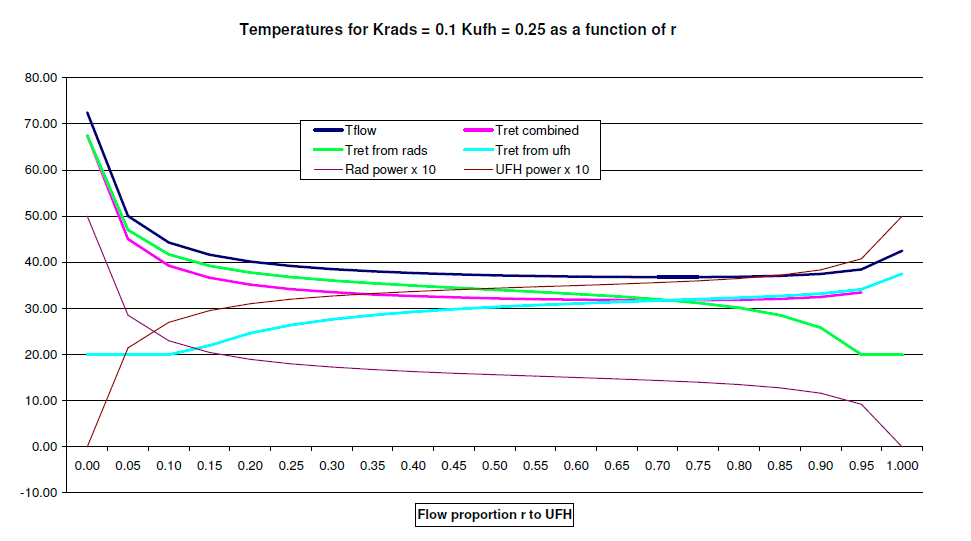
Equations actually result in a figure of less than 20 in these cases which is not physically possible, see my recent post. At the lhs the pnk and green lines do converge though the pink is not that easy to see, soz (the pic is a screenshot of a pdf print of the xls). At the rhs they don't bc I now notice there is a data point missing from the pink line, the missing value at r = 1 is 17.50, same as light blue. This gives an avg temp of 40 to the UFH which is what is required to dissipate twice the design value (2.5kW at 30C). HTH.
-
That is exactly the situation I am trying to model as it corresponds closely to my barn conversion retrofit except the numbers are 6 + 6 kW. I am taking a common feed from the HP to both rads and UFH, at whatever flow temp is necessary to dissipate a total of 5kW (dark blue top line). At r=0 this has to be 72.50(!) to get rid of all the heat via the rads. At the 2.5:2.5 power point it needs to be just under 47C (bc the flow rate through the rads is higher than the design condition so the delta T is less). (At such a low flow rate the equations are actually satisfied by a UFH return temp of about 12C which is clearly not attainable hence I have put in a lower limit of 20. Why this occurs I have not yet worked out, but see below regarding the UFH temp profile. OH teaches maths at Cambridge University and has independently solved the equations in the model to reach the same result but can't shed any light on this.) Have now modelled this too using heat loss proportional to average temp. If s times the flow to the UFH is mixed back from the UFH ret with a pump and mixer then the ratio Tf/Tu is given by 2(s+1) + Ku(2s+1) (2(s+1) - Ku) which tends to 1 + Ku for large s so in this case where Ku = 0.25 (kW/C) the limit is 1.25 If we assume s might be 4 this gives 12.25/9.75 = 50/39 = 1.256 with no recirculation at all k = 0 so Tf/Tu is 2.25/1.75 = 1.286 so not a lot different. But I cannot reconcile this result with the temps from the overall model and I think the problem is the "average temp" heat loss assumption breaks down for the UFH where an exponential decay temp profile along the loop is more likely in RL. Yes of course but in my retrofit situation to get to 45C flow I have already had to re-size the rads by a factor of 1.9x and to match to 30C would require a further 2.5x increase in size!
-
Puzzled by some previous threads about mixing I have run a model of a heating system that combines radiators designed for an average temp of 45C with UFH designed for avg 30C. The model assumes you have an HP which produces 5kW at 5 deg delta T (this keeps the numbers simple), and want 2.5 kW out of each side, as might be the case in a house with UFH downstairs and rads upstairs. The return pipe flows are allowed to mix on the way back to the HP. A few simplifications have been made: the heat loss from the emitters is taken as proportional to the avg temp which is not quite true for the rads, and also at low flow rates the temp drop profile along the UFH loops is not linear but an exponential decay. But I think the general shape of the curves is right and the conclusions are valid. Here is the graph of the various temps as a function of the proportion of the flow going to the UFH. The surprise is that for an equal 2.5kW/2.5kW split you only need 7.6% of the flow to go to the UFH circuit, because its emissivity per degree is much higher and the equilibrium flow temp is also 17 deg higher than it expects. For a 50:50 division in the flow you only get 1/3 of the heat into the radiators and 2/3 goes into the UFH. As you can see, this does not vary a great deal over the whole central portion of the diagram. I don't think the conclusion would be much affected by the conventional UFH arrangement of using a circulating pump and blending valve to temper the actual flow temp to the UFH loop but I have yet to complete the modelling of that arrangement. Notes on the model: It arrives at the equilibrium temperature values by solving the following simultaneous equations (which give rise to some very complicated algebraic expressions in r, Krads and Kufh). (i) The HP produces 5kW at 5 deg delta T - this defines the relationship between flow and (combined) return (ii) Each circuit dissipates an amount of heat equal to the average temp between its inlet and outlet multiplied by a constant K, from which the temp drop across each cct can be calculated (iii) The two circuits together dissipate exactly the 5kW ouput of the heat pump (iv) The combined return temp is the sum of the individual return temps weighted by the respective flow rates (Method of Mixtures).
-
The Intatec valves upthread are supposed to open at +3C so might open much earlier than you think. OTOH after some years of doiing nothing they might be stuck and not open at all. Ethylene glycol (= car antifreeze) is inherently higly toxic but some cos e.g. Hydratech DTX use de-toxifying additives, whatever they are. Propylene glycol is inherently less toxic and is used in Fernox HP-5C and Alphi-11. I don't recall right now what the many others are based on, some product details near top of thread.
-
Does ASHP work for older people on blood thinners?
sharpener replied to CalvinHobbes's topic in Air Source Heat Pumps (ASHP)
Think you might mean 120%(!) Not all of it especially as there is another 600kWh from the second array. Eventual plan is to get a smart meter before Radio Teleswitch turned off in Mar '25. Bc of poor coverage this may have to wait for wi-fi metering currently in development. And then move from deemed export to Octopus Outgoing. Even so it will only be a few £100s p.a., worth much less than my 2011 FITs which as you can see are a nice earner. -
Does ASHP work for older people on blood thinners?
sharpener replied to CalvinHobbes's topic in Air Source Heat Pumps (ASHP)
We have 6.9 kW on a due south facing roof in Devon, could hardly be better for insolation. But the generation in winter is only 1/10th of the summer peak, this is how it looked last year for the original 3.68 kW array. (The newer 3.24kW looks virtually identical, so the year's total was 7144 kWh which is 1032kWh per installed kW):
-
Does ASHP work for older people on blood thinners?
sharpener replied to CalvinHobbes's topic in Air Source Heat Pumps (ASHP)
Not really an ASHP answer but is she on the latest kind (apixaban or edoxaban)? Feeling cold is not I think a common side-effect but thyroid problems are notorious, has she been checked for that? -
Getting frustrated with heating suppliers.
sharpener replied to MikeSharp01's topic in Other Heating Systems
That would put you at risk if there is a problem as you would have to pay Alto in full first. As per @saveasteading's post the normal route is the installer applies for the BUS voucher on yr behalf, then they claim the grant after commissioning. If there is a problem it is them at risk, you only pay them the net amount. From the OFGEM guide for Property Owners: 5.41. Once the property owner has provided consent and subject to all eligibility criteria being met, a voucher will be issued to the installer. The property owner will also be informed. Completing the project 5.42. Once a voucher for an ASHP or biomass boiler is issued,56 the installer has three months from the date the application is approved to complete the installation in line with industry standards and scheme requirements, and to register the installation with MCS and to redeem the voucher. Installers will have six months to do this for GSHPs.57 MCS may get in touch with the property owner regarding the quality of the installation. -
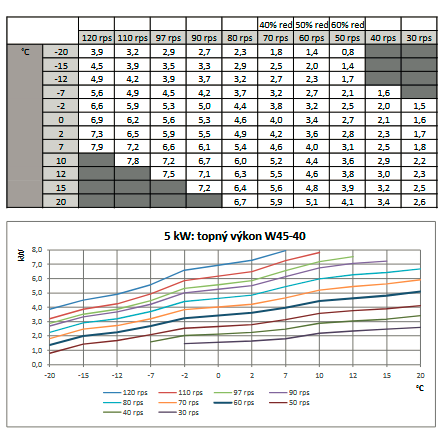
Yes, rated more generously than many other mfrs. Hence I have been quoted for a 12kW Vaillant unit in place of a 15kW Stiebel Eltron. Full performance tables (in Czech) are here starting at p34. Extract for 5kW unit at 40 - 45C flow temp (modulation is better than I thought):
-
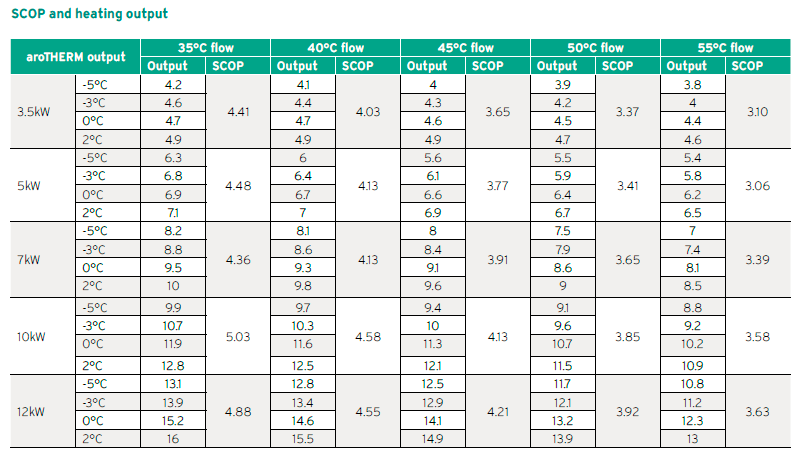
Depends quite a lot on your emitter setup. If you have (or fit) rads suitable for a 45C flow temp then from this table a 5kw Arotherm plus would do the job down to -2 OAT (southern England). Further north you would defo need the 7kW unit. With a SCoP of 3.77 your 18500 kWh would require 4907 kWh of electricity to generate, which is what you originally asked, multiplied as @SteamyTea says by maybe 70% to account for the (in)efficiency of the boiler. Depending on yr HW usage (which I assume is included in the 18500) you may also need to make a correction for the fact that producing HW will be at a lower CoP, I do not know if this is included in the SCoP formula. The 7kW unit has a higher SCoP so would use less, the downside would be more cycling in warmer weather, unlike a gas boiler they only modulate down to about 50% rated output, then they cycle.
-
When I extended the rainwater supply I put in 15mm polypipe mains water pipes to supply drinking water to the bathrooms. They go up into the loft and down again. I didn't consider the possibility of air locks at the time and there has never been a problem since.
-
Yes that is what I am proposing to do (and Vaillant have approved, with the filling loop and expansion vessel on the return as is their usual practice), but still with the zone valves shut and only one antifrost valve fitted à la @HughF there is no obvious way for air to get in so the water can get out of the external unit of the HP.
-
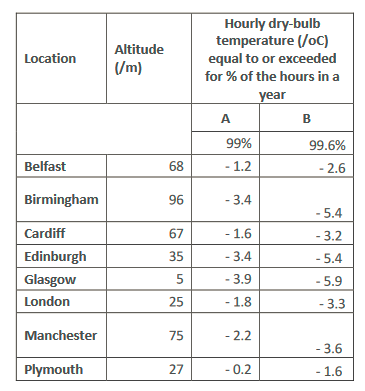
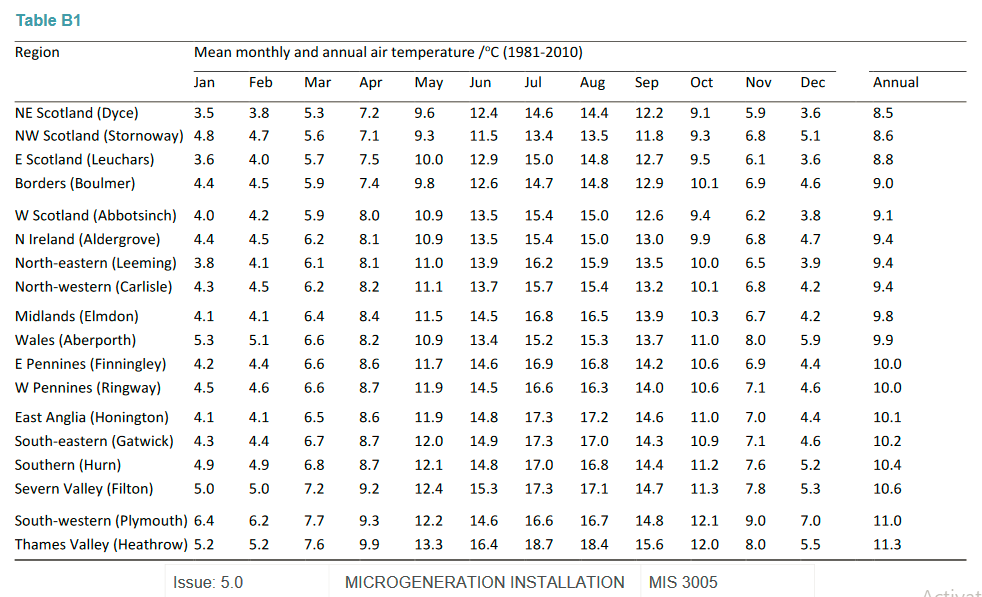
It's not the average you need to worry about. For example the mean February figure for Plymouth is +6.2C However to guarantee adequate HP performance the figure I need to use (from CIBSE Guide A) is -0.2C But for frost protection purposes the lowest temp in Plymouth in the last 10 years is -4.9C. And here on a tidal estuary just 20 miles away there was lying snow for a week in ?2009 and the river was iced over. Hence I would want to have protection down to -5C, and the Fernox HP-05 (or forthcoming Hydratech equivalent) seems well suited to this.
-
Some low tech solutions: A security camera will send you an email or pics every x hrs e.g. pics of your indoor/outdoor themometer. A burglar alarm - with its own battery backup - will phone or email you on break of a door circuit. This could be a relay contact held closed by the mains. Also if someone opens the cover of your HP. A Victron inverter will email you if the grid fails (or a number of other fault conditions). You can configure it so the battery always has a minimum SoC for this eventuality. I think you can also get Victron central to email you if it loses contact with your inverter. I am sure there are utility programs which would ping your router periodically and let you know if it is down. Do not rely on only one method. I worry about the migration of phone lines to VoIP, today's stats of 3.9M out of 35M smart meters not working properly does not fill me with confidence about national roll-out programmes.
-
No, the schematics for my proposed system (as approved and drawn up by Vaillant tech) re-use the existing n/c S-plan valves inc DHW to save the need to replace any of them with a diverter valve. So in a power cut all 4 circuits will be shut off. The only other flow path is an automatic bypass, but if the HP is not running there will be no differential pressure to open it. Thinking about some more, this is not a peculiarity of my system. The normal published Vaillant schematics have a HW diverter which defaults to the heating circuits, and then if these are more than one there are either zone valves or UFH actuators or both, all of which will shut off in a power cut.
-
So you are happy to rely on a single £30 Chinese copy valve to protect a £000s installation. I would not be confident that with only one valve it would allow enough air into the pipework to make sure all the water emptied out of the outdoor unit. Especially if the system is off and all the two-port valves are shut. Seems to me an ideal setup would isolate everything that is outside the house and then empty just that. To be independent of the mains it would need e.g. spring-loaded valves connected with bowden cables. Not easy to engineer to be reliable at reasonable cost though. Intatec valves in the video upthread look reasonably well thought out but as with all valves you cannot be sure they are not going to be stuck shut just when you need them to open. Then if they do you still have the hassle of re-filling the system before you can use it. And if it is < +3C how do you get the valves to stay shut for long enough to get the system running again, do you need an assistant to keep pouring hot water over them? For all these reasons I prefer to think in terms of glycol as per this thread.
-
Well at least the system will be well flushed. Don't see why you would now need glycol until September, why not just use inhibitor over the summer? Or 10% Fernox HP-5C at most, see link below. By co-incidence I watched this vid from Glyn Hudson yesterday, at 11'30" in he puts an elbow over the top of the AFV specifically to let the air get at it. [Edit - I see that is to break any vacuum, not to expose it to the OAT.] Also has only one valve, mostly I thought they were fitted in pairs, that's what Midsummer Wholesale supply by default. If you buy two it costs as much as a good load of glycol. Personally as I will need ~50 litres I am waiting for Hydratech to bring out their 5 deg protection product as per this thread.
-
Manifold system versus hot return system
sharpener replied to Russell griffiths's topic in General Plumbing
Thanks for the heads up. But as you may recall my application is to stir the tank to improve the heat transfer with a small coil. There is 1.05m head at zero flow, and it will do 0.9m^3/hr at zero pressure which should be fine, I don't need it to turn the tank contents over every 20 mins, just keep it moving. -
Thanks @mk1_man, I have been following your thread in Other Heating Systems (Mods, why are there two different boards covering ASHPs?). Presumably another advantage of going this route is you avoid paying VAT on a retrofit. But as I wrote there "Alto don't list Vaillant on their web site but I will enquire, don't want all the design work around their 12W Arotherm Plus to go to waste." Also AFAIUI the larger Mitsis are still R32.
-
Getting frustrated with heating suppliers.
sharpener replied to MikeSharp01's topic in Other Heating Systems
Looks very interesting. Am returning to this theme as am getting frustrated with my potential installers, they applied successfully for the BUS voucher but now seem unable to install before it lapses. Alto don't list Vaillant on their web site but I will enquire, don't want all the design work around their 12W Arotherm Plus to go to waste. @markocosic posted a thread on LinkedIn here about design-only and MCS umbrella schemes. As that was last September it would be good if he could give us an update to the list here and let us know what he eventually did. Octopus' web site declines to quote at all for a house in the SW. Good Energy's web site have just re-quoted me £11200 net after BUS for 2 x 12 kW Midea, based on what data I have no idea, maybe looked up the EPC online. Last year it was just 1 x 16kW Midea for £6734 (after the then £5k grant) which was at least a better match for my calculated 12kW heat loss. Underwhelmed by their process though their tame EPC surveyor good value at £60. -
Thanks, I will contact them tomorrow. Seem from their website to be a Mitsubishi specialist.
-
Sounds extremely competitive. I am in the S Hams, could you post their contact details here please @Surfiejim and @Tom, or PM me if you would rather.
-
Yes, connect output of flow switch to the coil of a substantial mains relay or small contactor. Connect normally open contacts of relay between mains and the pump. I still think the original fault is very odd as there appears to be some 20V across the reed switch contacts, this implies current is flowing but the contacts are high resistance so power is being dissipated. I would expect either 240V if they are burnt away or virtually nothing if they are making. Did you measure the voltage directly across the contacts?
